Curtain wall cost in Hyderabad typically ranges from Rs 950 to Rs 3,500 per square foot of facade area in 2026, with most commercial projects in HITEC City, Gachibowli and the Financial District landing between Rs 1,400 and Rs 2,400 per sq ft. The exact rate depends on the framing system (unitised vs stick-built), the glass specification, the aluminium profile, and the height and wind exposure of your building. For a typical mid-rise office facade in the twin cities, budget around Rs 1,800 per sq ft as a realistic starting point before finishes, mock-up testing and GST.
These rates cover supply and installation of the aluminium framing, glass, gaskets, brackets and sealants that make up a weathertight curtain wall glazing facade. Prices in Hyderabad and Secunderabad move with the summer heat load, monsoon waterproofing demands and the region's fine construction dust - all of which push clients toward better-performing (and slightly costlier) glass and gasket systems. The upside is that a well-specified facade is one of the few building elements that pays part of its cost back through lower air-conditioning bills over a 15 to 20 year life.
This guide breaks the numbers down the way a fabricator actually prices them, so you can budget accurately for a project anywhere across Telangana and Andhra Pradesh. We cover system-wise rates, the biggest cost drivers, a worked sample budget for a Gachibowli office, glass and coating choices, hardware, common mistakes, and where you can trim spend without weakening performance. When you are ready for firm numbers, you can get a free quote with your elevation drawings.
What is a curtain wall, and what does the price include?
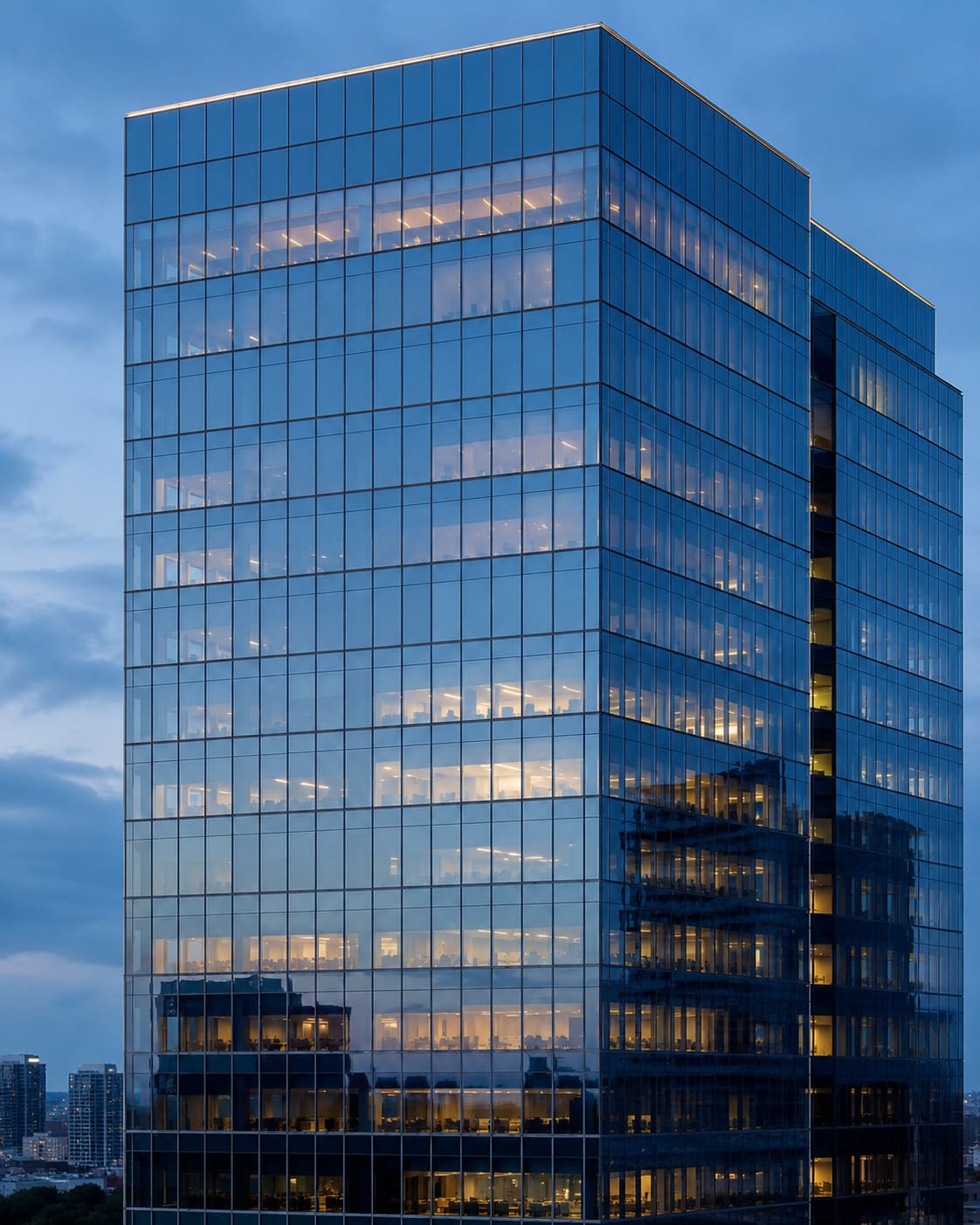
A curtain wall is a non-load-bearing external facade hung off the building's structural frame, carrying only its own weight plus wind and seismic loads and transferring them back to the floor slabs through brackets. Because it does not support the building, it can be almost entirely glass and slim aluminium, which is why it defines the look of nearly every IT tower in HITEC City and the Financial District.
When a Hyderabad fabricator quotes a per-sq-ft rate, that number normally bundles several distinct cost lines that are worth separating in your mind:
- The aluminium system: mullions, transoms, pressure plates, cover caps and the brackets that anchor the facade to each slab edge.
- The glass infill: single toughened, laminated, or double-glazed (DGU) units, plus any coating or spandrel panels.
- The weathering package: EPDM gaskets, structural and weather silicone, setting blocks and drainage paths.
- Installation: rigging, cradles or cranes, on-site glazing, sealing and making good.
- Engineering: shop drawings, wind-load calculation, and a project mock-up with water-penetration testing.
Knowing these lines exist is the foundation of comparing quotes fairly, because two bids at the same headline rate can hide very different glass, finishes and testing scope. You can see how a specialist scopes a full facade across our services before you request numbers.
Curtain wall cost per sq ft in Hyderabad (system-wise rates)
Curtain wall rates in Hyderabad vary mainly by the framing system you choose, and the gap between a basic stick system and a premium unitised facade can be more than double. The system decision is the single biggest lever on your budget, so it is worth understanding before you compare quotes. Here are realistic 2026 supply-and-install ranges for the twin cities:
- Stick-built (semi-unitised) aluminium curtain wall: Rs 950-1,500 per sq ft - common for low- to mid-rise buildings in Kukatpally, Kompally and Secunderabad, where the framing is assembled and glazed on site.
- Standard unitised curtain wall: Rs 1,600-2,400 per sq ft - the norm for IT offices in HITEC City, Madhapur and Kondapur, with factory-built panels craned into place.
- Premium unitised with high-performance DGU glass: Rs 2,400-3,500 per sq ft - used on landmark towers in the Financial District, Kokapet and Banjara Hills.
- Spider / point-fixed structural glazing for lobbies and atriums: Rs 2,000-3,800 per sq ft depending on fin and fitting design.
As a rule of thumb, unitised systems cost more per sq ft but install faster and leak less, which matters a great deal during Hyderabad's June-to-September monsoon. Stick-built remains a sensible, economical choice for smaller elevations where site access is easy and programme pressure is low. If you would like to see how these numbers translate to a finished facade, browse our recent projects across the twin cities.
What drives the curtain wall price up or down
The biggest cost drivers in a Hyderabad curtain wall are the glass specification and the aluminium profile, which together make up 55-70% of the rate. Knowing how each behaves lets you spend where it counts and economise where it does not:
- Glass: single glazed toughened (Rs 90-160 per sq ft of glass) is cheapest, while double-glazed units (DGU) with a low-E coating (Rs 260-450 per sq ft) cut heat gain sharply in Hyderabad's 40C-plus summers and reduce AC running costs.
- Aluminium system: branded systems (Schueco, Reynaers, Technal) cost 20-40% more than local extrusions but carry tested wind-load and water ratings, which matters for high-rises in Kokapet and the Financial District.
- Building height and wind zone: Hyderabad sits in wind Zone 2, but towers above 45m need thicker mullions and stronger brackets, adding Rs 150-400 per sq ft.
- Finish: powder coating is standard; PVDF or anodised finishes add Rs 80-200 per sq ft but resist the twin cities' dust and UV far better over a 15-20 year life.
- Access and scaffolding: tight sites in Banjara Hills or old Secunderabad may need cradles or extra rigging, which lifts the labour line.
One point clients often miss: a slightly higher upfront spec on glass and gaskets usually lowers total cost of ownership, because you spend less on cooling and on remedial sealing after the first monsoon.
Sample budget for a Hyderabad office facade
For a mid-size office in Gachibowli with roughly 12,000 sq ft of curtain wall area, expect a total supply-and-install cost of around Rs 2.1 to Rs 2.9 crore using a standard unitised system with DGU glass. Breaking that down into a rough cost split helps you sanity-check any quote you receive:
- Aluminium framing and brackets: 35-40% of cost.
- Glass (DGU, low-E): 30-35% of cost.
- Gaskets, sealants and hardware: 8-12% of cost.
- Installation labour and site access: 12-18% of cost.
- Design, engineering and mock-up testing: 3-6% of cost.
Always ask your fabricator for a rate that clearly states the glass make, the aluminium system and whether GST (18% on works contracts) is included, as quotes across Hyderabad often differ on exactly these terms. A quote that looks Rs 200 per sq ft cheaper can easily be dearer once you normalise for glass thickness, coating and taxes. Payment terms matter too: most Hyderabad facade contracts run on a 10-20% advance, staged payments against material delivery and installation milestones, with a retention held until the water test passes.
Unitised vs stick-built for the twin cities' climate
Unitised curtain wall is generally the better fit for Hyderabad's climate, because factory-sealed panels handle monsoon water and airborne dust more reliably than a system assembled and sealed on an open scaffold. The trade-off is cost and lead time - you pay Rs 400-900 per sq ft more and wait for factory fabrication, but you gain speed and consistency on site.
- Choose unitised when: the building is above four or five storeys, the programme is tight, or the elevation faces the prevailing south-west monsoon winds.
- Choose stick-built when: the facade is small, budgets are tight, and site access allows comfortable on-site glazing and sealing.
- Watch the joints: most facade leaks in Hyderabad start at horizontal-to-vertical intersections, where unitised interlocking gaskets outperform wet-sealed stick joints.
- Plan the programme: unitised panels need crane time and a clear delivery route, which can be tricky on congested plots in older Secunderabad.
Whichever route you pick, insist on a project-specific mock-up and a water-penetration test before mass production. It is the cheapest insurance you can buy on a facade, and it settles most disputes about performance before they reach the building.
Glass, coatings and energy performance in Hyderabad's heat
Glass selection is where a Hyderabad facade earns or wastes money over its lifetime, because the city's long, harsh summers make solar heat gain the dominant comfort and energy factor. A cheaper single-glazed elevation can quietly cost more every month in air-conditioning than the DGU it replaced would have.
- Single toughened glass: lowest first cost, but poor heat and acoustic control - acceptable only on shaded north elevations.
- Double-glazed units (DGU) with low-E coating: the workhorse for HITEC City and Gachibowli offices, cutting solar heat gain while keeping good daylight.
- High-performance / spectrally selective coatings: best glare and heat control for full-height west and south facades, at a premium.
- Laminated and acoustic interlayers: worth adding near ORR and inner-ring-road frontages where traffic noise is a concern.
Two numbers to hold your glass supplier to are the Solar Heat Gain Coefficient (SHGC) and the Visible Light Transmission (VLT): for a west-facing Hyderabad facade, an SHGC below about 0.30 with a VLT around 40-50% gives a comfortable, well-daylit interior without an oppressive cooling load. Match the glass to the orientation rather than glazing the whole building to one premium spec - DGU on the sun-facing faces and a simpler build-up on shaded faces gives you comfort where it matters and savings where it does not.
Hardware, fittings and sealing that affect the rate
Beyond the glass and aluminium, the fittings, gaskets and sealants inside a curtain wall quietly shape both cost and long-term performance, and this is an area where the twin cities' dust makes quality matter. Skimping here is a false economy: hardware and weathering are a small fraction of the facade cost but a large fraction of the complaints when they fail.
- Gaskets and glazing tapes: EPDM gaskets and structural silicone hold the glass and keep water out; UV-stable grades last far longer under Hyderabad sun than cheaper substitutes.
- Brackets and anchors: stainless or hot-dip galvanised fixings resist corrosion and carry wind loads back to the slab safely.
- Entrance hardware: patch fittings, floor springs, door closers and handles for the lobbies and revolving entrances set within a curtain-walled ground floor.
- Drainage and pressure equalisation: weep holes and baffles that let any water that gets in drain back out rather than pool inside the mullion.
Coordinate the entrance hardware with the facade rather than buying it piecemeal later, so brackets, closers and fittings match the system's tested details. The difference between good and cheap hardware rarely moves the per-sq-ft rate by more than a few percent, but it decides whether the doors and joints still perform after five monsoons.
Common curtain wall mistakes to avoid
The costliest curtain wall mistakes in Hyderabad are rarely about the headline rate - they come from thin scope, late design changes and skipped testing. Avoiding a handful of common errors protects both your budget and your building:
- Comparing quotes on price alone: normalise for glass make, coating, aluminium system, finish and GST before you decide, or you will compare a premium bid against a stripped one.
- Skipping the mock-up and water test: a failed facade discovered after installation costs many times more to fix than a test panel would have.
- Freezing the design late: changing floor heights or glass spec after fabrication starts triggers re-cutting and re-glazing, often during the monsoon window.
- Under-speccing glass on west and south faces: this saves a little upfront and costs far more in cooling and glare complaints for two decades.
- Ignoring fire stops and slab-edge sealing: the perimeter fire barrier between floors is a code requirement, not an optional extra.
- Choosing an installer with no local high-rise references: facade work in the twin cities has its own dust, wind and access quirks that reward experience.
How to save without cutting quality
You can trim 10-20% off a Hyderabad curtain wall budget without weakening performance by making smart specification choices rather than buying the cheapest system. The savings come from engineering discipline, not from downgrading safety-critical items:
- Use DGU glass only on sun-facing (west and south) elevations and simpler glazing on shaded faces to balance cost and comfort.
- Standardise panel sizes so extrusion and glass-cutting waste stays low across the facade.
- Choose a proven local unitised system over an imported one where wind loads allow, keeping tested quality at a lower rate.
- Finalise the facade design early to avoid costly rework and re-glazing during the monsoon window.
- Get at least three itemised quotes from Hyderabad fabricators and compare like-for-like glass and aluminium specs, not just the bottom-line number.
- Bundle the facade and its entrance hardware so brackets, closers and fittings are coordinated with the glazing rather than bought piecemeal later.
Getting an accurate curtain wall quote in Hyderabad
The most accurate way to price a curtain wall in Hyderabad is to share elevation drawings, floor heights and your target glass spec, then let a specialist take off the actual facade area rather than working from a rough per-sq-ft guess. Ballpark rates are useful for early budgeting, but the final number always depends on your building's geometry and exposure.
- Share what you have: architectural elevations, a section showing floor-to-floor heights, and any facade performance brief.
- Confirm scope: whether the price includes design, mock-up testing, GST, and allied works like flashings, fire stops and slab-edge sealing.
- Ask for an itemised rate: glass make and build-up, aluminium system, finish, and hardware, each priced separately.
- Check references: ask to see completed facades of similar height in Hyderabad, Secunderabad or elsewhere in Telangana and Andhra Pradesh.
When you are ready, get a free quote with your drawings and we will return a system-wise, itemised estimate you can compare confidently against any other bid in the twin cities. A specialist curtain wall glazing contractor will also flag anything your architect's elevation has missed, from expansion joints to maintenance access, before it becomes a site problem.