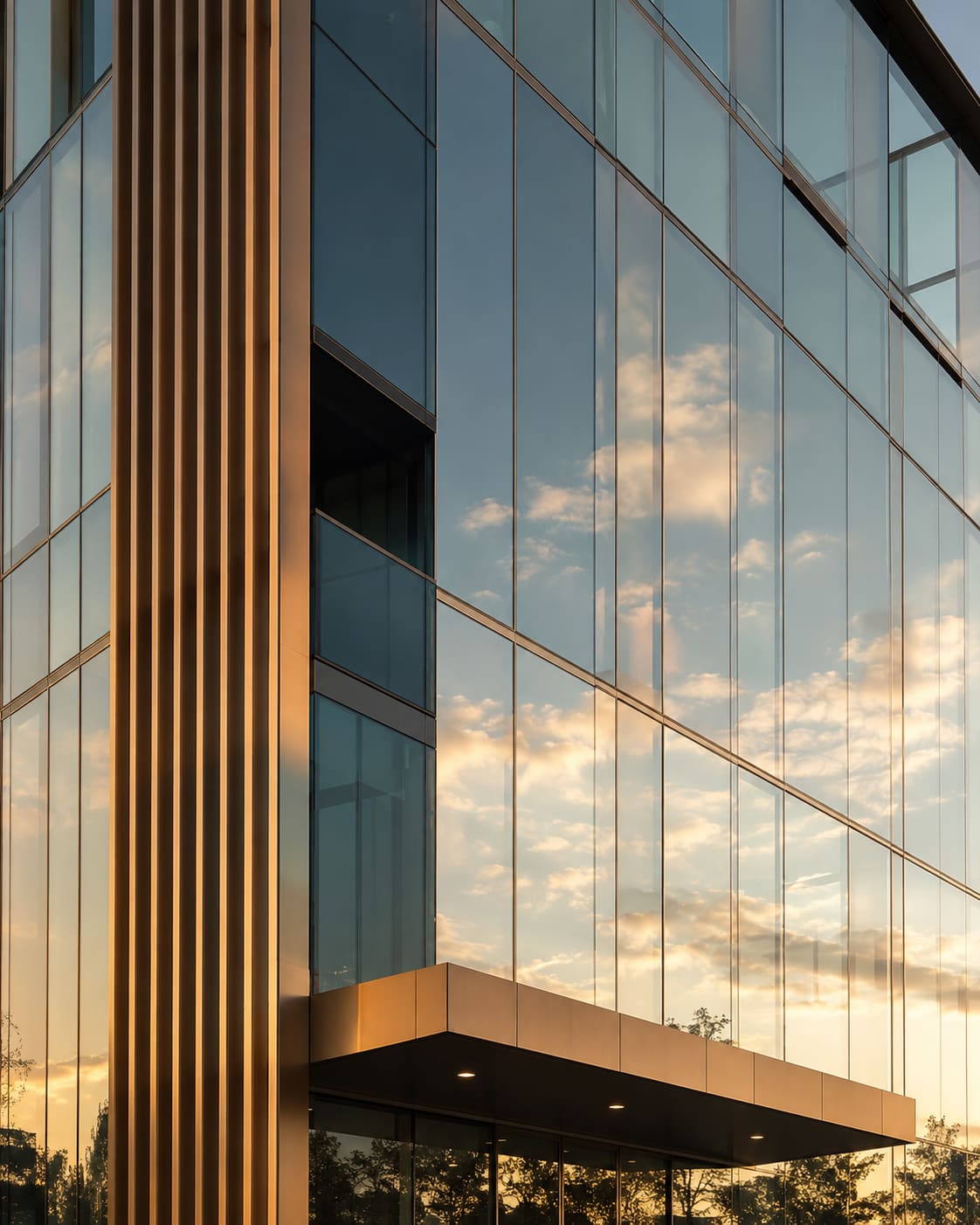
A glass facade in Hyderabad typically costs between Rs 550 and Rs 2,200 per square foot of facade area, with most quality projects landing around Rs 900 to Rs 1,500 per sq ft supplied and installed. The exact rate depends on four things: the system you choose, the glass specification, the building height, and the locality. A small shopfront in Kukatpally can start near Rs 5-6 lakh, while a full glass facade curtain-wall tower in the Financial District or HITEC City runs into several crore. This guide gives you realistic twin-city rates so you can build a defensible budget before you ever request a site visit.
Because Hyderabad and Secunderabad see intense summer heat above 42 degrees Celsius, heavy south-west monsoon rain from June to September, and near-constant construction dust, the cheapest quote is rarely the right one. The glass coating, the aluminium grade, and the sealant quality together decide whether your facade stays cool, dry and clean, or turns into a maintenance headache within two years. A poorly executed structural glazing job that leaks in its first monsoon costs far more to rectify than any amount it saved at the quotation stage.
Across Telangana and neighbouring Andhra Pradesh, facade budgets firmed up through 2025 and 2026 as aluminium and processed-glass prices settled higher than the pandemic years, and as GHMC and HMDA facade-safety expectations tightened. Whether you are cladding a G+8 office block in Gachibowli or a boutique showroom in Banjara Hills, understanding exactly where the money goes lets you spend it where it matters and trim it where it does not. When you have a defined scope, you can get a free quote tailored to your building.
Glass facade cost per square foot in Hyderabad (by system)
Your facade system is the single biggest cost driver, and Hyderabad rates fall into clear bands. The prices below are supplied-and-installed, per square foot of finished facade area, at mid-2026 twin-city rates. Facade area means the vertical envelope you are cladding, glass plus framing, not the floor plate.
- ACP cladding with glass accents: Rs 350 to Rs 650 per sq ft, popular for showrooms and mixed-use frontages in Kukatpally and Kondapur where budget matters more than a fully glazed look.
- Semi-unitised / conventional structural glazing: Rs 750 to Rs 1,300 per sq ft, the most common choice for independent offices and commercial blocks in Madhapur and Gachibowli.
- Spider glazing (point-fixed): Rs 1,100 to Rs 1,800 per sq ft, used for double-height lobbies, atriums and showroom fronts in Banjara Hills and Jubilee Hills where a frameless look is the design intent.
- Full unitised curtain wall: Rs 1,600 to Rs 2,200+ per sq ft, standard for high-rise towers in HITEC City, Kokapet and the Financial District where panels are factory-assembled and craned into place floor by floor.
As a rule of thumb, budget Rs 1,000-1,400 per sq ft for a quality commercial structural-glazing facade in the twin cities before add-ons like automation, louvers or feature lighting. Spider systems carry a premium because each pane is point-fixed to stainless-steel fittings and a tension truss or fin, which demands precise fabrication tolerances and higher-grade hardware. Unitised systems cost the most per sq ft but install fastest on tall buildings, which can offset the rate on projects where site time is money.
What the glass specification adds to the bill
The glass itself can swing your cost by 40% or more, so specify it for Hyderabad's climate, not just its looks. Given the city's harsh solar load, low-E and double-glazed units routinely pay for themselves in lower AC bills within three to five years on an air-conditioned building. The rates below are per square foot of glass, before framing and installation.
- Plain float / body-tinted glass (6-8mm): Rs 90 to Rs 180 per sq ft, suitable only for shaded or non-critical elevations.
- Toughened (tempered) single glazing: Rs 180 to Rs 320 per sq ft, four to five times stronger than annealed and the practical minimum for any facade.
- Reflective / heat-reflective coated glass: Rs 220 to Rs 420 per sq ft, effective against the punishing west-facing afternoon sun common on Hyderabad's east-west road grid.
- Double-glazed unit (DGU) with low-E: Rs 450 to Rs 750 per sq ft, the best choice for air-conditioned offices in Gachibowli and the Financial District.
- Laminated safety glass: Rs 260 to Rs 500 per sq ft, preferred for overhead glazing, canopies and ground-floor security where a broken pane must stay in the frame.
For homes in Jubilee Hills or Kokapet villas, a strong balance is toughened low-E glass, which cuts heat gain sharply without the full DGU premium. Whichever you choose, insist on toughened glass carrying the IS 2553 mark with a legible stamp etched in the corner, since untested tempered glass is a genuine safety and re-work risk. Reputable Hyderabad fabricators source from Saint-Gobain, Asahi India (AIS) or Modiguard and will name the make in writing.
Local factors that push Hyderabad facade prices up or down
Beyond system and glass, several twin-city realities move your final quote. Buildings above four floors, tight sites, and premium localities all add cost, sometimes materially.
- Building height: high-rise work in HITEC City and Kokapet adds Rs 100-250 per sq ft for scaffolding, powered cradles and safety compliance.
- Wind and structural design: towers above roughly 15 floors need wind-load-engineered mullions designed to IS 875 (Part 3), which increases aluminium tonnage and the depth of the section.
- Locality and access: congested lanes in old Secunderabad, Abids or Banjara Hills raise labour and material-handling costs versus open plots in the Financial District or Adibatla.
- Aluminium brand and grade: Jindal, Hindalco or imported systems cost more than local extrusions but resist corrosion and hold tolerance far better.
- Automation extras: automatic entrance doors, motorised louvers and ventilators typically add Rs 50,000 to Rs 3 lakh depending on scope and controls.
- GST and transport: 18% GST applies to fabricated and installed facade work, and haulage to outer areas like Shamshabad, Patancheru or Adibatla adds a small premium.
A single elevation facing due west in Gachibowli can justify a different, higher-performance glass than the shaded north face of the same building, so a good vendor may quote elevations separately rather than applying one blanket rate. That is a sign of engineering rigour, not upselling.
Sample budgets for real twin-city projects
Here are realistic all-in budgets to anchor your planning. Figures assume mid-range structural glazing with toughened glass and branded aluminium at 2026 Hyderabad rates, inclusive of installation but before GST.
- Retail shopfront, 400 sq ft (Kukatpally / Dilsukhnagar): Rs 4 lakh to Rs 7 lakh.
- Boutique showroom with spider glazing, 1,200 sq ft (Banjara Hills / Jubilee Hills): Rs 14 lakh to Rs 22 lakh.
- Residential villa glazing, 900 sq ft (Kokapet / Jubilee Hills): Rs 9 lakh to Rs 16 lakh.
- Independent office building, 3,500 sq ft facade (Madhapur / Kondapur): Rs 35 lakh to Rs 52 lakh.
- G+8 commercial block, 20,000 sq ft facade (Gachibowli / Financial District): Rs 2.4 crore to Rs 3.8 crore.
These ranges look wide because the glass and aluminium spec inside each project can nearly double the cost. Always insist on a written scope covering glass make, aluminium grade, sealant brand and warranty, so you can compare quotes fairly across vendors. If your project pairs a facade with interior glazing, keep partitions and railings as separate line items so the facade rate stays clean and comparable. To size your own project quickly, share the elevation area and floor count when you get a free quote.
How to compare facade quotes without getting burned
The lowest per-sq-ft number almost never wins on total cost of ownership, because vendors trim the specification to hit a headline rate. Compare like for like by checking these line items in every quote, and reject any quote that will not put them in writing.
- Glass: make (Saint-Gobain, AIS, Modiguard), thickness, coating and whether it is a genuine sealed DGU or a single glaze dressed up as one.
- Aluminium: brand, section weight per running metre, and finish (powder coat vs anodised) with the warranty stated in years.
- Sealant: primary structural silicone brand plus weatherseal, and whether structural bonding is shop-applied under controlled conditions or done on site.
- Fixings: the stainless grade (SS 304 vs SS 316) of brackets, spiders and any facade-door hardware.
- Scope boundaries: does the price include scaffolding, final cleaning, waterproofing at slab and sill junctions, and a mock-up or on-site water test?
A specialist who itemises all of the above is usually cheaper over ten years than a generalist quoting a single round figure, because the itemised quote is the one that will not spring a variation bill on you mid-project. Explore the full range of what we build across our services before you shortlist. When two quotes look far apart on price, the gap is almost always hiding in the glass coating, the sealant, or the stainless grade.
The facade process and timeline in Hyderabad
Knowing the sequence helps you plan cash flow and site coordination, and it flags a serious contractor from a fly-by-night one. A typical mid-size commercial facade in the twin cities runs 6 to 12 weeks from order to handover, depending on glass lead times and building height.
- Survey and design (1-2 weeks): site measurement, elevation drawings, glass and system selection, and a load and thermal check for the exposed elevations.
- Engineering and approval (1 week): shop drawings, wind-load calculations to IS 875 for taller buildings, and your written sign-off on glass make and hardware.
- Fabrication (2-4 weeks): aluminium cutting and finishing, glass processing and DGU sealing, and shop-applied structural bonding where specified.
- Installation (2-5 weeks): framing erection, glazing, sealing and weatherproofing, staged by floor on high-rise work.
- Testing and handover (few days): a water test on a sample bay, snag rectification, cleaning and warranty documentation.
Processed and coated glass, especially DGUs and imported low-E stock, carries the longest lead time, so lock the glass order early if your programme is tight. Monsoon months from June to September can slow external sealing and high-rise cradle work in Hyderabad, which is worth building into the schedule rather than discovering on site.
Common mistakes that inflate facade cost
Most facade budget overruns in Hyderabad trace back to a handful of avoidable decisions made at the quotation stage. Watching for these keeps the project on budget and out of the re-work cycle.
- Chasing the lowest headline rate, then paying variations when the trimmed spec fails the first monsoon.
- Specifying plain or under-toughened glass on west and south elevations, driving up cooling bills for the building's whole life.
- Accepting SS 202 or unmarked fixings on weather-exposed openings, which corrode and stain within a couple of seasons.
- Skipping the mock-up water test, which is the cheapest insurance against a leaking facade that is expensive to open up and re-seal.
- Ignoring maintenance access, so cleaning and re-sealing later cost far more than a designed-in cradle or anchor points would have.
- Mixing facade and interior-glazing scopes in one lump-sum, which hides the true facade rate and makes future comparison impossible.
Every one of these is cheaper to avoid at the drawing stage than to fix after installation. A facade is a building envelope, not a finish, and treating it as engineering rather than decoration is what keeps the cost honest.
Maintenance, lifespan and long-term value in Hyderabad
A well-installed glass facade lasts 20 to 25 years or more in Hyderabad's climate, but only if it is designed for dust and monsoon from day one. Sealant grade and annual cleaning are the two factors that most decide whether it ages gracefully or streaks, stains and leaks.
- Budget Rs 8 to Rs 20 per sq ft per year for professional facade cleaning, depending on height and access.
- Inspect structural silicone joints every two to three years; UV and heat gradually degrade cheaper sealants faster than premium ones.
- A reflective or low-E facade can cut cooling loads by 15-25%, a meaningful saving against Telangana's commercial power tariffs.
- Keep as-built drawings and the glass and hardware spec on file, so any future repair matches the original system instead of patching with mismatched parts.
Treat the facade as a 20-year asset, not a one-time purchase. Spending 10-15% more upfront on glass coating, aluminium grade and branded hardware typically returns that money within the first decade through lower energy bills and near-zero re-work. For most Hyderabad buildings, a properly engineered structural glazing envelope is one of the highest-return decisions in the entire construction budget, and it is the one most owners underspend on.