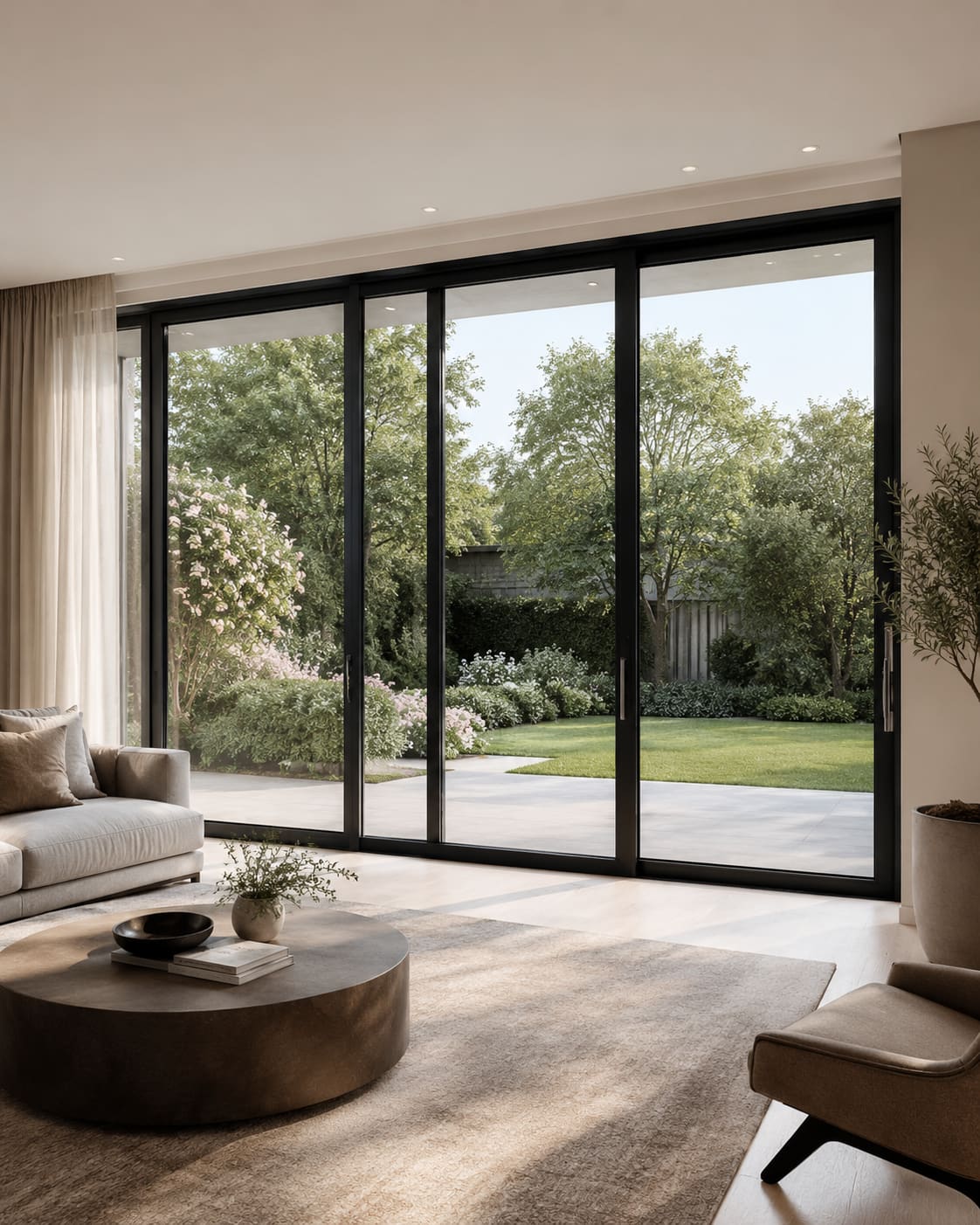
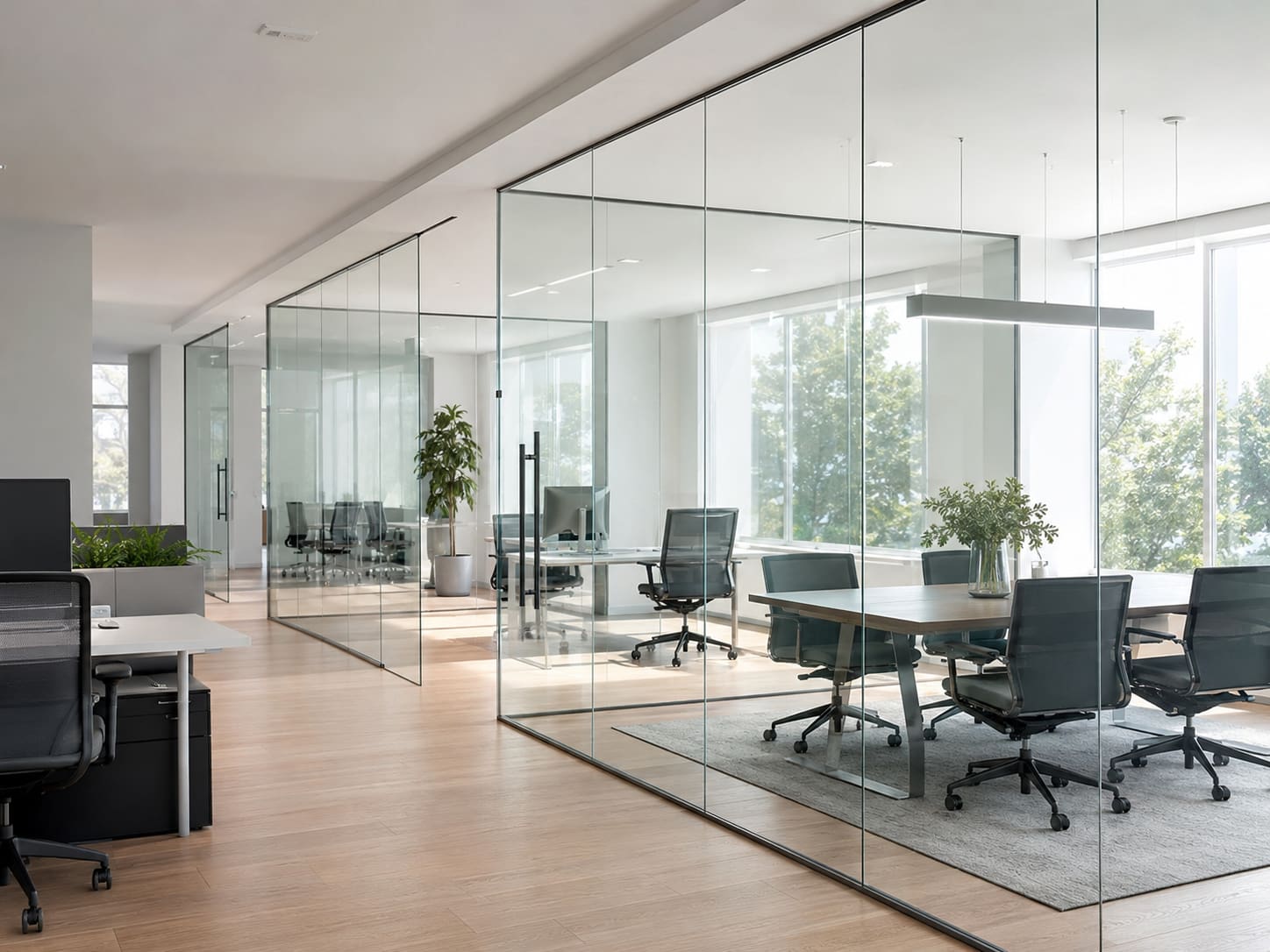
Glass partition cost in Hyderabad ranges from roughly Rs 250 to Rs 1,200 per square foot installed, with most office and home projects settling between Rs 450 and Rs 750 per square foot. Where your project lands inside that band comes down to three choices: glass thickness, the framing system and the hardware grade. If you are planning an office cabin, a boardroom front, a meeting room or a home divider, that single sentence is the honest starting point most vendors avoid. This guide gives the actual rates we quote for glass partitions across Hyderabad, Secunderabad and the wider Telangana and Andhra Pradesh market, so you can budget with real numbers instead of guesswork.
Glass partitions have become the default choice for offices in HITEC City, Gachibowli, Madhapur and the Financial District because they carry daylight deep into the floor plate while still giving acoustic and visual separation. Homes in Banjara Hills, Jubilee Hills, Kokapet, Kondapur and Kompally increasingly use them for pooja rooms, kitchen dividers, staircase screens, shower enclosures and home offices. The problem is that one term, glass partition, hides an enormous price range, and two quotes for the same room can differ by 40 percent for reasons that never appear on paper.
Below we break the pricing down by type, explain what genuinely drives the number, compare office versus home requirements, walk through the installation timeline, and flag the mistakes that quietly inflate a bill. If you would rather skip straight to a firm figure for your space, you can get a free quote and we will measure on site. First, the rate card.
Glass Partition Cost in Hyderabad by Type (Per Sq Ft)
Pricing is quoted per square foot of finished partition area, inclusive of glass, framing and standard installation. These are the indicative 2026 ranges we see across Hyderabad and Secunderabad:
- Aluminium framed partition (8mm glass): Rs 250 to Rs 450 per sq ft, the most economical office option and easy to reconfigure later.
- Frameless toughened glass (10mm): Rs 450 to Rs 700 per sq ft, a clean look with minimal visible hardware.
- Frameless toughened glass (12mm): Rs 650 to Rs 900 per sq ft, used for taller, full-height cabins and doors.
- Double-glazed acoustic partition: Rs 900 to Rs 1,200 per sq ft, for boardrooms and MD cabins needing genuine sound isolation.
- Sliding glass partition: Rs 550 to Rs 950 per sq ft, driven mostly by the track quality and roller mechanism you specify.
- Frosted, etched or digitally printed film finish: add Rs 60 to Rs 150 per sq ft over the base glass rate.
As a quick reference, a standard 8ft by 10ft office cabin (80 sq ft) built in a frameless 10mm system typically lands between Rs 36,000 and Rs 56,000 including a single glass door and floor spring. Scale that to a full floor of six cabins plus a boardroom and you are usually looking at Rs 4.5 lakh to Rs 7.5 lakh, depending on how much acoustic glazing the boardroom needs. You can see finished examples of both scales in our recent projects.
What Actually Drives the Glass Partition Price
Two quotes for the same room can differ dramatically, and the reason is almost always in the specification rather than the glass itself. Understanding these levers helps you compare vendors fairly and spot where a suspiciously low quote has quietly removed something you need.
- Glass thickness: 8mm is fine for low framed screens, but frameless full-height partitions need 10mm or 12mm toughened glass, which costs progressively more and demands stronger fittings.
- Framing system: powder-coated aluminium is budget-friendly, while slim stainless profiles or minimal spider arrangements raise the cost.
- Hardware grade: patch fittings, floor springs, soft-close mechanisms and premium handles add up quickly, and this is where quality gaps hide.
- Acoustics: double glazing plus top-and-bottom perimeter seals for a real sound rating command a clear premium of Rs 200 to Rs 400 per sq ft.
- Finishes: frosting film, ceramic frit, digital prints or manifestation branding are all extra over plain clear glass.
- Site conditions: uneven floors, high ceilings and structural obstructions increase labour and, occasionally, force custom glass sizes.
The single biggest hidden variable is hardware grade. A partition running on cheap unbranded fittings will sag, drift or lose its soft-close inside a year, which is why we standardise on trusted brands across every job. If you want an itemised comparison for your exact room, get a free quote and ask for the specification to be listed line by line.
Hardware Choices That Move the Cost
Glass is only half the partition. The fittings you cannot easily see are what determine whether a door still closes cleanly after five years of daily use, and they are a meaningful slice of the budget. Budget roughly 15 to 30 percent of the total partition cost for hardware alone.
- Patch fittings: the top and bottom patches that grip a frameless glass door. Good branded patches typically add Rs 3,500 to Rs 8,000 per door.
- Floor springs and closers: the mechanism controlling a swing door's return, running Rs 2,500 to Rs 9,000 depending on the load rating.
- Handles and locks: from a simple pull handle to a keyed office lock, adding Rs 800 to Rs 6,000 per door based on finish.
- Spider and structural fittings: for large frameless spans and glass fronts, these add both cost and a premium architectural look.
- Sliding tracks and rollers: on a sliding partition the track quality dictates how smoothly and quietly the leaf runs for years.
Skimping on hardware is the most common regret we hear from clients who used a cut-rate vendor. A door that drops even 2mm out of alignment stops latching, catches on the floor and eventually cracks at the patch. Spending an extra few thousand rupees per door here is almost always cheaper than replacing toughened glass, which cannot be re-cut once it is made.
Office Glass Partitions: What to Budget in Hyderabad
Office projects across HITEC City, Gachibowli and Madhapur are usually specified for durability and quick reconfiguration, so we recommend toughened 10mm frameless systems with sturdy floor springs that survive constant daily traffic. Our office glass cabins service covers cabins, meeting rooms and boardroom fronts as one coordinated package.
For an open-plan floor being carved into cabins plus one boardroom, a realistic all-in budget is Rs 500 to Rs 750 per sq ft once doors and hardware are included. A few planning moves keep that number sensible:
- Standardise cabin widths so glass panels repeat and cutting wastage drops.
- Specify manifestation film at eye level, which is both a safety requirement and a branding opportunity.
- Reserve acoustic double glazing for the boardroom and MD cabin only, not every wall.
- Plan door swings and floor-spring positions before the flooring goes down to avoid expensive rework.
For a 2,000 sq ft floor plate typical of a Financial District or Nanakramguda startup, a mixed specification of framed internal partitions and frameless client-facing fronts commonly totals Rs 6 lakh to Rs 9 lakh. Explore the full range of what we fit out under our services if the project also needs doors, railings or facade glazing.
Home Glass Partitions and Dividers
Home partitions lean toward aesthetics and are usually smaller in area, so the total project cost feels lower even at similar per-sq-ft rates. In homes across Banjara Hills, Kokapet, Kondapur and Manikonda, the popular uses are pooja room dividers, kitchen-to-living separators, staircase screens and home-office enclosures.
- A frosted glass pooja room divider commonly costs Rs 18,000 to Rs 40,000 depending on size and finish.
- A kitchen-to-living glass separator with a sliding leaf runs Rs 25,000 to Rs 55,000.
- A frameless shower enclosure for a master bathroom sits at Rs 20,000 to Rs 60,000 with quality hinges and seals.
- A staircase or mezzanine glass screen typically works out to Rs 30,000 to Rs 80,000 for a full run.
Homes generally favour clear or lightly frosted 10mm glass for a seamless look, and sliding configurations win where floor space is tight. Because a family lives with these partitions every day, insist on branded hinges and handles that hold their finish through humid Hyderabad summers, when cheap chrome plating pits and rusts within a monsoon or two.
Framed vs Frameless vs Acoustic: A Quick Comparison
Choosing between systems is really a trade-off between budget, looks and sound control. Here is how the three main options compare at a glance:
- Aluminium framed (Rs 250 to Rs 450 per sq ft): most economical, easy to move and rewire, but with visible framing lines and modest acoustics. Best for internal, non-client zones.
- Frameless toughened (Rs 450 to Rs 900 per sq ft): a premium minimal look, excellent daylight and moderate acoustics. Best for reception, boardroom fronts and homes.
- Acoustic double-glazed (Rs 900 to Rs 1,200 per sq ft): genuine sound isolation of 35 to 45 dB, at the highest cost. Best for boardrooms, HR cabins, clinics and legal offices.
If confidentiality matters, do not assume a single sheet of frameless glass blocks sound, because it does not. Only double glazing with perimeter seals delivers a real acoustic rating, and that line item is what most often separates a cheap quote from a correct one. A single run can mix framed sections for internal walls with frameless glazing where clients can see it, which is the most cost-effective way to balance appearance and budget.
Installation Process and Timeline
A professional glass partition installation follows a predictable sequence, and knowing it helps you plan around your office move-in or home renovation date.
- Site measurement and survey: 1 day. We check floor level, ceiling height and structural fixing points, since toughened glass is cut to exact size and cannot be trimmed afterwards.
- Design sign-off and quotation: 1 to 2 days for an itemised estimate with the glass, frame and hardware spec listed.
- Glass toughening and fabrication: 3 to 6 days, as toughened glass is made to order at the factory.
- Installation on site: 1 to 4 days depending on the number of cabins, doors and any acoustic glazing.
A single home divider can be surveyed, fabricated and fitted within a week. A full office floor of cabins and a boardroom typically takes 5 to 12 working days end to end. The stage that cannot be rushed is glass toughening, so ordering early is the simplest way to protect a tight deadline. Once the frames are up, glazing and hardware fitting move quickly.
Common Mistakes to Avoid (and How to Save)
The smartest saving is to right-size the specification to the actual need rather than defaulting to the most premium system everywhere. A little planning routinely trims 10 to 20 percent off a project total, while these avoidable errors quietly inflate it:
- Ordering frameless glass everywhere: use aluminium framed partitions for internal, non-client zones and reserve frameless glass for reception and boardrooms.
- Paying for etched glass when film will do: applied frosting film looks almost identical at a fraction of the etched-glass price.
- Splitting glass and hardware across two vendors: buy them as one package so there is a single point of accountability if anything needs adjustment.
- Skipping the IS 2553 check: always confirm the quote names toughened glass with an IS 2553 stamp, edge polishing, hardware and installation, so there are no surprises later.
- Forgetting manifestation film: clear full-height glass is a walk-into hazard, and eye-level film is both a safety essential and a branding chance.
For an accurate figure, a site measurement in Hyderabad, Secunderabad or anywhere across Telangana and Andhra Pradesh is essential, since ceiling height, floor level and existing structure all affect the final number. Send your floor plan and get a free quote, and we will return an itemised estimate within two working days.