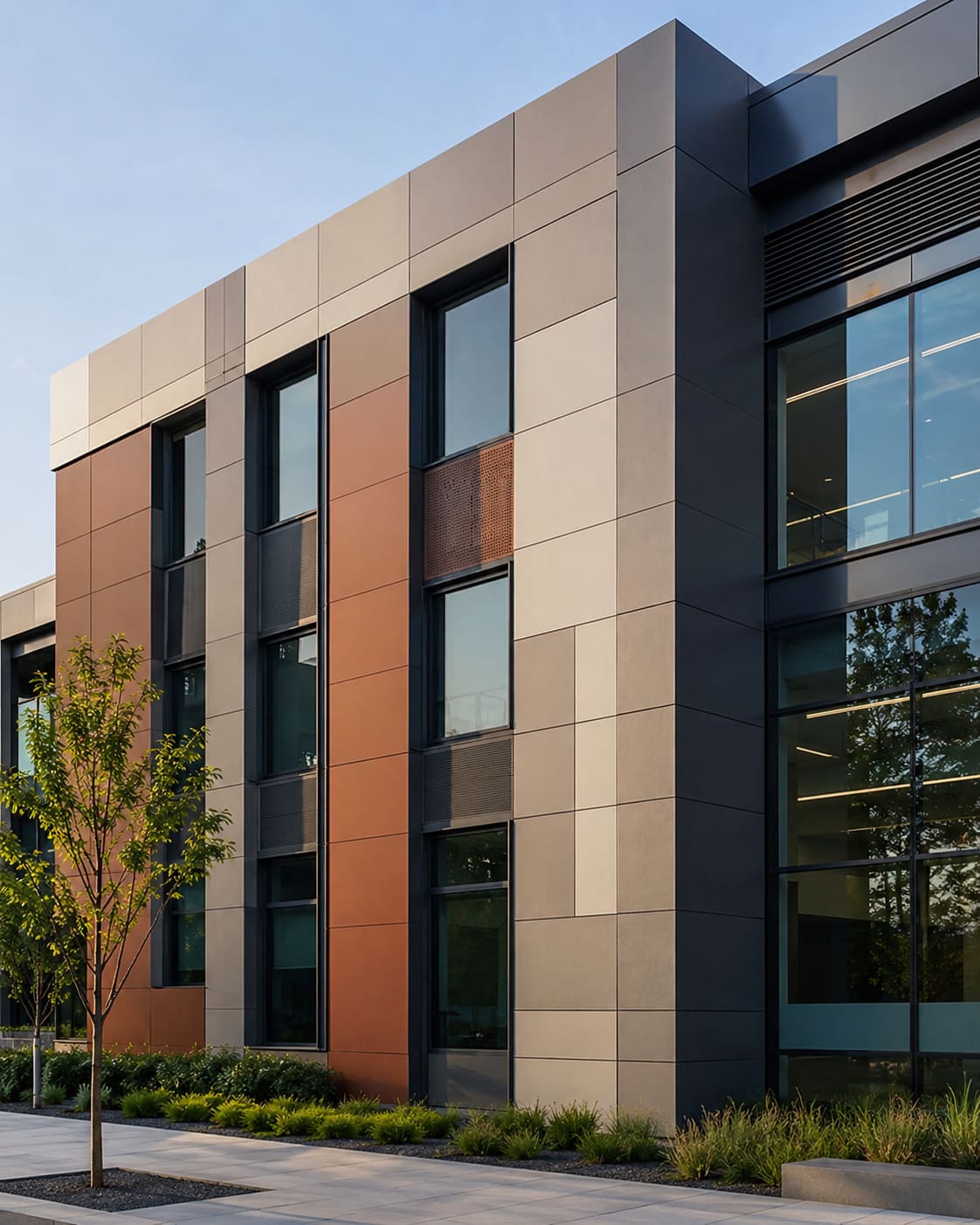
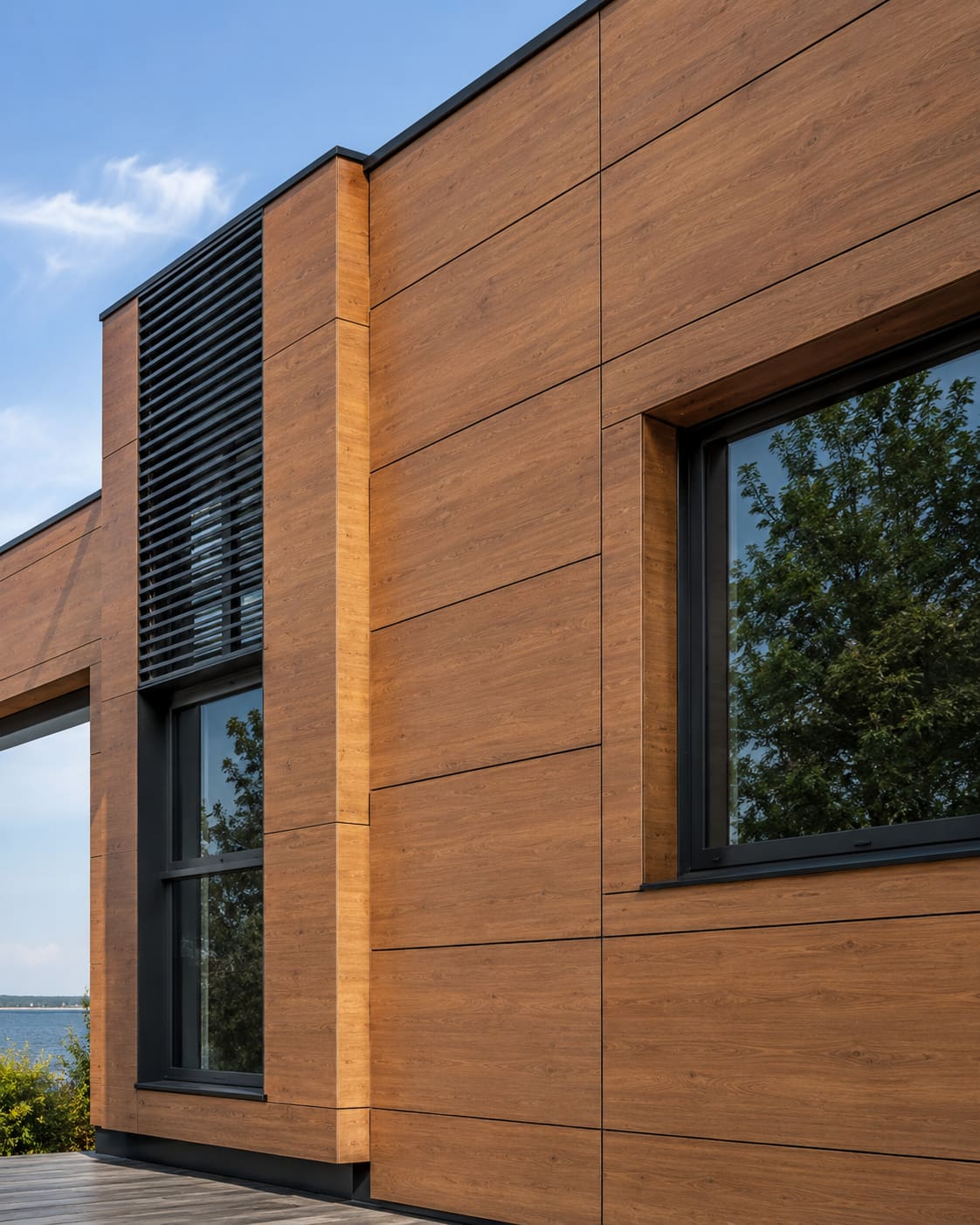
The HPL cladding cost per sq ft in Hyderabad in 2026 typically lands between INR 350 and INR 650 supplied-and-fixed, with the exterior-grade panel alone costing INR 150 to INR 420 depending on thickness, brand and finish. That is a wide band, so understanding what sits inside each rate matters far more than chasing the lowest quote. A difference of just INR 100 per sq ft on a 3,000 sq ft elevation is INR 3 lakh, and it almost always buys real differences in panel grade, framing metal and workmanship rather than pure margin.
HPL is High Pressure Laminate - a dense, compact panel made by fusing multiple kraft-paper layers with thermosetting resin under heat and roughly 1,000 psi of pressure, then bonding a decorative, UV-stable and weather-resistant surface. It has become the go-to alternative to ACP on premium residential, commercial and institutional projects across Telangana and Andhra Pradesh because it resists Hyderabad's harsh summer UV, monsoon moisture and city pollution without the fire and de-lamination concerns that dog cheap composite panels. Our HPL cladding service and ACP cladding installations cover both routes, so we can recommend the right panel for your budget rather than pushing one product.
This guide breaks the real 2026 cost down line by line - panel, framing, fixing hardware, labour and access - then compares HPL against ACP, explains what actually moves the price, and shows you how to turn an indicative per-sq-ft figure into a reliable project budget. Whenever you are ready for site-specific numbers, you can get a free quote and our team will survey your elevation across Hyderabad, Secunderabad and the wider AP region.
HPL Cladding Cost Per Sq Ft in 2026 (Indicative Rates)
The HPL cladding cost per sq ft splits into two parts: the panel itself and everything needed to hang it safely on the building. Here are realistic 2026 supply-and-fix rates for exterior-grade HPL in the Hyderabad and Secunderabad market:
- 6mm exterior HPL panel (supply only): INR 150 to INR 320 per sq ft, based on brand and finish.
- 8mm exterior HPL panel (supply only): INR 220 to INR 420 per sq ft.
- Aluminium sub-frame or MS framing with hardware: INR 90 to INR 180 per sq ft.
- Installation labour with rivets, clamps and fasteners: INR 60 to INR 130 per sq ft.
Put together, a completed HPL facade in Hyderabad usually costs INR 350 to INR 650 per sq ft. Solid-colour or plain finishes sit at the lower end, while woodgrain, metallic and imported designer decors push toward the top. Remember that the framing is not a minor line item - a quality substructure and corrosion-resistant fixing hardware can account for a third of the total, and skimping there is the fastest way to a facade that oil-cans, rattles or works loose within a couple of monsoons. You can see the standard of finish we deliver across our recent projects before committing to a spec.
What HPL Cladding Actually Is (and Which Grade to Use)
HPL, or High Pressure Laminate, is a homogeneous compact board - not a composite. Layers of resin-impregnated kraft paper are pressed under high heat and pressure into a single dense sheet, then finished with a decorative and protective surface layer. Because it has no separate core material, there is no polyethylene filling to burn or de-bond, which is the fundamental safety advantage over budget composite panels.
For any outdoor facade in Telangana or Andhra Pradesh, the grade you specify matters more than the brand on the label:
- EGF (Exterior Grade Fire-retardant): the only grade suitable for facades. UV-stabilised, weather-resistant and fire-retardant, engineered to hold colour and integrity outdoors for 10 to 15 years or more.
- Standard exterior grade: UV-resistant but without the fire-retardant rating some institutional and high-rise projects legally require.
- Interior grade: cheapest, but it fades, swells and delaminates within a few seasons if used outdoors - never specify it for an external wall.
The gap between interior and EGF panels is exactly why two quotes can look so different. When a rate seems suspiciously low, the first thing to check is whether the panel is genuine EGF compact laminate or a cheaper interior board dressed up as exterior stock.
What Actually Drives the HPL Cladding Price
Two quotes for the same square footage can differ by 40 percent, and it is rarely dishonesty on either side. The variables below explain most of the gap between a cheap number and a fair one.
- Panel thickness: 8mm is stiffer, spans wider and costs more than 6mm, but it reduces framing density and gives flatter large panels.
- Grade: only EGF compact laminate belongs on a facade; interior-grade HPL is cheaper but delaminates and fades outdoors.
- Framing material: an aluminium sub-structure costs more than MS but resists corrosion far better in humid, coastal Andhra Pradesh districts like Visakhapatnam and Nellore.
- Finish and brand: imported, metallic and woodgrain decors, plus premium brands, carry a clear premium over domestic plain shades.
- Fixing method: visible rivet fixing is cheaper than concealed clamp or undercut-anchor systems that hide every fastener.
The fixing method deserves special attention because it changes both the look and the labour bill. Concealed systems rely on precision-machined clips and anchors, and the quality of that structural fixing hardware directly affects wind-load performance on tall Hyderabad buildings. When you compare quotes, confirm you are comparing the same grade, the same framing metal and the same fixing philosophy - otherwise the numbers simply are not comparable.
HPL vs ACP - Where the Money Goes
Clients across Secunderabad and Hyderabad often ask whether HPL is worth the premium over ACP. ACP (aluminium composite panel) supplied-and-fixed runs roughly INR 180 to INR 420 per sq ft, so HPL costs 20 to 40 percent more up front.
The trade-off is durability and safety. Quality EGF HPL is a solid compact panel with no polyethylene core to burn or de-bond, holds colour longer under Telangana's UV load, and shrugs off impact better. For a school, hospital, showroom or a home facade you want to last 15 years or more, the higher HPL cost per sq ft is usually justified. For a fast, cost-led commercial re-skin, fire-rated ACP can still be the sensible choice - which is why we install both HPL and ACP cladding and recommend by project rather than by margin.
- Fire safety: EGF HPL has no combustible core; standard ACP relies on a mineral-filled core to achieve fire ratings.
- Colour retention: HPL holds decor and gloss longer under direct South-Indian sun.
- Panel flatness: ACP is generally flatter on very large panels; HPL can show slight bow if under-framed.
- Up-front cost: ACP is cheaper per sq ft; HPL costs more but often has a longer effective life and lower whole-life cost.
The Framing and Fixing Hardware Behind the Panel
A facade is only as good as the substructure holding it, and hardware is where cut-price jobs quietly cut corners. The bare panel is roughly half the cost of a completed elevation; the rest is framing, brackets, fasteners and labour.
- Aluminium or MS vertical and horizontal rails set out on a grid to suit panel size and wind zone.
- Brackets and cleats that transfer wind and dead load back to the building structure.
- Rivets, screws, clamps or undercut anchors depending on whether the fixing is visible or concealed.
- EPDM gaskets and weather sealant at every joint to manage rainwater and thermal movement.
Using consistent, engineered hardware rather than a bag of mixed fasteners is what keeps an HPL facade tight, quiet and rattle-free for its full service life. It also protects the panel warranty, which most manufacturers void if the substructure is inadequate. On tall or wind-exposed sites, the framing grid should be engineered to the local wind zone - a step that budget installers routinely skip, and one that separates a facade that lasts from one that fails at the first storm.
Installation Cost and Site Factors in Hyderabad
Installation labour and access typically add INR 60 to INR 200 per sq ft on top of material, and the range is wide for good reasons that have nothing to do with the panel.
- Building height: scaffolding, swing stages or cradles on tall commercial towers cost far more than a two-storey home elevation.
- Elevation complexity: curves, fins, louvres, soffits and deep reveals slow fabrication and cutting.
- Wastage: irregular openings, returns and corners typically add 8 to 15 percent to the net panel area.
- Access and logistics: congested inner-city Hyderabad sites with no lay-down area push labour and crane costs up.
For a straightforward, well-planned residential facade in Hyderabad or Secunderabad, installation stays near the lower end. For a high-rise Gachibowli or HITEC City commercial project with height access and a complex elevation, expect the upper end. Timeline follows the same logic: a small house frontage can be framed and clad in 7 to 12 working days, while a large institutional or commercial elevation runs 4 to 8 weeks once material lands on site. If you are combining cladding with glazing or other facade work, browsing our services shows the full scope we execute under one contract so the interfaces between glass, panel and framing are detailed correctly.
Sample Budgets for Real Hyderabad Projects
Numbers land better against real areas, so here are three indicative 2026 budgets using mid-range EGF HPL, aluminium framing and standard fixing. Treat them as planning figures, not quotes.
- Independent house front elevation, 800 sq ft net, plain and woodgrain mix: roughly INR 3.6 lakh to INR 4.4 lakh supplied-and-fixed.
- Showroom or office frontage, 2,500 sq ft, designer decors with concealed fixing: roughly INR 12.5 lakh to INR 16.25 lakh.
- Institutional building, 6,000 sq ft, EGF fire-retardant panels with aluminium substructure: roughly INR 27 lakh to INR 36 lakh, before height-access premiums.
Bulk orders on the larger projects unlock 10 to 15 percent off supply rates, which is why the per-sq-ft figure on a 6,000 sq ft job often beats a small 800 sq ft elevation. GST, coping, drip beads, corner profiles and scaffolding are usually billed as separate line items, so always confirm what is in and what is out before you compare two numbers.
Common Mistakes to Avoid When Buying HPL Cladding
Most HPL facade failures in Telangana trace back to a handful of avoidable buying decisions rather than to the panel itself. Watch for these before you sign:
- Specifying by brand name only, without confirming grade and thickness (EGF, 6mm or 8mm) in writing on the quote.
- Accepting interior-grade laminate for an external wall because the rate looked attractive.
- Under-sizing the framing grid below the wind-zone requirement to save on aluminium.
- Skipping or under-speccing EPDM gaskets and sealant, which is the number-one cause of water ingress at joints.
- Comparing a visible-rivet quote against a concealed-fixing quote as if they were the same job.
- Ignoring wastage - pricing only the flat net area and getting surprised by the 8 to 15 percent added by corners, returns and openings.
Each of these shortcuts shows up later as fading, oil-canning, rattling or leaks, and repairing a failed facade costs far more than doing it right once. A transparent, itemised quote is your best protection against all of them.
How to Reduce HPL Cladding Cost Without Cutting Quality
You can trim the bill meaningfully without dropping to unsafe interior-grade panels or flimsy framing. The smart savings come from planning, not from buying the cheapest panel.
- Standardise panel sizes so the factory minimises off-cuts and wastage.
- Mix a premium designer decor on the eye-level frontage with plainer shades on side and rear elevations.
- Choose 8mm only where spans demand it, and 6mm on smaller, well-supported areas.
- Order the whole elevation in one batch to hit bulk pricing rather than phasing in small lots.
- Combine cladding, glazing and hardware procurement under one vendor to save on mobilisation and access.
Never save money by dropping from EGF to interior-grade laminate, thinning the framing grid below the wind-zone requirement, or skipping proper sealant and gaskets. Those false economies show up as fading, oil-canning and water ingress within two or three monsoons in Telangana and Andhra Pradesh, and they wipe out any saving several times over.
Getting an Accurate Quote for Your Site
A per-sq-ft rate is only a starting point; the final bill depends on your actual elevation. Ask any vendor to price these separately so you can compare fairly:
- Net cladding area versus gross area, since openings, returns and reveals add wastage.
- Corner profiles, coping, drip beads and sealant, which are often billed as extras.
- Scaffolding and height access, significant on tall Hyderabad commercial buildings.
- Panel grade and thickness in writing (EGF, 6mm or 8mm), not just a brand name.
- Warranty terms on both the panel finish and the installation workmanship.
At Hakimi Aluminium and Glass, we survey the site, calculate real net areas and quote a transparent supply-and-fix rate so there are no surprises mid-project. When you want a site-specific number for a home, showroom or commercial building anywhere across Hyderabad, Secunderabad, Telangana or Andhra Pradesh, get a free quote and we will turn an indicative HPL cladding cost per sq ft into a budget you can actually rely on.