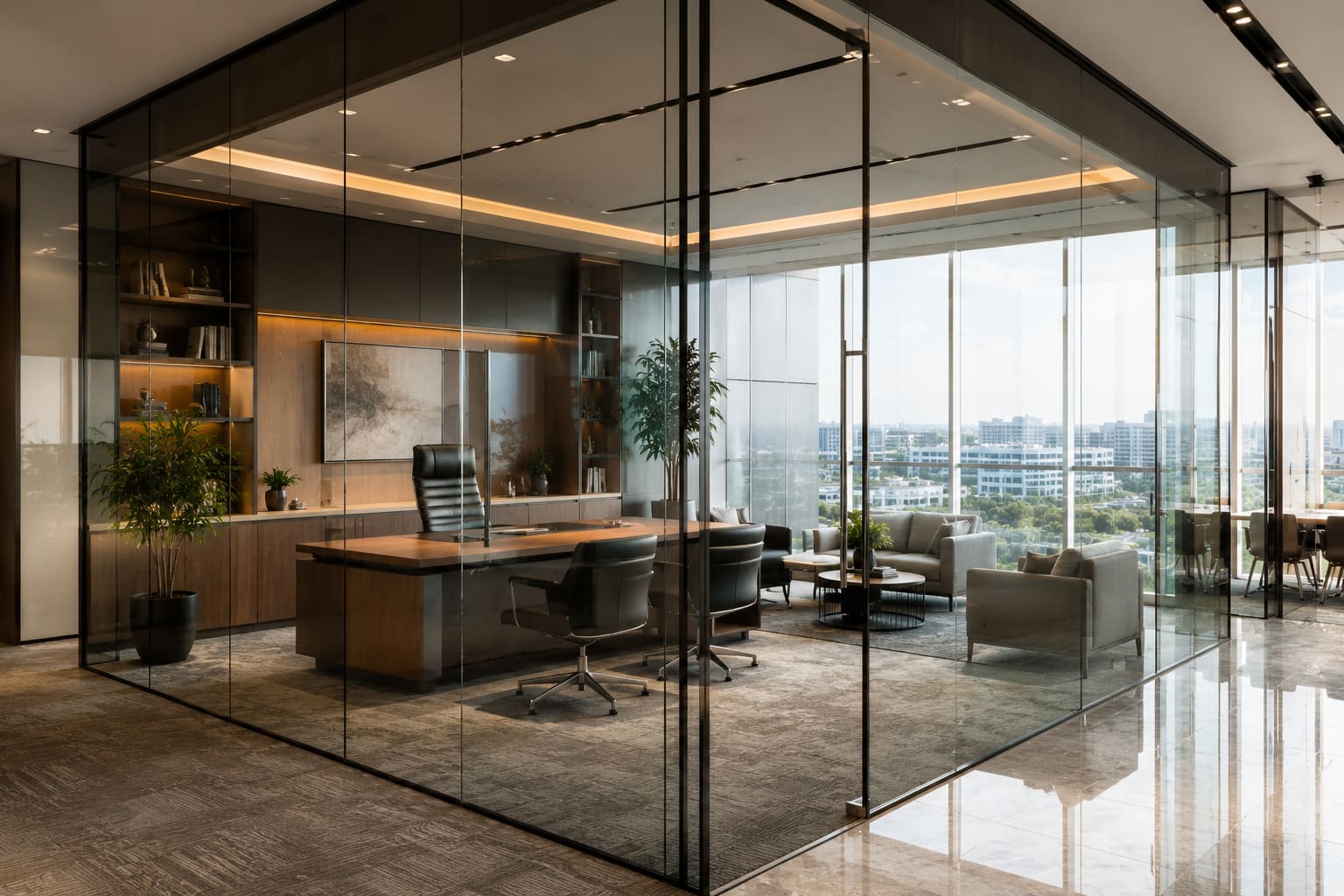
Office glass cabin cost in Hyderabad ranges from about Rs. 45,000 for a basic aluminium-framed cabin to Rs. 1,90,000 or more for a premium frameless toughened glass room, with per-sq-ft rates running Rs. 350 to Rs. 2,200 depending on glass type. A "glass cabin" can mean anything from a simple 5mm framed enclosure to a fully frameless 12mm toughened room with an automatic door and acoustic double glazing - which is exactly why quotes vary so much. This guide gives you honest 2026 numbers, both per cabin and per square foot, so you can budget confidently before a site visit.
As a glass, aluminium and facade specialist based in Hyderabad, we build these cabins every week for offices in HITEC City, Gachibowli, Kokapet, Madhapur, Kondapur, the Financial District and Secunderabad. Below we break down the two ways cabins are priced, the realistic INR ranges, and the specific choices - glass thickness, framed vs frameless, hardware and finishes - that move your quote up or down. When you are ready for exact figures for your floor plate, you can get a free quote and we will measure on site.
The good news: office cabins are one of the most predictable interior fit-out items to budget. Once you fix three decisions - glass thickness, framed or frameless, and door hardware - you have effectively locked around 80% of your final office glass cabin cost.
How are office glass cabins priced?
There are two costing methods you will see on quotes, and knowing both helps you compare fairly across vendors:
- Per square foot of glass/partition: a running rate applied to the total glazed area (height x length). This is the most common and transparent method, and the one most Hyderabad fabricators default to.
- Per complete cabin (lump sum): a packaged price for a defined cabin size, including glass, framing, door, hardware and labour - convenient for standard manager rooms and repeat cabins on a floor.
Most fabricators quote per sq ft for the glazing and then add fixed-cost items - doors, locks, frosted film, transport, hoisting - as separate line items. For a genuine like-for-like comparison, always confirm whether the door and hardware are included in the per-sq-ft rate or charged separately. A rate that looks Rs. 100/sq ft cheaper often excludes a Rs. 18,000 door. If you are still deciding on the partition style itself, our office glass cabins and glass partitions pages walk through the common configurations.
Indicative per sq ft rates in Hyderabad (2026)
The following are realistic supply-and-install ranges for the Hyderabad, Secunderabad and wider Telangana/AP market. Rates are per sq ft of finished partition and assume standard floor-to-ceiling heights of 9–10 ft:
- Aluminium-framed with 5mm plain glass: Rs. 350 – Rs. 550 per sq ft.
- Aluminium-framed with 8mm–10mm toughened glass: Rs. 550 – Rs. 850 per sq ft.
- Frameless 10mm–12mm toughened glass partition: Rs. 800 – Rs. 1,300 per sq ft.
- Double-glazed / acoustic glass cabin (soundproof): Rs. 1,300 – Rs. 2,200 per sq ft.
Frosted film or branding vinyl typically adds Rs. 45 – Rs. 120 per sq ft, and a toughened glass swing door with patch fittings and floor spring usually runs Rs. 12,000 – Rs. 22,000 per door depending on the hardware brand. If you want the seamless, minimal look, a frameless glass partition uses thicker glass and precise fittings, which is why it sits at the upper end of these bands.
What does a complete glass cabin cost?
To translate rates into real budgets, here is what a finished cabin tends to cost. Assume a standard manager cabin of about 10 ft x 10 ft with roughly 9 ft height on two glazed sides (the other two being existing walls):
- Basic aluminium-framed cabin (plain glass, single door): Rs. 45,000 – Rs. 70,000.
- Mid-range toughened glass cabin (framed, frosted band, quality lock): Rs. 75,000 – Rs. 1,10,000.
- Premium frameless toughened cabin (12mm glass, patch-fitting door, minimal hardware): Rs. 1,20,000 – Rs. 1,90,000.
A small phone-booth or single-seater pod (about 4 ft x 4 ft) generally lands between Rs. 30,000 and Rs. 65,000, while a full acoustic MD cabin with double glazing can exceed Rs. 2,50,000. If you are fitting out a larger floor with several cabins and open meeting rooms, per-cabin costs usually drop 8–15% at volume because mobilisation, transport and hoisting are shared across the job. You can see the range of layouts we have delivered on our projects page.
Framed vs frameless glass cabins: which should you pick?
This single decision changes both the look and the budget more than anything else. Here is how they compare:
- Framed (aluminium) cabins use slimmer 5–10mm glass held in an aluminium track top and bottom. They are cheaper, faster to install, easier to modify later, and forgiving of slightly uneven floors and ceilings. Colour-anodised or powder-coated profiles let you match office branding.
- Frameless cabins use 10–12mm toughened glass with minimal patch fittings and floor springs, giving an almost invisible, high-end appearance ideal for MD rooms and client-facing zones. They cost 40–70% more and demand precise site measurement.
For most Hyderabad offices, a practical mix works best: frameless glass for the MD cabin and reception-facing meeting room where impressions matter, and framed cabins for internal manager rooms and team pods where budget is the priority. Our meeting room glass and MD cabin glass options cover both approaches, and we are happy to specify a hybrid on your floor plan.
What pushes your office glass cabin cost up or down?
Two cabins of the same size can differ by 40% in price. The main drivers are:
- Glass thickness and type: 12mm toughened and acoustic double-glazing cost far more than 5mm plain glass. Toughening alone (mandatory for safety near doors) adds to the base glass rate.
- Framed vs frameless: frameless looks premium but needs thicker glass and precise patch fittings, raising the price.
- Door hardware: floor springs, patch locks and access-control fittings from reputed brands add cost upfront but last years and avoid the sag and rattle that cheap fittings develop within months.
- Site conditions: high ceilings, false-ceiling coordination, and upper-floor access in office towers around Gachibowli, Kokapet or the Financial District increase labour and hoisting time.
- Finishes: frosted film, printed branding, LED-integrated aluminium profiles and colour-anodised framing all add per-sq-ft cost.
Our advice for Telangana and AP offices: get the measurement done on site, decide framed vs frameless early, and lock the glass thickness - those three choices set roughly 80% of your final office glass cabin cost.
Do glass cabins actually block noise?
This is the most common surprise for first-time buyers. A single sheet of glass - even 12mm toughened - is a modest sound barrier. If you can hear a normal conversation through your cabin wall, the glass is not the problem; the gaps are. Real acoustic performance comes from three things working together:
- Laminated or double-glazed (DGU) glass with an acoustic interlayer, which damps sound far better than a single monolithic sheet.
- Full-height sealing, including a proper door sweep or drop seal and continuous gaskets rather than open reveals at the ceiling.
- A sealed door - sliding doors leak sound at the overlap, so a well-gasketted swing door performs better for privacy.
For MD cabins, HR rooms and boardrooms where confidentiality matters, budget for an acoustic glass partition with double glazing at Rs. 1,300–2,200 per sq ft rather than expecting a single 10mm sheet to do the job. For general team cabins where you only want a visual boundary, standard toughened glass is perfectly fine and far cheaper.
Do Hyderabad's climate and dust affect glass cabins?
Indoor cabins are largely shielded from Telangana's heat and monsoon, but a few local realities still matter for interior glazing:
- Dust: Hyderabad's dry, dusty months leave a visible film on large clear panels, so plan for easy-reach cleaning and consider a frosted band at hand height on high-traffic doors to hide smudges.
- Heat and glare on facade-facing cabins: cabins placed against west or south glazing in towers around HITEC City and Madhapur can get warm and bright. A tinted or frosted film, or coordinating with the building's structural glazing, keeps them comfortable.
- Floor movement and levels: older buildings and fresh screed can be slightly uneven; frameless cabins need a level base, so factor in a small allowance for packing or a threshold channel.
- Humidity in the monsoon: quality anodised or powder-coated aluminium and stainless-grade fittings resist the corrosion that cheaper hardware shows after a couple of wet seasons.
None of these dramatically change your budget, but specifying the right glass film and hardware grade up front avoids callbacks a year later.