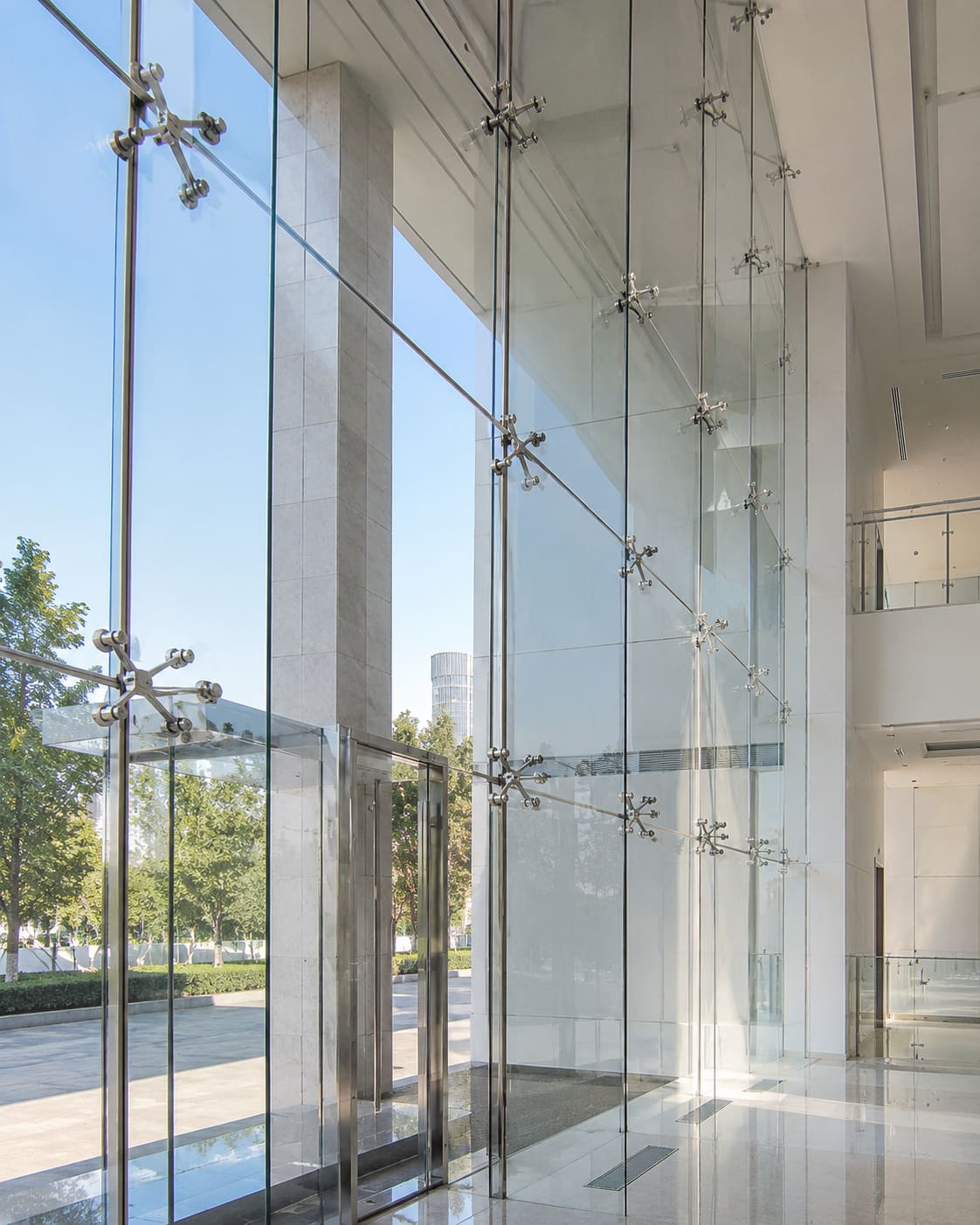
Spider glazing in Hyderabad typically costs between Rs 850 and Rs 2,200 per square foot in 2026, fully installed. Standard 12mm toughened spider glazing for a small commercial storefront in areas like Kukatpally or Secunderabad usually lands around Rs 850 to Rs 1,300 per sq ft, while high-performance double-glazed (DGU) spider glazing facades for corporate towers in HITEC City, Gachibowli and the Financial District commonly run Rs 1,500 to Rs 2,200 per sq ft, depending on glass spec, spider fitting grade and building height.
Spider glazing (also called bolted or point-fixed glazing) uses stainless steel spider brackets and routels to hold large glass panels with almost no visible framing, creating the seamless glass look seen across Hyderabad's IT corridor and premium retail. It is a specialised branch of facade and structural glazing, and because pricing swings widely with glass thickness, fitting quality and access, this guide breaks down exactly what drives the number so you can budget accurately for a project anywhere in the twin cities.
Below you will find current per-square-foot rates, the six factors that move the price most, three real Hyderabad project budgets, and practical ways to control cost without compromising on safety or the frameless look. If you want a figure for your own elevation, you can get a free quote with a drawing and dimensions.
Spider glazing price per square foot in Hyderabad (2026)
Expect Rs 850 to Rs 2,200 per sq ft installed for spider glazing in Hyderabad, with the exact rate set mainly by glass type and spider fitting grade. Below are typical twin-city ranges:
- Single toughened 12mm, 202-grade spiders: Rs 850 to Rs 1,200 per sq ft (budget storefronts, showrooms in Kukatpally, Dilsukhnagar, Secunderabad)
- Toughened 15mm or 19mm, 304-grade spiders: Rs 1,150 to Rs 1,600 per sq ft (atriums, mall entrances, canopies)
- DGU / high-performance solar-control glass, 304/316 spiders: Rs 1,500 to Rs 2,200 per sq ft (IT towers in HITEC City, Madhapur, Kondapur, Kokapet)
- Curved or ceramic-fritted glass: Rs 2,000 to Rs 3,000+ per sq ft (bespoke corporate facades)
These rates include glass, spider fittings, spider arms, routels and installation but exclude the primary structural support (MS/SS mullions, tension rods or glass fins), which is quoted separately. If you are weighing point-fixed against framed systems, our bolt-fixed spider glazing and glass-fin spider glazing pages explain the visual and cost differences in detail.
What drives spider glazing cost in the twin cities?
Six factors move spider glazing cost the most in Hyderabad, and knowing them helps you compare quotes fairly. The biggest levers are glass specification and the grade of stainless steel used in the spiders.
- Glass type: laminated or DGU solar-control glass (recommended for Hyderabad's harsh summer heat gain) costs far more than plain toughened glass.
- Spider grade: 304 and marine-grade 316 stainless resist Hyderabad's dust and monsoon corrosion better than cheaper 202 grade, and cost 20 to 40 percent more.
- Support system: glass fins look cleanest but cost more than MS or SS mullions or tension-rod spider trusses; a cable-net glazing support pushes cost higher still.
- Building height and access: facades above the third floor in Gachibowli or Financial District need scaffolding, cradles or cranes, adding Rs 100 to Rs 400 per sq ft.
- Panel size: larger jumbo panels reduce joints but need heavier glass and more careful handling, raising cost.
- Wind load and design: taller towers require engineered spider systems rated for higher wind pressure, increasing steel and glass thickness.
How is spider glazing built and installed?
Understanding the process explains why the cost sits above ordinary framed glazing. Spider glazing is a point-fixed system, so each glass panel is drilled at the corners and held by a stainless steel spider bracket that transfers load back to a support structure.
- Design and wind-load calculation: the fabricator engineers panel sizes, glass thickness and spider spacing for the building height and Telangana wind zone.
- Structural support fabrication: MS or SS mullions, glass fins, or a tension-rod truss are erected first to carry the spiders.
- Glass toughening and drilling: panels are heat-toughened (often laminated or made into a DGU) and precision-drilled before tempering, which is why holes cannot be changed later.
- Spider and routel fixing: 2-arm, 3-arm or 4-arm spiders and articulated routels connect the glass to the support with a controlled gap for movement.
- Sealing and finishing: joints are sealed with structural silicone to keep out Hyderabad's monsoon driving rain and dust.
Because drilling, toughening and steelwork all carry lead time, the glass cannot be modified on site, making accurate measurement critical up front.
Real Hyderabad project cost examples
Here are three representative 2026 spider glazing budgets for common twin-city project types. Use them as ballpark figures before requesting a site-specific quote.
- Retail showroom double-height entrance, Banjara Hills, ~600 sq ft, 12mm toughened, 304 spiders: roughly Rs 7 to 9 lakh installed.
- Corporate lobby facade, HITEC City, ~2,000 sq ft, DGU solar-control glass, 304 spiders with glass fins: roughly Rs 34 to 42 lakh.
- Mall atrium skylight-to-wall, Kondapur, ~3,500 sq ft, laminated + toughened, 316 spiders: roughly Rs 60 to 75 lakh.
Prices assume ground-to-mid-level access; high-rise cradle work in Kokapet or the Financial District adds to each figure. You can see the kind of facades these budgets deliver in our completed projects, which cover showrooms, corporate lobbies and atrium glazing across the twin cities.
Spider glazing vs structural and curtain wall glazing
Choosing between glazing systems is really a choice about look, span and budget, and each behaves differently in Hyderabad's climate. Spider glazing gives the most transparent, frameless result but is not always the cheapest or the right fit.
- Spider glazing: point-fixed, maximum transparency, ideal for lobbies, atriums and showrooms; Rs 850 to Rs 2,200 per sq ft.
- Structural (silicone) glazing: glass bonded to a hidden frame, a flush look at lower cost; Rs 550 to Rs 1,200 per sq ft.
- Curtain wall glazing: a full building envelope for multi-storey towers, strong on weather-sealing and thermal performance.
- Unitized glazing: factory-assembled panels for fast, high-quality install on tall IT towers.
For a large west-facing tower in the Financial District, a curtain wall or unitized system often makes more sense, while a double-height retail entrance in Jubilee Hills is where spider glazing earns its premium. If you also need opaque infill areas, pair the glass with ACP cladding or reflective glass facade panels for a coordinated elevation.
Why glass choice matters in Hyderabad's climate
Glass specification is where you protect both comfort and running cost, because Hyderabad's summers push past 40 C from April to June and west and south facades take intense afternoon sun. The right glass is not a luxury here, it is a payback investment.
- Solar-control DGU: two glass panes with a low-emissivity coating and an air gap cut heat gain sharply, lowering air-conditioning load in glass-heavy IT offices.
- Laminated glass: an interlayer holds fragments if broken, improving safety for overhead atriums and high-footfall retail, and it cuts noise and UV.
- Tinted or reflective glass: reduces glare and heat on exposed elevations in Madhapur and Gachibowli.
- Monsoon and dust resistance: proper structural silicone sealing and 304/316 spiders keep joints watertight and rust-free through the June to September rains.
Specifying a coated DGU on the sun-exposed elevations and plain toughened on shaded ones is a common way to balance performance against budget. Our DGU facade and specialty glass options cover the coatings that work best for Telangana and Andhra Pradesh conditions.
How to get an accurate quote and control cost
To get an accurate spider glazing quote in Hyderabad, share your elevation drawing, opening dimensions, floor height and preferred glass spec so the fabricator can calculate wind load and steel accurately. A few practical tips keep the budget in check:
- Choose solar-control DGU glass in west and south facades to cut AC load through Hyderabad's April-June peak, saving running cost.
- Insist on 304 or 316 spiders near open or dusty sites to avoid rust streaks during monsoon.
- Standardise panel sizes where possible to reduce wastage and fabrication time.
- Get the structural support and glazing quoted line by line so you can compare vendors like for like.
- Confirm a warranty on glass, fittings and workmanship, plus a maintenance and re-tightening schedule.
When you are ready, get a free quote with your drawing and we will return a line-by-line estimate covering glass, spiders, support steel and access. For a broader read on facade budgeting, our facade consultancy service helps compare systems before you commit.
Maintenance and long-term value
Spider glazing is low-maintenance but not no-maintenance, and a small annual routine protects a large investment. In Hyderabad's dusty, high-UV environment, upkeep also keeps the facade looking new.
- Periodic cleaning: dust settles quickly along the ORR corridor and Financial District, so scheduled glass cleaning keeps transparency high.
- Spider re-tightening: bolted fittings should be inspected and re-torqued as part of a yearly check.
- Sealant inspection: structural silicone joints are checked before and after monsoon for any water ingress.
- Gasket and routel checks: worn gaskets are replaced to preserve the movement gap and prevent glass stress.
Well-specified spider glazing with 304 or 316 fittings and quality DGU glass comfortably lasts 20 years or more, which is why the upfront premium over framed systems is easy to justify for premium commercial buildings across the twin cities.