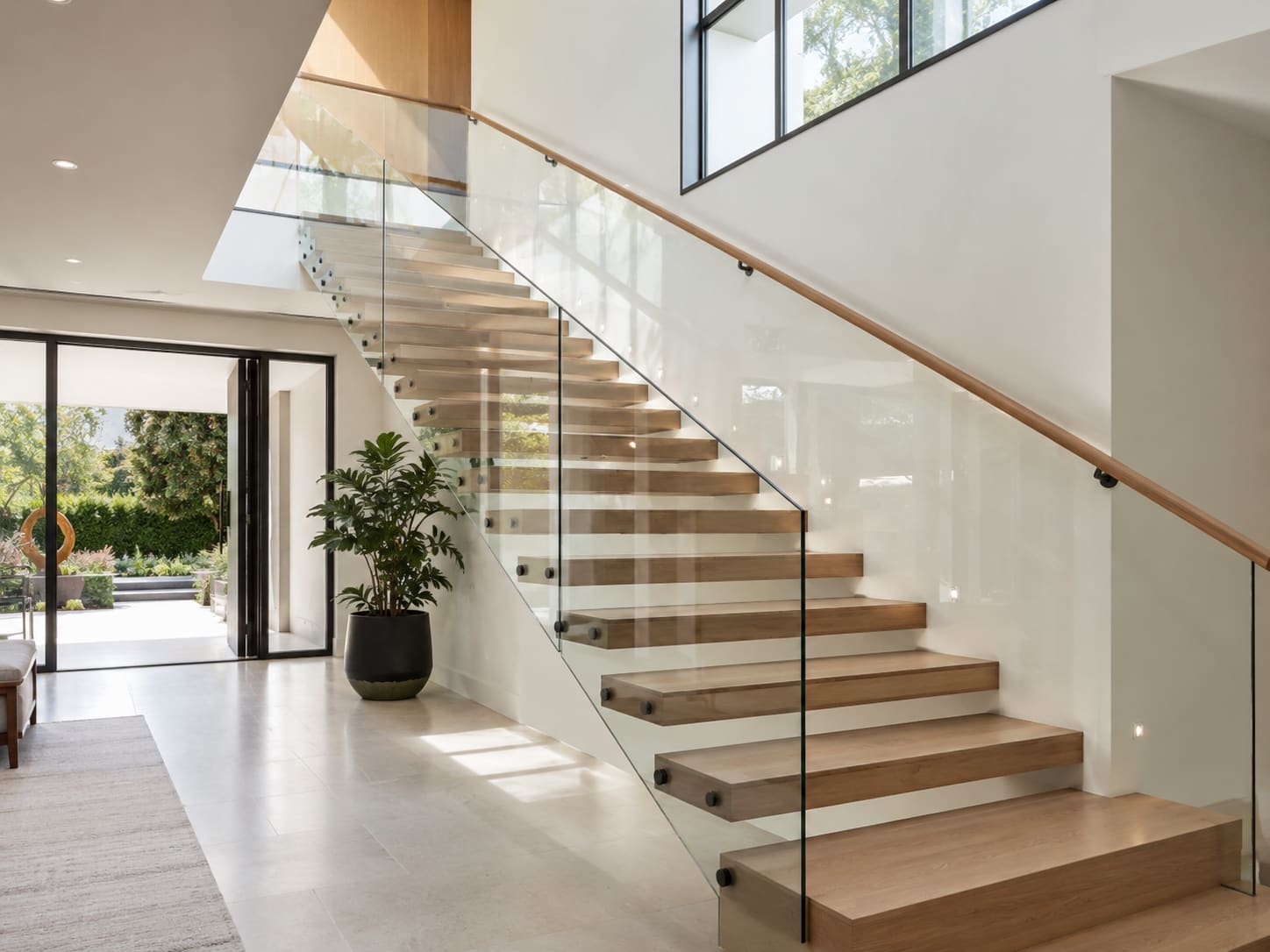
Staircase glass railing cost in Hyderabad ranges from Rs 550 to Rs 2,200 per square foot installed, depending on the glass thickness, the fixing system and the grade of stainless steel or aluminium hardware you choose. A budget framed railing sits at the lower end, while a fully frameless base-channel balustrade with 12mm toughened glass and SS316 hardware sits at the top. For a standard residential staircase of about 140 square feet, that translates to roughly Rs 1.6 lakh to Rs 2.4 lakh for a mid-range frameless job.
At Hakimi Aluminium and Glass we quote and install hundreds of staircase railings every year for villas, duplexes, penthouses and commercial interiors across Gachibowli, Kokapet, Madhapur, Hitec City, Kondapur, the Financial District and greater Secunderabad. This guide breaks down exactly what you pay for so you can read any quotation with confidence.
The wide price gap catches most homeowners off guard, but it is rarely about profit margin. It comes down to concrete, checkable variables: glass thickness, whether the glass is plain or laminated toughened, the fixing method, the steel grade and site complexity. Once you understand those five levers you can compare quotes accurately and avoid the two common traps: overpaying for hardware you do not need, or under-speccing glass that fails safety norms.
Staircase Glass Railing Cost Per Square Foot in 2026
Pricing is almost always calculated on the visible glass area, meaning the running length of the staircase multiplied by the railing height. Here are the realistic installed ranges we see across the Hyderabad market in 2026:
- Framed glass railing (aluminium or MS top and bottom channel): Rs 550 to Rs 900 per sq ft
- Standoff / patch-fitting glass railing: Rs 900 to Rs 1,400 per sq ft
- Spigot-mounted frameless railing: Rs 1,100 to Rs 1,700 per sq ft
- Base channel (U-profile) frameless railing: Rs 1,400 to Rs 2,200 per sq ft
A typical residential staircase with around 40 running feet of railing at 3.5 ft height works out to roughly 140 sq ft. So a mid-range frameless job commonly lands between Rs 1.6 lakh and Rs 2.4 lakh, while the same run as a budget framed railing might be closer to Rs 90,000 to Rs 1.2 lakh. If you are weighing options across the whole floor, our staircase glass railing team can price framed and frameless side by side so you see the trade-off clearly.
What Actually Drives the Price?
Two quotes for the same staircase can differ by 40 percent, and the difference is almost always in the specification rather than the markup. These are the real cost levers, in order of impact:
- Glass thickness and type: 12mm toughened is standard for frameless work. Stepping up to 13.52mm toughened laminated (safer, holds together with no shatter fall-out) adds roughly Rs 250 to Rs 400 per sq ft.
- Fixing system: spigots and base channels carry far more machined hardware than a simple framed channel, so they cost more per foot.
- Hardware grade: SS316 stainless steel resists corrosion far better than SS304 and is worth it near open balconies and monsoon-exposed edges, but it adds around 15 to 20 percent to hardware cost.
- Handrail: an added stainless steel or wooden top handrail runs Rs 350 to Rs 900 per running foot depending on profile and timber.
- Site complexity: curved stringers, non-standard tread angles, floating treads and higher floors all increase labour, wastage and crane or hoisting charges.
If your project pairs a staircase with balcony or landing runs, combining it with our frameless spigot railing work in a single order often reduces the per-foot hardware and mobilisation cost.
Framed vs Frameless: Which System Should You Pick?
For most Hyderabad villas and duplexes, a 12mm toughened spigot or base-channel railing gives the clean frameless look people want at a sensible price. Frameless systems maximise light and sightlines, which matters on the narrow internal staircases common in Kokapet and Financial District apartments where every foot of perceived space counts.
Framed systems remain the budget-friendly choice for rental properties, back staircases and service areas where appearance matters less. Because the frame carries the load, framed railings can use thinner 8mm to 10mm toughened glass, which is a genuine saving.
- Choose framed if: budget is tight, the staircase is utilitarian, or you want the fastest turnaround.
- Choose spigot if: you want the frameless look with individual glass panels that can be replaced one at a time.
- Choose base channel if: you want the cleanest possible hidden fixing and a continuous glass line, and budget allows.
Our frameless staircase railing options cover all three, and you can see finished installations on our projects page to judge the look before committing.
Glass Thickness and Safety Standards for Staircases
Glass choice is where safety and cost meet, and it is the one area you should never trim to save money. For frameless staircase railings we specify 12mm toughened as the working standard. Toughened (tempered) glass is four to five times stronger than ordinary annealed glass and, if it ever breaks, crumbles into blunt granules rather than dangerous shards.
Where children, elderly family members or heavy daily footfall are involved, we strongly recommend 13.52mm toughened laminated glass. The interlayer holds the pane together even when broken, so a cracked panel stays in place rather than collapsing out of the staircase, an important consideration on an upper flight.
- Insist on a visible IS 2553 or manufacturer toughening stamp on every panel for safety and warranty.
- Ask for a heat-soak-tested option on large panels to minimise the rare risk of spontaneous breakage.
- Confirm edge polishing quality, since exposed frameless edges are both a safety and finish detail.
The same toughening and lamination logic applies to our wider toughened glass work, so the standards we hold on a staircase are the standards we hold on partitions and shopfronts too.
Hardware, Handrails and Finish Options
The metal you cannot always see is a big part of what you pay for. Spigots, patch fittings, base-channel cladding and handrail brackets are the components that hold your safety and your finish together for decades, so grade matters.
SS316 stainless steel is the marine-grade choice and the one we default to for anything near an open edge, a balcony overhang or a monsoon-exposed landing in Hyderabad. SS304 is acceptable for fully internal, dry staircases and costs less. The visible tea-staining and rust spotting you sometimes see on older railings is almost always SS304 used where SS316 was needed.
- Handrail options: brushed stainless steel (durable, modern), wooden top rail (warm, premium), or no handrail for a pure minimalist glass line where code permits.
- Finish options: mirror-polish, satin/brushed, matte black powder-coat and champagne or rose-gold PVD tints are all available.
- Standoff caps and patch fittings can be matched to door hardware for a coordinated interior.
If you are coordinating a wood-topped look, our wood handrail glass railing combinations pair a warm timber rail with a frameless glass infill, which is a popular choice in Jubilee Hills and Kokapet villa interiors.
Why Hyderabad's Climate Changes the Spec
Telangana's climate is harder on railings than people expect, and specifying for it up front saves money over the life of the staircase. Long summers push interior surfaces hot, the monsoon brings sustained humidity, and the region's fine construction dust settles into every joint and fixing.
That combination is exactly why hardware grade matters. On staircases that sit near open atriums, courtyards or balcony openings, dust plus monsoon moisture accelerates corrosion on lesser steel. SS316 fittings and proper sealing at the base channel keep the railing looking new for years rather than months.
Dust also affects how a frameless railing looks day to day. Larger glass panels show fewer joint lines where dust collects, which is one practical reason many Hyderabad clients prefer base-channel runs over multi-spigot layouts on prominent staircases. A quick wipe-down routine and a good-quality sealant keep both the glass and the metal presentable through the dusty pre-monsoon months.
The same climate thinking runs through our exterior railings and balcony work, where sun, rain and dust exposure are even more demanding than on an internal flight.
How to Get an Accurate, Itemised Quote
A vague per-square-foot number hides the variables that actually determine your bill. Before you approve any quotation, make sure it spells out the following in writing:
- Glass thickness and whether it is plain or laminated toughened.
- The stainless steel grade (SS304 or SS316) for every fitting.
- Whether the handrail is included, and in what material and finish.
- Whether GST and transport within Hyderabad, Secunderabad or nearby AP towns are included.
- Confirmation that site measurement happens before ordering, since toughened glass cannot be cut or drilled after tempering.
A site visit is the only way to give a firm figure, because tread angles, landing heights and wall conditions all move the number. Hakimi Aluminium and Glass offers free measurement and a written itemised quotation across Hyderabad and Telangana, so you can get a free quote that lists every line rather than a single opaque rate.
Timeline, Installation and Aftercare
From confirmed measurement to installed railing, a standard residential staircase typically takes 7 to 12 working days in Hyderabad. The bulk of that is toughening and, if specified, lamination, because tempered glass must be manufactured to exact final dimensions and cannot be altered afterwards.
Installation itself is usually a one to two day job for a single flight, longer for curved runs or multi-storey atriums that need staged access. A tidy crew will protect treads, drill and anchor base channels or spigots accurately, set the panels, and seal and polish before handover.
- Aftercare is simple: wipe glass with a mild glass cleaner, avoid abrasive pads on brushed steel, and re-check base-channel sealant every couple of years.
- Keep one or two spare panels noted in your file, since matched replacement glass is easiest to source when the original spec is on record.
For larger homes we often combine the staircase with matching glass partitions and interior work so the whole interior reads as one coordinated glass system rather than a set of mismatched jobs.