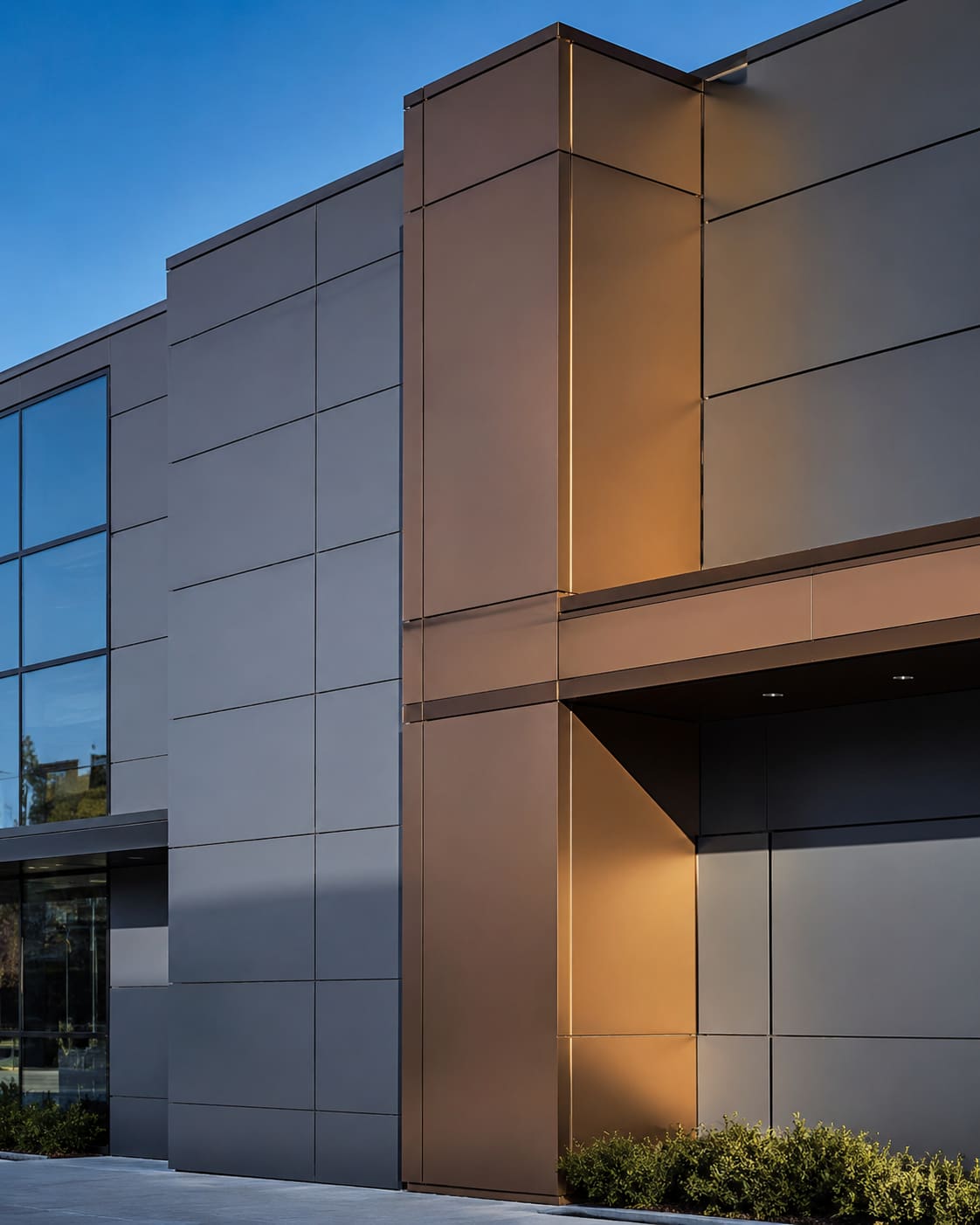
ACP cladding in Banjara Hills, Hyderabad typically costs between Rs 190 and Rs 420 per sq ft installed, with most street-facing PVDF elevations landing at Rs 260 to Rs 420 per sq ft and completing in 7 to 20 working days. Aluminium Composite Panel (ACP) is the default facade skin along Road No. 1 to Road No. 12 because it gives showrooms, clinics, offices and premium homes a crisp, modern face that shrugs off Hyderabad's 40C-plus summers, dry-season dust and heavy monsoon without fading, streaking or warping. Whether you are building a fresh elevation or re-skinning a tired one, our ACP cladding service covers the full scope from site survey and framework fabrication to panel folding and final silicone sealing.
Banjara Hills is one of the most visible commercial and residential belts in Telangana, so a facade here is judged closely by clients, patients, tenants and buyers every day. The gap between a facade that still looks sharp after a decade and one that bulges or de-bonds after two monsoons comes down to three decisions: the panel grade, the framework behind it, and the waterproofing detail at every joint. Getting those right is worth far more than shaving a few rupees off the per-square-foot rate.
This guide breaks down exactly what ACP cladding costs across Hyderabad and Secunderabad in 2026, which grades and brands suit the local climate, how a durable installation is actually executed, the mistakes that cause early failure, and how ACP pairs with glass and aluminium systems. When you are ready to price your own elevation, you can get a free quote with your measurements and finish preferences, or see how these details play out on real facades in our recent projects.
What is ACP cladding and why Banjara Hills uses it
ACP cladding is a facade skin made from Aluminium Composite Panels: two thin aluminium sheets bonded to a mineral or polyethylene core, factory-coated in colour, then grooved, folded and fixed to a metal framework over your building's structure. The result is a lightweight, dead-flat, weatherproof surface that reads as sharp modern architecture without the weight, cost or cracking risk of stone, plaster or paint.
The material suits Banjara Hills for practical reasons, not just looks. It is light enough to hang off an existing wall without heavy structural additions, its factory PVDF coating holds colour through years of harsh sun, and its smooth surface rinses clean of the fine red dust that blows across the twin cities in the dry months. Because panels are fabricated in the workshop and assembled on site, a whole elevation can be transformed in days rather than the weeks a masonry or textured-paint facade would need.
- Lightweight: roughly 5.5 kg per sq m for a 4mm panel, so it loads the structure far less than stone or tile.
- Fast: workshop fabrication plus site fixing means minimal disruption to a running showroom or clinic.
- Versatile: available in solid, metallic, mirror, wooden and stone finishes, and can wrap curves, fins, parapets and signage grooves.
- Weather-tough: a correctly detailed ACP facade sheds monsoon water and resists UV where paint would fade and plaster would crack.
ACP cladding cost in Banjara Hills and the twin cities (2026)
Installed ACP cladding in Banjara Hills ranges from Rs 190 to Rs 420 per sq ft in 2026, and the biggest cost drivers are the panel brand, the coating type and the framework behind it. Pricing across Hyderabad and Secunderabad is broadly similar, with premium localities like Jubilee Hills, Banjara Hills and the Financial District sitting at the upper end because design expectations and signage complexity are higher.
- Economy PE-coated ACP: Rs 190 to Rs 240 per sq ft installed, suited to boundary walls, parking facades, rear elevations and tight-budget jobs.
- Premium PVDF-coated ACP (Alstrong, Aludecor, Eurobond, Alucobond): Rs 260 to Rs 420 per sq ft installed, the correct choice for street-facing elevations in Banjara Hills.
- Framework: a GI or aluminium tube sub-frame adds Rs 40 to Rs 90 per sq ft, and this line item is never the place to economise.
- Design extras: LED-lit signage grooves, mirror or wooden-finish panels, curved corners and standoff fins add 10 to 25 percent.
For a typical 1,200 sq ft showroom front on Road No. 12, budget roughly Rs 3.5 to Rs 5 lakh for a quality PVDF installation. Quantities are almost always measured on the developed surface area, which counts grooves, returns, soffits and reveals, not just the flat street face you see from the road. This is why a rough square-foot guess often lands 15 to 20 percent under the real number, and why a measured estimate from a facade contractor is worth insisting on before you commit.
Choosing the right ACP grade for Hyderabad's climate
For Banjara Hills facades, choose a 4mm PVDF-coated panel with a 0.25mm to 0.30mm aluminium skin, because PVDF (polyvinylidene fluoride) resists UV fading through Hyderabad's 40C-plus summers and repels monsoon moisture far better than cheaper PE coatings. PE (polyester) panels are acceptable indoors or in shaded, protected areas, but on a sun-hit street elevation across Telangana they chalk and lose colour within a few years.
- Panel thickness: 4mm is the standard for exteriors; 3mm is only for interiors or fully protected zones.
- Skin thickness: insist on 0.25mm or higher aluminium skin so the panel stays rigid and does not oil-can (ripple) in the heat. Many cheap panels use a 0.10mm to 0.18mm skin that visibly waves on a hot afternoon.
- Fire rating: for tall buildings, hospitals, malls and other public occupancies, specify FR (fire-retardant) A2-core panels to meet fire-safety norms.
- Colour and finish: solid, metallic, wooden and stone finishes all hold up; darker shades absorb more heat, so pair them with a ventilated air gap behind the panels.
Because dust settles on every surface in the dry season, a smooth PVDF face that rinses clean in the first rains is a genuine practical advantage in the twin cities. If you are unsure which grade fits your building height, orientation and budget, a quick look at our services or a photo of your elevation is enough for us to recommend a specification.
How a proper ACP installation is executed
A durable ACP installation starts with a rigid, plumb aluminium or GI framework anchored to the structure, followed by grooved panels fixed with both structural adhesive and mechanical fasteners, and finished with weatherproof silicone joints and flashings. Skipping the framework or relying on adhesive alone is the single most common reason facades fail in the Hyderabad monsoon.
- Step 1: Survey and measure the elevation, then fabricate a sub-frame of aluminium or GI tubes, typically at 600mm centres.
- Step 2: Fix the framework true to line and level, leaving a ventilated air gap behind the panels so trapped moisture can escape.
- Step 3: Groove and fold panels in the workshop for clean edges, consistent shadow lines and tight tolerances.
- Step 4: Mount panels with a combination of structural adhesive and rivets or screws, never adhesive alone.
- Step 5: Seal every joint with weatherproof structural silicone and detail flashings so monsoon water sheds away from the wall, not behind the panels.
A 1,000 to 1,500 sq ft facade in Banjara Hills usually takes 7 to 15 working days once material is on site, with larger, curved or signage-heavy elevations running longer. The quality of the sub-frame anchoring, fastener spacing and silicone workmanship is what separates a facade that survives a decade from one that streaks in its first year, which is exactly why the framework should never be value-engineered out of a quote.
Pros and cons of ACP cladding
ACP is the right facade material for most Banjara Hills projects, but it is worth understanding its limits before you commit, because the trade-offs decide where it should and should not be used on your building.
Advantages:
- Clean, modern, dead-flat finish that instantly modernises an older elevation.
- Wide range of colours and finishes, including metallic, mirror, wood and stone effects.
- Lightweight and fast to install, with minimal structural loading and short site time.
- Weather-resistant and low-maintenance when PVDF-grade panels and a proper framework are used.
Limitations to plan around:
- Quality depends entirely on specification and workmanship; a cheap panel or missing sub-frame fails fast.
- Polyethylene-core panels carry fire risk, so FR A2-core panels are essential on tall or public buildings.
- Poorly sealed joints let water behind the skin, causing bulging and de-bonding that is expensive to fix.
- Not a structural or waterproofing layer in itself; it must sit over a sound, watertight wall.
Common mistakes to avoid on a Banjara Hills facade
Most ACP failures in the twin cities trace back to a handful of avoidable shortcuts, and every one of them is cheaper to prevent than to repair. Knowing them lets you challenge a suspiciously low quote before it becomes your problem.
- Buying "ACP" without a spec: always get the brand, grade, thickness and coating in writing, not just the word ACP on a quotation.
- Skipping or under-building the framework: fixing panels straight onto an uneven wall guarantees ripples and early joint failure.
- Adhesive-only fixing: without mechanical fasteners, panels can creep or peel in the heat, especially on west-facing walls.
- Wrong coating for the exposure: using PE panels on a full-sun street elevation to save money leads to fading within a few years.
- Poor joint sealing and no flashings: this is how monsoon water gets behind the skin and causes de-bonding.
- No 3D preview before fabrication: approving colours and groove lines only after panels are cut leads to costly on-site rework. A rendered 3D elevation design removes that guesswork entirely.
ACP for showrooms, clinics, offices and homes
The best ACP specification depends on how the building is used, because a retail showroom, a diagnostic clinic and a private residence each judge a facade by different standards. Banjara Hills has all three within a few hundred metres, so a one-size brief rarely fits.
- Showrooms and retail: bold metallic or brand-colour PVDF panels with recessed LED signage grooves, where the facade itself is the advertisement.
- Clinics and diagnostic centres: clean white, grey or wood-tone panels that read as trustworthy and wash down easily between monsoons.
- Corporate offices: large-format grey and champagne panels, often combined with glazing for a corporate-campus look.
- Premium homes and villas: wooden-finish and stone-finish ACP on porches, parapets and compound gates, frequently mixed with real material accents.
For any of these, having a designer render the elevation before fabrication lets the owner approve colours, groove lines and signage placement upfront, and it is the cheapest insurance against the on-site changes that blow budgets. It also makes comparing quotes fairer, because every contractor is pricing the same agreed design.
Maintenance and lifespan in the twin cities
Quality PVDF ACP cladding in Banjara Hills lasts 12 to 20 years with almost no maintenance beyond an occasional wash, while cheap PE panels often need attention within 4 to 6 years. The main enemies here are trapped monsoon water, UV on south and west faces, and dust build-up in the grooves.
- Rinse the facade once or twice a year, ideally before and after the monsoon, using water and a mild detergent.
- Inspect silicone joints every couple of years and re-seal any that have cracked or shrunk.
- Avoid abrasive scrubbers and harsh solvents, which strip the PVDF coating.
- Fix any lifting panel or open joint promptly, because water ingress behind ACP is what causes bulging and de-bonding.
The simplicity of this upkeep is itself an argument for spending on grade and framework at the start. A Rs 300 per sq ft PVDF facade that needs only an annual hose-down comfortably beats a Rs 200 per sq ft PE facade that has to be re-skinned in five years, once you count the second job, the scaffolding and the disruption to a working premises.
Choosing an ACP contractor in Hyderabad and Secunderabad
Choose an ACP contractor in Hyderabad who fabricates a proper framework, uses branded PVDF panels and can show you finished facades that have survived at least two monsoons. The market has a wide quality spread, from professional facade specialists to labour-rate operators who skip the sub-frame, so the cheapest quote is often the most expensive over the life of the building.
- Ask for the exact panel brand, grade, thickness and coating in writing, not just "ACP".
- Confirm the framework material and centres; a GI or aluminium tube frame at 600mm is the durable standard.
- Check that mechanical fixing plus adhesive is used, and that joints are sealed with structural silicone and proper flashings.
- See recent completed work in Banjara Hills, Jubilee Hills or Secunderabad and ask how it has weathered.
As a facade and glass specialist serving Hyderabad, Secunderabad, Telangana and nearby Andhra Pradesh, Hakimi Aluminium and Glass supplies the panels, fabricates the framework and coordinates the glazing and hardware that finish the job. If you want a design-led approach, we can start with a 3D elevation and facade design so you see the finished frontage before a single sheet is cut, then move straight into supply and installation through our ACP cladding service. When you are ready, get a free quote with your measurements and we will return a specified, itemised estimate.