The best glass for building facades in Hyderabad is solar-control low-E glass or a double-glazed unit (DGU) with a low-E coating, because both reflect the intense heat of the Deccan sun while letting daylight through. In a city where summer temperatures cross 42 C and air-conditioning dominates the electricity bill, the glass specification you choose is the single biggest factor in how comfortable and how cheap your building is to run.
Get it right and interiors stay cool, glare disappears, and cooling loads drop by 25-40% on sun-facing elevations. Get it wrong - with plain float or a cheap tinted sheet - and the building behaves like a greenhouse, forcing the HVAC system to work overtime year-round. This guide breaks down every facade glass type, realistic INR pricing for Hyderabad, the specs that actually matter (SHGC, VLT, U-value), and how to choose the right glass for each face of your building.
Whether you are a builder in Gachibowli, an architect in Banjara Hills, or a homeowner in Secunderabad planning a glass elevation, use this as your specification checklist before you approve a single sheet. If you would rather have the numbers run for your specific project, you can always get a free quote from our team.
Why Facade Glass Choice Matters More in Hyderabad
Hyderabad and the wider Telangana region sit on the Deccan Plateau with long, intense summers, high solar radiation, and a cooling-dominated climate. Unlike coastal cities, the challenge here is not humidity but raw radiant heat and glare from a sun that stays high and bright for most of the year. A glass facade is essentially a large solar collector - if the glass does not reject heat, that energy pours straight into your interiors.
The consequence shows up on the electricity bill. In a typical air-conditioned office in HITEC City or Financial District, the facade can account for 30-50% of the total cooling load. Specifying high-performance glass facade work instead of ordinary glazing is therefore one of the fastest-paying upgrades in the entire building - the premium is often recovered in 3-5 years through lower running costs.
There is also a comfort and productivity angle. Glare on screens, hot spots near windows, and uneven temperatures all trace back to poor glass selection. The correct specification delivers even daylight without the heat, which is exactly what solar-control coatings are engineered to do.
The Main Facade Glass Types Compared
There is no single best glass for every building - the right answer depends on orientation, budget, and whether the space is air-conditioned. Here are the options that perform in Hyderabad's climate:
- Solar-control (low-E) glass: A microscopically thin metallic-oxide coating reflects infrared heat and blocks UV while allowing visible light through. This is the workhorse for hot-climate facades and offers the best balance of heat rejection, clarity, and cost.
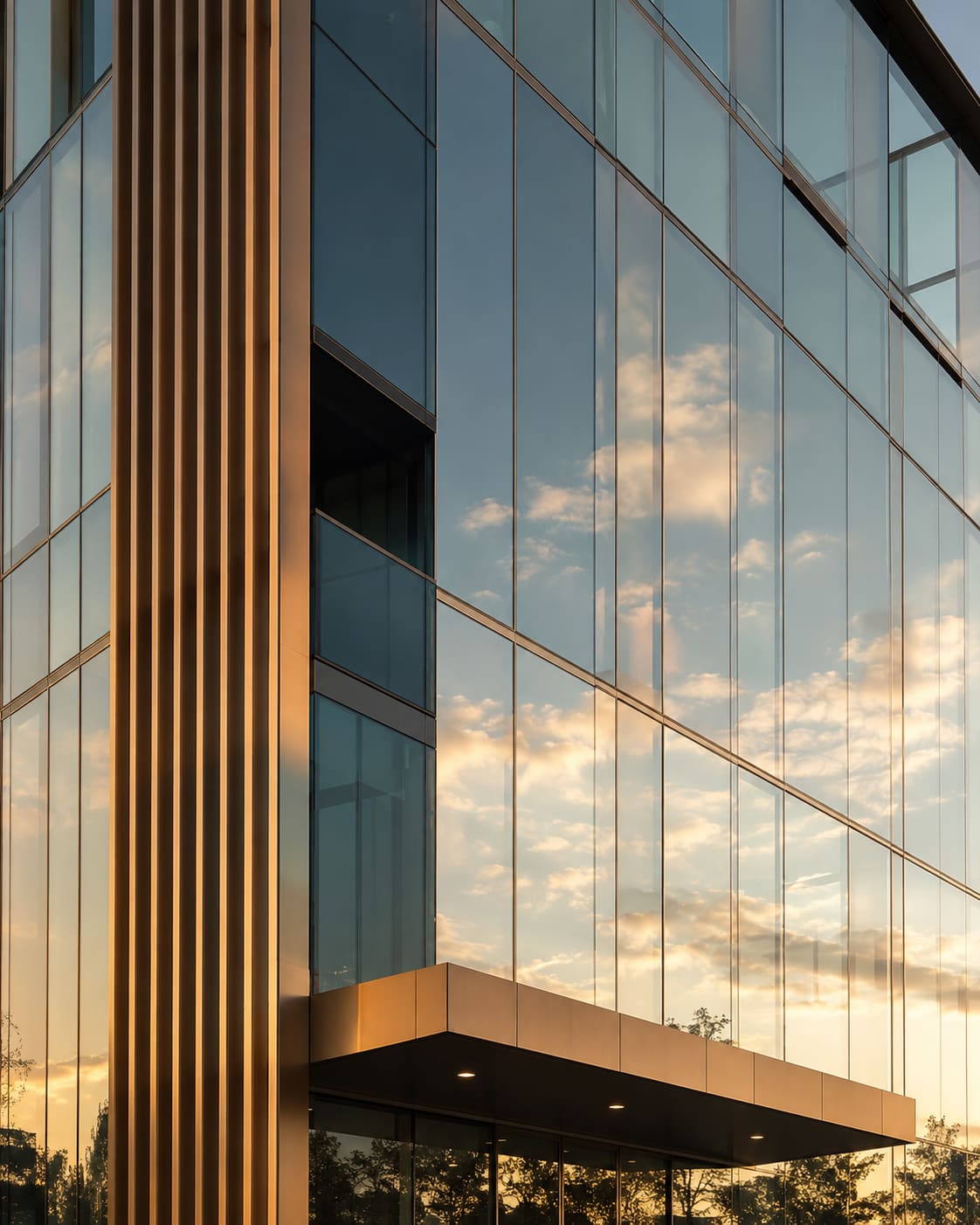
- Reflective glass: A tinted, mirror-finish coating that strongly reduces heat gain and adds daytime privacy. Popular for commercial towers, though it can look dated and reflects heat onto neighbours if overused.
- Double-glazed units (DGU): Two glass panes with a sealed, spacer-separated air or argon gap. Add a low-E coating on the inner face and you get the best possible thermal and acoustic performance - ideal for premium offices and buildings near traffic noise.
- Heat-absorbing tinted glass: Body-tinted (grey, green, blue, bronze) float that absorbs some solar energy. Cheapest option but re-radiates absorbed heat inward, so it is far weaker than coated glass.
- Toughened / laminated safety glass: Not a performance category on its own, but every facade sheet should be toughened or heat-strengthened, and often laminated, for safety and to resist thermal-stress cracking under the Deccan sun.
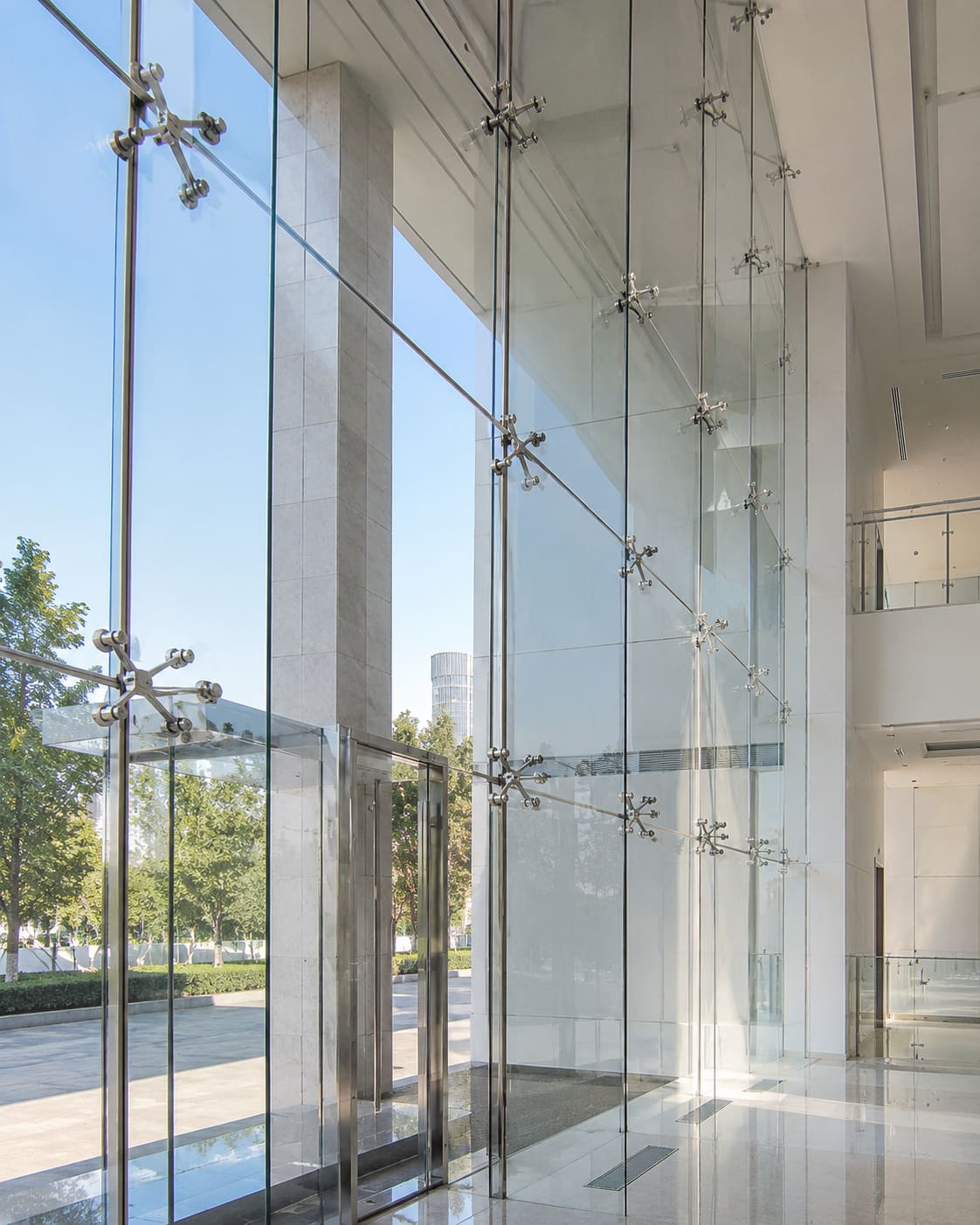
For most Hyderabad projects the sweet spot is toughened solar-control glass for single glazing, or a low-E DGU where budget and energy targets justify it. Our structural glazing systems are typically built around exactly these glass make-ups.
The Specs That Actually Matter: SHGC, VLT and U-Value
Salespeople quote brand names; engineers quote numbers. These three figures tell you whether a glass will actually perform in Hyderabad:
- SHGC (Solar Heat Gain Coefficient): The fraction of solar heat that passes through, from 0 to 1. Lower is better in a hot climate. Target 0.25-0.35 for west and south facades; up to 0.40 is acceptable on shaded or north elevations.
- VLT (Visible Light Transmission): The percentage of daylight let through. Aim for 40-60% for comfortable, glare-free daylight without needing lights on all day. Very low VLT looks dark and forces artificial lighting.
- U-value: The rate of heat conduction. It matters most for DGUs and air-conditioned buildings - a low-E DGU can hit a U-value around 1.6-1.8 W/sq.m.K versus roughly 5.7 for single glazing.
A useful shortcut is the Light-to-Solar-Gain ratio (VLT divided by SHGC). A ratio above 1.25 means the glass is efficient - it delivers plenty of daylight for each unit of heat it lets in. Ask every supplier for the full performance data sheet, not just the tint colour. If a vendor cannot give you SHGC and VLT figures, treat that as a red flag.
Facade Glass Prices in Hyderabad (Indicative INR)
Pricing varies with brand (Saint-Gobain, AIS, Guardian, Sisecam), coating type, thickness, and toughening. The ranges below are indicative supply rates for Hyderabad and Telangana as of 2026 and exclude framing, structural systems, and installation:
- Body-tinted / heat-absorbing glass (6-8 mm, toughened): Rs 120-200 per sq ft.
- Reflective toughened glass (6-8 mm): Rs 160-280 per sq ft.
- Solar-control low-E single glass (toughened): Rs 180-350 per sq ft.
- Standard DGU (clear + solar-control, toughened): Rs 350-550 per sq ft.
- High-performance low-E DGU (double silver/argon-filled): Rs 500-750 per sq ft.
- Laminated + DGU acoustic units: Rs 700-1,100 per sq ft.
Installed facade cost is a different number. Once you add the aluminium framing, structural sealant, hardware, and labour, a complete curtain wall glazing system typically lands at Rs 750-1,800 per sq ft depending on the framing system and glass grade. For a realistic figure on your building, ask for a measured quotation rather than relying on rate cards, and browse our recent projects to see comparable specifications in practice.
How to Choose Glass for Each Elevation
The single most common mistake is wrapping an entire building in one glass. In Hyderabad, each face of the building sees the sun very differently, and the specification should follow:
- West facade: Takes the brutal low-angle afternoon sun and the highest heat load. Use the most aggressive solar control - low SHGC (0.25 or below), ideally a DGU, plus external shading or fins where possible.
- South facade: High sun exposure most of the year; specify solar-control low-E with SHGC around 0.30. Horizontal shading devices are very effective here.
- East facade: Morning sun, moderate load. Solar-control glass with SHGC 0.30-0.35 works well.
- North facade: Least direct sun. You can relax to SHGC up to 0.40 and prioritise higher VLT for good daylight, saving cost.
Also weigh appearance, daylight, and acoustics together. Buildings near busy corridors like the ORR, Mehdipatnam, or the airport road benefit from laminated DGUs for noise control. A competent facade contractor tunes the glass per elevation rather than selling a one-size-fits-all sheet - that per-face optimisation is where the real energy savings live. Explore the full range of options across our services to see how glass pairs with the right framing system.
Pros and Cons of High-Performance Facade Glass
It helps to be clear-eyed about the trade-offs before you commit budget:
- Pro: Dramatically lower cooling loads and electricity bills - often 25-40% on sun-facing facades.
- Pro: Better occupant comfort, no hot spots, reduced glare on screens.
- Pro: DGUs add acoustic insulation and reduce condensation risk.
- Pro: Modern coatings keep interiors bright, so you rely less on artificial lighting.
- Con: Higher upfront cost - a good DGU can be 2-3x the price of plain tinted glass.
- Con: Coated and double-glazed units are heavier, needing stronger framing and structural design.
- Con: Repairs and replacements of sealed DGUs take longer and cost more than single glass.
For most air-conditioned commercial buildings in Telangana and Andhra Pradesh, the energy savings comfortably outweigh the premium over a 5-year horizon. For unconditioned or partly shaded spaces, a well-chosen single solar-control glass is often the smarter spend.
Common Mistakes to Avoid
Even good buildings get let down by avoidable glass errors. Watch for these:
- Choosing glass by tint colour alone instead of SHGC and VLT numbers.
- Using untoughened or unsuitable glass, which can crack from thermal stress under direct sun.
- Specifying very dark, low-VLT glass that saves heat but forces lights on all day, cancelling the benefit.
- Wrapping every elevation in the same glass regardless of orientation.
- Ignoring the framing thermal bridge - a great glass in a poor aluminium system underperforms; the frame and thermal break matter too.
- Buying on lowest quote without a performance data sheet or proper warranty on the coating and edge seals.
A trustworthy fabricator will insist on toughening safety glass, provide the manufacturer's performance certificate, and warranty the DGU edge seal (typically 5-10 years). If any of those are missing, keep looking.
Process and Timeline for a Glass Facade
A well-run facade project in Hyderabad moves through predictable stages. Knowing them helps you plan and spot delays early:
- Survey and design (1-2 weeks): Site measurement, elevation analysis, glass and framing specification per face.
- Quotation and approval (3-7 days): Detailed measured estimate, glass performance sheets, and sample approval.
- Fabrication and glass ordering (2-4 weeks): Toughening, coating, and DGU assembly; coated glass often comes from Saint-Gobain or AIS plants.
- Installation (2-6 weeks): Depends on facade area, framing system, and building height; structural glazing needs curing time for structural sealant.
- Handover and cleaning (2-3 days): Final sealing checks, water-tightness testing, and cleaning.
For a typical mid-rise commercial facade, budget roughly 6-12 weeks end to end. Rains during the monsoon can slow external work, so schedule accordingly. Serving Hyderabad, Secunderabad, and across Telangana and Andhra Pradesh, our team handles specification-to-handover so you get glass matched to each elevation rather than a compromise sheet.