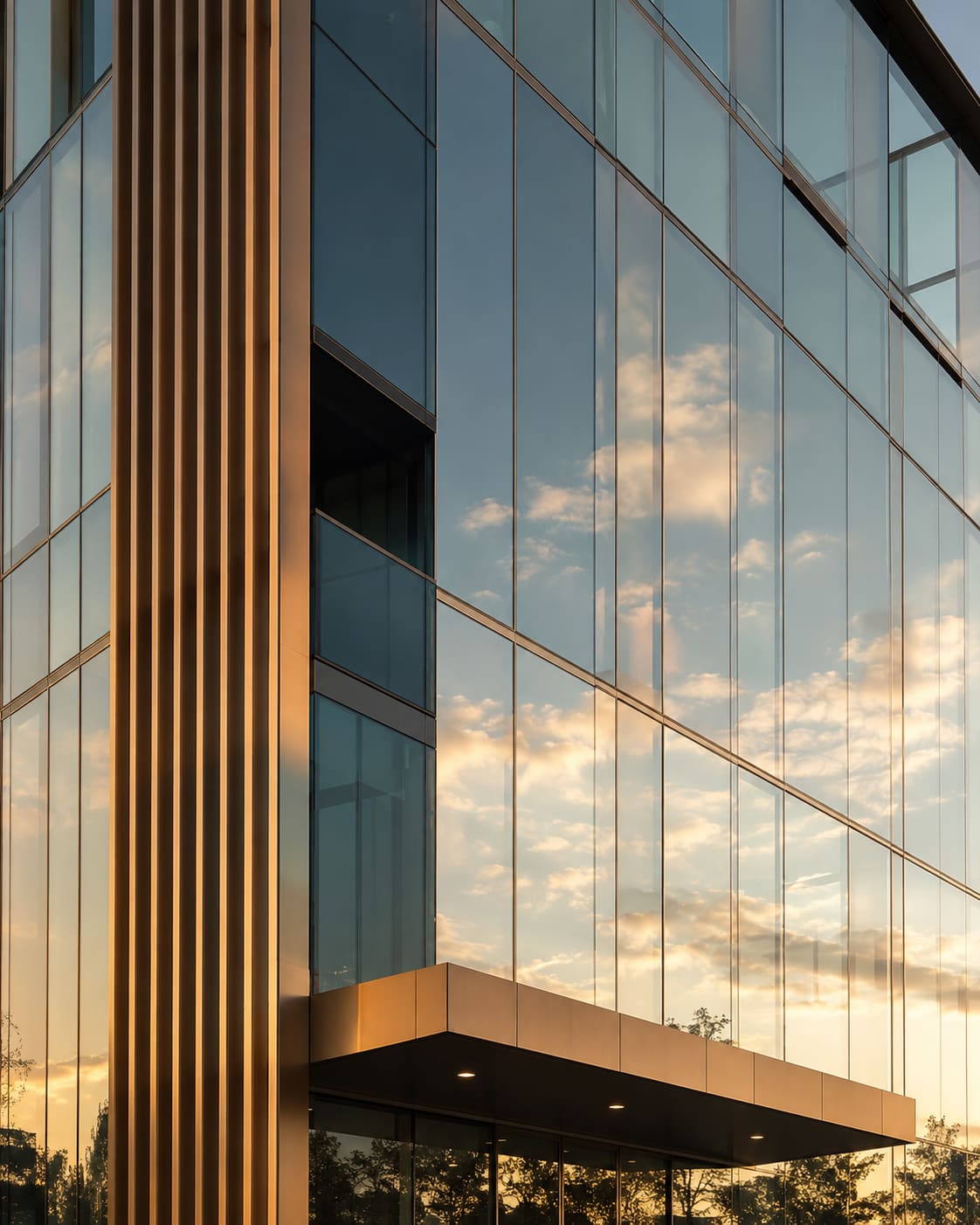
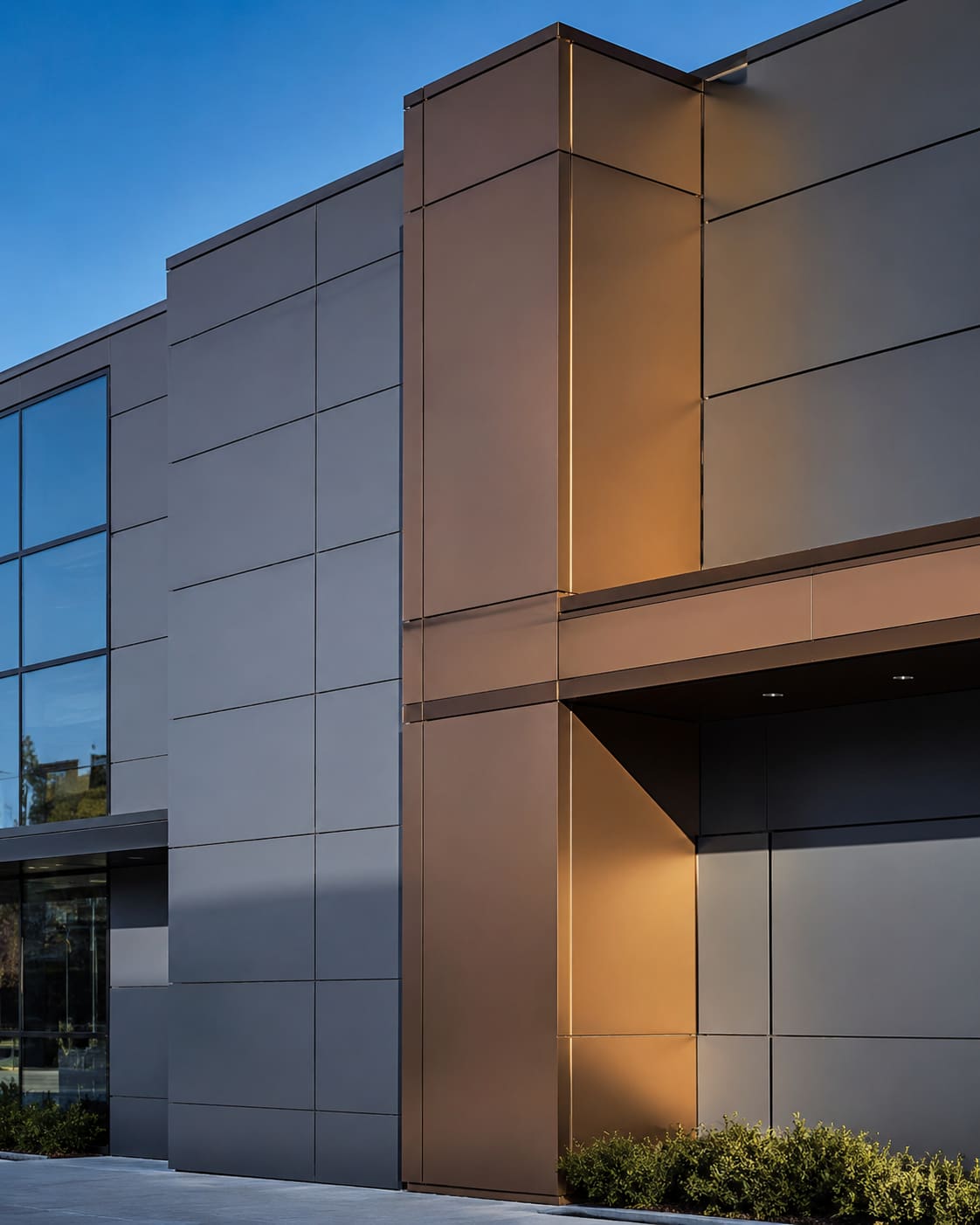
ACP cladding in Guntur costs roughly INR 160 to 450 per square foot fully installed, and it is the fastest, most cost-effective way to give a showroom, office block or commercial building a clean, modern and weather-resistant facade. Aluminium Composite Panels bond two thin aluminium skins to a polyethylene or fire-retardant core, producing a flat, rigid, lightweight surface that stays sharp for 15 to 20 years with minimal upkeep. That combination of premium looks, low weight and quick fitment is why ACP has become the default choice for retail frontages and corporate elevations across Guntur, Vijayawada and the wider Andhra Pradesh commercial corridor.
Guntur's climate, however, is unusually harsh on building exteriors. Long, dry summers that push past 42 degrees Celsius, intense UV, monsoon downpours and the salt-laden air drifting in from the coastal Andhra belt all accelerate fading, corrosion and delamination on low-grade panels. Getting the panel grade, coating and installation method right the first time matters far more here than in milder inland regions, and the gap between a cheap job and a durable one only becomes visible two or three summers later.
Whether you are re-cladding an ageing building near Brodipet or fitting out a new complex on the Guntur-Vijayawada highway, the same principles apply. We handle full ACP cladding and 3D elevation work across Telangana and Andhra Pradesh using branded panels and hardware, so the guidance below reflects real project experience rather than catalogue theory. This guide walks through panel types, honest pricing, the sub-frame that actually holds a facade together, weather design, maintenance and how to hire well.
What Is ACP Cladding and Why It Suits Guntur
ACP cladding is an external facade system built from Aluminium Composite Panels: two 0.5mm aluminium sheets sandwiching a plastic or mineral core, fixed onto a lightweight aluminium sub-frame to form a flat, uniform skin over a building. It is popular in Guntur because it delivers a premium, seamless elevation without the weight, cost or slow installation of stone, brick or heavy glazing. Each panel weighs only 5 to 8 kg per square metre, so it adds negligible load to the structure and can be retrofitted onto existing buildings.
Panels can be routed, folded and curved into signage boxes, canopies, parapet caps and column covers, giving architects freedom that flat sheet materials cannot match. This is why ACP pairs so naturally with feature elevation design and why it is the workhorse behind most modern commercial 3D elevation work in the region. For Guntur's specific conditions, the advantages stack up quickly:
- UV-stable PVDF coatings resist the harsh Andhra sun and hold colour for 10 to 15 years with minimal chalking
- Ventilated, water-tight joint systems shed heavy monsoon rain and stop water tracking behind the facade
- The smooth surface wipes clean, so roadside dust and pollution do not stain the elevation permanently
- Fast dry-fixing on a metal sub-frame minimises on-site disruption for running shops and offices
- Individual panels can be swapped years later without dismantling the whole elevation
That last point matters for busy commercial frontages where downtime costs money. A dented or damaged section can be replaced in a day rather than triggering a full re-clad, which is a real cost advantage over monolithic finishes like plaster or stone.
Panel Types: PE, FR and A2 Cores Compared
Not all ACP is the same, and the grade you choose decides both durability and price. The two variables that matter most are the core material, which governs fire behaviour, and the surface coating, which governs weather resistance.
- PE (polyethylene) core: the economical choice for low-rise shops, boundary walls, signage and interior cladding where fire codes are relaxed
- FR (fire-retardant) core: a mineral-filled core recommended for tall buildings, hospitals, schools and anywhere a fire rating is required
- A2 non-combustible core: the highest fire-safety tier, increasingly specified for large commercial and institutional facades
On coatings, the distinction is just as important. PVDF (polyvinylidene fluoride, often sold as Kynar 500) is a fluorocarbon finish that survives intense sunlight, while cheaper PE paint or basic polyester will chalk and fade within a couple of Guntur summers. For any exterior facade, insist on genuine PVDF; the difference in panel cost is small, but the difference in how the building ages is dramatic. Interior-only areas, back elevations and short-life signage can sensibly use polyester-coated PE core to save money.
Reputable brands available through the Hyderabad, Secunderabad and Vijayawada supply chain include Alstrong, Aludecor, Eurobond, Alstone and Viva. Finishes range from solids and metallics to timber, marble, mirror and brushed textures, so you can match a corporate identity or a heritage streetscape without compromising on grade. Ask for the brand's coating warranty document, not just a verbal assurance, because that certificate is what protects you if colour fails early.
Indicative ACP Cladding Prices in Guntur (2026)
ACP cladding in Guntur is usually quoted per square foot of finished facade, including the aluminium sub-frame, fasteners, structural sealant and labour. As an indicative 2026 guide for the Guntur and Andhra Pradesh market:
- Basic PE-core ACP, supply and installation: around INR 160 to 220 per sq ft
- PVDF-coated PE core, fully installed: around INR 220 to 300 per sq ft
- FR-core PVDF panels, fully installed: around INR 300 to 420 per sq ft
- A2 non-combustible grade, fully installed: INR 450 and above per sq ft
Material alone, meaning the panel only, typically runs INR 90 to 250 per sq ft depending on grade, with the balance covering framework, consumables and skilled labour. Several factors then push a quote up or down:
- Panel thickness: 4mm is standard for exteriors; 3mm suits interiors and signage at a lower rate
- Elevation complexity: grooves, curves, LED-lit signage and 3D box work add 15 to 40 percent
- Height and access: upper floors needing scaffolding or suspended cradles raise labour cost
- Order size: larger areas dilute fixed costs and attract better per-sq-ft pricing
Always get a written quote that specifies the brand, coating type, core grade, panel thickness and framework specification so you compare like for like. A quote that only says 'ACP at INR 190' tells you nothing about what is actually going on the wall, and it is the most common way buyers get a substandard panel at a good-panel price. You can browse our services for scope, look at our recent projects for real finished elevations, or get a free quote for a line-itemised estimate tailored to your building area in square feet.
The Sub-Frame and Hardware That Hold a Facade Together
The panel is only half the job; the aluminium sub-frame and the fixings are what keep a facade flat, sealed and safe for two decades. Most facade failures in the region, such as bowing panels, oil-canning, water ingress and rattling in wind, trace back to a weak or poorly aligned grid rather than the panel itself. Industry experience puts up to 80 percent of premature failures down to framing and sealing rather than the ACP sheet.
A durable ACP system relies on a properly engineered support layer:
- A true, plumb aluminium grid of vertical and horizontal members anchored to the structure at correct centres, typically 600mm or less
- Correct expansion gaps sized for Guntur's heat so panels can move without buckling
- Genuine structural silicone and closed-cell backer rod at every joint for a weatherproof, ventilated seal
- Stainless or coated fasteners that will not bleed rust streaks down the elevation
Insist on aluminium framing rather than timber battens or mild-steel angles. Timber warps and rots in monsoon humidity, and untreated steel corrodes in the salty coastal air, both of which telegraph through the finished panels within a few years. Where a facade combines cladding with entrances, shutters and glazed shopfronts, coordinate the ACP cladding with those systems early so the sub-frame, thresholds and glazing lines all meet cleanly. Getting this interface right is the difference between a facade that merely looks good on handover and one that still performs a decade on.
Designing for Weather, Corrosion and Coastal Andhra Conditions
Guntur sits close enough to the Bay of Bengal that salt-laden air is a genuine corrosion factor, and inland heat compounds the challenge. Designing for these conditions is not optional if you want the facade to age gracefully rather than streak, fade and lift.
Key weather-driven decisions include:
- Coating: PVDF is essential; it resists UV, salt spray and industrial pollution far better than PE or polyester finishes
- Drainage: an open-joint or rear-ventilated system lets wind-driven rain drain and dry rather than pooling behind panels
- Metals: aluminium sub-frames and stainless fasteners avoid the galvanic corrosion that mild steel suffers in humid, salty air
- Colour choice: mid-tones and metallics hide dust better than pure white in a high-dust roadside environment
During peak summer, surface temperatures on a south or west elevation can climb well above 60 degrees Celsius. This is why expansion allowance and a floating fixing detail are critical: panels that are pinned too tightly will oil-can and distort as they expand and contract each day. A cladding contractor who understands Andhra Pradesh conditions will design joint width and fixing method around this thermal movement from the outset, and will orient the panel grain and colour to suit each elevation's exposure.
Installation Process and Timeline
A well-run ACP cladding project in Guntur follows a predictable sequence, and knowing it helps you spot corners being cut. A typical commercial frontage of 2,000 to 4,000 sq ft takes roughly two to four weeks depending on complexity, height and weather.
- Survey and measurement: the existing wall is checked for plumb and the elevation is measured for an accurate panel layout
- Design and shop drawings: panel joints, groove lines, signage cut-outs and 3D features are drawn before anything is ordered
- Sub-frame erection: the aluminium grid is anchored, aligned true and checked for level across the whole face
- Panel fabrication: sheets are routed, folded into trays and edge-prepared, usually in a workshop for accuracy
- Fixing and sealing: trays are fixed to the grid, then joints are backer-rodded and sealed with structural silicone
- Cleaning and handover: the protective film is peeled, the facade is washed and any snags are corrected
Weather delays are common during the monsoon because sealant needs a dry, clean joint to bond properly, so plan exterior work around the season where you can. If your project also involves feature elevations, coordinate the ACP with the 3D elevation work at the drawing stage rather than on site, as retro-fitting profiles and light boxes after the grid is up is slow and expensive.
Maintenance, Cleaning and Lifespan
Quality PVDF-coated ACP cladding lasts 15 to 20 years or more in Guntur when installed correctly, and it asks very little in return. Routine care keeps a facade looking new and protects the coating warranty.
- Wash the facade one to two times a year with plain water and a soft cloth or sponge, adding mild pH-neutral detergent for stubborn grime
- Rinse from top to bottom and avoid abrasive pads, wire brushes or strong solvents that scratch or dull the PVDF finish
- Inspect joint sealant every 3 to 5 years and re-seal any sections that have hardened, cracked or pulled away
- Address minor scratches early with a matched touch-up system so bare aluminium is not exposed to salt air
Because individual panels are modular, an accidentally dented or damaged section can be replaced without touching the rest of the elevation. Treated this way, the cost-per-year of a good ACP facade is far lower than the initial sticker price suggests, which is why it remains the value benchmark for commercial buildings across Telangana and Andhra Pradesh. A cheap PE-and-polyester job may look identical on day one but often needs re-cladding in five to seven years, so the apparent saving disappears fast.
Common Mistakes to Avoid
Most disappointing ACP facades in the region come from a handful of avoidable errors, not from the material itself. Watch for these before and during the project:
- Buying on price per square foot alone without pinning down brand, core grade, coating and panel thickness in writing
- Accepting polyester-coated PE core for an exterior to save a few rupees, then watching it chalk and fade in two summers
- Allowing timber or mild-steel framing instead of aluminium, which warps or rusts in coastal humidity
- Skipping fire-rated FR or A2 cores where the building height or occupancy legally requires them
- Pinning panels tightly with no expansion allowance, causing oil-canning and distortion in summer heat
- Using cheap general-purpose sealant instead of genuine structural silicone at the joints
Each of these looks like a small saving at quotation stage and becomes an expensive, visible problem within a few years. The safeguard is a detailed, specified quote and an installer who is happy to put the panel brand, coating and framework in writing. When in doubt, ask to inspect a facade the contractor completed three or more years ago, because time is the only honest test of ACP quality.
How to Hire the Right ACP Installer in Guntur
Choosing the right installer matters as much as choosing the right panel, because framing and sealing quality determine whether a facade lasts five years or twenty. Before you sign a contract, run through a short checklist:
- Ask to see completed facades in Guntur or nearby, and inspect the joint lines, corners and panel flatness up close
- Confirm the panel brand warranty in writing, plus a separate workmanship warranty on the installation
- Ensure the quote separates material grade from labour so nothing is quietly substituted on site
- Check that the crew uses aluminium framing and genuine structural silicone, not timber battens or generic sealant
- Verify fire-rating documentation (FR or A2) where the building code or occupancy demands it
As a Hyderabad and Secunderabad based glass and aluminium specialist, Hakimi Aluminium and Glass serves clients across Telangana and Andhra Pradesh, including Guntur, Vijayawada and Amaravati, with facade ACP cladding and 3D elevation work, all backed by branded materials and proper documentation. To scope your elevation, get a free quote with the building area and a photo of the existing facade, and we will return a line-itemised estimate you can actually compare against other bids.