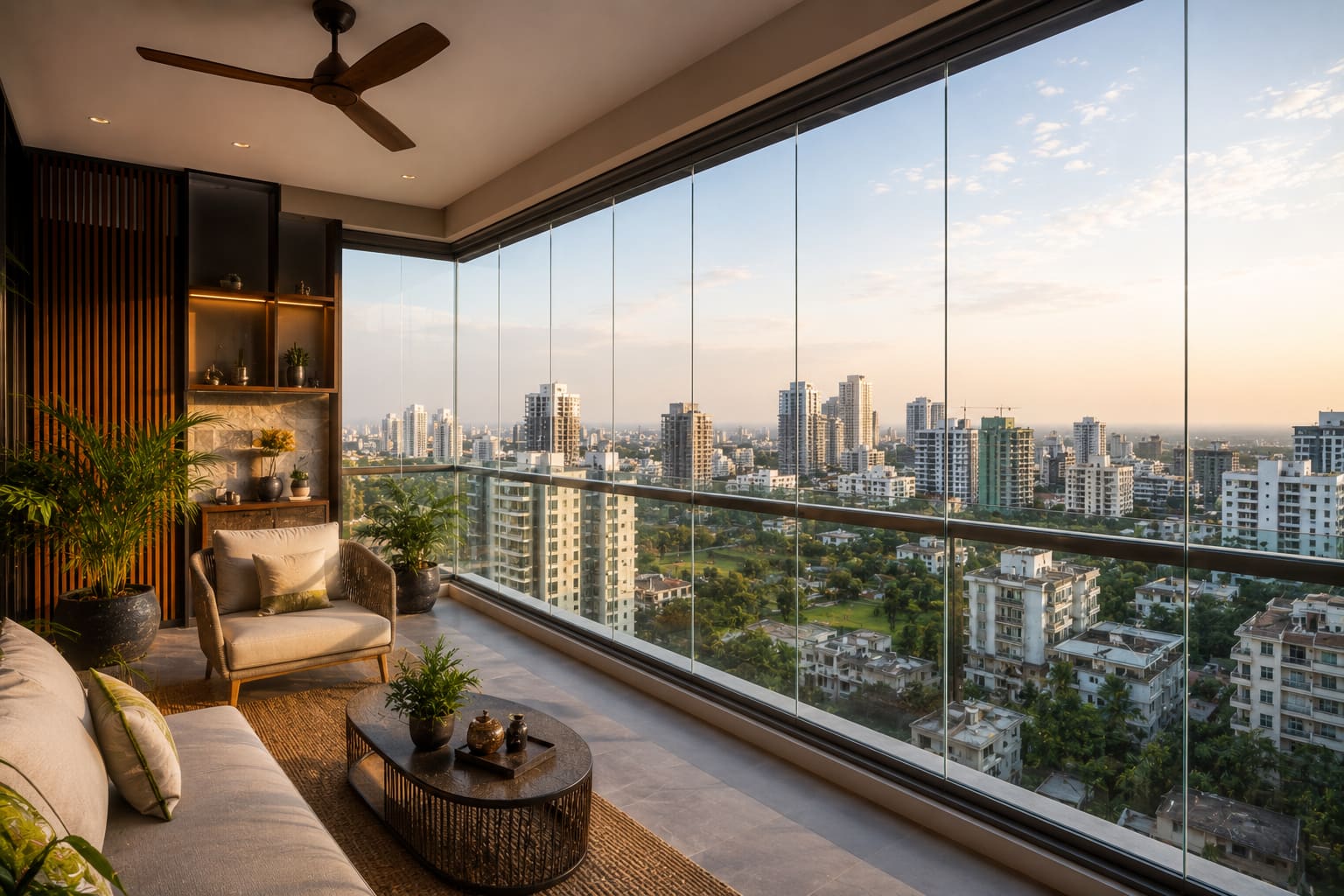
Enclosing an apartment balcony with glass in Hyderabad typically costs Rs 450 to Rs 1,200 per square foot and takes 2 to 4 days from measurement to a finished, dust-free room, using either aluminium sliding windows or a frameless slide-and-fold system. For a standard 40 sq ft balcony in a Gachibowli, Kondapur or Kokapet high-rise, expect an all-in cost of roughly Rs 25,000 to Rs 55,000 depending on the system, glass thickness and hardware grade you choose. That single upgrade converts an open, unusable ledge into an air-conditionable, weather-sealed extension of your living room.
In the twin cities, a balcony glass enclosure is less about luxury and more about everyday liveability. Hyderabad's long dry summers push construction and road dust straight into flats, the June-to-September monsoon drives rain horizontally into upper-floor balconies, and traffic noise along the Outer Ring Road and through HITEC City is relentless. A correctly specified enclosure tackles all three at once, adds usable floor space, protects your flooring and furniture from fading, and measurably lifts the resale appeal of your apartment.
This guide walks you through every decision that matters: what a balcony enclosure actually is, choosing between framed and frameless, budgeting in real INR figures, selecting glass thickness and hardware, avoiding the mistakes that cause leaks, and clearing your society's approval process. If you would rather skip straight to a tailored figure for your flat, you can get a free quote and our team will survey your balcony anywhere across Hyderabad, Secunderabad and the wider Telangana and Andhra Pradesh region.
What exactly is a balcony glass enclosure?
A balcony glass enclosure is a glazed screen fitted across the open face of a balcony, turning it from an exposed ledge into a sealed, usable indoor space while preserving the view and daylight. In most Hyderabad apartments this means installing sliding or folding glass panels between the balcony parapet or railing and the underside of the slab above, sealed against dust, rain and noise but able to open fully for ventilation.
It is not the same as replacing your railing, and it is different from a full window replacement. The railing stays for fall protection, and the glass system sits above or behind it to close the opening. Done well, an enclosure gives you a small extra room you can use as a reading nook, a home-office corner, a pooja space, a laundry-drying zone protected from dust, or simply an extension of the living room that you can now air-condition.
The two most common formats in the twin cities are framed aluminium sliders and frameless slide-and-fold glazing. Both are covered by our dedicated balcony glazing service, and the right choice depends on your budget, the view you want to keep, and how exposed your floor is to wind. The sections below break down each factor so you can specify with confidence rather than relying on a fabricator's cheapest default.
Which glass enclosure system suits your Hyderabad balcony?
The right system for your flat depends on how completely you want the balcony to open, your budget, and your building's wind exposure. Three systems dominate the twin-city market, and each has a clear sweet spot.
- Aluminium sliding windows (Rs 450-700/sq ft): The most common and economical choice, with 2 to 4 sliding panels in a powder-coated or anodised frame. Ideal for Kukatpally, Miyapur, Uppal and mid-rise apartments where value leads the decision.
- Slide-and-fold frameless glazing (Rs 900-1,200/sq ft): 10-12 mm toughened panels that stack fully to one side, giving an almost unobstructed view when open. Popular in Banjara Hills, Jubilee Hills and Financial District premium towers.
- uPVC sliding systems (Rs 600-850/sq ft): Better thermal and acoustic insulation than bare aluminium, a strong fit for west-facing balconies that take the full afternoon sun in Kokapet, Narsingi and Tellapur.
- Thermally broken aluminium (Rs 700-950/sq ft): A slim aluminium slider with an insulating barrier in the frame, blending the looks of aluminium with the insulation of uPVC. A popular middle path for ORR-facing homes.
For high floors above the 15th in wind-exposed towers around Gachibowli and the Financial District, insist on 8 mm minimum toughened glass and structurally rated hardware. If you are unsure which system fits your railing height and slab, browse our services or ask our team to recommend a spec after a quick site visit.
How much does balcony glazing cost in the twin cities?
A realistic all-in budget for a typical Hyderabad apartment balcony is Rs 20,000 to Rs 60,000, with the final figure driven by size, glass thickness, system type and hardware grade. Use these twin-city benchmarks as a planning guide:
- Small utility balcony (25-30 sq ft): Rs 14,000 to Rs 25,000 with aluminium sliders.
- Standard living-room balcony (40-50 sq ft): Rs 25,000 to Rs 55,000 depending on system.
- Large wrap-around or duplex balcony (80+ sq ft): Rs 60,000 to Rs 1,20,000, usually frameless.
The single biggest cost lever is the glass. Toughened (tempered) glass adds roughly Rs 60-90/sq ft over ordinary float, and moving from 8 mm to 12 mm or to double-glazed (DGU) units pushes the rate up further. Add-ons matter too: mosquito mesh tracks, a bottom drainage channel and premium rollers typically add Rs 3,000 to Rs 8,000, but they are well worth it in Hyderabad's monsoon and mosquito seasons.
Two hidden line items catch buyers out. First, hardware quality: cheap nylon rollers and locks fail within a year in dusty conditions, so budget for branded rollers and multi-point locks rather than accepting the lowest bid. Second, external access or scaffolding charges on very high floors, which some fabricators quote separately. Always ask for an itemised quotation so you can compare like with like, and see the standard we deliver on real jobs by looking at our recent projects across the twin cities.
Glass thickness, toughening and safety standards
For any balcony above the ground floor in Hyderabad, use minimum 8 mm toughened glass, stepping up to 10-12 mm for frameless spans and exposed high-rises. Toughened glass is heat-treated to be four to five times stronger than ordinary float, and when it does break it crumbles into small blunt granules instead of dangerous shards, satisfying IS 2553 safety-glazing expectations.
- 6 mm toughened: Acceptable only for small, low-floor utility balconies with short spans.
- 8 mm toughened: The workhorse thickness for standard sliding balcony enclosures on mid and upper floors.
- 10-12 mm toughened: Required for frameless slide-and-fold panels and any balcony above the 15th floor in wind-exposed corridors around Gachibowli, Kokapet and the Financial District.
For extra sound and heat control on ORR-facing or west-facing balconies, consider double-glazed (DGU) units or laminated glass. A DGU traps an insulating air gap between two panes to cut both noise and cabin heat, while laminated glass holds together even when cracked, an added safety margin for homes with young children. Whatever the thickness, insist that every pane carries a legible toughening stamp in a corner so you can verify it on site before installation, and never accept ordinary annealed float glass on an upper floor.
Handling Hyderabad dust, heat and monsoon rain
Hyderabad's climate demands specific detailing so the enclosure stays sealed and low-maintenance year-round. The difference between an enclosure that keeps working for a decade and one that leaks dust within a year lies almost entirely in these four details.
- Dust sealing: Continuous EPDM gasket beading and interlocking meeting stiles keep out the fine dust common near the ORR, metro-construction corridors and unpaved plots in fast-growing suburbs like Tellapur, Nallagandla and Bachupally.
- Drainage: A weep-holed bottom track lets monsoon water escape outward instead of pooling on the balcony floor, which is critical for upper floors facing the south-west monsoon wind.
- Heat control: Solar-control or tinted glass on west and south-facing balconies in Kokapet, Tellapur and Narsingi cuts cabin heat and protects flooring, curtains and furniture from fading.
- Easy cleaning: Choose lift-out or fully sliding panels so the outer face can be wiped from inside, because exterior cleaning is impractical and unsafe on high floors.
Get these four right and your enclosure will shrug off Hyderabad's harshest weeks, from the peak May heat to the heaviest August downpour, with nothing more than an occasional wipe-down. Get them wrong and you will be chasing water stains and dust lines every monsoon.
Hardware that makes or breaks a balcony enclosure
Good glass fails without good hardware, and in Hyderabad's dusty air the rollers, locks and channels take a constant beating. The frame and glass may last 15 years, but budget hardware can jam or corrode within one, so this is not the place to cut cost.
- Rollers and tracks: Stainless-steel bearing rollers on precision tracks resist the grit that seizes cheap nylon wheels within months. Ask specifically for SS rollers, not zinc or plastic.
- Locks and security: Multi-point locks keep low-floor and stilt-adjacent balconies secure without spoiling the clean glass look, and give real peace of mind on ground and first-floor flats.
- Frameless fittings: Slide-and-fold and pivot systems rely on quality patch fittings and floor guides that must be kept free of grit to run smoothly.
- Gaskets and seals: Continuous EPDM beading is what actually stops dust and rain; interlocking stiles at the meeting rails complete the seal.
As dealers for trusted brands such as Taiton, Enox and Ozone, we specify hardware rated for daily dust-and-heat duty so your panels keep gliding for years. If you are also upgrading the railing at the same time, our glass railing service uses matching structural fittings for a consistent, minimal-frame finish across the balcony.
Framed vs frameless: pros, cons and how to choose
Choose framed aluminium sliding if budget and everyday practicality lead your priorities; choose frameless slide-and-fold if an uninterrupted view and a premium finish matter most. Here is how the two compare on the factors twin-city buyers ask about.
- Cost: Framed aluminium runs Rs 450-700/sq ft; frameless runs Rs 900-1,200/sq ft, roughly double.
- Open view: Frameless panels stack completely to one side for a near-total opening; framed sliders always leave visible mullions between panels.
- Insulation: Framed uPVC and thermally broken aluminium insulate noticeably better against heat and noise than bare frameless glass.
- Maintenance: Framed systems have more gaskets and tracks to keep clean; frameless has fewer parts but needs precise floor tracks kept scrupulously free of grit.
- Wind performance: On very tall, exposed towers, framed systems with structural anchoring often handle wind load more forgivingly than a long frameless span.
- Best for: Framed suits Kukatpally, Miyapur and value-focused mid-rises; frameless suits Banjara Hills, Jubilee Hills and Financial District premium homes.
Many twin-city households land on a middle path: a slim thermally broken aluminium slider with 8 mm toughened glass, which balances cost, insulation and looks. Whichever you lean towards, a quick site visit through our balcony glazing service will confirm what your railing height, slab depth and floor level actually allow.
Society approvals, process and timeline in Hyderabad apartments
Most Hyderabad gated communities and apartment associations require written approval before you enclose a balcony, because it changes the building's external elevation. Skipping this step risks a removal notice from the committee, so handle it before you place the order.
- Check the by-laws: Large communities in Gachibowli, Kondapur and the Financial District often mandate a uniform frame colour (usually clear glass with black or grey frames) to keep the facade consistent.
- Get association sign-off: Submit a simple drawing and system spec to your RWA or facility office; approval usually takes a few days.
- Confirm structural fixing: Ensure the installer anchors into the RCC slab or beam, not just the parapet railing, especially on high floors.
- Schedule the work: A survey plus fabrication takes about 5 to 7 days, and on-site installation is completed in 1 to 2 days with minimal mess.
Because societies value a consistent look, it helps to work with an installer who can match the frame colour and glass to neighbouring flats so your enclosure passes committee review the first time. To move ahead, share your balcony dimensions and floor level and get a free quote so we can confirm the spec, price and approval-friendly finish for your community.
Common mistakes, maintenance and warranty
A well-installed balcony glass enclosure in Hyderabad needs only light maintenance, but a handful of avoidable mistakes account for almost every problem we are called to fix. Sidestep these and your enclosure will serve you trouble-free for years.
- Skipping the drainage track: Without weep-holes, monsoon water pools and eventually seeps inside. Never accept a bottom track without drainage on an exposed balcony.
- Using annealed glass upstairs: Ordinary float glass on an upper floor is unsafe and often against safety norms. Always specify toughened glass above the ground floor.
- Anchoring only to the railing: Fixing into the parapet alone rather than the RCC slab or beam risks failure under wind load on high floors.
- Choosing the cheapest hardware: Nylon rollers and single-point locks fail fast in dusty air; SS rollers and multi-point locks are worth the small premium.
For upkeep, vacuum or brush the bottom track quarterly so rollers glide and drainage weep-holes stay clear, and wipe the glass and gaskets periodically. EPDM gaskets are inexpensive to replace after several years and restore the original dust and rain seal. Before you pay the balance, confirm in writing the warranty on rollers, locks and toughened glass. For an accurate figure, an on-site survey always beats a phone estimate because railing height, slab condition and wind exposure change the spec, and we cover Hyderabad, Secunderabad and nearby Telangana and Andhra Pradesh towns, with the option to bundle matching glass railings or partition work where it makes sense.