The best facade materials for Telangana's climate are PVDF-coated ACP cladding paired with reflective or double-glazed (DGU) glass, because together they survive Hyderabad's punishing heat-rain-dust cycle for 15 to 20 years without fading, leaking or delaminating. For most buildings the single smartest specification is PVDF ACP on the large plain surfaces and high-performance DGU glass on the primary elevation, with stone or HPL used only as an accent where durability and touch-appeal matter. Everything else in this guide is a variation on that core answer, tuned to your budget, building height and orientation.
Telangana's climate is genuinely unforgiving on a building's skin. Hyderabad and Secunderabad regularly cross 42 degrees C in April and May, the southwest monsoon dumps heavy driving rain from June to September, and airborne dust from construction and traffic coats every surface for much of the year. Picking a facade here is less about looks and far more about which system endures that punishment while keeping interiors cool and cooling bills sane. A material that photographs beautifully but chalks white in three summers or leaks at the first monsoon is not a saving, it is a future recladding bill.
At Hakimi Aluminium and Glass we have executed glass and facade work across Hyderabad, Secunderabad and into coastal and interior Andhra Pradesh, from IT office towers in HITEC City to retail showrooms, hospitals and residential elevations. This guide compares the materials that actually perform in this region, with realistic 2026 INR rates so you can budget honestly before you commit. You can see how the same principles play out on real buildings in our recent projects, or skip ahead and get a free quote if you already know your building type.
What the Telangana climate demands from a facade
Before comparing materials, be clear on the four stresses a Hyderabad or Secunderabad facade must survive. The right choice is simply the one that answers all four for your building type and budget, not the one that looks best in a rendering.
- Heat and UV: Peak summer sun above 42 degrees C fades cheap coatings and warps thin panels, so you need high solar reflectance and UV-stable finishes on any surface facing west or south.
- Monsoon water ingress: Driving rain from June to September finds every weak joint, so sealed, well-drained systems matter more than the panel itself. A drained-and-ventilated cavity behind the cladding is what keeps water off the structure.
- Dust and cleaning: Rough or matte surfaces trap fine Deccan dust; smooth, wash-friendly finishes stay presentable between cleaning cycles and cost less to maintain over a decade.
- Thermal gain indoors: Glass-heavy elevations can turn interiors into ovens and spike AC bills unless the glazing is specified for the actual sun path of the site.
Any material or system below is judged against these four demands. A facade that aces heat but fails at the monsoon joint will still cost you dearly, which is why detailing and installation quality run through every recommendation in this guide. In coastal Andhra Pradesh you add a fifth stress, salt-laden humidity, which makes stainless-steel hardware grade a non-negotiable rather than an upgrade.
ACP cladding: the practical workhorse for Hyderabad
Aluminium Composite Panel (ACP) is the most widely used facade material across Telangana, and for good reason. It is lightweight, fast to install, hides structural imperfections in RCC and blockwork, and comes in hundreds of colours, wood grains, metallics and stone-look finishes. For a full breakdown of systems, finishes and fixing methods, see our dedicated ACP cladding service.
The single most important spec in Hyderabad's climate is the coating. Insist on PVDF (Kynar 500) coated panels rather than cheaper polyester (PE) coating, which chalks and fades within a few summers of direct Telangana and Andhra Pradesh sun. The price gap is real but so is the lifespan gap, and on an exterior facade the cheaper panel almost always costs more over its life.
- Standard ACP (PE coating): roughly INR 90 to 150 per sq ft of material only.
- Premium PVDF / fire-retardant ACP: roughly INR 180 to 320 per sq ft of material.
- Installed cost including aluminium framework, fasteners, sealing and labour: typically INR 250 to 450 per sq ft.
A quality PVDF panel holds colour for 12 to 15 years even on a west or south elevation, which is why we recommend it for any surface that takes the harshest afternoon sun. For buildings above 15 metres, step up to fire-retardant (FR) grade panels with a mineral-filled core to align with NBC 2016 fire-safety expectations. Also confirm panel thickness: 4mm panels with a 0.5mm aluminium skin resist oil-canning and wind flutter far better than thin 0.21mm skins that ripple visibly in the sun. Get the substrate right too, because ACP is only as flat and durable as the aluminium sub-frame carrying it.
Glass and structural glazing: light without the heat
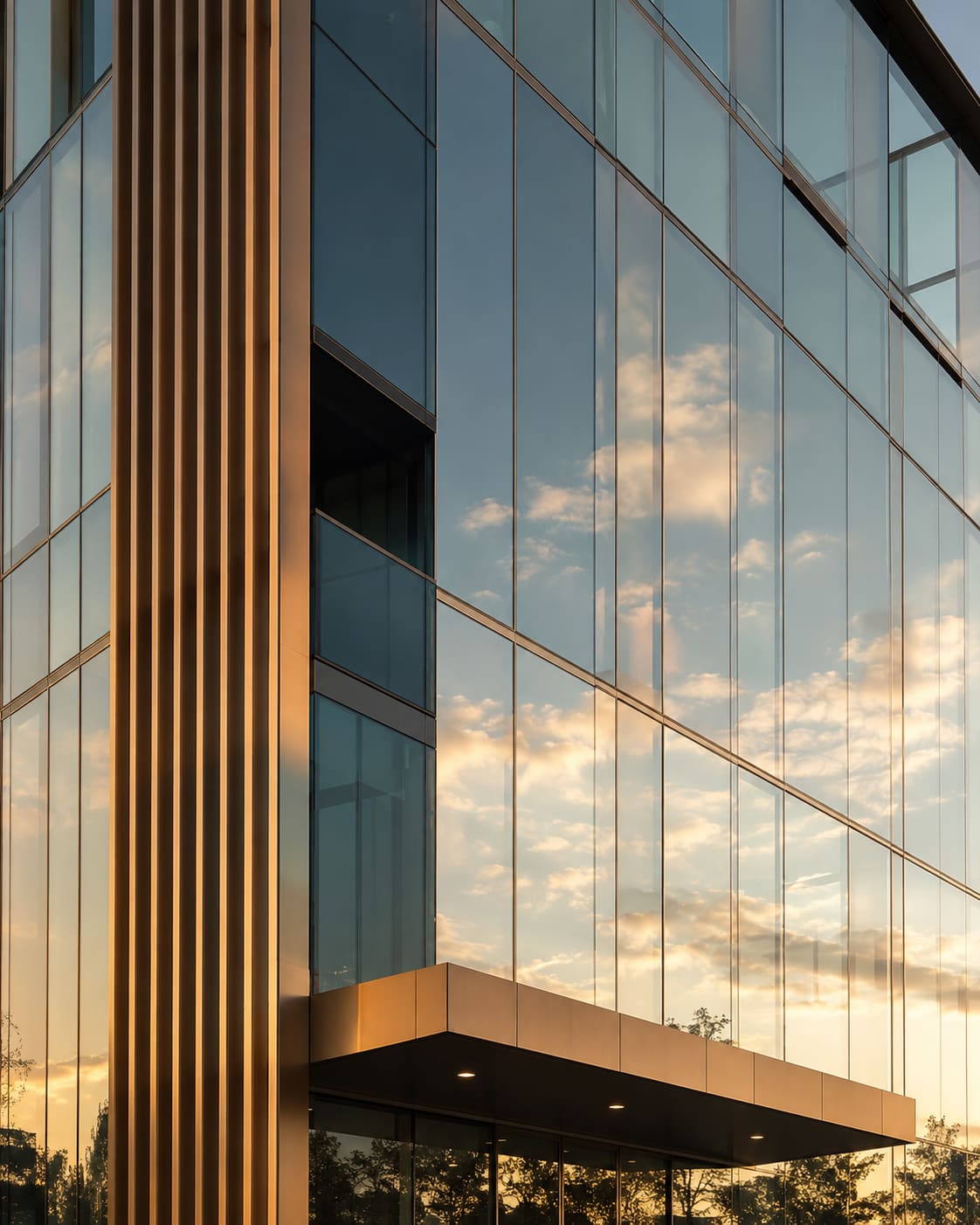
Glass facades give the premium corporate look that dominates HITEC City and the Financial District, but plain single glazing is a costly mistake in Telangana. Specify Double Glazed Units (DGU) with a low-E or reflective coating to cut solar heat gain and keep interior AC loads and electricity bills manageable through the long Hyderabad summer. A well-specified DGU can reduce solar heat gain by 40 to 60 percent compared with plain float glass.
- Structural glazing with reflective single glass: roughly INR 350 to 550 per sq ft installed.
- DGU / low-E high-performance glazing: roughly INR 650 to 1,100 per sq ft installed.
- Spider / point-fixed glazing for lobbies and atria: roughly INR 900 to 1,600 per sq ft installed.
For residential and low-rise commercial work, semi-unitised glazing balances cost and weather performance well. The extra spend on DGU typically pays back through lower cooling costs within three to five years in Hyderabad's climate, which turns it into an operating-cost decision rather than a purely aesthetic one. Whatever the system, the glass is only as reliable as its supports and sealants: quality stainless spider fittings, structural silicone rated for the climate, and correctly detailed weep paths are what keep a large glazed elevation safe and leak-free. Our full structural glazing approach covers how we detail these joints so they survive the monsoon.
Stone, HPL and hybrid elevations
Natural stone and dry-cladding options like granite handle heat and rain superbly and never fade, but they are heavy and costlier to fix, demanding a stronger sub-frame and anchoring system. High Pressure Laminate (HPL) offers a durable, low-maintenance middle path with convincing wood and stone looks and simpler fixing than stone.
- Dry stone cladding (granite, installed): roughly INR 350 to 700 per sq ft depending on stone and thickness.
- HPL exterior panels (installed): roughly INR 300 to 550 per sq ft.
- Louvres and aluminium fins (sun-shading add-on): roughly INR 400 to 900 per sq ft.
The smartest Hyderabad and Secunderabad elevations are usually hybrids: PVDF ACP for large plain surfaces, DGU glass for daylight and views, and a stone or HPL accent band at ground level where durability and touch-appeal matter most. This layered approach also lets you concentrate budget where it is visible from the street and economise on upper floors that no one inspects up close. Aluminium fins and louvres deserve a special mention in Telangana: adding external shading to a west face can do more for indoor comfort than upgrading the glass, because it stops the heat before it reaches the pane.
Facade materials compared: cost, heat and lifespan
Use this quick comparison to shortlist before you request detailed drawings. All figures are installed 2026 rates for the Hyderabad and Secunderabad market and move with panel grade, building height and site access.
- PVDF ACP: INR 250 to 450 per sq ft, excellent heat and dust performance, 12 to 15 year colour life, best all-round value.
- PE ACP: INR 150 to 250 per sq ft, poor UV life, only for interiors or very short-term signage, not exterior facades in Telangana.
- Reflective single glazing: INR 350 to 550 per sq ft, good looks but higher heat gain, best on north and east faces.
- DGU / low-E glazing: INR 650 to 1,100 per sq ft, best thermal performance, ideal for premium and west or south elevations.
- Dry stone cladding: INR 350 to 700 per sq ft, unbeatable durability, heaviest and slowest to install.
- HPL panels: INR 300 to 550 per sq ft, durable and low-maintenance, a strong wood-look alternative to ACP.
Read cost per square foot alongside expected lifespan, not in isolation. A PE panel that looks cheap on day one is the most expensive choice by year five once you repaint or reclad, whereas PVDF and DGU spread their cost across a far longer service life. Divide the installed rate by the realistic years of service and the value ranking often flips from what the sticker price suggests.
How to choose the right facade for your building
The correct facade is a function of four inputs: building height, orientation, use and budget. Work through them in that order and the shortlist narrows quickly.
- Building height: below 15 metres you have free choice of PVDF ACP, glazing or stone; above 15 metres, fire-retardant grade materials and engineered anchoring become essential.
- Orientation: put your best thermal performance (DGU, shading, PVDF) on the west and south faces that take the brutal afternoon sun, and economise on shaded north faces.
- Building use: an air-conditioned IT office justifies DGU glass for the energy payback; a warehouse or godown does not, and PVDF ACP alone is the sensible call.
- Budget discipline: decide the mix before tender, because value-engineering the coating or the framework mid-project is where most future problems are born.
If you are unsure, a short site survey settles it faster than any catalogue. We model the sun path, check the structure's capacity to carry the cladding, and recommend a build-up that fits both the climate and the budget. Browse our services to see how glazing, cladding and hardware come together, then get a free quote for a specification tailored to your elevation.
Installation, detailing and timeline
Material choice is only half the outcome; the framework, sealing and drainage detailing decide whether a facade leaks in year one or performs for two decades. A facade is a system, and the weakest joint sets its true lifespan.
- Survey and design: 3 to 7 days to measure, model the sun path and finalise the build-up and shop drawings.
- Framework fabrication: powder-coated or mill-finish aluminium sub-frame, plumbed and levelled to hide structural tolerances in the RCC.
- Panel or glass fixing: mechanical fixing for ACP and stone, structural silicone or spider fittings for glazing, always with a drained-and-ventilated cavity.
- Sealing and weatherproofing: weather silicone at joints, gaskets at openings, and weep paths so any water that gets in drains straight back out.
A typical mid-size commercial facade in Hyderabad runs 4 to 8 weeks from survey to handover depending on area, height and scaffolding or access constraints. Larger towers with unitised systems take longer but install faster per square foot once the rhythm is set. The non-negotiable is disciplined workmanship: correct fastener spacing, continuous sealing lines and a real drainage strategy are cheap at the outset and ruinously expensive to retrofit later.
Common facade mistakes to avoid in Hyderabad
Most facade problems we are called to repair across Telangana trace back to a short list of avoidable decisions made to save money at tender stage.
- Choosing PE-coated ACP for exterior use, then watching it chalk white within three summers on the sunny face.
- Using plain single glazing on a west elevation and creating an interior that no air conditioner can keep comfortable.
- Skimping on framework and fasteners so panels oil-can, rattle in high wind, or loosen during the monsoon.
- Poor joint sealing and no drainage path, so water tracks behind the panels and stains or corrodes the substructure.
- Fitting budget 202-grade hardware in humid, coastal-influenced Andhra Pradesh where only 304 or 316 stainless resists pitting and streaking.
Every one of these is designed out at the drawing stage with the right material, the right hardware and disciplined installation. When you are ready, get a free quote and we will survey your building, model the sun path, and recommend a facade build-up that fits your budget and Telangana's climate.
Our recommendation for Telangana and Andhra Pradesh projects
For most commercial buildings in Hyderabad, Secunderabad and Andhra Pradesh we recommend a PVDF ACP base with reflective or DGU glazing on the primary elevation. It survives the summer, sheds the monsoon, cleans easily after dusty spells, and keeps interiors cool without an extreme budget. It is the specification we return to again and again precisely because it balances every one of the four climate stresses.
For premium offices and showrooms, lean toward more DGU glazing and a spider-glazed entrance; for tight budgets, maximise PVDF ACP cladding and use glass only at entrances and feature bands. Whatever the mix, the framework, sealing, drainage and hardware decide whether a facade leaks in year one, so use an experienced installer for the workmanship, not just for the panels.
Explore our recent projects to see how glazing, cladding and hybrid elevations perform on real Telangana buildings, and reach out whenever you want a climate-appropriate facade specified end to end. A short conversation now saves a recladding bill later.