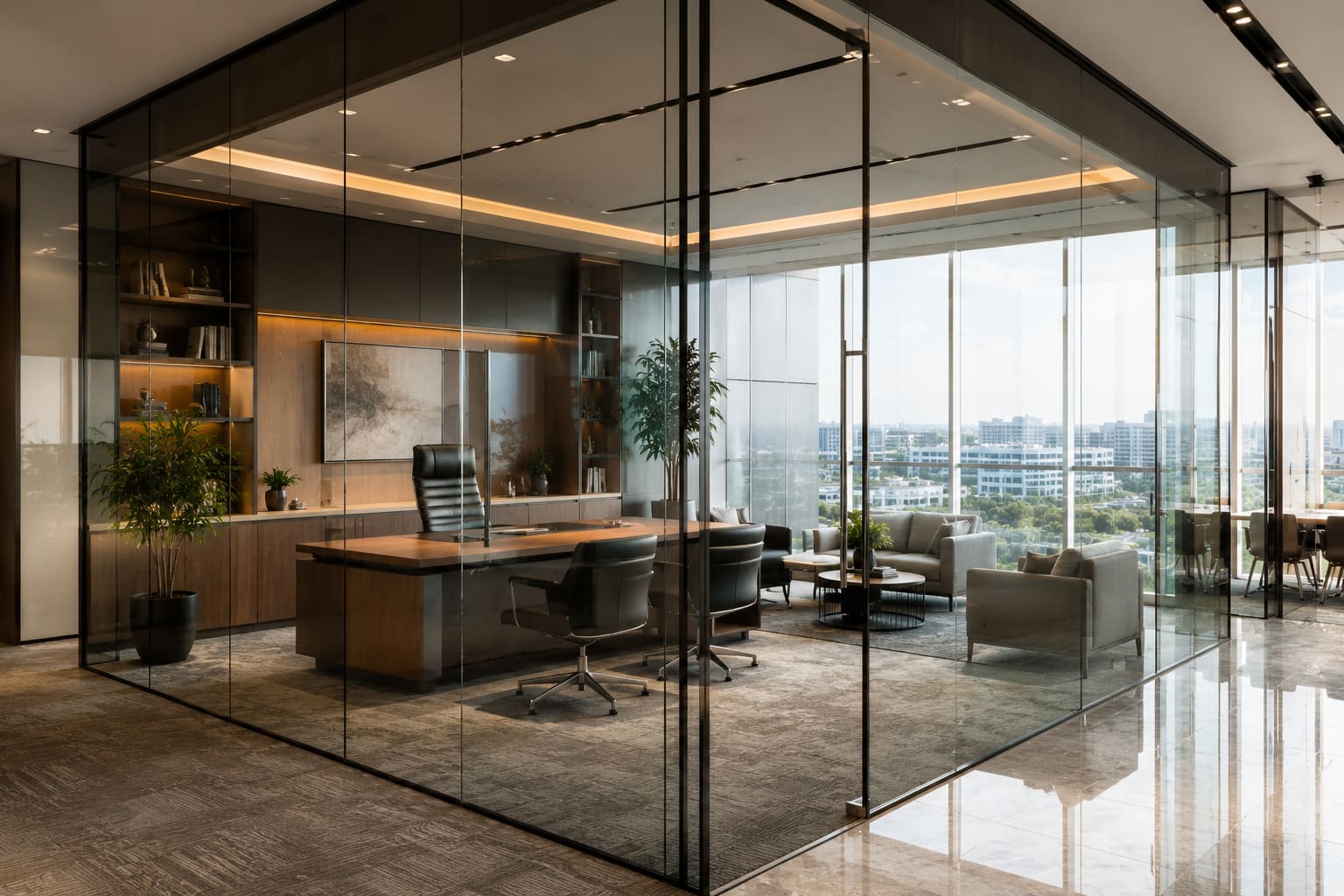
Office glass cabins in Kondapur and Gachibowli typically cost between INR 550 and INR 1,500 per square foot installed, depending on whether you choose a plain 10mm-12mm toughened glass partition, a frameless design with premium patch fittings, or a double-glazed acoustic cabin. A standard manager's cabin of roughly 10ft x 8ft with a swing door usually lands between INR 55,000 and INR 1.5 lakh, ready to use in 5 to 10 working days across the twin cities.
For fast-growing IT, startup and coworking offices around HITEC City, Madhapur, Nanakramguda and the Financial District, office glass cabins have become the default way to create private meeting rooms and manager rooms without blocking natural light or triggering a full civil renovation. Unlike solid drywall, a glass cabin keeps floor plates feeling open and bright while still giving heads-down privacy, and it can be dismantled and reconfigured as your team grows or your lease changes.
This guide from Hakimi Aluminium and Glass covers the glass and glass partition options that suit Hyderabad's hot summers, dusty air and heavy monsoon, realistic INR pricing per square foot, the exact hardware that keeps doors running smoothly for years, the mistakes that cause most cabin complaints, and how a cabin gets built step by step so you can budget and plan with confidence. When you are ready, you can get a free quote for a site survey anywhere in Hyderabad, Secunderabad or the wider Telangana and Andhra Pradesh region.
What office glass cabins cost in Kondapur & Gachibowli
Office glass cabins in Kondapur and Gachibowli are priced by the square foot of glass plus hardware, and most twin-city offices fall into three clear tiers. Knowing which tier you need is the fastest way to set a realistic budget before any vendor visits your site.
- Standard toughened glass partition (10mm-12mm, aluminium framed): INR 550-750 per sq ft, ideal for straightforward manager cabins, meeting rooms and startup fit-outs.
- Frameless or semi-frameless toughened glass with patch fittings: INR 750-1,100 per sq ft, the popular choice for HITEC City and Financial District offices wanting a premium, minimal look.
- Double-glazed acoustic cabins (two glass panes with a sealed air gap): INR 1,100-1,500 per sq ft, used for CXO rooms and board rooms that need genuine sound isolation.
A typical 10ft x 8ft cabin (about 80 sq ft of glass) therefore ranges from roughly INR 55,000 for a basic partition to INR 1.5 lakh for a fully acoustic, frameless setup. Add-ons change the number quickly: frosted privacy film runs INR 45-90 per sq ft, printed branding graphics INR 90-180 per sq ft, an automatic sliding door adds INR 25,000-45,000, and switchable smart glass can add INR 1,600-2,500 per sq ft for the panels that use it.
For accurate budgeting, remember that hardware quality moves the total price almost as much as the glass itself. A cabin built with premium Taiton, Enox or Ozone fittings costs a little more up front but avoids the sagging doors and failed locks that plague cheap imports within a year or two. If you want an exact figure for your floor plate rather than a per-square-foot estimate, get a free quote and we will measure and itemise it for you.
One quick way to sanity-check a quotation: ask the vendor to split glass, hardware and labour on separate lines. A quote that bundles everything into a single rate often hides thin glass or unbranded fittings that will cost you more in repairs later.
Choosing the right glass for Hyderabad's climate
Toughened (tempered) glass is the right base choice for almost every office cabin in the twin cities because it resists the heat build-up of Hyderabad summers and, if broken, shatters into blunt granules instead of sharp shards. Toughened glass is roughly four to five times stronger than ordinary annealed glass of the same thickness, and quality float glass from Saint-Gobain or AIS carries an IS 2553 safety mark you should insist on seeing. Beyond that base choice, match the glass to how the room is actually used.
- For offices with west-facing windows in Gachibowli, Kokapet and the Financial District, add a solar or reflective film to cut glare and heat from the harsh afternoon sun and to lower air-conditioning load.
- For meeting rooms needing privacy, use frosted or switchable smart glass rather than heavy fabric blinds that collect the fine dust common across Kukatpally and Kondapur.
- For genuine quiet on noisy open-plan floors, specify double-glazed 8mm+8mm units, which noticeably reduce speech transfer between rooms.
- Because monsoon humidity swings are sharp in Hyderabad, insist on rust-resistant anodised or powder-coated aluminium framing and quality EPDM gaskets so the cabin stays sealed and squeak-free year-round.
If your office also faces a busy road or an atrium, consider laminated glass for the outer face; it holds together on impact and adds a further layer of acoustic damping on top of the double-glazed air gap. Laminated-plus-toughened combinations are common in ground-floor cabins along busy stretches like the Kondapur main road, where both security and street noise are concerns.
Glass thickness should track the panel height. A 10mm pane is comfortable up to about 2.4m; 12mm is the safe default for full-height cabins up to 3m; taller partitions need 12mm with a structural top rail or a move to a framed system.
Hardware and fittings that make or break a glass cabin
The single biggest cause of glass cabin complaints in Hyderabad offices is not the glass at all, but the hardware. Doors that sag, close crookedly, or rattle almost always trace back to under-specified fittings, so this is where dealer-grade brands like Taiton, Enox and Ozone earn their keep. Getting the glass partition hardware right is what separates a cabin that still swings true after three years from one that needs a callout every monsoon.
- Floor springs and door closers control how a heavy toughened glass door swings and self-closes; a quality floor spring rated for the door weight is essential for any frameless glass door and lasts far longer than a budget unit.
- Patch fittings are the corner clamps and connectors that hold frameless panels and doors without a full frame, giving that clean, minimal HITEC City look.
- Door handles and pull hardware such as D-handles and push plates set the daily feel and finish of the cabin, and are the parts people actually touch.
- Locks and access options range from a simple patch lock to keyless keypad and access-controlled cabins for HR, finance and server rooms where confidentiality matters.
- Spigots, standoffs and connectors tie panels together neatly and carry the load where two sheets of glass meet.
For cabins built around a sliding door instead of a swing door, a quality top-hung sliding system keeps the panel gliding smoothly for years, which matters most on the tight floor plates common in Kondapur and Madhapur. A cheap sliding track is a false economy: it is the part most likely to bind up under the fine dust that blows across these neighbourhoods. You can see the standard of hardware and finish we deliver across our recent projects before you commit.
How installation works and how long it takes
A glass cabin installation in the twin cities follows a fixed five-step process and is usually completed within 5 to 10 working days from site measurement to handover. Understanding the sequence helps you plan around your team's working hours and avoid nasty surprises.
- Day 1: Free site survey and exact laser measurement at your Kondapur, Gachibowli, Madhapur or Secunderabad office, plus a written, itemised quote.
- Days 2-6: Toughened glass is cut, drilled and processed to size at the factory. Toughened glass cannot be trimmed or drilled on site, so accurate measurement at this stage matters enormously; a 5mm error means a rejected panel and a week's delay.
- Day 7: Aluminium track, floor and ceiling channels are fixed, typically after office hours to avoid disrupting your team.
- Days 8-9: Glass panels, doors, patch fittings, floor springs, locks and any frosted film or branding are installed and aligned.
- Day 10: Final cleaning, door adjustment and handover. Reputable vendors, including Hakimi Aluminium and Glass, provide a written 1-year workmanship warranty on hardware and fittings.
Because the bulk of the timeline is off-site processing, on-site disruption is minimal, usually just 2 to 3 days of fixing that can be scheduled around your working hours or over a weekend. For larger fit-outs spanning a whole floor, the glass processing for multiple cabins runs in parallel, so a ten-cabin floor rarely takes ten times longer than a single room. Browse our services to see how cabin work fits alongside partitions, facades and doors on a combined project.
Frameless vs framed vs double-glazed cabins compared
Choosing between the three main cabin styles comes down to budget, acoustics and the look you want. Here is how they compare for a typical Hyderabad office.
- Framed toughened glass (INR 550-750/sq ft): most economical, quick to install, and easy to reconfigure; the visible aluminium frame is the trade-off for those who prefer a fully minimal look. Blocks roughly 25-30 dB of sound.
- Frameless toughened glass (INR 750-1,100/sq ft): the premium, near-invisible look favoured in the Financial District and HITEC City, held by patch fittings and floor springs rather than a frame; moderate acoustic performance around 28-32 dB.
- Double-glazed acoustic (INR 1,100-1,500/sq ft): two panes plus a sealed air gap deliver the best sound isolation, cutting 35-45 dB, for board rooms and CXO cabins; higher cost and a slightly thicker footprint.
As a rule of thumb, framed cabins suit budget-conscious startups and coworking operators, frameless cabins suit client-facing floors that want to impress, and double-glazed cabins are reserved for the handful of rooms where confidential conversations happen. Many offices mix all three across a single floor to control cost while still getting quiet where it counts: framed cabins for junior managers, frameless for the reception-facing rooms, and one or two double-glazed cabins for HR and the boardroom.
If you are unsure which mix is right, an office glass cabins specialist can walk the floor with you and mark up a layout that balances cost against the rooms that genuinely need privacy.
Design tips for IT and coworking offices
The best glass cabins balance privacy, acoustics and Hyderabad's premium open-office aesthetic, and a few practical choices make a big difference to how the finished floor feels.
- Use a manifestation strip or logo frosting at eye level (about 1.4m-1.6m high) so people do not walk into clear glass, which is also a safety requirement in many corporate fit-outs.
- Choose sliding doors over swing doors in tight Kondapur floor plates to save usable floor area, since a swing door needs a clear arc of about a metre that you cannot furnish.
- Keep a 10mm-12mm glass thickness for cabins up to 3m high; go thicker or add a top rail for taller partitions.
- Combine glass with a low gypsum or aluminium dado at the base if you want to hide cabling, wire management and skirting neatly.
- For coworking spaces around HITEC City and Madhapur, modular demountable glass systems let you reconfigure rooms later without breaking and re-buying glass, which protects your investment when tenants change.
- Plan power and data before the glass goes up. Cabins look best when switches and network points are set into the dado or the frame, not surface-run across a clear panel.
If you are fitting out a whole floor rather than a single room, matching frames, handles and manifestation designs across every cabin keep the space visually consistent while still letting you mix clear, frosted and acoustic zones room by room.
Common mistakes to avoid when ordering a glass cabin
Most glass cabin regrets in Hyderabad offices come down to a handful of avoidable errors. Knowing them in advance saves money and rework.
- Buying on glass price alone. A rock-bottom per-square-foot rate almost always hides thinner glass or unbranded hardware; the cabin looks fine on day one and starts sagging within a year.
- Skipping acoustics where they matter. Fitting a single-pane cabin for the boardroom to save cost, then finding every negotiation is audible in the corridor, is a common and expensive mistake to reverse.
- Forgetting manifestation. A fully clear cabin is a walk-into hazard and often fails a corporate safety audit; budget the frosted band from the start.
- Ignoring door swing and floor area. In tight Kondapur and Madhapur cabins, a swing door can waste a full square metre that a sliding door would have saved.
- Poor measurement or DIY sizing. Toughened glass cannot be cut on site, so a measurement error turns into a rejected panel and a week's delay; always let the vendor take the final measurement and own it.
- No written warranty or spares plan. Insist that the 1-year workmanship warranty and the hardware brand are named in writing, so a future repair is not held up by an unavailable part.
Avoiding these is straightforward when you work with an established local vendor who takes the measurement, names the hardware, and stands behind the install. If you would rather have it checked professionally, get a free quote that spells out glass, hardware and warranty line by line.
Maintenance, safety and warranty for twin-city offices
A well-built glass cabin needs very little upkeep, but a few habits keep it looking and working like new through Hyderabad's dusty summers and humid monsoons.
- Wipe glass with a soft cloth and a mild non-abrasive cleaner; avoid ammonia-heavy sprays that can degrade frosted film and manifestation over time.
- Have floor springs and door closers checked once a year so heavy glass doors keep closing squarely and safely.
- Re-apply or refresh the manifestation strip if branding graphics fade, both for looks and for walk-into safety.
- Keep tracks and gaskets free of the fine dust common across Kondapur, Kukatpally and Miyapur so sliding doors and seals keep performing.
- Tighten patch-fitting bolts during the annual check; a quarter-turn once a year prevents the slow droop that ends in a scraping door.
Insist on toughened, IS-marked safety glass for any full-height cabin, and confirm the workmanship warranty in writing before work begins. Hakimi Aluminium and Glass backs its installations across Hyderabad, Secunderabad, Telangana and Andhra Pradesh with a 1-year warranty on hardware and fittings, and stocks genuine Taiton, Enox and Ozone spares so repairs are never held up by unavailable parts. Whether you need a single manager's cabin in Kondapur or a full floor of meeting rooms in the Financial District, a proper survey and honest specification are the foundation of a cabin that still looks sharp years later.