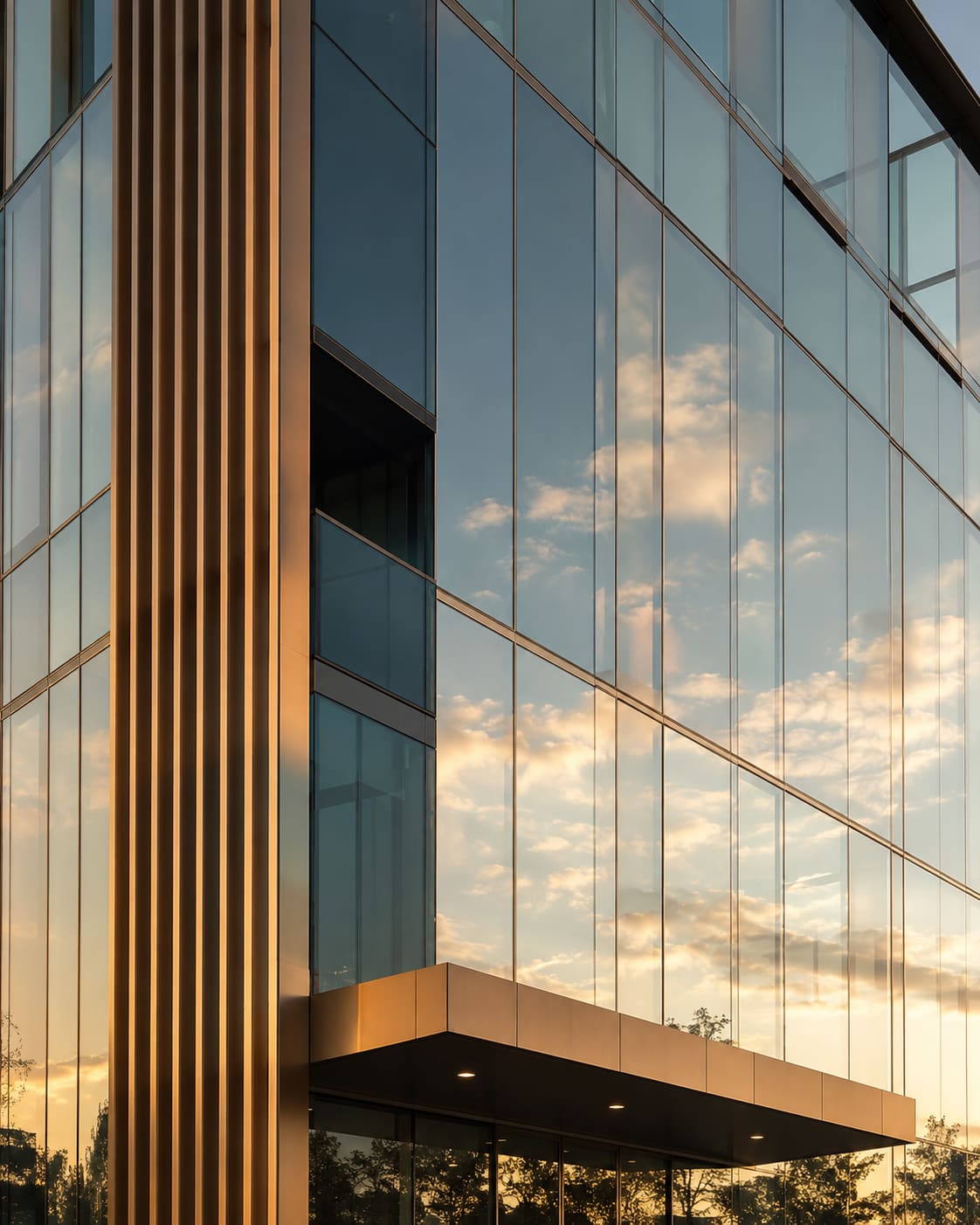
A glass facade for an office in Gachibowli is an exterior glazed skin - usually structural glazing, a unitised curtain wall, or a spider (point-fixed) system - that seals the building envelope while delivering the clean, high-rise look expected across Hyderabad's IT corridor. For most Gachibowli and Financial District office blocks the practical choice is double-glazed units (DGU) with a solar-control or low-E coating, because that single spec cuts Telangana's harsh summer heat gain while keeping interiors bright, quiet and comfortable. Expect a working budget of roughly INR 550 to INR 900 per square foot for a structural-glazing DGU facade in the twin cities.
Gachibowli sits at the centre of Hyderabad's tech belt alongside HITEC City, Madhapur, Kondapur, Nanakramguda, Gopanpally and Kokapet, where Grade-A office demand keeps facade standards high. A modern glass and aluminium facade is no longer just cladding - it is a thermal, acoustic and safety system that decides your air-conditioning bill, your IGBC or GRIHA green rating, and how the building reads from the Outer Ring Road. Getting the specification right at the design stage is far cheaper than retrofitting a facade that overheats or leaks.
This guide explains the facade options that actually work in the twin cities, realistic INR pricing for Hyderabad and Secunderabad, how to engineer for heat, dust and monsoon, which glass build-ups and hardware matter, the standards you must meet, and exactly what to check before you get a free quote from a facade contractor. Wherever possible we give numbers you can plan a budget around.
What is a glass facade, and why it matters in Gachibowli
A glass facade is the outer glazed wall of a building - an engineered envelope of glass and aluminium that keeps out heat, water, dust and noise while defining the architecture. In an IT-corridor market like Gachibowli, it also signals grade and brand, which is why almost every new office block on the Nanakramguda–Kokapet stretch is fully glazed.
The important shift for owners to understand is that a facade is a performance system, not decoration. The glass coating sets your solar heat gain and therefore your chiller load; the aluminium framing carries wind pressure across tall elevations; and the sealing detail decides whether monsoon rain stays outside. Treat those three together and you get a facade that looks premium and runs cheaply for 25-plus years.
Because Gachibowli, HITEC City and the Financial District attract multinational tenants, facades here are also judged on green credentials. A well-specified DGU directly supports structural glazing designs that earn IGBC and GRIHA points - a genuine leasing advantage in the twin cities.
Which glass facade type suits a Gachibowli office?
The right glass facade type for a Gachibowli office depends on building height, budget and the architectural look you want, and three systems cover almost every project across the IT corridor.
- Structural glazing: Glass bonded to an aluminium frame with structural silicone for a flush, frameless exterior. It offers the best value for 4-15 storey offices across HITEC City, Kondapur and Nanakramguda, and is the most-requested structural glazing system in the twin cities.
- Unitised curtain wall: Factory-assembled storey-height panels craned into place, ideal for tall towers in the Financial District and Kokapet where site speed and factory quality control matter most.
- Spider / point-fixed glazing: Toughened glass held by stainless-steel spider fittings, used for double-height lobbies, atriums and showroom frontages in Madhapur and Banjara Hills.
For occupied offices always specify double-glazed units (DGU) with a solar-control coating rather than single glass - in Hyderabad summers the difference in heat, glare and cooling cost is dramatic. Semi-unitised systems are a sensible middle path when a project wants curtain-wall performance on a structural-glazing budget. You can see how these systems differ in practice across our recent projects.
How much does a glass facade cost in Hyderabad?
Glass facade prices in Hyderabad and Secunderabad typically run from around INR 450 to INR 1,400 per square foot of facade area, depending on the system and glass specification. The table below reflects working ranges we see across Gachibowli and the wider ORR belt.
- Structural glazing with DGU: roughly INR 550-900 per sq ft - the common working range for Gachibowli office blocks.
- Unitised curtain wall: roughly INR 1,000-1,400 per sq ft, reflecting factory assembly and taller-building engineering.
- Spider glazing: roughly INR 700-1,100 per sq ft, driven by toughened glass and stainless structural fittings.
- ACP and louvre accents: often INR 250-450 per sq ft where solid infill or shading is combined with vision glass.
As a rough guide, a 5,000 sq ft office facade in structural glazing lands near INR 30-45 lakh, while a 20,000 sq ft unitised tower elevation can run well past INR 2 crore. Prices move with glass brand (Saint-Gobain, AIS, Guardian), coating type, aluminium section (Jindal, Hindalco or an imported system), floor height and site logistics, so always get a measured quote rather than relying on a headline rate. Compare specifications across our facade services before committing to a number.
Engineering for Hyderabad heat, dust and monsoon
A Gachibowli facade must be engineered for high solar heat, seasonal dust and heavy monsoon rain, because the glass and sealing choices decide long-term comfort and running cost more than the initial look ever will.
- Heat: Choose solar-control or low-E DGU with a low solar heat gain coefficient (SHGC around 0.25-0.35) to cut air-conditioning load through the long April-June summer, when Hyderabad routinely crosses 40 degrees C.
- Monsoon: Insist on proper drainage channels, EPDM gaskets and weep holes so wind-driven June-September rain from the southwest monsoon never tracks inside. Pressure-equalised rain-screen detailing is worth the small premium on exposed elevations.
- Dust: The IT corridor carries road and construction dust, so an easy-clean or self-cleaning coating plus a planned facade-cleaning cycle keeps glass clear between cleans.
- Acoustics: A laminated inner pane or a wider air gap tames Outer Ring Road and feeder-road traffic noise for quieter workspaces - valuable near the busy Gachibowli and Nanakramguda junctions.
- Safety: Use toughened or laminated glass at all vulnerable spots to meet IS 2553 and resist wind pressure on taller Financial District and Kokapet blocks.
Glass types, coatings and DGU build-ups explained
Choosing the glass is as important as choosing the system, and the right build-up balances daylight, heat rejection and privacy for a Telangana climate.
- Solar-control (reflective) glass: rejects a large share of heat and glare, giving the classic tinted-tower look popular in the Financial District.
- Low-E (low-emissivity) glass: keeps daylight high while blocking infrared heat, ideal for offices that want bright, colour-neutral interiors.
- Laminated glass: two panes bonded with a PVB interlayer for safety, security and acoustics - essential at ground floor, overhead glazing and balustrades.
- Ceramic-fritted or double-silver low-E glass: premium options that fine-tune shading patterns and push SHGC below 0.25 for west-facing elevations.
A typical high-performance DGU is a 6mm solar-control outer pane, a 12mm argon or air cavity, and a 6mm clear or laminated inner pane. Match the coating to orientation: west and south Gachibowli elevations take the worst afternoon sun and benefit from the lowest SHGC, while north faces can prioritise daylight and clarity. Getting this mix right is a core part of a well-detailed glass and aluminium facade.
Facade hardware, fittings and entrance systems
A glass facade is only as reliable as the hardware that moves and holds it, so entrance doors, vents and glass junctions deserve the same care as the panels themselves.
- Frameless glass entrances run on patch fittings and heavy-duty floor springs and door closers that survive thousands of daily cycles in a busy Gachibowli lobby.
- Point-fixed and canopy glass relies on stainless spider and structural fittings rated for local wind loads.
- Ventilated and sliding sections use engineered sliding systems and quality door handles and locks for a durable, premium feel.
As authorised dealers for Taiton, Enox and Ozone, we match every facade to the right fittings and specify them to the exact door and glass junction. Skimping on hardware is the single most common cause of facade complaints: sagging doors, leaking vents and worn closers almost always trace back to under-specified fittings, not the glass. Spending an extra few thousand rupees per door on genuine floor springs is far cheaper than replacing a sheared toughened door later.
Compliance, standards and energy codes in Telangana
Every commercial glass facade in Telangana and Andhra Pradesh must satisfy structural, fire and energy rules, and getting this right protects both occupants and your occupancy certificate.
- Safety glazing must meet IS 2553; toughened glass should ideally be heat-soak tested to reduce the risk of spontaneous breakage on tall towers.
- Wind loads follow IS 875 (Part 3), which matters for exposed Kokapet, Nanakramguda and Financial District high-rises.
- The Energy Conservation Building Code (ECBC) and IGBC or GRIHA green ratings reward low-SHGC, high-daylight facades - a well-specified DGU helps you earn points and can support a higher rent.
- Fire safety needs proper perimeter fire-stopping between floor slab and facade, plus fire-rated glazing at refuge and stairwell zones where required.
A contractor who quotes without referencing any of these standards is a red flag. Compliant design is always cheaper than retrofitting a facade that fails inspection or a GHMC occupancy check.
Installation timeline and what to expect on site
A typical mid-size Gachibowli office facade takes about 4-10 weeks on site once measurement and material procurement are complete, and knowing the stages helps you plan your interior fit-out around it.
- Survey and design: laser site measurement, shop drawings and structural-silicone sign-off, usually 1-2 weeks.
- Fabrication: aluminium cutting, DGU procurement and factory assembly, 2-4 weeks depending on system and glass lead time.
- Installation: bracket fixing, framing, glazing and sealing, sequenced floor by floor to keep the building usable.
- Testing and handover: water-spray leak testing, cleaning and warranty documentation before sign-off.
Unitised curtain-wall towers can be faster on site because panels arrive factory-assembled, while bespoke structural glazing takes longer to fabricate but offers more design freedom for Gachibowli headquarters buildings. Build in extra lead time during the monsoon, when sealant curing and external access both slow down.
Common facade mistakes to avoid
Most facade regret in Hyderabad comes from a handful of avoidable decisions made to shave the initial cost. Watch for these before you sign.
- Choosing single glazing or clear glass to save money, then paying it back many times over in higher air-conditioning bills and glare complaints.
- Under-specifying the coating on west and south elevations, which bake through the afternoon in Telangana's summer.
- Ignoring drainage and weep-hole detailing, so the facade leaks in the first heavy monsoon.
- Buying cheap or unbranded fittings that fail within a year on high-traffic entrance doors.
- Awarding purely on lowest price without checking fabrication capability, references or warranties.
Each of these is far cheaper to prevent at the drawing stage than to fix on a completed elevation. A short design conversation upfront usually pays for itself several times over.
Choosing a facade contractor in the twin cities
Pick a Gachibowli facade contractor who can show completed local projects, in-house fabrication and a clear warranty - not just the lowest quotation.
- Ask for site references across Gachibowli, HITEC City, Kondapur, Kukatpally, Kompally or Secunderabad that you can actually visit.
- Confirm structural-silicone and DGU warranties in writing, typically 5-10 years.
- Check they handle the full scope: survey, design, aluminium fabrication, glazing, hardware and post-install service.
- Ensure the design meets IS wind-load and fire-safety norms, especially for high-rise Kokapet and Financial District towers.
- Confirm they source genuine fittings and can service them later - a single dealer for facade plus Taiton, Enox and Ozone hardware simplifies accountability.
As a Hyderabad and Secunderabad specialist in glass, aluminium, facades and hardware, Hakimi Aluminium and Glass covers all of the above under one roof. Browse our recent projects, compare specifications across our services, then get a free quote with your drawings or a site address and we will return a measured estimate.