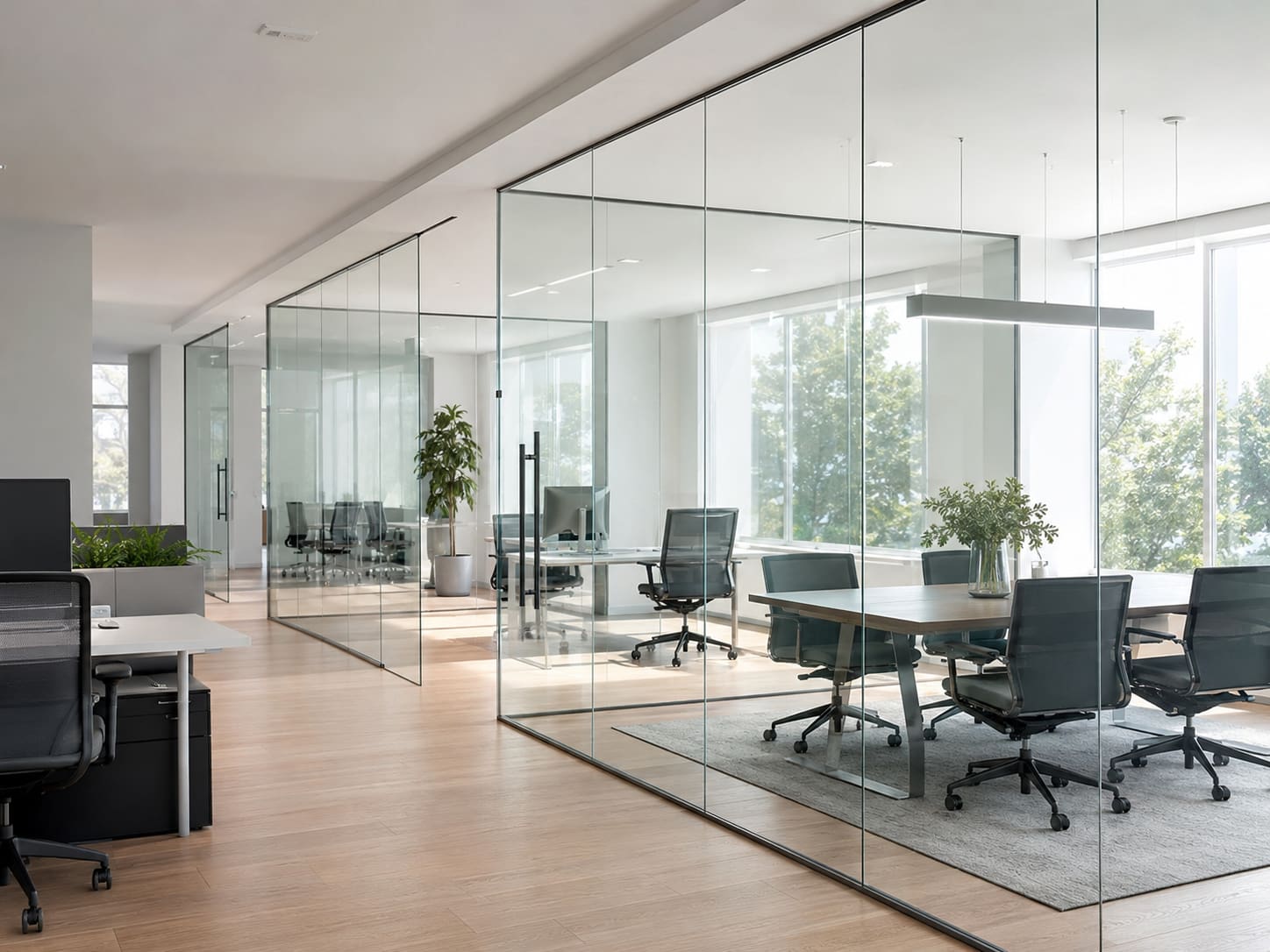
Office glass partitions in HITEC City, Hyderabad typically cost between INR 350 and INR 1,200 per square foot installed, depending on whether you pick a single-glazed aluminium-framed system or a premium frameless double-glazed one. For a standard 10 ft x 8 ft manager's cabin (about 80 sq ft of glazing) most HITEC City offices spend roughly INR 30,000 to INR 95,000 including the door, hardware and fixing - a fast, dust-controlled way to carve meeting rooms and cabins out of open floor plates without any wet civil work.
HITEC City, Madhapur and the wider IT corridor run on quick tenant fit-outs, and office glass partitions have become the default choice because they let daylight travel deep into leased floors while still delivering acoustic separation. Landlords like them because they are demountable and leave the base build untouched; facilities teams like them because a partition project rarely needs more than a week of after-hours work. Across Hyderabad, Secunderabad and the newer Financial District and Kokapet towers, glass has quietly replaced brick and gypsum as the standard cabin material.
This guide covers what you will actually pay across the twin cities in 2026, which glass survives Hyderabad's heat, dust and monsoon, the hardware that makes or breaks a partition, how installations are sequenced around your team's working hours, and the mistakes that cost offices money. When you want a tailored figure for your floor you can get a free quote - but the numbers below will let you sanity-check any vendor proposal first.
What office glass partitions cost in HITEC City (2026 INR)
Expect INR 350-1,200 per square foot installed in HITEC City, with the price driven mainly by glass thickness, framing and acoustic rating. The single biggest swing is whether you go framed or frameless, followed by whether the partition is single or double glazed. Here is how the common systems compare for a Hyderabad IT-corridor office:
- Aluminium-framed single glazed (8-10 mm): INR 350-550 per sq ft - the budget standard for cabins in Kondapur and Kukatpally.
- Frameless toughened single glazed (12 mm): INR 550-850 per sq ft - the clean, minimal look most Madhapur and Gachibowli offices want.
- Double glazed acoustic partition (12-16 mm air gap): INR 900-1,200 per sq ft - for boardrooms and quiet rooms needing 38-45 dB reduction.
- Add-ons: frosted or printed film INR 40-120 per sq ft; a frameless glass door with floor spring and patch fittings INR 12,000-22,000 each.
As a rule of thumb, a mid-range frameless cabin in HITEC City lands around INR 650 per sq ft all-in, so a 120 sq ft meeting-room enclosure works out to roughly INR 78,000 before film or premium hardware. Prices in Secunderabad and the older Begumpet office belt tend to run 5-10% lower than the Financial District simply because building access and fit-out charges are lower. Always compare the total installed figure, not the glass rate alone, because hardware and sealing can quietly add another 15-25%. You can see the mix of systems we have delivered across the city in our recent projects before locking a budget.
Framed vs frameless: which partition system suits your floor
Choose frameless when appearance and daylight matter most, and framed aluminium when budget, speed and easy re-configuration matter more. Both are proven across Hyderabad offices; the decision usually comes down to brand image versus cost per seat.
Frameless partitions use 10-12 mm toughened glass held by minimal top and bottom channels or patch fittings, giving an almost invisible separation that photographs beautifully and suits client-facing floors in Madhapur and Gachibowli. The trade-off is a higher glass cost and less tolerance for out-of-level floors, so the site survey matters more.
Framed aluminium partitions run a slim profile around each pane, hiding wiring and making future changes simple - pop a panel out, move a wall, done. They are the pragmatic pick for back-office, BPO and support floors in Kondapur, Kukatpally and Uppal where layouts change often.
- Frameless: best sightlines, premium feel, INR 550-850 per sq ft, needs precise floor levels.
- Aluminium-framed: fastest to reconfigure, hides services, INR 350-550 per sq ft, more forgiving on site.
- Double-skin framed with blinds inside the cavity: privacy on demand, INR 950-1,400 per sq ft, popular for HR and finance cabins.
If you expect to relocate within a two- or three-year lease - common for startups scaling in HITEC City - a demountable framed system will save far more than the small upfront premium because you can dismantle and re-erect it on the next floor. Match the system to your headcount plan and privacy needs before you shortlist glass; our office glass cabins range is built around exactly this trade-off between look, cost and re-usability.
Choosing the right glass for Hyderabad's climate
For Hyderabad's hot summers, dusty air and heavy monsoon, use toughened (tempered) glass of at least 10-12 mm with quality edge-polishing and, where sun hits the facade, a low-E or tinted coating. HITEC City floors near west-facing glazing in Madhapur and the Financial District can gain a lot of solar heat, so the right specification keeps AC loads down and monitors glare-free.
- Toughened glass (12 mm): 4-5x stronger than ordinary glass and shatters into safe granules - essential for safety near high-footfall corridors.
- Double glazing for acoustics: two panes with a sealed air gap cut server-room hum and open-plan chatter, ideal for Gachibowli call-floor cabins.
- Low-E / solar-tinted glass: reflects heat on sun-exposed elevations in Kokapet and Financial District towers, reducing glare on screens.
- Frosted or gradient film: adds waist-height privacy to meeting rooms while keeping the borrowed light that makes glass worthwhile.
- Dust-friendly finishes: choose flush framing and smooth patch fittings so Hyderabad's fine dust wipes off in one pass rather than collecting in grooves.
For interior partitions the glass rarely needs to be laminated as well as toughened, but any partition that doubles as a stair or edge barrier should meet IS safety-glazing norms. When in doubt, over-specify thickness on tall panels - a 3 m high frameless screen in 10 mm glass will flex noticeably, whereas 12 mm stays rigid and quiet. Getting this one decision right up front is cheaper than replacing an under-specified panel that hums or bows a year into the lease.
Hardware that makes or breaks a glass partition
Hardware is 15-25% of a partition's cost and it determines how the doors feel for the next five years, so never let a vendor treat it as an afterthought. We specify hardware to match the daily footfall of each door rather than the cheapest catalogue line, because a failed spring on a busy entry door is disruptive and never covered by a glass warranty.
- Floor springs and closers: a quality floor spring rated for the door weight keeps a frameless glass door swinging true through thousands of cycles a day without sagging or slamming.
- Patch fittings and connectors: top and bottom patch fittings transfer the door's load cleanly and are the difference between a door that stays square and one that drops out of alignment.
- Handles and pulls: brushed stainless handles resist Hyderabad's humidity and fingerprints far better than plated finishes that pit and discolour.
- Locks and access control: electronic strikes and card-reader integration suit server rooms and HR cabins that need an audit trail of who entered.
- Sliding options: where swing clearance is tight, sliding or telescopic door gear recovers usable floor area in narrow HITEC City cabins.
A typical frameless door bundle - floor spring, patch set, handle and lock - runs INR 12,000-22,000. Spending at the top of that band on a high-traffic entry door is almost always cheaper than replacing a failed budget spring mid-lease. Ask your vendor to name the hardware brand and load rating in writing; reputable dealers stock genuine parts and can service them, whereas unbranded fittings are near impossible to source spares for once they fail.
How a HITEC City installation actually runs
A standard glass-partition fit-out in HITEC City takes 5-10 working days from site survey to handover, and most of that is off-site glass fabrication rather than on-site disruption. Because many Madhapur and Gachibowli buildings restrict daytime drilling, expect night or weekend fixing slots and plan your team's seating around a two- to three-day window.
- Day 1: Site survey and exact measurement of the leased floor, plus a check of false-ceiling and floor levels.
- Days 2-6: Off-site cutting, toughening and edge-polishing of glass to your dimensions - this stage cannot be rushed without risking fit, because toughened glass cannot be trimmed once heat-treated.
- Days 7-8: Track and channel fixing to floor and ceiling - the only noisy, dust-generating stage, usually scheduled after hours.
- Days 9-10: Glass panels, doors, gaskets and any film are installed, sealed with clear silicone and cleaned for handover.
Confirm your building's fit-out rules and security gate-pass process early, as HITEC City tech parks often need 48-hour prior approval for material entry and may cap the lift booking window. Keep a snag list for the handover walk-through: door alignment, silicone finish, gasket seating and lock operation are the four things worth checking before you release final payment.
Acoustics and privacy: getting meeting rooms right
For genuine speech privacy in a Hyderabad meeting room, target 38-45 dB of reduction, which in practice means double glazing plus properly sealed edges rather than one thicker pane. Many offices spend on premium glass and then lose the benefit through an unsealed ceiling gap or a door with no bottom seal - the weakest link sets the real performance.
- Single 12 mm glass delivers around 30-34 dB - fine for a manager's cabin, not enough for confidential HR, legal or finance discussions.
- Double-glazed units with a 12-16 mm cavity reach 38-45 dB, muffling both open-plan chatter and the drone of BPO floors.
- Seal the perimeter: continuous gaskets, an acoustic ceiling connection and a door bottom seal matter as much as the glass grade.
- Add frosted film or an eye-level manifestation band for visual privacy without killing daylight.
For boardrooms in Financial District and Gachibowli towers, we usually pair a double-glazed structural glass partition with a well-sealed frameless door so the room stays quiet even when the floor outside is full. The incremental cost over single glazing - roughly INR 300-400 per sq ft - is modest against the value of a room people actually trust for private calls and client conversations.
Common mistakes offices make - and how to avoid them
The most expensive glass-partition mistakes in HITEC City are not about the glass itself but about specification, sealing and skipping the site survey. A little care on these points saves re-cutting, re-fixing and disputes over the final bill.
- Quoting per running foot instead of installed square feet, which makes vendor comparison meaningless and hides the true cost.
- Skipping the pre-order floor-level check - a frameless system on an uneven floor either bows the glass or leaves ugly gaps.
- Under-specifying door hardware to hit a headline price, then replacing failed floor springs within the first year.
- Buying premium acoustic glass but leaving the ceiling gap and door bottom unsealed, throwing away most of the sound performance.
- Forgetting building approvals and lift-booking windows, which can stall a job for days in Madhapur and Financial District parks.
The fix for all of these is a proper survey and a written scope that spells out glass grade, thickness, hardware brand, sealing and cleaning. If you may relocate mid-lease, confirm in writing that the system is demountable and re-usable - otherwise a 'cheap' fixed partition becomes a sunk cost when you move.
Maintenance and getting quotes right
To keep HITEC City glass partitions clear year-round, wipe them with a microfibre cloth and a mild glass cleaner weekly, and check door floor-springs and gaskets every 6-12 months. Hyderabad's fine dust means visible smudging faster than in cooler cities, so a simple cleaning routine matters more here than in most metros.
- Always get quotes measured in installed square feet of glass, not per running foot, so you can compare vendors fairly.
- Ask whether toughening, edge-polishing, hardware and silicone sealing are included or extra - hidden add-ons are the most common quote gap.
- For leased floors in Kondapur, Banjara Hills or Jubilee Hills, confirm the system is demountable if you may relocate.
- Request a site visit before signing; a floor-level check prevents costly re-cutting of glass that cannot be trimmed once toughened.
- Keep two or three spare glass clamps and a gasket roll on site so minor knocks are fixed in minutes, not weeks.
Whether you are fitting out a single startup cabin in Madhapur or a full floor in the Financial District, the winning approach is the same: specify the right glass and hardware once, seal it properly, and maintain it lightly. Explore our services across Hyderabad, Secunderabad, Telangana and Andhra Pradesh, or send your floor plan to get a same-week quote tailored to your building.