Office glass partitions in Nanakramguda cost between INR 350 and INR 1,200 per square foot installed in 2026, with framed toughened glass at the lower end and double-glazed acoustic systems at the top. Nanakramguda sits at the heart of Hyderabad's Financial District, alongside Gachibowli, Kokapet and the Manikonda belt, where Grade-A towers and IT campuses increasingly replace solid drywall with glass to keep floors bright and open while still separating meeting rooms, MD cabins and workstations. A glass partition delivers daylight, a premium look and flexible space in a single move - which is exactly why it has become the default choice for fit-outs across the twin cities.
For a typical 10x12 ft conference room, expect to pay roughly INR 55,000 to INR 1.4 lakh installed, driven mainly by glass thickness, framing and acoustic performance. A simple framed cabin sits at the bottom of that range, while a fully frameless glass partition with an acoustic double-glazed unit and a branded glass door sits at the top. Getting the specification right matters far more than chasing the cheapest quote: over-specifying acoustic glass for a quiet reception wastes lakhs across a floor, while under-specifying single glazing on a call-heavy IT floor buys you a noise complaint you will pay to fix twice.
This guide breaks down the real 2026 costs, glass types, hardware, installation timeline and climate considerations specific to Nanakramguda and the wider Hyderabad, Telangana and Andhra Pradesh market, so you can budget accurately, brief your contractor precisely and avoid the two most expensive mistakes - buying the wrong glass and buying the wrong hardware. If you already know your layout, you can get a free quote with your floor dimensions and skip straight to a costed proposal.
What is a glass partition and why Nanakramguda offices choose them
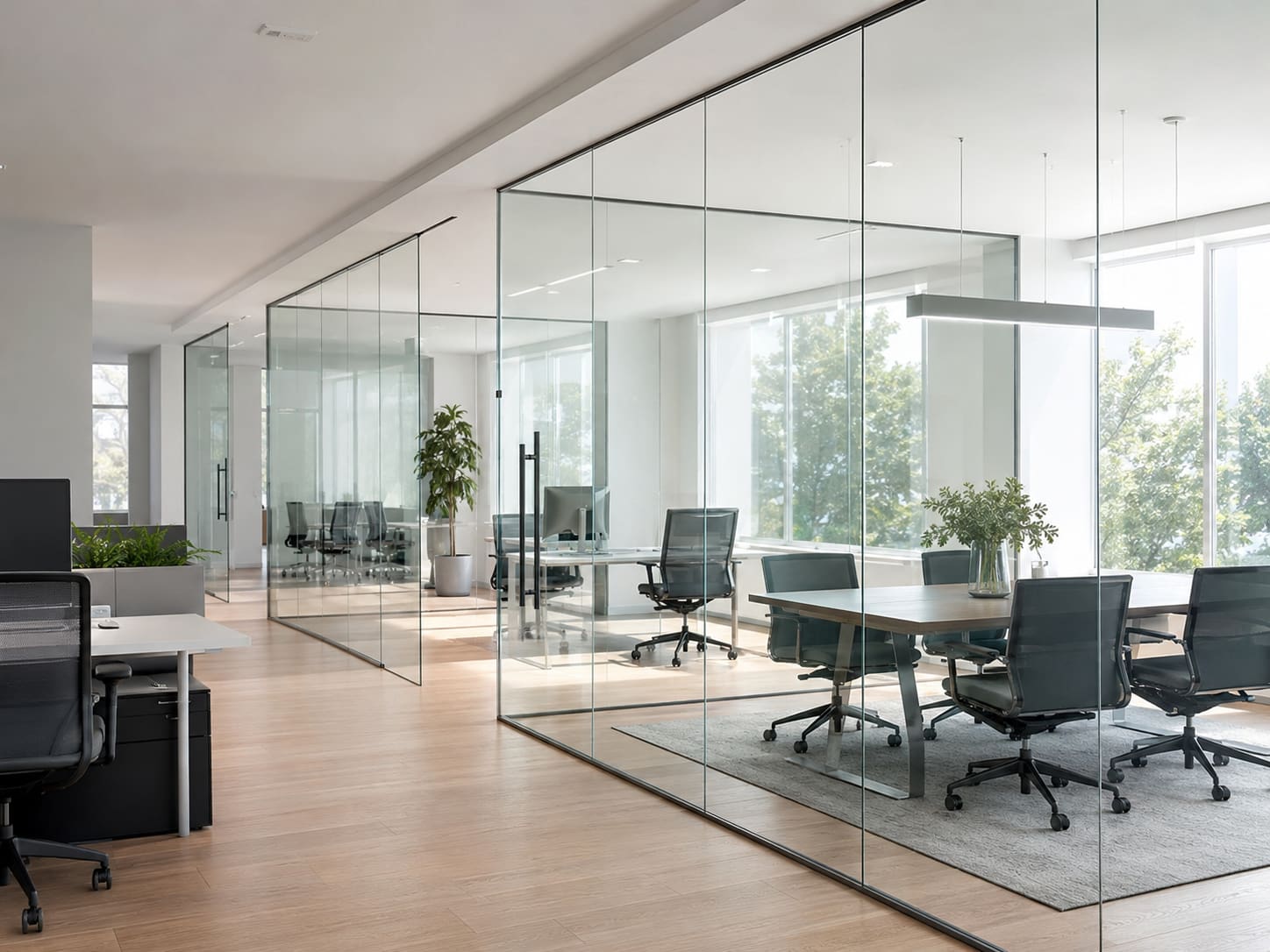
A glass partition is a non-load-bearing internal wall made of toughened glass, used to divide an office into cabins, meeting rooms and zones without blocking light or sightlines. Unlike brick or gypsum drywall, glass lets daylight travel deep into the floor plate, makes a space feel larger, and can be dismantled and reconfigured when your team grows or the layout changes.
In the Financial District, the appeal is practical as much as aesthetic. IT and BFSI tenants in Nanakramguda and Gachibowli lease large open floors and then need to carve out meeting rooms, focus rooms and leadership cabins quickly - often between lease milestones. Glass partitions deliver that separation while preserving the daylight that Grade-A landlords design their curtain walls to capture.
The most common configurations we install across the twin cities are floor-to-ceiling frameless boardroom walls, aluminium-framed cabin systems for managers, and acoustic double-glazed rooms for call-heavy teams. Many clients also pair partitions with matching office glass cabins so the whole floor reads as one coherent, glazed system rather than a patchwork of mismatched enclosures. You can see the range of interior glazing we cover on our services page.
How much do glass partitions cost in Nanakramguda in 2026?
Glass partitions in Nanakramguda cost INR 350 to INR 1,200 per square foot installed in 2026, with the final figure set by glass type, framing and hardware. Here are the configurations Financial District offices choose most:
- Aluminium-framed 8mm toughened glass: INR 350-550 per sq ft - the standard, budget-friendly choice for cabins and cubicles.
- Frameless 10-12mm toughened glass: INR 650-950 per sq ft - a premium seamless look popular in Kokapet and Gachibowli boardrooms.
- Double-glazed acoustic partitions (two panes with a sealed air gap): INR 900-1,200 per sq ft - best where noise isolation genuinely matters.
- Switchable smart (PDLC) glass: INR 2,500-4,500 per sq ft - frosts on demand for high-end boardrooms and private cabins.
- Glass door with floor spring and patch fittings: add INR 12,000-25,000 per door.
As a rule of thumb, a 100 sq ft cabin runs INR 45,000-95,000 for framed glass and INR 80,000-1.2 lakh for a frameless acoustic setup, including installation. Prices in Nanakramguda, Gachibowli, Kokapet and Manikonda are broadly similar because they draw on the same Hyderabad toughening plants and hardware distributors. Expect a marginal premium in high-rise Grade-A towers where material must be moved through service lifts and installed after hours, and factor in GST, which is quoted separately by most contractors. To compare a like-for-like scope, ask for an itemised quote and look at how similar rooms were delivered in our recent projects.
Framed vs frameless vs acoustic: which type wins?
For most Nanakramguda offices, 10mm or 12mm toughened glass is the right choice because it is safe, rigid enough to span floor-to-ceiling, and meets fire-exit norms. The bigger decision is the system around the glass. Here is how the three main types compare:
- Framed partitions: slim aluminium profiles hold thinner 8mm glass, giving the cheapest option that is also the most forgiving of uneven walls and floors. Best for reception zones, breakout areas and tight budgets.
- Frameless partitions: 10-12mm toughened glass butt-jointed with clear structural silicone and slim top and bottom channels, for an almost invisible, high-end wall. Best for MD cabins and boardrooms where appearance sells.
- Acoustic double-glazed partitions: two glass panes with a sealed air gap, engineered to block sound. Best for call-heavy IT floors, HR rooms and any space where confidentiality is non-negotiable.
Match the glass finish to each room's privacy need. Switchable smart glass turns frosted at the flick of a switch for boardrooms, while applied frosted or gradient film gives the same daytime privacy for a fraction of the cost. Toughened glass is mandatory over ordinary annealed glass in all these systems: it is roughly 4-5 times stronger and, if it ever fails, shatters into blunt granules rather than long, sharp shards. If your layout mixes open cabins and enclosed rooms, our office glass cabins service can standardise the glass thickness and hardware across both so nothing looks mismatched.
Acoustics: making meeting rooms actually quiet
Double-glazed acoustic glass partitions cut 35-42 dB, which is the practical difference between overhearing a neighbour's call and holding a genuinely private meeting. On the open, call-heavy floors typical of Nanakramguda IT tenants, poor acoustics is the single most common reason a partition project gets re-done, so it is worth getting right the first time.
Sound leaks through the weakest link, not the glass, so real-world performance depends on the whole assembly:
- Seal the perimeter fully with acoustic-grade silicone - even a small gap at the floor or ceiling drops measured performance sharply.
- Use a proper door with brush seals and a drop-down bottom seal; a standard glass door with a 10mm floor gap will undo an expensive acoustic wall.
- Consider a laminated pane in the double-glazed unit for an extra few decibels where boardroom confidentiality matters.
- Carry the partition to the structural slab, not just the false ceiling, or sound will simply travel over the top.
For rooms that only need visual privacy rather than silence - a manager's cabin beside a quiet corridor, for example - single 12mm frameless glass with frosted film is far more cost-effective than paying the acoustic premium. Reserve the double-glazed budget for the rooms that truly earn it, and specify single glazing everywhere else to keep the overall fit-out affordable.
Hardware and finishes that make or break a partition
The glass gets the attention, but the hardware decides whether your partition still works smoothly in three years. We see far more service calls caused by cheap fittings than by failed glass, so this is the line item to protect in your budget. The parts that matter most:
- Floor springs and door closers: the heart of any swinging glass door. A quality floor spring rated for the door weight keeps the door self-closing and aligned for years; a cheap one sags within months.
- Patch fittings: the top and bottom patches that grip a frameless glass door - specify them rated for your exact glass thickness rather than accepting whatever the installer has in the van.
- Handles and locks: these set the daily feel and the security of cabins and server rooms, so choose brand-name units.
- Structural and spider fittings: for tall or feature glass walls, these transfer load safely and must be sized correctly.
Insist on brand-name hardware from established makers such as Taiton, Enox, Ozone or Dorma; it adds a modest amount to the quote but transforms the lifespan of the installation. It also stops the classic bait-and-switch where premium glass is paired with no-name springs. On the glass itself, decide finishes early - clear, tinted, frosted-film, ceramic-frit or manifestation branding all change both the look and the lead time, and retro-fitting film to a live floor is fiddly and more expensive than applying it during install.
Sliding, movable and demountable partition options
Not every space wants a fixed wall. Nanakramguda offices that reconfigure often, or that hold shorter leases, increasingly choose sliding and demountable systems that can be moved or taken to a new office at fit-out end. The main options:
- Sliding glass partitions: single or multi-panel top-hung doors that open a meeting room into the floor when needed, then close for privacy.
- Movable acoustic walls: heavier operable panels for training rooms and town-hall spaces that split one room into two.
- Demountable partition systems: modular, unbolt-and-reuse walls that appeal to tenants who want to protect their fit-out investment across a lease move.
Sliding and demountable systems cost more per square foot than a fixed wall because of the track engineering and hardware, but they save money over a multi-year horizon for any business that reorganises its floor plate often. If flexibility is a priority, flag it early - the track and structural support have to be planned before the ceiling and flooring are finished, or you will pay to open them up again.
Installation timeline and Hyderabad's climate
A standard glass partition project in Nanakramguda takes 5 to 12 working days from site measurement to handover, because toughened glass must be cut and tempered to size before delivery - it cannot be trimmed on site once tempered. The usual sequence is:
- Day 1-2: site survey, exact measurements and layout sign-off.
- Day 2-6: glass toughening and hardware procurement (the longest step).
- Day 6-10: aluminium track fixing, glass installation and door alignment.
- Day 10-12: silicone sealing, film or branding application and final cleaning.
Hyderabad's climate matters more than most buyers expect. Summer temperatures cross 40 C and the June-September monsoon brings sustained humidity, so partitions on west-facing facades benefit from a small expansion gap and neutral-cure silicone that resists yellowing. Fine Deccan dust settling in door channels is the most common maintenance issue across the twin cities, so specify concealed floor springs and easy-clean patch fittings to keep doors swinging smoothly year-round. Where an interior partition meets an external facade or double-glazed window, coordinate the two so expansion joints and seals line up - a detail worth confirming with your contractor at survey stage rather than on site.
Common mistakes and how to choose an installer
Choose a Nanakramguda glass partition installer who tempers glass locally, handles aluminium and hardware in-house, and provides a written warranty on both glass and fittings. A single accountable contractor avoids the finger-pointing that happens when a separate glazier, carpenter and hardware supplier each blame the other for a misaligned door. The mistakes we are most often called in to fix:
- Under-speccing acoustics on a call floor, then re-doing rooms in double glazing at twice the cost.
- Pairing premium glass with cheap floor springs, so doors sag within a year.
- Skipping the site survey and ordering glass to a drawing, only to find the slab is out of level.
- Sealing the partition to the false ceiling instead of the structural slab, killing the acoustics.
- Accepting a single lump-sum price with no breakdown, which hides where corners are being cut.
Before you sign, confirm the vendor visits your site in Nanakramguda, Gachibowli or Kokapet to measure; that toughened glass carries an IS 2553 or equivalent safety mark; that the quote itemises glass, framing, doors, hardware and installation separately; that there is a minimum 12-month warranty on hardware; and that install is scheduled after hours to avoid disrupting a live floor. Because we serve Hyderabad, Secunderabad and the wider Telangana and Andhra Pradesh region as both a facade contractor and a hardware dealer, we supply the glass, the aluminium and the fittings from one source - send your floor plan to get a free quote for a costed, itemised proposal tailored to your Financial District office.