A glass railing in the Financial District, Hyderabad typically costs between INR 550 and INR 1,800 per running foot installed, so a standard 10-foot balcony lands roughly between INR 15,000 and INR 45,000 fitted. The exact figure depends on whether you choose a framed, semi-frameless (spigot) or fully frameless system, the thickness of toughened glass, and the grade of stainless steel fittings. For the high-rise apartments, villa balconies and office terraces around Nanakramguda, Gachibowli and Kokapet, a 12mm toughened frameless railing with 316-grade stainless steel fittings is the most popular specification because it survives the area's high winds and heavy monsoon exposure while keeping the skyline views open.
The Financial District puts real demands on a railing that a sheltered inner-city flat never sees. Its tall towers, open plots and dusty construction corridors mean surface temperatures climb past 42C in summer, the June-to-September monsoon drives rain hard against exposed balconies, and airborne dust settles fast on every horizontal edge. Choosing the right glass grade, the right steel and the right fixing method matters far more here than elsewhere in the twin cities - a cheap specification will show rust bleeding, loose panels or water staining within a monsoon or two.
This guide explains which glass and fittings actually hold up locally, what fair 2026 pricing looks like across Hyderabad and Secunderabad, the installation details that separate a safe railing from a risky one, and the exact points to check before you sign off. Whether you are fitting a single balcony or an entire office terrace, our frameless glass railing service and balcony glazing team can specify a system to match your floor height, wind exposure and budget - and you can get a free quote once you know what you need.
What is a glass railing, and which system suits the Financial District?
A glass railing (or glass balustrade) is a barrier made from panels of toughened safety glass held in place by a base channel, stainless steel spigots or point-fixed clamps, used to edge balconies, staircases, terraces and mezzanines. It gives fall protection without blocking light or views - which is exactly why it dominates the modern towers of Nanakramguda, Kokapet and Gachibowli. Every panel uses toughened (tempered) glass, which shatters into blunt granules rather than sharp shards if it ever breaks, a non-negotiable for any elevated balcony in the twin cities.
For Financial District homes and offices there are three systems to choose between, ranked by view priority, wind exposure and budget:
- Framed railings: aluminium top and bottom channels grip the glass on all sides. This is the lowest-cost option (around INR 550-850 per running foot), the sturdiest in high wind, and the easiest to service - ideal for higher floors in windy towers near Nanakramguda. The frame also hides the glass edge, which helps when panels are only 10mm.
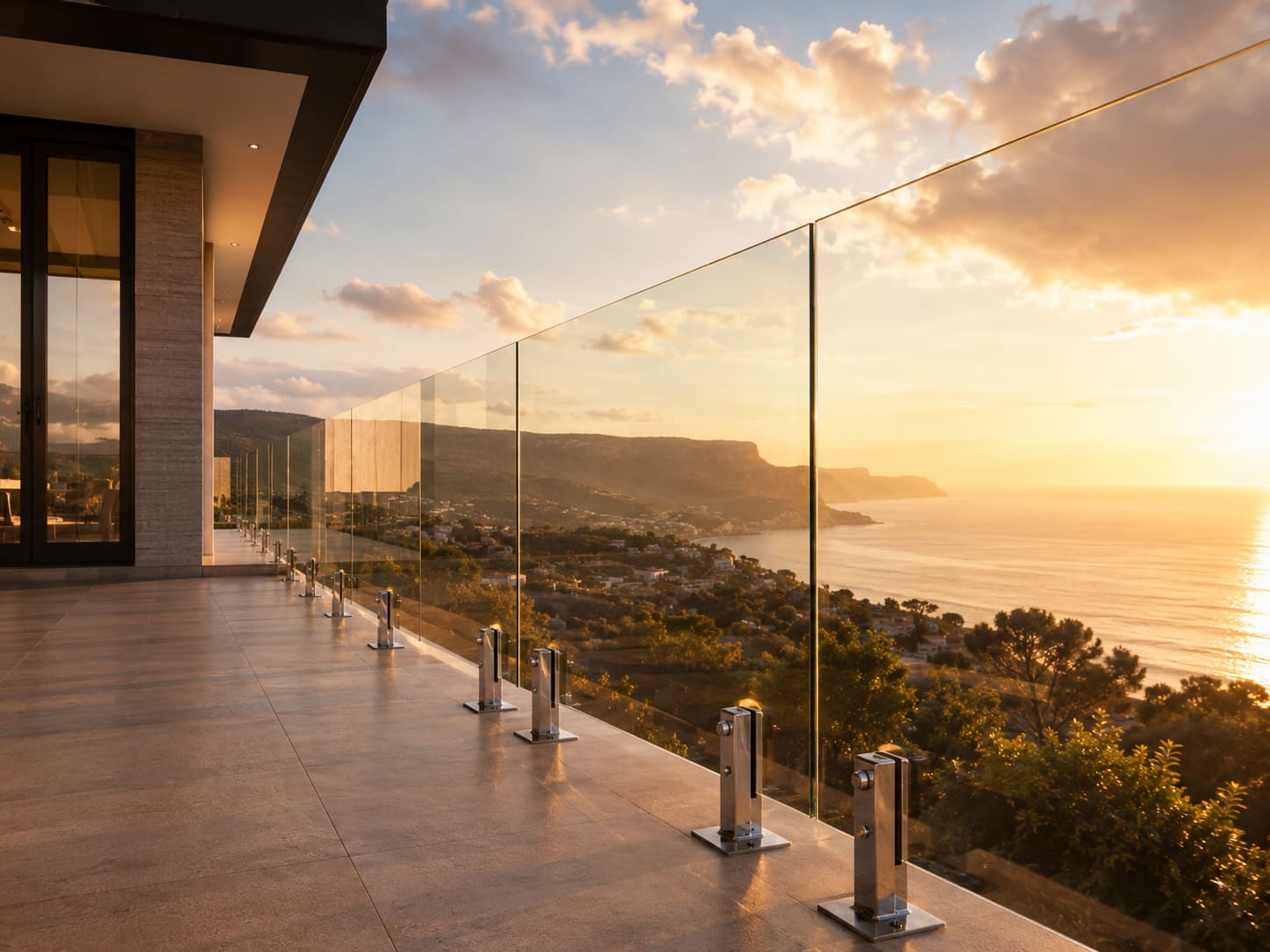
- Semi-frameless (spigot/standoff) railings: stainless steel spigots or standoffs grip the glass at the base with an open top edge. Mid-range (INR 900-1,300 per running foot) and popular on villa balconies in Kokapet and Kondapur, this system leans entirely on the quality of the base fittings, which carry the full load.
- Frameless railings: 12mm-15mm glass sits in a slim base channel or point-fixed clamps with no top rail. It is the premium look (INR 1,200-1,800 per running foot), favoured in Banjara Hills and Jubilee Hills apartments and Financial District office terraces where uninterrupted skyline views justify the cost. You can see finished examples in our recent projects.
How the twin-cities climate changes the specification
Hyderabad's climate should directly change your fittings and glass choice, not just the design. The twin cities swing from 42C-plus summers to a lashing monsoon, and the Financial District's open, elevated plots amplify both wind loading and dust far beyond what an inner Secunderabad street sees. Specifying for a calm inland balcony when you actually have an exposed 15th-floor corner is the most expensive mistake owners make here.
- Fittings: use 316-grade stainless steel (not 202) on any balcony facing open weather. 316 resists monsoon moisture and airborne pollutants far better and will not develop tea-coloured rust bleeding after a couple of years. 202 steel is cheaper and looks identical in the showroom, but it is the single most common cause of a railing looking tired within one wet season.
- Glass tint and coating: a low-iron or lightly tinted glass cuts glare on west-facing HITEC City and Gachibowli balconies that catch harsh afternoon sun, and reduces the surface heat you feel when you lean on the rail.
- Drainage and sealing: base channels must have weep holes so monsoon water drains instead of pooling and staining the fixings. Poor drainage is the number one reason a railing ages badly after its first monsoon.
- Wind loading: exposed high-floor balconies see far higher gust pressure than a covered ground-floor terrace. That is what pushes the recommendation to 12mm minimum glass and 316 spigots above the third floor - the glass and fixings must resist deflection, not just support a static lean.
- Dust: frameless standoff systems collect less grime than deep framed channels, which matters given the construction dust common around Kokapet, Neopolis and the wider Financial District growth corridor.
Realistic 2026 pricing across Hyderabad and Secunderabad
Expect to pay INR 550 to INR 1,800 per running foot installed across Hyderabad and Secunderabad, with the final figure driven by glass thickness, fitting grade and site access. A standard 10-foot apartment balcony therefore lands roughly between INR 15,000 and INR 45,000 fitted, before any premium for high-floor access. Here is how the tiers break down:
- Budget framed (8mm-10mm glass, aluminium channel, 202/304 steel): INR 550-850 per running foot.
- Standard spigot or standoff (12mm glass, 304 steel): INR 900-1,300 per running foot.
- Premium frameless (12mm-15mm glass, 316 steel, minimal hardware, top handrail): INR 1,200-1,800 per running foot.
Several factors push a quote toward the top of the band. High-floor towers needing rope access or crane lifting add 10-25%. Custom curved or bent glass, low-iron ultra-clear glass, laminated-toughened build-ups, and a bolt-on stainless handrail each add cost. So does difficult site access - narrow service lifts and long carry distances on a live construction site all add labour.
Always get the quote in writing with glass thickness, steel grade and warranty stated line by line, and compare like-for-like specifications rather than headline prices. A cheaper quote using 202 steel and 8mm glass is simply not the same product as a 316-and-12mm one - it will cost you again within two years. Browse our services to see the full range of railing and glazing systems we can price against your drawings.
Hardware and fittings that make or break a glass railing
The hardware is what fails first on a poorly specified glass railing, so it deserves as much attention as the glass itself. In the Financial District's exposed conditions the fixings, clamps and channels carry every gust and every downpour, and cheap components loosen or corrode long before the glass ever does. Getting the fitting set right is the difference between a rail that still looks new at five years and one that is streaked and wobbly at eighteen months.
- Base spigots and clamps: these transfer the entire load into the slab, so 316-grade spigots are non-negotiable on open balconies. Look for solid cast or forged bodies, not thin pressed shells.
- Glass clamps, standoffs and patch plates: precision hardware keeps panels aligned and the gap between them consistent, which is what makes a frameless run read as crisp rather than wavy.
- Handrails and end caps: a bolt-on stainless handrail adds grip and stiffens the top edge of a spigot railing, meaningfully reducing panel deflection in high wind.
- Gaskets and setting blocks: the small rubber components inside a base channel stop glass-to-metal contact and let the panel move with heat. Skipping them causes edge chips and rattles.
As a dealer for Taiton, Enox and Ozone, we supply matched fitting sets so the spigots, clamps and handrail brackets share one finish and one corrosion grade. That single detail - one grade, one finish, all from the same range - keeps the whole railing looking new for years and avoids the mismatched-metal look of parts bought piecemeal.
Installation, drainage and structural fixing done right
A safe glass railing depends more on how it is anchored than on how it looks, so the fixing detail is where a good installer earns their fee. In Financial District high-rises the base spigots and clamps must be chemical-anchored into the structural slab or beam - never into tile, screed or a thin topping that can crack out under load. This is the point most worth watching on site.
The correct sequence matters just as much as the final fixings. Accurate site measurement comes first, then toughening and any lamination off-site (the glass cannot be cut or drilled after tempering), then core-drilling and chemical-anchoring the base fixings, and only then setting the glass. Rushing the anchoring stage to hit a handover date is a common local shortcut that leaves panels which rattle in the wind and fixings that work loose within a year. Our balcony glazing crews sequence the waterproofing and anchoring together so nothing has to be reopened later.
- Waterproofing: the fixing points must be sealed and integrated with the balcony's existing waterproofing so monsoon water cannot track down into the slab and rust the anchors from inside.
- Weep holes and slope: base channels need weep holes and a slight fall so water sheds toward the drain, not into the fixings.
- Movement gaps: leave small tolerance gaps at panel joints so glass and steel can expand in 42C summer heat without stressing the fixings.
- Access and safety: high floors often need edge protection or rope access during fitting, which should be planned and priced up front, not improvised on the day.
Glass railings beyond the balcony: staircases, terraces and offices
Glass railings do far more than edge a balcony - across the Financial District they define staircases, mezzanines, rooftop amenity decks, office fit-outs and cafe frontages. The same toughened glass and stainless fittings that suit an apartment balcony scale up neatly to commercial work, and a consistent glass language ties a whole building together.
- Staircase railings: a frameless glass balustrade with a slim stainless top handrail is the signature look in Gachibowli and Nanakramguda office fit-outs, pairing cleanly with the rest of a glazed facade for one seamless identity.
- Terrace and amenity decks: rooftop lounges on Kokapet towers use 15mm frameless glass with 316 spigots to keep sightlines open while meeting fall-protection height rules.
- Office and retail frontages: full-height glass rails at mezzanine edges and along atrium voids let daylight travel deep into a floor plate, a priority in the district's grade-A office stock.
- Villa and duplex interiors: internal glass rails on Kondapur and Tellapur villa staircases use 304 steel (covered, indoor conditions) and can drop to a lighter 10mm-12mm build with a top handrail.
Planning the glass, hardware and installation together - rather than buying each piece separately from different vendors - is what keeps a large Financial District project on schedule and on budget, and it is how we handle multi-floor commercial railing packages.
Common mistakes to avoid
Most railing problems in the Financial District trace back to a handful of avoidable decisions taken to save a little money up front. Knowing them in advance lets you challenge a suspicious quote before you sign it.
- Choosing 202 steel to save money: it looks identical on day one and bleeds rust within a year or two on any weather-facing balcony. Only 316 belongs outdoors here.
- Under-speccing glass thickness: 8mm on an exposed high-floor balcony deflects alarmingly in wind. Treat 12mm as the floor above the third storey.
- Anchoring into tile or screed: fixings must reach structural slab or beam. Anchors set only in a topping can pull out under load - a genuine safety risk, not just a durability one.
- Skipping weep holes and gaskets: these tiny items prevent water pooling and glass-to-metal contact. Leaving them out guarantees staining, chips and rattles.
- Comparing quotes on price alone: a headline number means nothing without the glass thickness, steel grade, hardware brand and warranty spelled out. Insist on a like-for-like, line-by-line comparison.
- No written warranty: without a workmanship warranty in writing, you have no recourse when a fixing loosens. Reputable installers put it on paper.
What to check before you sign off
Before approving any glass railing installation, verify these six things to avoid safety and rust problems later. They separate a durable railing from one that loosens within a monsoon or two, and they cost nothing to insist on. A reputable installer will welcome the scrutiny.
- Toughened stamp: every panel should carry an etched IS 2553 / safety-glass mark in a corner - no stamp, no acceptance.
- Steel grade: confirm 304 for indoor or covered runs and 316 for open, weather-facing balconies, and ask to see the fitting brand and grade documentation.
- Anchor fixing: base spigots and clamps must be chemical-anchored into structural slab or beam, not just tile or screed.
- Gap and height: keep the overall height and panel gaps compliant - generally 900mm-1100mm high for balconies in Telangana and Andhra Pradesh developments.
- Drainage: check for weep holes in the base channel and a slight slope so monsoon water sheds away from the fixings.
- Warranty and quote: get at least a 1-year workmanship warranty plus the glass manufacturer's toughening warranty in writing, and keep the itemised quote as your reference. If any of these cannot be confirmed on site, pause the sign-off and ask questions.