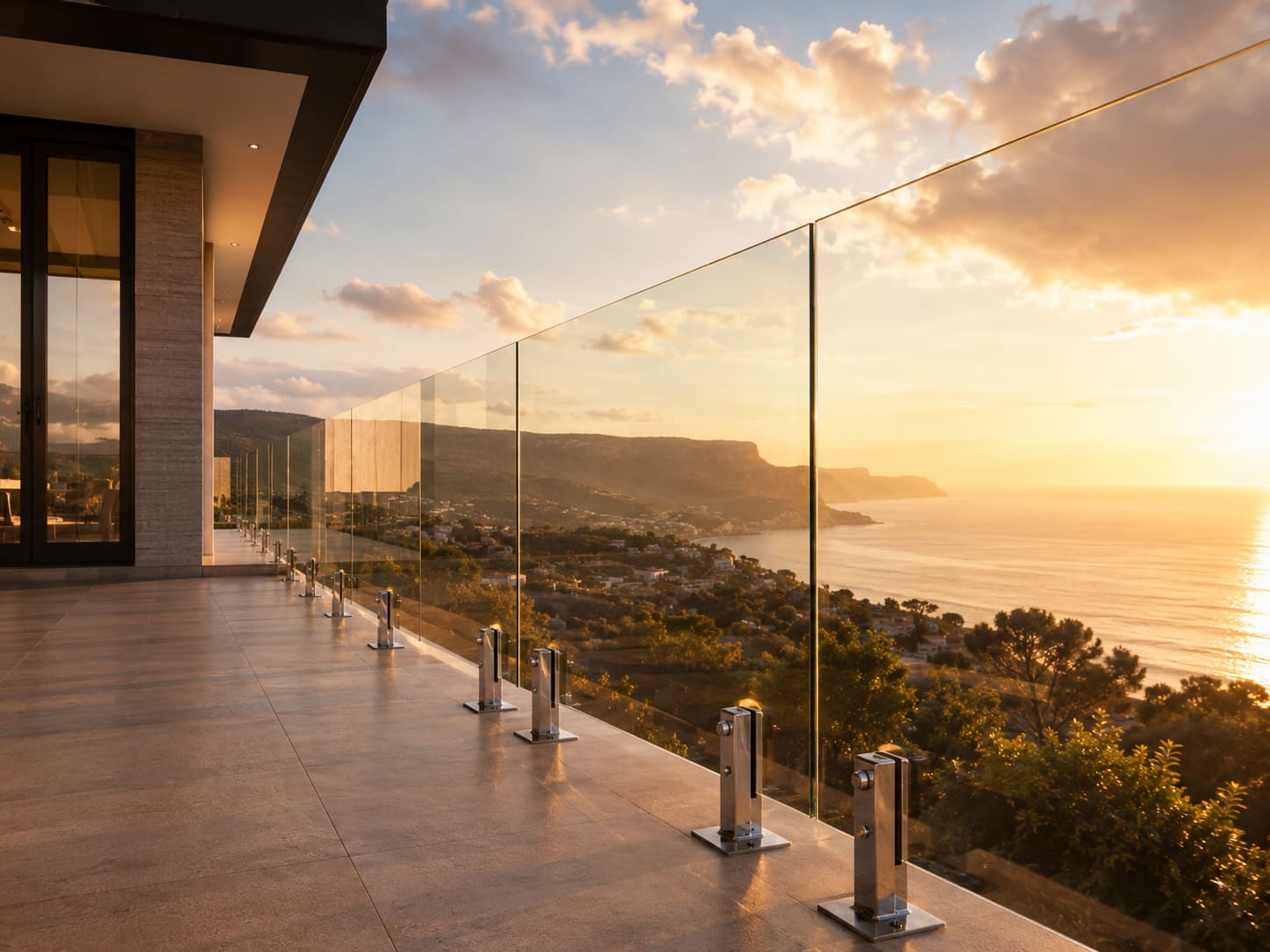
A glass railing in Kondapur typically costs between INR 550 and INR 1,400 per running foot installed in 2026, depending on whether you choose a framed, semi-frameless or fully frameless system and the thickness of toughened glass used. For a standard 10-foot balcony in a Kondapur apartment, expect a finished price of roughly INR 18,000 to INR 45,000 including hardware and installation. The upper end applies to frameless 12mm toughened glass on premium SS-316 stainless-steel spigots, the most requested option for balconies that open onto the HITEC City skyline. Our glass railing systems cover all three styles, so the only price that really matters is the one matched to your exact opening, floor height and view.
Kondapur sits at the heart of Hyderabad's IT corridor, wedged between Gachibowli, Madhapur and the Financial District, so demand for clean, modern glass balustrades in new apartments and gated villas is unusually high. Builders across Telangana now specify glass over MS grille because it protects the view, meets modern safety norms and photographs beautifully for resale listings. This guide breaks down the glass grades, fittings, realistic twin-city pricing and the climate-specific details - 44-degree summers, driving monsoon rain and construction dust - that decide whether your railing still looks good five years from now.
Whether you are finishing a 3BHK balcony, an internal duplex staircase or a full villa terrace, three levers control cost and lifespan: glass thickness, stainless-steel grade and installation quality. Get those right and a glass railing becomes a one-time, near-maintenance-free upgrade. Get them wrong and you are chasing rust stains and loose spigots after the first monsoon. If you already have your measurements, you can get a free quote and jump straight to a site visit.
How much does a glass railing cost in Kondapur in 2026?
A glass railing in Kondapur costs INR 550 to INR 1,400 per running foot installed in 2026, with the final figure driven by framing style, glass thickness and hardware finish. Running foot pricing is the industry standard here, so the fastest way to sanity-check a quote is to divide the total by the length of the railing. Here is how the common systems compare across Hyderabad and Secunderabad:
- Framed / channel railing (8mm toughened): INR 550 to INR 750 per running foot - budget-friendly and common in Kukatpally, Miyapur and older Kondapur flats.
- Semi-frameless with SS pillars (10mm toughened): INR 800 to INR 1,050 per running foot - a popular, sturdy mid-range balcony choice.
- Frameless with base channel or spigots (12mm toughened): INR 1,100 to INR 1,400 per running foot - favoured in Gachibowli, Kokapet and Jubilee Hills villas.
- Staircase glass railing (10-12mm with SS handrail): INR 1,000 to INR 1,500 per running foot depending on step geometry and the number of turns.
As a rule of thumb, a typical Kondapur 3BHK with two balconies and one internal staircase lands between INR 60,000 and INR 1,20,000 for a complete frameless job. Prices then flex with three add-ons: low-iron (extra-clear) glass adds roughly 15-25 percent, laminated-toughened glass adds 30-40 percent, and premium branded structural fittings can add INR 150-300 per foot over generic hardware. A swing gate onto a terrace, a curved run, or a cut-out around a column will each carry a small extra because they add fabrication complexity.
Ask every vendor to quote the glass thickness and stainless-steel grade in writing. Two quotes that look INR 200 apart per foot are often really comparing 8mm SS-202 against 12mm SS-316 - not the same product at all, and not a fair comparison. You can browse our recent projects to see what finished frameless and semi-frameless jobs actually look like before you lock a budget.
Which toughened glass and fittings suit Hyderabad's climate?
For Hyderabad's climate, always use toughened (tempered) safety glass of at least 10mm for balconies and 12mm for frameless designs, paired with grade SS-304 or SS-316 stainless-steel fittings. Hyderabad summers push 42-44 degrees C, the June-September monsoon brings driving rain, and construction dust from the IT corridor settles fast - so material choice matters more here than in cooler, cleaner cities.
- Glass thickness: 10-12mm toughened is standard for railings; thinner 8mm belongs only in fully framed channel systems where the frame carries the load.
- Glass type: clear glass shows fewer water spots than tinted in dusty areas, while low-iron (extra-clear) glass removes the faint green edge tint and suits premium Banjara Hills and Jubilee Hills homes.
- Fittings near open balconies: choose SS-316 spigots and clamps - the higher chromium and nickel content resists the pitting corrosion that SS-202 develops within a couple of monsoons.
- Interior staircases: SS-304 is adequate and more economical because the hardware stays dry.
- High-floor safety: laminated-toughened glass is worth the extra cost on high balconies in HITEC City towers because the interlayer holds the pane together even if it breaks.
The hardware you cannot see does most of the work. Quality spigots, standoffs, base shoes and clamps are what keep a 40-45 kg pane rigid in wind and dead level over years. Insist that every pane carries a manufacturer's toughening stamp etched in a corner; untoughened glass is a genuine safety hazard on any balcony above the ground floor, and it is the first thing a good installer will point out.
Framed vs frameless glass railing: what should Kondapur homes pick?
Frameless glass railings give the cleanest, most modern look and are the top choice for Kondapur apartments and Gachibowli villas that want an unobstructed view, while framed systems cost less and hide minor glass edge imperfections. Your decision usually comes down to three things: view, budget and how often you are willing to wipe the glass.
- Choose frameless (spigot or base-channel) if you want maximum transparency for a skyline or garden view and are comfortable cleaning glass more often.
- Choose semi-frameless (SS pillars with a top handrail) for the best balance of cost, strength and easy cleaning - a sensible default for most twin-city balconies.
- Choose framed / channel systems for terraces, service balconies or rental units in Kukatpally and Miyapur where budget is the priority and the view is secondary.
- For internal staircases, a slim SS handrail on top of frameless glass is the most requested combination in new Kondapur duplexes.
The engineering behind the look matters too. Frameless systems lean entirely on the base fixing, so they demand thicker 12mm glass and premium spigots anchored deep into the slab. Semi-frameless designs share the load with vertical posts, so you can drop to 10mm glass and save on both glass and structural hardware without losing real-world strength. If you are torn, most homeowners are happiest with semi-frameless on service-heavy sides and full frameless on the one balcony that carries the view.
Balcony vs staircase glass railings: matching the system to the space
For a Kondapur balcony, prioritise weather-resistant SS-316 frameless spigots and 12mm glass; for an internal staircase, prioritise a comfortable SS handrail and 10mm glass on SS-304 fittings. The two applications face completely different stresses, and treating them the same is where budgets get wasted - either overspending on corrosion resistance indoors, or underspending on it outdoors.
Balconies are exposed to sun, rain and dust, and code-conscious builders across Telangana and Andhra Pradesh now target a minimum 1050mm (about 42-inch) railing height on upper floors. That exposure is exactly why outdoor work justifies the corrosion-resistant grade and the thicker pane. Our balcony glazing work often pairs a glass railing with a top rail or a slim aluminium capping so the exposed glass edge is protected and the sightline stays crisp against the weather.
Staircases live indoors, stay dry and are touched constantly, so ergonomics beat weather-proofing. Here the handrail comfort, the smoothness of the SS finish and neat standoff fixings matter most, and you can safely economise on the stainless grade.
- Balcony must-haves: SS-316 fittings, 12mm toughened glass, sealed slab anchors, and a wipe-clean clear pane.
- Staircase must-haves: a warm-to-touch SS-304 handrail, 10-12mm glass sized to the step geometry, and standoffs that clear the stringer cleanly.
- Shared must-have: proper edge polishing on every exposed glass edge so there are no chip-prone sharp corners and no injury risk.
Hardware, spigots and fittings that keep a glass railing rigid
The single biggest predictor of whether a glass railing stays tight and rattle-free is the quality and anchoring of its stainless-steel hardware, not the glass itself. As a glass, aluminium and facade specialist we see the same failure repeatedly: good glass let down by cheap fittings and shortcut fixing. A pane is only ever as steady as the spigot holding it.
- Spigots and base shoes: these are the structural anchors for frameless glass. Specify SS-316 outdoors and bolt them into the RCC slab with load-rated chemical or expansion anchors, never into screed or tile bed.
- Clamps and standoffs: these hold semi-frameless and staircase glass to posts or walls, and let you fix without drilling extra holes through the pane.
- Handrails and grips: a well-finished top rail turns a balustrade into something people actually enjoy touching, and it caps and protects the vulnerable glass edge.
- Patch fittings: where a glass railing meets a glass gate or terrace door, these give a slim, frameless junction that keeps the whole run looking continuous.
- Gate closers: if your railing includes a swing gate to a terrace or pool deck, a properly rated closer keeps it self-closing and child-safe.
Finish consistency is the detail that separates a professional job from an assembled-piecemeal one. Matching the SS finish - satin versus mirror - across railing, gate and door hardware is what makes a home read as designed rather than patched together. It costs nothing extra to plan, but it is nearly impossible to fix after the fact, so decide the finish before anyone orders parts.
Installation process and timeline for a Kondapur project
Plan for about a week from final measurement to a finished glass railing in Kondapur: 3 to 5 working days to fabricate toughened glass, then 1 to 2 days of on-site installation for a typical balcony. Toughened glass cannot be cut, drilled or edge-worked after tempering, so every measurement and cut-out has to be locked before the panes ever go into the furnace. This is why a phone estimate can never be a real quote.
- Step 1 - Site measurement: a technician measures each opening, checks slab condition and confirms the fixing type; this is where a firm quote replaces a rough estimate.
- Step 2 - Fabrication: glass is cut, holes and notches are added, edges are polished, and only then is it toughened (3-5 working days).
- Step 3 - Base setup: spigots or base channels are anchored into the RCC slab with chemical or expansion bolts and levelled precisely.
- Step 4 - Glazing: panes are set, aligned, gapped for thermal expansion and locked into the fittings.
- Step 5 - Sealing and handover: joints are silicone-sealed against monsoon water, the glass is cleaned, and the warranty plus toughening certificate are handed over.
Larger villa or multi-staircase jobs in Gachibowli or Kokapet may run 3 to 4 days of on-site work. Explore our services if the same project also needs shower enclosures, partitions or facade glazing handled by one accountable team on one schedule, which usually saves a round of coordination headaches.
Maintenance: keeping glass railings clear through the monsoon
A toughened glass railing in Hyderabad needs only light monthly cleaning and one annual hardware check to stay clear and safe for a decade or more. The enemies here are hard-water spotting, corridor dust and slow corrosion at the fixings - all of them easily managed with a simple routine that takes minutes.
- Clean the glass monthly with a mild soapy solution and a squeegee; avoid abrasive pads that permanently scratch the surface.
- Treat stubborn hard-water spots with a 1:1 white vinegar and water mix, leave it a minute, then rinse clear.
- Wipe SS-316 fittings occasionally with a soft cloth; genuine 316 will not rust, so any orange staining is a red flag that a cheaper grade was substituted - raise it with your installer immediately.
- Once a year, check that spigots and clamps are still torqued tight and that silicone seals have not lifted at the joints.
- After heavy monsoon storms, rinse off dust and grit before it bakes onto the glass in the following summer heat.
This is far less upkeep than a painted MS railing, which needs rust treatment and repainting every couple of years in the humid twin-city climate - one of the main reasons glass has quietly overtaken grille in new Kondapur builds.
Common mistakes to avoid when buying a glass railing
The most expensive glass railing mistakes in Kondapur are all avoidable, and every one of them shows up only after installation - when it is hardest to fix. Knowing them in advance is the cheapest insurance you can buy.
- Buying on headline price per foot without comparing glass thickness and SS grade - the cheap quote is almost always thinner glass on SS-202.
- Accepting untoughened or heat-strengthened glass in place of fully toughened; ask to see the corner stamp.
- Letting a fitter anchor spigots into tile adhesive or screed instead of the RCC slab, which causes wobble within months.
- Skipping edge polishing to save a little, leaving sharp, chip-prone glass edges on a surface people lean on.
- Ignoring railing height - going below the 1050mm minimum on upper floors fails safety expectations and can be flagged at resale.
- Forgetting expansion gaps and silicone sealing, which lets monsoon water sit in the base channel and corrode the fixings.
A reliable installer will raise every one of these before you ask, and will happily put the specification in writing. If a vendor gets cagey about grade, thickness or fixing method, treat that as the answer. When you are ready to compare properly, get a free quote with your rough dimensions and floor level and insist the numbers name the glass and the steel.
How to choose a reliable glass railing installer in Hyderabad
Choose a Kondapur glass railing installer who fabricates toughened glass to your exact measurements, supplies SS-316 fittings for outdoor use, and offers a written warranty on both glass and hardware. The quality of the install - anchor bolts, level, silicone sealing - matters as much as the glass itself, so vet the process, not just the price.
- Ask for a site measurement before quoting; a flat per-foot number over the phone almost always hides extras.
- Confirm the glass is cut and drilled first and then toughened, since holes and edges cannot be worked after tempering.
- Check that spigots are anchored into the RCC slab with proper chemical or expansion bolts, not tile adhesive.
- Request a minimum 1-year workmanship warranty plus the glass maker's toughening certificate.
- Get 2-3 quotes across Hyderabad and Secunderabad and compare on glass thickness and fitting grade, not just the headline number.
As a specialist that both fabricates glass and stocks branded hardware, we can quote a single accountable price covering glass, fittings and installation across Telangana and Andhra Pradesh. If you want a firm number for your balcony or staircase, get a free quote with your rough dimensions and floor level and we will follow up with a site visit anywhere across the twin cities.