
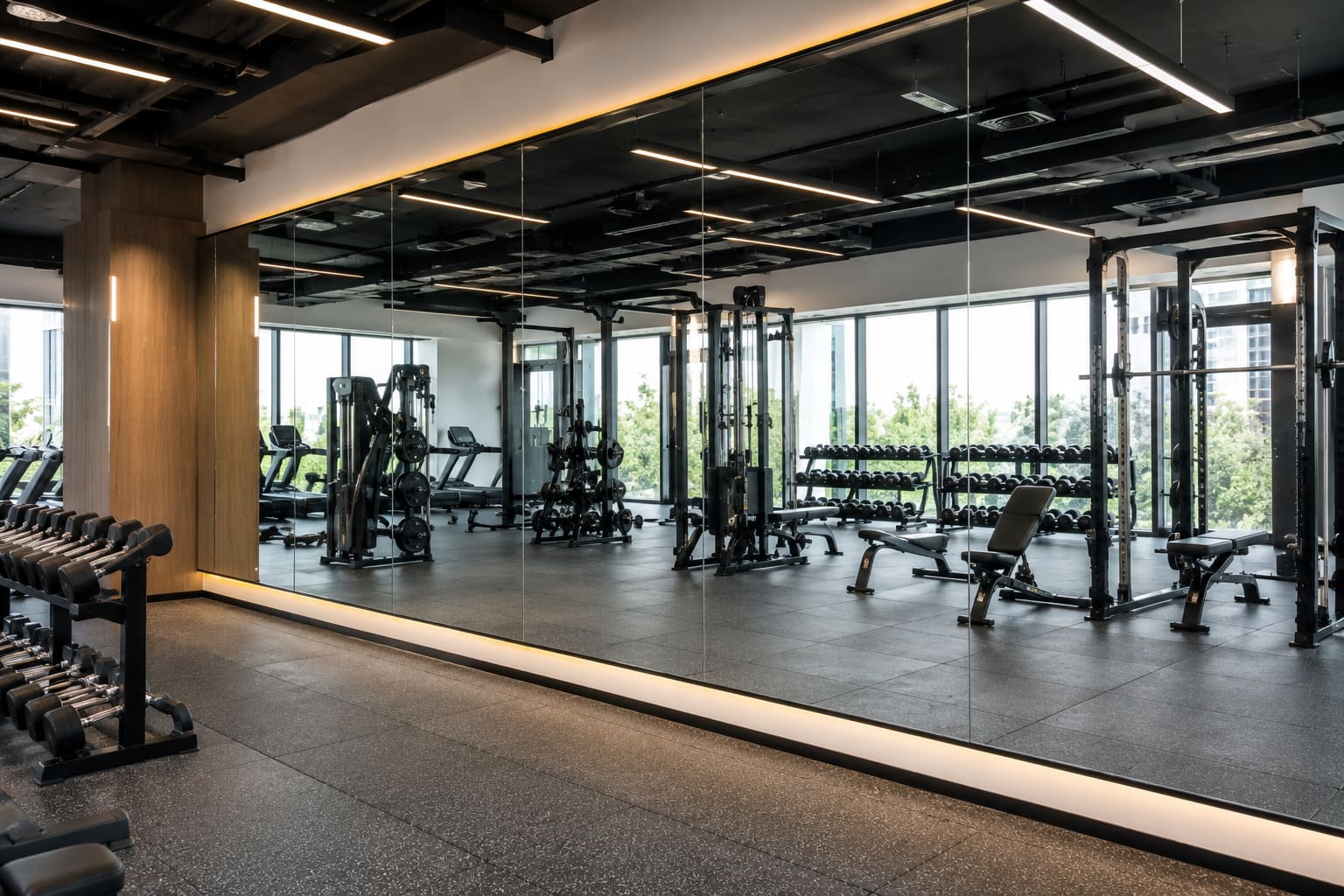
To maintain a gym or studio mirror wall, wipe it daily with a dry or barely damp microfibre cloth, clean it weekly with a few drops of mild dishwashing liquid sprayed onto the cloth (never onto the glass), keep the exposed bottom edge sealed with silicone, and run ventilation to pull humid air out. Do this and a properly installed gym mirror wall will stay bright and corrosion-free for eight to twelve years. Skip it, and the same wall can bloom with grey-black edges inside two monsoons.
A floor-to-ceiling mirror is the hardest-working surface in any gym or dance studio, yet it is the one owners forget until it starts to fog, streak or blacken at the corners. The sweat, humidity and aerosol deodorants inside a fitness room are far more aggressive on glass than anything in a home, so the routine has to be a little different.
In Hyderabad, Secunderabad and across Telangana and Andhra Pradesh, the swing from dry 42 degree summer afternoons to a saturated July monsoon puts real stress on the silver backing of a mirror. This guide walks through daily cleaning, humidity control, edge protection, safety checks and when repair or replacement makes sense, with realistic INR costs so you can budget properly.
Why do gym mirrors need special care?
A gym mirror faces a combination of stresses a bathroom or bedroom mirror never sees. Body heat and breath raise the humidity of the room, sweat throws salt onto the surface, and clients spray deodorants and dry shampoos that settle as an oily film. Salt and ammonia are both mild corrosives, and the reflective sandwich behind the glass, a thin layer of silver protected by copper and paint, is exactly what they attack.
The other factor is scale. A studio mirror is often 8 to 12 feet wide and floor mounted, which means every mop stroke, every splash of drinking water and every wipe of the floor sends moisture straight at the vulnerable bottom edge. Understanding these two pressures, chemistry and water at the edge, is the whole basis of good mirror works maintenance.
Get the routine right and the payoff is real: a mirror that reads true and bright supports better form correction for lifters, dancers and yoga practitioners, and a clean wall is the single biggest driver of how premium a studio feels to a prospective member.
Daily and weekly cleaning the right way
The single biggest cause of a dull, cloudy gym mirror is the wrong cleaner used too often. Ammonia-based glass sprays and vinegar look harmless, but repeated overspray runs down to the exposed bottom edge and attacks the silver and copper backing, which is what produces those grey-black blooms.
Follow a simple two-tier routine for a streak-free, long-lasting finish:
- Daily: wipe visible sweat splashes and hand marks with a clean, dry or barely damp microfibre cloth. Do not spray anything directly onto the glass.
- Weekly: mist a microfibre cloth (not the mirror) with a mild solution of a few drops of dishwashing liquid in warm water, wipe the whole surface, then buff dry with a second lint-free cloth using vertical strokes.
- Always spray onto the cloth, never onto the wall, so liquid can never pool along the exposed edges or run behind the glass.
- Keep a squeegee for large walls; it clears water fast and prevents the drip lines that dry into streaks.
- Use two cloths, one damp and one dry, and swap the dry one when it stops squeaking clean. A saturated cloth just spreads film around.
A commercial studio with heavy footfall should treat the weekly wipe as a twice-weekly job in monsoon season, when condensation forms overnight and dries into a haze by morning.
Why is my studio mirror turning black at the edges?
Black or grey patches creeping in from the corners are called desilvering, and in a Hyderabad monsoon they are the number one enemy of a mirror wall. Trapped moisture reaches the reflective layer, corrodes the silver, and once it starts it only spreads inward. There is no way to reverse it on an installed panel.
The good news is that prevention is far cheaper than replacement, and every preventive step is within a facility manager's control:
- Run cross-ventilation or an exhaust fan during and after classes to pull humid, sweaty air out of the room.
- Never mount a mirror flush against a damp or freshly plastered wall; a small air gap and a moisture-resistant backing board are essential, especially in coastal Andhra Pradesh humidity around Visakhapatnam and Kakinada.
- Wipe mirrors down after high-sweat sessions so salt residue does not sit on the glass overnight.
- Seal the bottom edge with a clear neutral-cure silicone bead so mopping water and sweat cannot wick underneath.
- In fully air-conditioned studios in Gachibowli or Hitec City, keep an eye on the wall nearest the AC drain and any exterior wall, which are the coldest surfaces and the first to sweat condensation.
If you already see a dark bloom smaller than a coin, seal the nearby edge immediately and monitor it monthly. If it is growing, plan for a panel swap before it reaches eye level.
Protecting edges, fixings and safety
A gym mirror wall is usually large glass, and the fixings matter as much as the surface. Loose J-channels, aged adhesive or a chipped edge can turn into a genuine hazard in a room full of moving people, dropped dumbbells and jumping feet.
Inspect the installation every three to four months. Check that top clips and bottom tracks are firm, that no corner is bowing away from the wall, and that any safety-backing film is intact and un-peeled. If your studio uses free-standing or rolling mirrors, tighten castors and frame bolts on the same schedule.
For any wall above waist height in a public studio, insist on safety-backed or film-laminated mirrors so that if the glass is ever struck, the shards stay bonded to the backing rather than showering onto the floor. This is the same safety logic behind toughened glass work and laminated glass work elsewhere in a building, and it is not a place to cut cost. A weight plate dropped against an unbacked annealed mirror can send glass across a busy floor in an instant.
Hyderabad climate: heat, monsoon and dust
Telangana's climate hits a mirror wall from three directions across the year, and each needs a slightly different response.
- Summer heat (March to June): high room temperatures accelerate the off-gassing of adhesives and can soften cheap mastic behind a mirror. Keep the room within normal comfort range and make sure fixings are mechanical, not adhesive alone, on large panels.
- Monsoon humidity (July to September): this is the desilvering season. Ventilation and edge sealing matter most now, and the weekly clean should become twice weekly to clear condensation haze.
- Dry dusty spells and the Deccan dust that blows through Kondapur, Kokapet and the Financial District: airborne grit is abrasive, so never wipe a dusty mirror dry with pressure. Lift the dust with a damp cloth first, or you will drag fine scratches across the face.
Studios near construction zones, and there are many in fast-growing Kokapet and the Financial District, should expect a heavier dust load and clean the mirror face more gently and more often to avoid micro-scratching that clouds the reflection over time.
How much does gym mirror repair and replacement cost in Hyderabad?
Minor issues are worth fixing early. Re-sealing edges, re-securing clips or polishing out light scratching is inexpensive compared with a full panel swap. Here are indicative costs in the Hyderabad and Telangana market for 2026:
- A new 5mm gym-grade mirror wall typically runs INR 110 to 180 per square foot supplied and fitted, depending on size, backing and site access.
- Safety film backing or a laminated safety mirror adds roughly INR 40 to 90 per square foot, and is money well spent in any public room.
- Edge re-sealing and refixing a loose panel: around INR 1,500 to 4,000 as a service call, depending on wall size and access.
- Replacing a single desilvered panel is usually far cheaper than reglazing an entire wall, so design the layout in modular sheets and swap only the affected sheet.
- LED-backlit feature mirrors and framed decorative walls cost more; a decorative mirror wall or a studio mirror wall with integrated lighting is priced per project.
Once desilvering has spread beyond a small corner, replacement is the only real fix; there is no reliable way to re-silver an installed mirror on site. You can see the range of studio and gym installations we have completed on our projects page, and if you want a firm number for your room you can get a free quote with measurements.
Choosing the right mirror at installation to reduce upkeep
Half of all maintenance headaches are designed out at the fitting stage. The cheapest 4mm import mirror with a thin backing will desilver years before a quality 5mm or 6mm mirror with a full copper-free, lead-free protective coat, and the price difference is small over the life of the wall.
When you commission a wall, specify these four things:
- Glass thickness of at least 5mm for spans over 6 feet, so the surface stays flat and the reflection does not distort.
- A moisture-resistant backing board and a ventilated air gap, never a mirror glued straight onto raw plaster.
- A sealed bottom edge and mechanical top-and-bottom fixings, not adhesive alone.
- Safety backing film as standard on any public wall.
Getting these right is exactly what a specialist gym mirror wall installer builds in by default. It is also worth planning the wall around your fit-out; where a studio also wants clear zoning, pairing mirrors with glass partitions keeps sight lines open while separating a stretching area from the main floor.
A simple maintenance schedule you can hand to staff
The easiest way to keep a mirror wall pristine is to turn the advice above into a checklist the front-desk or housekeeping team follows without thinking. Print it and stick it in the cleaning cupboard.
- Daily: dry or barely damp microfibre wipe of splashes and hand marks; quick look for new drips at the base.
- Weekly (twice weekly in monsoon): full clean with diluted dish soap on the cloth, buff dry with vertical strokes, squeegee large panels.
- Monthly: check the silicone bead at the bottom edge and re-seal any gaps; inspect for early desilvering spots.
- Quarterly: check all clips, tracks, castors and bolts; confirm safety backing is intact and no corner is bowing.
- Annually: professional inspection for any studio open to the public, tied in with your other facade and glazing checks.
Kept up, this routine costs a few minutes a day and postpones a five-figure reglaze by years. If a check ever turns up a bowing panel, a loose track or spreading desilvering, do not wait, contact us for an assessment before a cosmetic issue becomes a safety one.