Reducing building heat gain means limiting the solar and conductive heat that enters through glazing, walls and roof, achieved primarily by specifying low-SHGC insulated glass, adding external aluminium shading, installing a reflective cool roof and running continuous wall insulation. In a hot city like Hyderabad, where summer air temperatures regularly cross 40 degrees Celsius and strong solar radiation persists for eight months a year, controlling heat gain is the most effective lever for cutting air-conditioning energy, which typically accounts for 40-60% of a commercial building's electricity bill.
Heat enters a building through three physical pathways: solar radiation (direct sunlight through glass and onto opaque surfaces), conduction (heat flowing through the fabric of walls, roof and window frames) and infiltration (hot outside air leaking through gaps and joints). A sound strategy tackles all three, but the largest and cheapest wins come from the building envelope, and within the envelope, from the glazing. For an office tower in Gachibowli, the Financial District or Hitec City with a fully glazed elevation, the glass is doing most of the heating and cooling work.
This guide walks through each measure with concrete performance figures, realistic Hyderabad pricing, and the Indian standards, the National Building Code (NBC) 2016 and the Energy Conservation Building Code (ECBC), that govern them. Whether you are building a new structural glazed facade or retrofitting an existing home in Kondapur, the principles and priorities are the same.
What Are the Three Sources of Heat Gain?
Heat gain is quantified as a cooling load, measured in watts or tons of refrigeration (TR), and comes from external sources (solar and conduction), infiltration, and internal loads from people and equipment. Understanding which source dominates tells you where to spend money first.
- Solar (radiant) gain: Sunlight passing through glazing is the largest external source in glass-heavy buildings, governed by the glass Solar Heat Gain Coefficient (SHGC), a value from 0 to 1 where lower is better.
- Conductive gain: Heat flowing through walls, roof and frames, governed by the U-value in W/m2K; a lower U-value means better insulation and slower heat flow.
- Infiltration gain: Uncontrolled hot-air leakage through joints, gaps and poorly sealed windows, controlled by air-tight gaskets and continuous weather seals.
- Internal gain: Heat from lighting, computers, machinery and occupants, reduced with LED lighting and efficient equipment rather than glass or shading.
In Hyderabad's composite-to-hot-dry climate, west- and south-facing facades take the heaviest solar load, especially the brutal 2 pm to 6 pm western sun, and should be prioritised for the strongest glazing and shading. East elevations get intense low-angle morning sun; north faces are the mildest and can carry more vision glass.
Specify High-Performance Glazing First
The single most impactful measure is replacing ordinary glass with low-SHGC, low-emissivity insulated glazing, because windows and curtain walls can contribute 30-40% of total heat gain despite covering a modest share of surface area. If you change only one thing, change the glass.
- Single 5-6mm clear glass has an SHGC near 0.80 and a U-value around 5.7 W/m2K, offering almost no thermal control; it is the worst choice for Telangana.
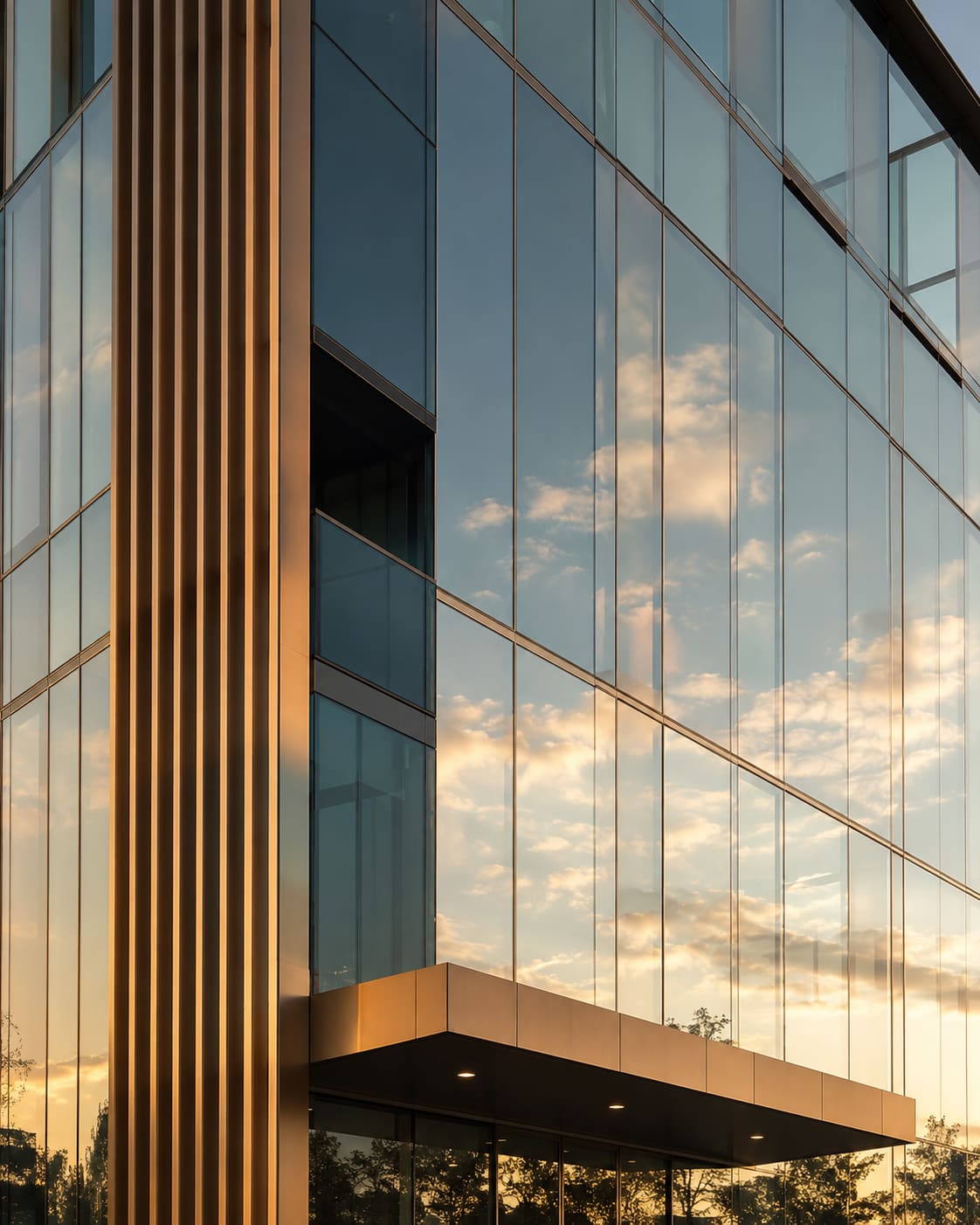
- Solar-control (heat-reflective) coated glass lowers SHGC to roughly 0.30-0.45 while keeping useful daylight, a solid mid-range option for reflective glass facades.
- Low-E double-glazed units (DGUs), typically 6mm glass + 12mm argon gap + 6mm glass, achieve U-values of 1.6-2.8 W/m2K and SHGC below 0.30; these are the workhorse of a DGU facade.
- The best DGUs with spectrally selective low-E coatings reach SHGC of 0.20-0.25, blocking over 75% of solar heat while transmitting comfortable visible light.
- All glass in facades, doors and impact-risk zones should be toughened (tempered) safety glass conforming to IS 2553, up to five times stronger than annealed glass; laminated glass adds acoustic and safety benefits.
For large commercial buildings, ECBC prescribes maximum SHGC and U-value limits by climate zone that high-performance DGUs are designed to meet. If you are unsure which build-up suits your elevation and budget, our facade consultancy team can model the options.
Add External Shading and Orientation Control
External shading is the most cost-effective radiant-heat control because it intercepts sunlight before it strikes the glass, cutting solar gain through windows by 40-80%, far more than any internal blind can. It also protects glazing seals from UV and reduces glare for occupants.
- Horizontal overhangs and fins, such as aluminium sunshade louvres, are most effective on south and west facades where the sun is high.
- Vertical fins block low-angle morning and evening sun on east and west orientations, a common need on Hyderabad's IT-corridor towers.
- An overhang sized to the window height can eliminate direct summer sun while still admitting lower-angle winter light, a passive tuning that costs nothing to run.
- Aluminium is the preferred shading material for its light weight, corrosion resistance and 25-40 year lifespan with minimal maintenance in dusty, monsoon-prone conditions.
- Perforated metal screens and mesh, like a metal mesh facade, shade the elevation while preserving views and ventilation, and double as an architectural feature.
Where external shading is impractical on an existing building, internal blinds and heat-reflective window films offer partial relief but are far less effective because the heat is already inside the glass by the time it is intercepted.
How Much Does DGU Glazing Cost in Hyderabad?
As a planning benchmark in the Hyderabad market, expect roughly the following supplied-and-installed rates in 2026, varying with coating grade, frame system and project size.
- Single toughened glass in aluminium frames: around 450-700 INR per square foot.
- Solar-control reflective single glazing: around 550-850 INR per square foot.
- Low-E double-glazed unit (DGU) facade: around 900-1,600 INR per square foot depending on coating and spacer.
- External aluminium louvre shading: around 350-750 INR per square foot of screen.
- Cool-roof reflective coating: around 25-60 INR per square foot; roof insulation boards add 60-140 INR per square foot.
While a DGU costs more upfront than single glass, it typically pays back in 3-6 years through lower cooling bills in a hot climate, and it improves acoustic comfort near busy roads in Madhapur and Kondapur. For an accurate figure on your elevation, get a free quote with your drawings or window schedule.
Insulate the Roof and Walls
The roof is the largest single heat-gain surface on low-rise and mid-rise buildings, receiving the most intense direct solar radiation for the longest hours, so a reflective cool roof plus insulation delivers outsized savings on villas, showrooms and warehouses.
- A cool-roof coating or membrane with solar reflectance above 0.70 can lower roof surface temperature by 15-25 degrees Celsius, directly cutting ceiling heat.
- Roof insulation such as extruded polystyrene (XPS), expanded polystyrene (EPS) or PUF boards of 40-75mm brings roof U-value below 0.5 W/m2K.
- Wall insulation, cavity walls, or autoclaved aerated concrete (AAC) blocks reduce conductive gain through the largest opaque area of the building.
- Ventilated rainscreen cladding, such as ACP cladding or HPL cladding on an air gap, shades the wall and lets hot air rise away behind the panel.
- Light-coloured, high-reflectance external paint on walls and parapets reduces absorbed heat cheaply.
ECBC and the NBC 2016 energy provisions specify envelope U-value and roof insulation requirements for compliant commercial buildings, and Telangana's building approvals increasingly reference them.
Upgrade Window and Door Frames
The frame matters as much as the glass; a high-performance DGU set in a cheap, conductive aluminium frame leaks heat and defeats the investment. Frames are a thermal bridge unless deliberately broken.
- Thermal-break aluminium frames insert a polyamide barrier between inner and outer profiles, and thermal break windows can cut frame heat transfer by 40-60% versus plain aluminium.
- uPVC frames are naturally insulating; uPVC windows suit homes and offices seeking the lowest U-value with good sealing against dust.
- Casement and tilt-turn windows seal more tightly than basic sliders because they clamp against a gasket, reducing infiltration.
- Multi-point locking and quality EPDM gaskets keep the frame air-tight through years of monsoon and summer expansion cycles.
- For large openings, aluminium sliding windows with interlocking meeting stiles balance ventilation and reasonable sealing.
Choosing the right frame and operation type for each orientation is part of a whole-envelope approach rather than a glass-only fix.
Seal Gaps and Verify Real Performance
Air-tight sealing prevents hot outside air from infiltrating and quietly undermining your insulation and glazing investment; it should be verified during and after installation, not assumed. A leaky building never delivers the SHGC and U-values on the datasheet.
- Use quality EPDM or silicone gaskets and continuous weather seals around every window and door perimeter.
- Structural glazing joints should use weatherproof structural silicone sealant meeting ASTM C1401 for durable, water- and air-tight facades that survive Hyderabad's monsoon.
- Ensure glazed units are installed plumb and true so gaskets seat correctly and thermal breaks in aluminium frames stay continuous.
- After completion, check for daylight gaps, condensation and drafts, which are tell-tale signs of air leakage and poor workmanship.
- Keep glass clean; heavy dust films on the Outer Financial District corridor can reduce daylight and reflect performance, and grime traps heat on the surface.
You can see examples of sealed, high-performance facades in our completed projects, and read more on picking coatings in our guide to choosing energy-efficient glass.
Put It Together: A Priority Plan
For most Hyderabad buildings, tackle heat gain in this order of cost-effectiveness, doing what your budget and building type allow at each step.
- Step 1: Upgrade west- and south-facing glass to low-E DGU or at least solar-control glazing; this addresses the biggest single load first.
- Step 2: Add external aluminium shading to those same critical facades to compound the glazing benefit.
- Step 3: Apply a cool roof and roof insulation, essential for villas, showrooms and top-floor spaces.
- Step 4: Fit thermal-break or uPVC frames with tight-sealing gaskets to stop infiltration and frame conduction.
- Step 5: Insulate or clad walls, and switch to LED lighting to trim internal gain.
Done together, these measures routinely cut peak cooling load by 30-50% in retrofit projects and let new buildings meet ECBC comfortably. Hakimi Aluminium and Glass supplies and installs low-SHGC insulated glazing, aluminium shading, cladding and structural glazing across Hyderabad, Secunderabad and the wider Telangana and Andhra Pradesh region; talk to our team to plan the right combination for your project.