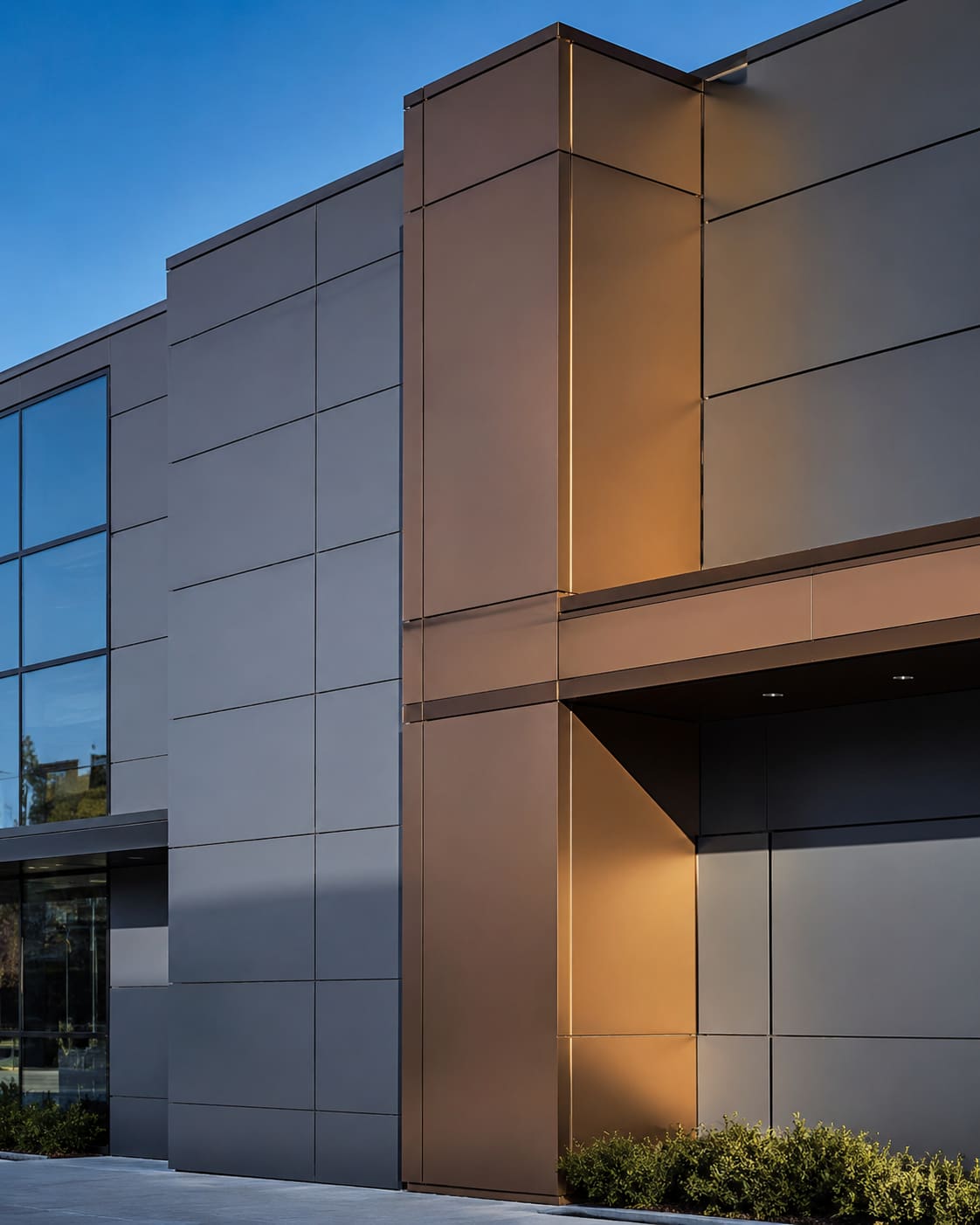
ACP fire rating comes down to a single hidden layer: the core sandwiched between the two aluminium skins decides whether a panel self-extinguishes or carries flame up an entire elevation. In the PE vs FR vs A2 comparison, PE is a combustible polyethylene core, FR is a fire-retardant mineral-blended core (typically Class B), and A2 is a near-fully mineral, non-combustible core (Class A2-s1,d0). That one specification choice is the line between a contained incident and a facade fire, which is why it now sits at the centre of every serious cladding conversation in Hyderabad, Secunderabad and across Telangana and Andhra Pradesh.
This guide breaks down what PE, FR and A2 actually mean, the Indian and European standards that govern them, the honest pros and cons of each grade, and realistic 2026 INR pricing so you can budget accurately. Whether you are cladding a showroom in Jubilee Hills, a hospital in Secunderabad, an IT block in the Financial District or a commercial tower in Vijayawada, understanding these grades protects both occupants and your capital. It also keeps your project on the right side of the municipal fire NOC, which is increasingly unforgiving on combustible cladding.
As a facade specialist that supplies and installs ACP cladding alongside fire-rated glazing across the twin cities, we specify these panels every week. Below is the same framework we use with architects and property owners before we price a job - no jargon, just the decisions that actually matter for safety, compliance and cost.
What PE, FR and A2 Actually Mean in an ACP Panel
An aluminium composite panel is a sandwich: two thin aluminium sheets, typically 0.21 mm to 0.50 mm thick, bonded to a central core. Total panel thickness is usually 3 mm or 4 mm. The core material is exactly what the fire rating classifies, and it is where the entire safety difference lives. Because the aluminium faces, colour, gloss and flatness look identical across grades, the fire performance is invisible to the naked eye.
- PE (Polyethylene): A 100% thermoplastic polyethylene core. It is economical, lightweight and flexible, which makes it easy to rout, fold and fabricate. But it is highly combustible, melting and dripping as it burns and releasing intense heat and dense black smoke once ignited. It carries no meaningful reaction-to-fire classification and behaves as fuel on a facade.
- FR (Fire Retardant): A core blended with mineral filler, commonly around 70% mineral to 30% polymer. It resists ignition, limits flame spread and self-extinguishes when the flame source is removed, typically achieving Class B / B-s1,d0 under EN 13501-1. It is the practical baseline for occupied low- to mid-rise buildings.
- A2 (Non-Combustible): A core with roughly 90% or more mineral content, classified A2-s1,d0. It contributes almost no fuel to a fire, produces very little smoke and no flaming droplets, and is the benchmark for high-rise, hospital and public buildings.
In short, PE is the cheapest and least safe, FR is the sensible middle ground, and A2 is the safest and the one most life-safety codes now demand for tall, public or occupied structures. This is why the grade must be verified on paper rather than judged by eye or by touch.
The Fire Standards That Actually Matter
Fire ratings are only meaningful when they are tied to a recognised test. For ACP, the key references are EN 13501-1 (the European reaction-to-fire classes A1, A2, B, C, D and downward) and the Indian framework under IS 5162 and the National Building Code (NBC) 2016, which governs facade fire safety across the country. A grade named without a test standard behind it is marketing, not compliance.
- A2-s1,d0 means a non-combustible core (A2), the lowest smoke class (s1) and zero flaming droplets (d0) - the gold standard for external cladding on tall or public buildings.
- B-s1,d0 is the typical result for a quality FR grade panel, and is acceptable for many low- to mid-rise applications where local rules allow it.
- PE, tested honestly, falls to Class E or worse and fails most facade fire requirements outright.
Two practical rules protect you here. First, always ask suppliers for a valid third-party test certificate that names the actual product and core - a label printed on the sheet or a line in a glossy brochure is not proof. Second, match the certificate to the exact panel batch you are buying, because a single brand often sells PE, FR and A2 under similar-looking product families and near-identical names. For buildings above 15 metres, and for hospitals, schools and assembly occupancies, NBC guidance and most municipal fire NOC requirements in Telangana and Andhra Pradesh push clearly toward A2 non-combustible cladding. If you are combining cladding with vision panels, the same fire logic applies to your glass line, which is why compartment and stairwell facades often pair A2 ACP with fire-rated glazing.
Indicative ACP Pricing in Hyderabad and Secunderabad (INR)
Prices vary with brand, coating (PVDF vs polyester), panel thickness, aluminium skin gauge and order quantity, but the following ranges are realistic per square foot for supply in the Hyderabad and Secunderabad market as of 2026:
- PE core ACP: roughly INR 120 to 180 per sq ft.
- FR grade ACP: roughly INR 200 to 320 per sq ft.
- A2 non-combustible ACP: roughly INR 330 to 550 per sq ft.
Coating matters within each band. A genuine PVDF (Kynar 500) finish, which holds colour and resists chalking for 15 to 20 years, sits at the top of each range, while a basic polyester (PE paint) finish sits at the bottom and is best kept to interiors or low-exposure areas.
Installation - including the aluminium sub-frame, fasteners, cleats, structural sealant and edge detailing - typically adds INR 90 to 160 per sq ft depending on facade height and access. A tall, tight-access elevation needing scaffolding, a suspended platform or night work sits at the upper end, while a ground-floor shopfront sits at the lower end.
The A2 premium is real, usually 40 to 70 percent over FR, but across a full elevation it is a small fraction of total project cost. On a 5,000 sq ft facade, stepping from FR to A2 might add roughly INR 6 to 11 lakh on supply - meaningful, but modest against the value and liability of an occupied building. For an accurate figure on your elevation, send drawings and get a free quote, and we will price the panel, framing and hardware together as one number rather than a vague rate.
Pros and Cons of Each ACP Grade
Every grade has a legitimate use case, and the right pick balances safety, budget and the building's risk profile. Here is the honest trade-off.
- PE - Pros: lowest cost, lightest weight, easiest to fabricate and fold into sharp profiles, widest colour and finish range. Cons: combustible, high smoke and heat release, banned or restricted on most occupied and high-rise buildings, and a growing liability as codes tighten.
- FR - Pros: strong balance of price and safety, self-extinguishing, Class B rated, suitable for most mid-rise commercial and residential work, still easy to fabricate. Cons: not non-combustible, so it is often rejected above 15 metres and for high-risk occupancies; quality varies widely between genuine and counterfeit FR.
- A2 - Pros: non-combustible, lowest smoke and no flaming droplets, accepted by fire authorities everywhere, the safest long-term specification, and the best fit for insurance and NOC approval. Cons: highest cost, heavier, slightly stiffer to fabricate, and demands a competent installer because a premium panel on a poor sub-frame wastes its rating.
A useful rule of thumb we share with clients: never let the finish or colour range drive the grade decision. All three can be produced in the same PVDF shades, so choose the core for the building's height and use first, then pick the colour.
Choosing the Right Grade for Your Project
The right choice depends on building height, use and occupancy risk - not just the budget line. Match the grade to the consequence of a fire, not to the lowest quote.
- Boundary walls, signage, gate panels and single-storey non-critical structures: PE may be acceptable where local fire rules explicitly permit it.
- Showrooms, offices and mid-rise residential up to roughly 15 metres: FR is the sensible baseline.
- High-rise towers, hospitals, malls, schools, IT parks and anything needing a fire NOC: specify A2, no compromise.
Across Hyderabad, Warangal and coastal Andhra Pradesh cities like Visakhapatnam and Vijayawada, we consistently recommend FR as the minimum for any inhabited facade and A2 wherever height or occupancy raises the stakes. Cutting corners with PE on an occupied building is a false economy that fire authorities increasingly refuse to sign off - and re-cladding a rejected facade costs far more than specifying correctly the first time. Browse our services to see how we scope a compliant cladding and glazing system end to end, and view our recent projects for examples of A2 and FR facades delivered across the twin cities.
Installation Details That Make or Break Fire Performance
A correctly rated panel can still underperform if the system around it is wrong. Fire safety on a facade is a system property, not just a panel property, and inspectors increasingly assess the whole assembly.
- Cavity and barriers: The ventilated air gap behind ACP can act as a chimney. Non-combustible cavity barriers at every floor level and around openings are essential on tall buildings to stop concealed flame spread.
- Sub-frame: Use an aluminium or galvanised steel sub-frame; never fix rated panels onto a combustible timber batten arrangement, which quietly defeats the panel's rating.
- Sealants and gaskets: Specify fire-appropriate sealants at panel joints and around penetrations rather than generic silicone.
- Fixing method: Whether routed-and-returned (tray) or through-fixed, panels must be mechanically secured so they cannot detach and feed flame spread or fall as debris.
Where cladding meets curtain wall or vision glass, the interface detailing is critical. The transition between an A2 ACP cladding panel and a glazed unit is a common weak point that must be closed with the right cavity barrier and bracketry, so the fire logic carries continuously across the elevation rather than stopping at the panel edge.
The Process and Realistic Timeline
Knowing how a compliant cladding job actually runs helps you plan and avoids last-minute NOC surprises. A typical mid-size facade in Hyderabad follows this sequence.
- Survey and design (3 to 7 days): site measurement, elevation drawings, panel layout, joint and cavity-barrier detailing, and grade selection against building height and occupancy.
- Specification and NOC alignment (parallel): confirm the FR or A2 requirement with the fire authority, and lock the panel brand, core certificate and coating before ordering.
- Material procurement (1 to 3 weeks): stock colours in FR and A2 are often available quickly; special PVDF shades or large A2 volumes can take longer, so order early.
- Sub-frame and fabrication (1 to 2 weeks): aluminium framing is set out and levelled while panels are cut, routed and returned into trays in the workshop.
- Installation and finishing (1 to 3 weeks): panels are fixed, cavity barriers set, joints sealed and edges detailed, with final cleaning and snag correction.
For a typical 4,000 to 6,000 sq ft commercial elevation, expect roughly four to seven weeks from confirmed order to handover, with access height and weather being the main variables. Building the fire-grade decision into the earliest design stage keeps the whole programme smooth.
Common Mistakes and Red Flags When Buying ACP
Most fire-safety problems on facades trace back to a handful of avoidable buying mistakes. Watch for these before you commit an order.
- Buying on price alone: The gap between PE and A2 is exactly where corners get cut. If a quote for A2 looks unusually cheap, it probably is not A2.
- Accepting a label as proof: Insist on a batch-matched third-party test certificate, not a sticker, a website claim or a generic brochure.
- Ignoring building height triggers: The 15-metre threshold and the occupancy type change what is legally acceptable - confirm the requirement before you specify.
- Forgetting the system: Panels, cavity barriers, sub-frame and sealants must all be rated together; a Class A2 panel on a poor system is not a safe facade.
- Skipping the NOC check: Clear the specification with the fire authority early so you are not re-cladding after inspection.
- Mixing grades to save money: Using A2 only on the visible frontage while the rear or a shaft gets PE undermines the whole building's protection.
When in doubt, treat the fire grade as a life-safety decision rather than a finishing choice. If you want a second opinion on a specification or a supplier's paperwork, our team reviews these documents routinely and can flag gaps before you order.
The Hyderabad, Telangana and Andhra Pradesh Angle
Local approval practice matters as much as the national code. In Hyderabad and Secunderabad, GHMC and the Telangana State Disaster Response and Fire Services Department scrutinise cladding on high-rises, hospitals, malls and IT campuses, and combustible facades are a recurring reason for delayed or refused occupancy certificates. The Financial District, Gachibowli, HITEC City and Kokapet high-rise corridors, in particular, see A2 specified as the default for tall towers.
Climate is a second local factor. Telangana and coastal Andhra Pradesh combine intense summer heat with heavy monsoon exposure and, near Visakhapatnam and Vijayawada, cyclonic wind and salt-laden air. That argues for a genuine PVDF coating and correct wind-load engineering of the sub-frame, alongside the right fire grade, so the facade performs on both safety and durability for two decades rather than fading or de-bonding early.
Practically, this means specifying FR as a minimum for any occupied elevation and A2 for anything tall, public or NOC-driven, then backing it with proper certificates and a competent installation. We supply and fit both grades across the twin cities and beyond, and we can package the panel, sub-frame and hardware as a single coordinated scope so nothing falls between vendors.