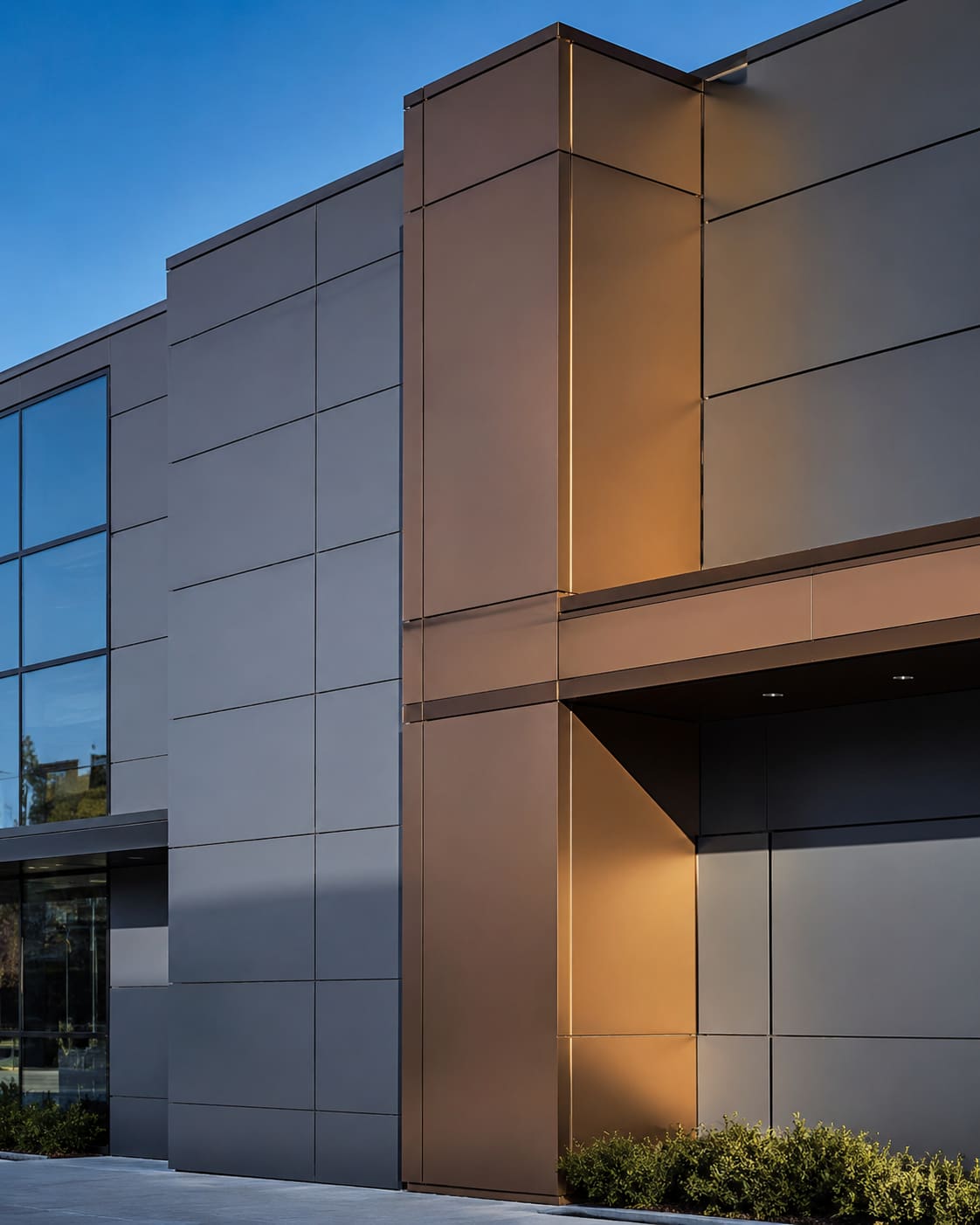
ACP fire safety in India is defined by the panel's core: FR (fire-retardant) grade uses a mineral-filled core of about 70% aluminium trihydroxide and reaches reaction-to-fire class B-s1,d0, while A2 grade uses a core of 90% or more non-combustible mineral filler and reaches the near-non-combustible class A2-s1,d0 under EN 13501-1. An Aluminium Composite Panel is a sandwich of two thin aluminium skins (typically 0.30-0.50mm each) bonded to a polymer or mineral core, and it is the flammability of that core, not the aluminium, that decides whether a panel is safe for a given building.
External cladding fire performance in India is governed by the National Building Code of India (NBC) 2016, Part 4 (Fire and Life Safety), which calls for non-combustible or limited-combustibility materials on high-rise facades. Because Hyderabad, Secunderabad and the wider Telangana and Andhra Pradesh region carry a dense stock of IT parks, commercial towers and mixed-use high-rises, specifying the correct FR or A2 grade is a plan-approval requirement rather than an optional upgrade - and getting it wrong can stall a fire NOC.
This guide breaks down the three fire grades, the EN 13501-1 and ASTM classes behind them, what NBC 2016 actually enforces at approval stage, realistic panel thicknesses and INR costs, the mistakes that trip up buyers, and how to choose between FR and A2 for a specific project. Hakimi Aluminium and Glass supplies and installs certified ACP cladding across Hyderabad and Secunderabad, and you can get a free quote for a compliant facade specification.
The three ACP fire grades: PE, FR and A2
ACP is classified by core composition, which directly controls how much energy the panel can release in a fire. The aluminium skins are broadly the same across grades; the core is what changes, and it is the single most important thing to verify before you buy.
- PE (polyethylene) core: a virtually 100% combustible polymer with high heat release, classed Euroclass E or F. It is the cheapest grade, has the brightest colours, and is restricted on high-rise external walls.
- FR (fire-retardant) core: roughly 30% polymer blended with about 70% mineral filler (aluminium trihydroxide, ATH), which releases water vapour when heated to suppress flame spread. This typically reaches class B-s1,d0.
- A2 (non-combustible) core: 90% or more mineral filler with minimal binder, classed A2-s1,d0 with limited combustibility. This is the highest practical grade for aluminium composite and is specified for tall towers and high-occupancy buildings.
A useful rule of thumb: the higher the mineral-filler percentage, the lower the heat release, the higher the panel density and the higher the cost. FR is the mid-tier compromise; A2 is the safety benchmark for anything tall or crowded. Do not confuse a thick aluminium skin with fire performance - a 4mm PE-core panel with a 0.50mm skin is still combustible at its heart.
What the EN 13501-1 fire classes actually mean
The EN 13501-1 reaction-to-fire classification is the most widely quoted benchmark for ACP fire standards in India, expressed as a letter class plus smoke (s) and flaming-droplet (d) suffixes. Reading the label correctly is the single most useful skill when comparing panels from different brands.
- Class A1 / A2: non-combustible or limited combustibility. A2 requires a gross heat of combustion of 3.0 MJ/kg or less.
- Class B: combustible but with very limited contribution to fire; this is the ceiling for FR-grade ACP.
- Class C, D, E, F: progressively greater contribution to fire, with F being untested or failing.
- Smoke: s1 = little or no smoke, s2 = moderate smoke, s3 = substantial smoke.
- Droplets: d0 = no flaming droplets, d1 = limited droplets, d2 = significant flaming droplets.
So A2-s1,d0 means non-combustible, minimal smoke and no burning droplets - the safest ACP specification available. American testing uses ASTM E84 (surface burning / flame-spread index, where Class A is 0-25), while full-scale facade behaviour is assessed by large-scale system tests such as NFPA 285 or BS 8414. A panel's small-scale reaction-to-fire class is necessary but not sufficient: how the whole cavity, sub-frame and insulation behave together is what large-scale tests capture.
NBC 2016 and Indian facade fire regulation
The National Building Code of India (NBC) 2016 is the primary reference for facade fire safety and, in Part 4 (Fire and Life Safety), directs that external cladding on high-rise buildings use non-combustible or limited-combustibility materials. In Telangana and Andhra Pradesh this is enforced through the state fire services and the local development authority at the plan-approval stage, before a building is occupied.
- High-rise buildings in India are generally those above 15m in height, which triggers the stricter fire provisions for facades, refuge areas and materials.
- The Telangana State Disaster Response and Fire Services department issues the fire No Objection Certificate (NOC) that enforces these material requirements in Hyderabad and Secunderabad.
- After the Grenfell Tower fire in London in June 2017, which spread via a PE-core ACP facade and killed 72 people, Indian authorities and consultants moved decisively toward FR and A2 grades on tall buildings.
- Panels should be backed by BIS or accredited third-party fire-test reports and reaction-to-fire certificates issued to EN 13501-1 or ASTM E84, with batch traceability to the delivered stock.
The practical takeaway for owners and builders across Hyderabad: if your building needs a fire NOC, the ACP core grade will be scrutinised, and a PE-core panel on a high-rise will not clear approval. Retro-fitting the correct grade after the fact is far costlier than specifying it once, correctly, at the start.
ACP construction: skins, core, thickness and coatings
A typical ACP panel is 4mm thick overall - two aluminium skins of 0.30-0.50mm bonded to a 3mm core - with standard panel widths of 1220mm and 1250mm and lengths up to 5800mm. The build quality of the skin and coating matters as much as the fire grade for long-term facade performance in a hot, dusty climate like Telangana's.
- Common thicknesses: 3mm, 4mm and 6mm. A 0.50mm skin gives noticeably better flatness and dent resistance than economy 0.21mm skins used on cheap signage-grade sheets.
- Coatings: PVDF (Kynar 500) fluorocarbon for long-life colour retention on exteriors, or polyester (PE coating) for lower-cost interior use only.
- Finishes include solid colours, metallic, sparkle, timber-look and stone-look prints, and mirror or brushed effects - the fire grade does not restrict the finish.
- Fixing systems: cassette (routed-and-returned) panels hung on an aluminium sub-frame, or sheet-fixed panels; both require quality gaskets, sealants and fixings at every junction with doors, windows and parapets.
Well-detailed ACP cladding ties into the surrounding facade - curtain walls, spider glazing and entrance systems - so the sub-frame, movement joints and fire barriers must be designed as one envelope, not bolted on afterwards. Cavity fire barriers behind the panels are as important as the panel grade itself.
FR vs A2: pros, cons and where each fits
Both FR and A2 are legitimate fire-rated products, but they sit at different points on the safety-versus-cost curve. Understanding the trade-off prevents both over-spending and under-specifying.
FR-grade strengths: lower cost, lighter weight (easier on the sub-frame and structure), wide colour and finish range, and full acceptance on mid-rise and low-occupancy facades. Its limit is that it remains combustible (class B) and will not satisfy the strictest high-rise or assembly-occupancy requirements.
A2-grade strengths: near-non-combustible performance, minimal smoke and no flaming droplets, and clearance for the tallest and most crowded buildings. Its trade-offs are a 15-30% cost premium, a heavier panel that needs a slightly more robust sub-frame, and marginally more care during routing and folding because the mineral core is denser and more brittle.
- Choose FR when: the building is mid-rise, low-occupancy, and the code and fire NOC explicitly permit a class B facade.
- Choose A2 when: the building is above 15m, or is a hospital, mall, hotel, cinema, school or any assembly/high-occupancy use.
- Never choose plain PE core for any occupied external facade, regardless of height - the small saving is not worth the risk or the NOC rejection.
ACP vs HPL and other cladding materials
ACP is not the only rainscreen option, and for some fire-sensitive or design-led projects an alternative panel is a better fit. High-Pressure Laminate is the most common comparison in the Hyderabad market.
- ACP (FR/A2): lightweight, fast to install, huge colour range, and cost-effective at roughly INR 250-500 per sq ft for FR grade.
- HPL (High-Pressure Laminate): thicker solid panels with strong impact resistance and very realistic wood or stone finishes, available in fire-rated grades. Our HPL cladding service suits facades, balconies and high-traffic frontages where dent resistance matters.
- Natural stone, terracotta and fibre-cement: heavier, inherently non-combustible options used where the budget and structure allow.
- For a full picture of facade and envelope options - cladding, glazing and aluminium fabrication across Telangana - browse our services.
The decision usually balances fire class, weight on the structure, maintenance and the architectural finish the client wants. A2 ACP and fire-rated HPL both satisfy high-rise codes, so between them the choice often comes down to aesthetics, panel thickness and cost per square foot.
How to choose the right grade for a Hyderabad project
For most Hyderabad and Secunderabad high-rise and commercial projects, A2-grade ACP is the safest specification, while FR grade is acceptable for lower-rise or low-occupancy buildings where the code permits. The building's height, occupancy and fire-NOC requirements drive the decision more than personal preference.
- Confirm the building height and occupancy classification first - this determines whether A2 is mandatory or FR is allowed.
- Hyderabad's hot, dry summers (regularly 40-44 C) favour PVDF-coated panels with good solar reflectance for surface durability and colour retention.
- Always verify the manufacturer's fire-test certificate and the core mineral percentage before ordering; some panels marketed as FR fall short of a genuine B-s1,d0.
- Insist on batch traceability so the panels delivered to site match the certificate submitted for the fire NOC.
You can see how compliant, well-detailed facades come together in our recent projects across the twin cities. When the grade, coating and fixing system are matched to the building from day one, the fire NOC, the warranty and the long-term appearance all fall into place together.
Cost breakdown in INR: panels, sub-frame and fixing
Budgeting an ACP facade in Hyderabad means separating the panel cost from the sub-frame, fabrication and installation, which together often equal or exceed the panel price. These realistic 2026 figures give a working range for planning before a site-specific quote.
- FR-grade PVDF ACP: roughly INR 250-500 per sq ft supply-and-fix, depending on brand, skin thickness and coating.
- A2-grade ACP: typically 15-30% higher than FR for the same finish, reflecting the denser mineral core and heavier panel.
- Aluminium sub-frame, fabrication and scaffolding can add INR 100-250 per sq ft depending on building height and access.
- Cassette (routed-and-returned) fixing costs more than sheet fixing but gives crisper shadow lines and better serviceability.
- Reputable manufacturers offer 10-20 year coating warranties on PVDF panels; a well-installed FR/A2 facade commonly lasts 15-20 years or more before recoating.
For a firm number, share your elevation area, building height and target fire grade, and we will price a compliant FR or A2 specification with the sub-frame and fixings included. Under-costing the sub-frame and fire barriers is the most common budgeting error, so treat the panel price as only part of the total.
Common mistakes to avoid when specifying fire-rated ACP
Most facade fire failures and NOC rejections trace back to a handful of avoidable errors during specification and procurement. Knowing them in advance protects both safety and budget.
- Buying on price alone and accepting a PE-core panel relabelled as fire-safe - always demand the EN 13501-1 or ASTM E84 certificate.
- Confusing skin thickness with fire grade; a thick aluminium skin over a combustible core is still combustible.
- Ignoring cavity fire barriers behind the panels, which are essential to stop fire and smoke travelling up the ventilated gap.
- Mixing certified panels with uncertified offcuts or a different batch, breaking the traceability the fire NOC depends on.
- Detailing the cladding in isolation from the glazing, doors and parapets, leaving gaps at junctions where weather and fire can bypass the system.
- Under-budgeting the sub-frame, sealants and access, then value-engineering the fire grade down at the last minute to hit a number.
Working with a single supplier who fabricates, certifies and installs the facade avoids most of these pitfalls, because one team owns the panel grade, the sub-frame and the site detailing end to end.