Back-painted glass in interiors is float or low-iron glass coated on its rear face with a pigmented, cured lacquer and mounted painted-side-to-wall, giving you a seamless, grout-free, colour-saturated surface that paint, laminate or tile cannot match. Because the face you see and touch is pristine glass and the colour is sealed behind it, back-painted glass delivers deep gloss on day one and stays wipe-clean for well over a decade - as long as the glass, coating and bonding are specified together as a single system rather than treated as a decorative afterthought.
For the architect, interior designer or homeowner in Hyderabad and Secunderabad, the decisions that decide success are all upstream of colour: which base glass, what safety rating, which paint chemistry, and how the panel is bonded and jointed. Get these right and you own a fifteen-year splashback, feature wall or wardrobe shutter; get them wrong and you get delamination, edge creep, colour drift, or a green-shifted white that never matched your sample. This guide walks through the full specification language - with realistic INR figures and Indian-standard references - so your finishes schedule reads like a professional's.
We fabricate and install back-painted glass every week across residential kitchens, corporate lobbies and retail fit-outs, and the same handful of details separate a flawless job from a callback. Whether you are cladding a lift lobby in Gachibowli or a modular kitchen in Kondapur, treat the sections below as a checklist you can lift straight onto your drawings.
What Back-Painted (Lacquered) Glass Actually Is
Back-painted glass - also sold as lacquered glass - is a standard glass sheet with an opaque, pigmented coating rolled, curtain-coated or sprayed onto its rear (No. 2) face and then oven-cured or air-dried. You look through the glass at the colour, so the surface you clean is pure glass while the paint is sealed away from wear, fingerprints and cleaning chemicals.
That reversed construction is exactly why it outperforms painted MDF, PVC laminate or ceramic tile in the right locations:
- The visible face is non-porous glass - no grout lines, no seams, nothing for grease or bacteria to lodge in.
- Colour depth reads as lacquered furniture, not flat wall paint, because you view it through 5-6 mm of glass.
- It cleans with a soft cloth and neutral spray, so kitchens and healthcare interiors stay hygienic with minimal effort.
- Colours can be matched to RAL or NCS references, so brand walls and joinery stay consistent across a whole project.
Because the paint never faces the room, its job is not abrasion resistance - it is adhesion, UV stability and chemical compatibility with the sealant and wall behind it. That single point is the most misunderstood thing about the product, and it drives every specification decision that follows.
Where Back-Painted Glass Earns Its Place
Back-painted glass suits interior vertical and joinery surfaces where you want continuity, hygiene and depth of colour. It is not a structural or exterior product, and it should never be used as flooring or where its rear face sits in standing water.
- Kitchen and pantry splashbacks - jointless, grout-free and heat-tolerant behind hobs when toughened.
- Feature and accent walls in lobbies, boardrooms and retail - high gloss that reads as lacquer, not tile.
- Wardrobe shutters, cabinet fronts and reception fascias bonded to MDF or plywood carcasses.
- Lift lobby and corridor cladding - durable, cleanable and available in matched brand colours.
- Sliding wardrobe and cupboard doors, where a lacquered panel runs in an aluminium track for a whisper-quiet glide.
- Writing and marker surfaces - a low-iron gloss panel doubles as a smooth, seamless whiteboard.
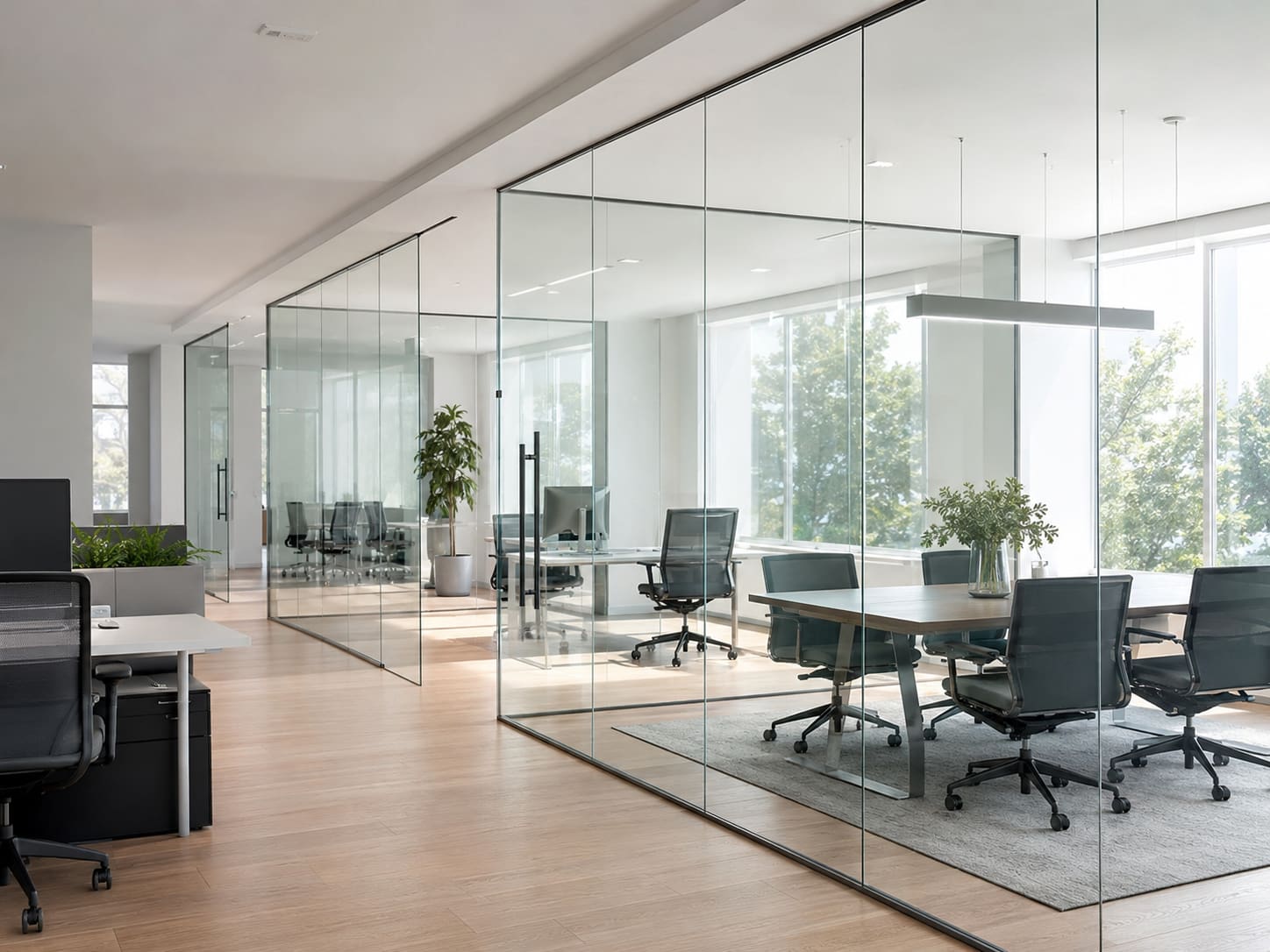
Where you need a see-through divider rather than an opaque wall, a back-painted panel can be combined with clear glazing in the same glass partition system - solid below the sightline for privacy, transparent above for light. You can see how we mix opaque and clear glass across real fit-outs in our recent projects.
Substrate: Standard Float vs Low-Iron Glass
The base glass sets your colour ceiling before a drop of paint is applied. Standard soda-lime float has a faint green tint from its iron content - visually harmless on clear glazing, but it corrupts pale and neutral back-paint colours by pushing them toward olive.
- Specify low-iron (extra-clear) glass for whites, greys, pastels and any brand-critical colour; it renders the lacquer true to the swatch.
- Standard float is acceptable and economical for deep, saturated colours - black, navy, charcoal, burgundy - where the green cast is completely masked.
- Call out the substrate explicitly on your finishes schedule: "white back-painted glass" on standard float will never match a low-iron sample, and this is the single most common colour dispute on site.
- Always confirm colour on a production-representative sample under the project's actual lighting - warm 3000K LED shifts perception markedly versus daylight.
In cost terms across Hyderabad and Secunderabad, expect low-iron to add roughly 25-40% over standard float. That premium is trivial next to the cost of tearing out a mismatched feature wall, so on any pale or corporate colour it is money well spent.
Safety, Thickness and Toughening to IS 2553
Match the safety and thickness spec to location and support condition, not to appearance. Toughened (tempered) glass to IS 2553 is four to five times stronger than annealed and fractures into small, blunt granules rather than dangerous shards.
- Toughen for splashbacks behind hobs (thermal load), wet areas, full-height cladding, and any panel a National Building Code (NBC) 2016 impact assessment would treat as a hazard location.
- Remember that back-painting happens after toughening - the glass is cut, edge-worked and heat-treated first, then coated. Toughened glass cannot be re-cut or drilled, so every dimension and cut-out must be final before fabrication.
- 6 mm is the workhorse thickness for adhesive-bonded wall panels and splashbacks up to roughly a 1 m grid.
- 8-10 mm suits large unsupported spans, mechanically fixed panels, or situations where flatness under raking light is critical.
- Polish exposed edges (flat-polished or pencil-round) wherever joints or reveals leave them visible, and consider a safety backing film on panels above sinks or seating so fragments are retained if a panel ever fails.
Toughening typically adds INR 40-90 per sq ft depending on thickness and volume, but for kitchens and cladding it is non-negotiable - it is both a safety requirement and cheap insurance against thermal cracking behind a gas or induction hob.
Paint System, Adhesive and Long-Term Durability
The coating and the way you bond it are one compatibility question, not two - the paint must survive both the wall behind it and the sealant around it. This is where the great majority of field failures originate, so it deserves the most attention on your drawings.
- Use manufacturer-approved lacquer systems rated for interior back-painting, with documented adhesion, UV and humidity resistance - never decorative spray paint from a hardware counter.
- Bond with neutral-cure (alkoxy or oxime) structural silicone, or an approved double-sided VHB-style tape. Never use acetic-cure (acetoxy) "vinegar-smell" silicone: the acetic acid it releases while curing attacks the coating and causes edge creep within months.
- Prefer lacquers applied over a PU-primed rear face - they resist moisture migration from masonry and MDF far better than bare coatings.
- For splashbacks, seal the full perimeter with a colour-matched neutral silicone to block water and grease from tracking behind the panel.
- On masonry walls, let the plaster fully cure and prime the wall first - trapped alkaline moisture is the single most common cause of edge discolouration in Telangana's monsoon-humid interiors.
- Clean only with a pH-neutral cleaner; abrasives and ammonia degrade both gloss and coating at cut edges.
When the panel, its lacquer and its bonding sealant come from one coordinated source, compatibility is guaranteed as a package rather than assembled from mismatched site materials. That single-supplier discipline is a quiet advantage of resolving the whole detail through our services instead of buying components piecemeal.
Detailing, Tolerances and Interfaces
Glass has negligible thermal and moisture movement, but the substrate and building around it move - your joints absorb that movement, not the panel.
- Detail 2-3 mm perimeter and inter-panel joints; hard-butting panels transfers substrate movement into the glass and risks edge chipping.
- Design to a panel grid that respects transport, handling and door widths - single panels beyond about 2.4 m are logistically difficult and costly to move into a finished flat.
- Locate and pre-drill all service penetrations (sockets, switches, tap tails) before toughening; site drilling of toughened glass is impossible.
- Frame or trim panel edges with slim aluminium profiles where you want a crisp reveal or a concealed fixing channel rather than an exposed silicone line.
- Ensure the wall is flat to within a few millimetres over the panel area - high spots telegraph through as visible distortion in a gloss finish.
- Coordinate the bonding-cavity depth with adjacent finishes so the glass face aligns cleanly with tile, stone or plaster returns.
For a coherent look, carry the same lacquer colour or a mirrored companion panel through into adjacent joinery and dressing areas - a technique we detail alongside our decorative and mirror wall work.
Common Mistakes to Avoid
Most back-painted glass problems are specification errors, not manufacturing defects. Watch for these recurring mistakes before they reach site:
- Choosing standard float for a white or pastel colour and being surprised by the olive cast - always upgrade pale colours to low-iron.
- Approving colour from a printed swatch or screen instead of a real glass sample under project lighting.
- Letting a contractor use general-purpose acetic silicone because it was on the van - this is the fastest route to edge creep and delamination.
- Bonding panels to a freshly plastered, unprimed wall that is still releasing alkaline moisture.
- Finalising cut-outs for sockets or taps after the glass is toughened, forcing a full remake.
- Hard-butting panels with no movement joint, then blaming the glass when a corner chips.
- Specifying annealed glass behind a hob to save money - a thermal crack there is a safety and warranty failure, not a saving.
Every one of these is avoidable at the drawing stage. When in doubt on a specific detail, get a free quote with your colour reference, dimensions and location, and we will flag any spec risk before fabrication.
Realistic Costs and Lead Times in Hyderabad
Back-painted glass sits in the mid-to-upper band of interior surfacing, but it is competitive once you account for its lifespan and near-zero maintenance. The figures below are typical supply-and-fix ranges for Hyderabad, Secunderabad and the wider Telangana and Andhra Pradesh markets in 2026; confirm them against a measured quotation for your project.
- Standard back-painted float (annealed, deep colours): roughly INR 250-400 per sq ft supplied.
- Toughened back-painted float: roughly INR 450-650 per sq ft supplied.
- Toughened low-iron back-painted glass (true whites and pastels): roughly INR 600-1,100 per sq ft supplied.
- Add INR 80-200 per sq ft for site measurement, adhesive, neutral silicone and skilled fixing.
- Cut-outs, polished edges and mitred corners are usually priced per item and can add meaningfully on detailed joinery.
Lead time for measured, toughened, colour-matched panels is typically 7-12 working days after final sign-off, because toughening and curing cannot be rushed. Where you also need matching partitions or dressing-area glass, planning them together on the same glass partition system keeps colour, edgework and delivery aligned across the fit-out.
Sustainability, Standards and Specification Support
Back-painted glass is durable, inert and easily cleaned, which supports low-maintenance interiors and can contribute to interior credits under IGBC and LEED where low-emitting materials and durability are recognised - always confirm the specific coating's VOC data for your rating pathway.
- Request low-VOC lacquer and adhesive data sheets where you are chasing indoor environmental quality credits.
- Specify recycled-content float where available, and detail panels for eventual removal and replacement rather than permanent bonding.
- Reference IS 2553 for safety glass and NBC 2016 for impact-safety locations directly in your specification so the fabricator is left in no doubt.
Hakimi Aluminium and Glass provides design-assist, colour matching, shop drawings, fabrication and installation of back-painted and decorative glass for architects, designers and homeowners across Hyderabad, Secunderabad, Telangana and Andhra Pradesh. Browse our recent projects for finished examples, then get a free quote when you want the substrate, coating, hardware and bonding resolved as one detail - before it ever reaches your finishes schedule.