Balcony glass safety regulations in India require that any glass used on a balcony as a railing, balustrade, or barrier be safety glass, meaning either toughened (tempered) glass conforming to IS 2553 (Part 1) or laminated glass, installed to a minimum barrier height of 1.0-1.2 metres and engineered to resist wind and imposed loads under the National Building Code of India (NBC) 2016 and the IS 875 series. In plain terms: ordinary annealed float glass is never legal as a fall barrier, and every compliant balcony guard combines the correct glass make-up, the correct height, and a documented structural design.
These rules exist for one blunt reason: physics. Ordinary annealed glass shatters into long, dagger-like shards on impact, whereas mandated safety glass either crumbles into small blunt granules (toughened) or holds together on its interlayer (laminated), protecting occupants from both falls and lacerations. For a frameless balustrade on a 15th-floor apartment, a single non-compliant pane is a life-safety failure, not a cosmetic one. That is why professional glass railing installation is treated as a structural discipline rather than a finishing trade, and why the specification deserves scrutiny before any glass is cut.
Compliance is governed primarily by NBC 2016, which municipal and development authorities adopt into their building bye-laws, alongside Bureau of Indian Standards (BIS) product standards for the glass and hardware. For balconies in the high-rise towers now common across Hyderabad, Secunderabad and the Financial District, the combination of fall risk, monsoon wind pressure and intense summer thermal stress makes correct glass selection, thickness and fixing a genuine code-compliance issue. If you are planning a project, it pays to understand each rule before you get a free quote so the specification is right on day one rather than reworked after a site inspection.
Which Glass Types Are Legally Permitted for Balcony Railings
Only safety glazing materials are permitted where balcony glass functions as a barrier against falling. Indian codes recognise two compliant categories, and ordinary annealed glass is never acceptable for railings, balustrades, or barriers under any circumstances.
- Toughened (tempered) glass to IS 2553 (Part 1): heat-treated to be 4-5 times stronger than annealed glass; on failure it fragments into small, relatively blunt granules that greatly reduce laceration risk.
- Laminated safety glass: two or more glass plies bonded by a PVB or SGP interlayer; on breakage the fragments adhere to the interlayer, so the barrier stays standing and does not open up a fall path.
- Toughened-laminated glass: combines both behaviours and is the preferred choice for frameless balustrades and any high fall-risk location because it is both strong and fail-safe.
Laminated glass is generally required wherever the glass is the sole guard, with no separate structural top handrail, because it retains residual barrier capacity even after a pane cracks. A toughened-only pane, by contrast, can lose all containment the instant it shatters, leaving an open edge. The right selection also depends on how the balcony is used: an open railing, a full weather enclosure, or a facade-integrated guard each carry different specifications, which is why our balcony glazing team specifies the make-up against actual exposure rather than a generic default.
Railing Height and Barrier Requirements Under NBC 2016
NBC 2016 mandates a minimum protective barrier height of 1.0 metre for balconies and 1.2 metres in higher-risk situations, measured from the finished floor level to the top of the railing or glass. Getting the datum right matters more than most clients expect: a raised timber deck, a tile bed, or a stone coping reduces the effective height and can quietly push a compliant design below code.
- Residential balconies: minimum 1.0 m (1000 mm) barrier height from finished floor level.
- High-rise, elevated, or higher-hazard locations: 1.2 m (1200 mm) is commonly required by local bye-laws across Telangana and Andhra Pradesh.
- In buildings occupied by children, barriers must be designed so that a 150 mm sphere cannot pass through openings near the base, limiting both gaps and climbable foot-holds.
- The barrier must resist a horizontal imposed load without excessive deflection, so glass thickness and fixings are sized to the loading, not merely to the height.
Height alone never certifies a railing. A 1.2 m guard that flexes alarmingly under a light push still fails the intent of the code and will feel unsafe to anyone leaning on it. That is why the height rule is always read together with the load and wind provisions covered next, and why a frameless system pairs the glass with engineered base channels or spigots rated for the calculated forces rather than off-the-shelf clamps.
Load and Wind Design Standards for Balcony Glass
Balcony glass barriers must be engineered for both imposed (people) loads and wind loads using the IS 875 series, because a railing that meets the height rule can still fail if it is not designed for these forces. This structural check is the single most skipped step in cheap installations, and it is precisely the step that separates a decorative guard from a code-compliant one.
- Imposed handrail load: a minimum horizontal line load of about 0.75 kN/m is applied at the top of the barrier per IS 875 (Part 5) for residential occupancies; assembly, viewing-balcony, and commercial areas demand substantially higher values.
- Wind load: IS 875 (Part 3) governs design wind pressure, which increases sharply with building height and exposure and is decisive for high-rise balconies and corner units caught in accelerated airflow.
- A concentrated point load and a uniform infill load are also checked, so the glass resists a localised impact as well as a spread crowd load.
- Deflection limits and post-breakage behaviour are verified so that a single cracked pane never creates an open fall hazard even before it is replaced.
For structural-silicone and bolted-glass applications, international practice for weathersealed structural glazing supplements the Indian codes. In Hyderabad and Secunderabad the wind case is rarely extreme, but for the coastal belt of Andhra Pradesh (Visakhapatnam, Kakinada and similar cyclone-exposed zones) the wind-load calculation frequently governs the glass thickness. Skipping it to save on engineering fees is a false economy that shows up the first stormy monsoon.
Recommended Glass Thickness for Balcony Applications
Balcony glass thickness in India typically ranges from 8 mm to 19 mm depending on whether the glass is framed or frameless and the span between supports. Thickness is always confirmed by structural calculation, but the common ranges below give a reliable starting point for budgeting and early specification.
- Framed toughened glass railings (top rail plus base frame): 8-12 mm toughened glass.
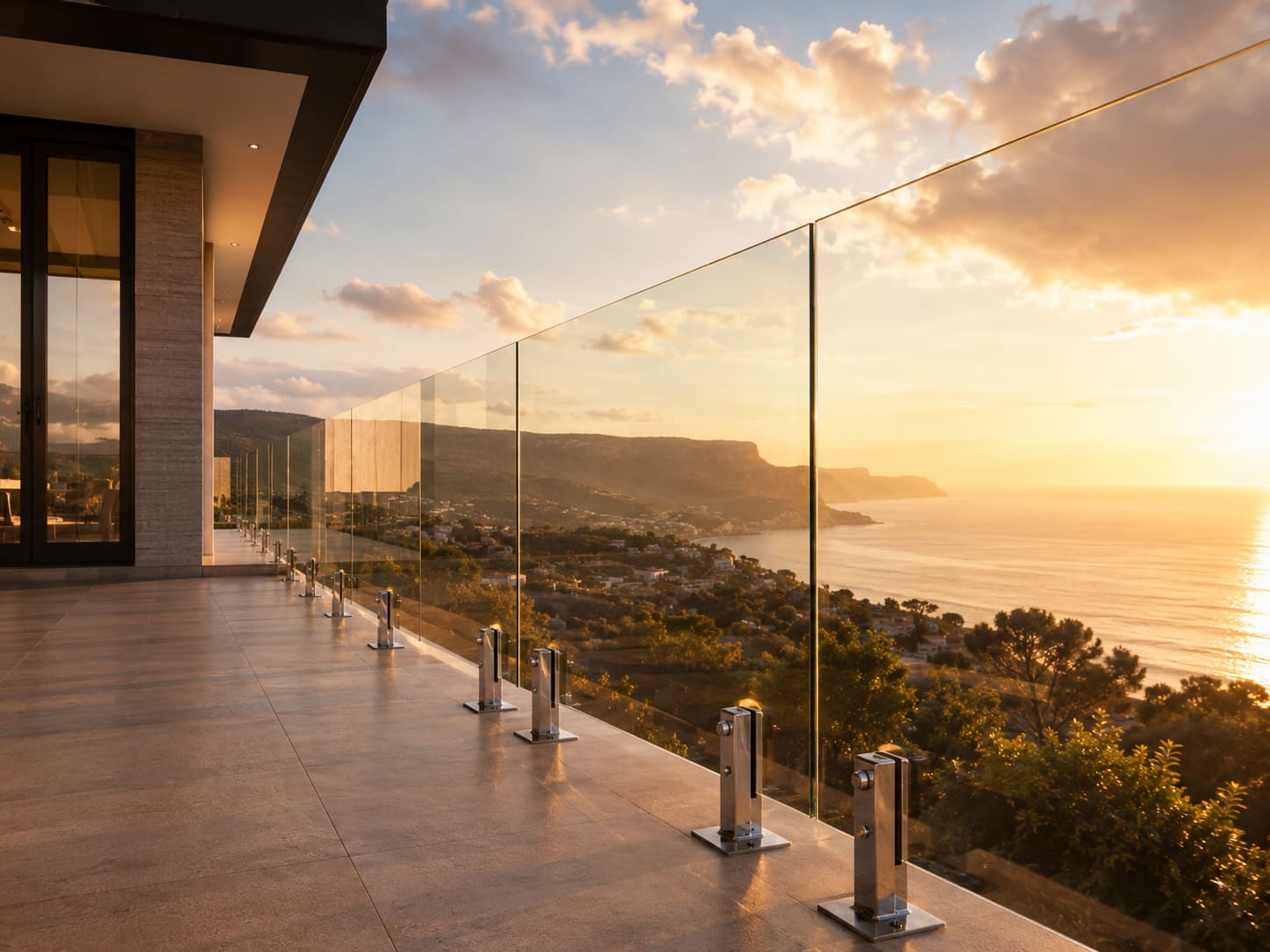
- Frameless spigot or channel-fixed toughened balustrades: 12-19 mm toughened or toughened-laminated glass.
- Toughened-laminated make-ups such as 13.52 mm (6 mm + 6 mm + 1.52 mm PVB) are common for frameless guards that require post-breakage integrity.
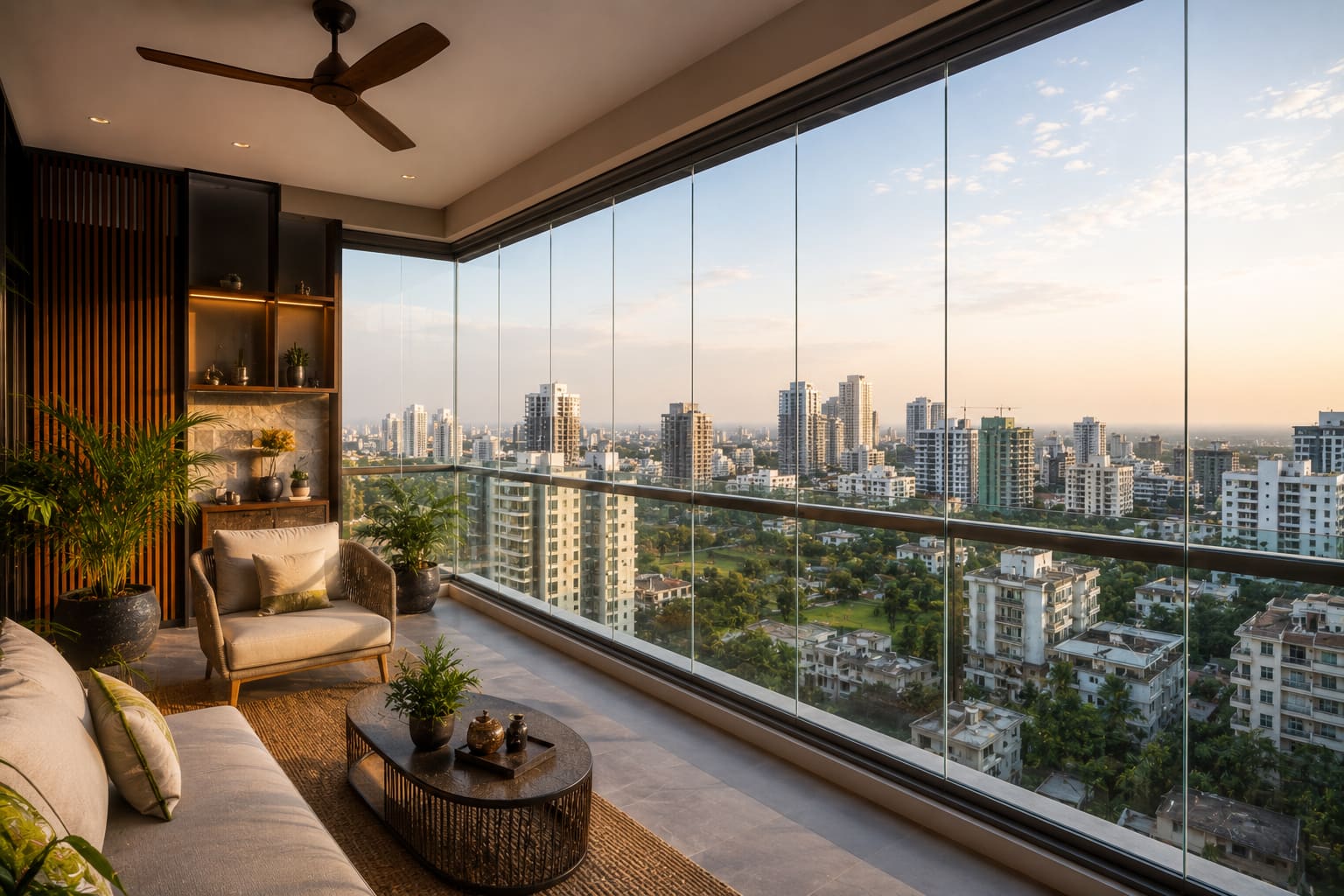
- Balcony weather enclosures using sliding or folding glass typically use 8-12 mm toughened glass set in aluminium framing.
The choice of fixing system drives the thickness as much as the load does. A base-clamped frameless guard with no top handrail cantilevers the full bending moment through the glass, so it needs a thicker laminated pane than a design where a continuous top rail ties the panels together and shares the load. When you review our recent projects you will notice the frameless balustrades use visibly thicker glass than the framed ones for exactly this reason, not for appearance.
Indicative Costs for Compliant Balcony Glass in Hyderabad
Compliant balcony glass in Hyderabad generally costs between 900 and 4,500 INR per square foot supplied and fixed, with the wide range driven by glass make-up, fixing system, and hardware grade rather than by supplier margin alone. Understanding what sits behind the number helps you compare quotes on a like-for-like basis instead of chasing the cheapest headline rate.
- Framed toughened glass railings (aluminium top rail and base): roughly 900-1,600 INR/sq ft.
- Frameless toughened balustrades on spigots or base channel: roughly 1,800-3,000 INR/sq ft.
- Premium frameless toughened-laminated balustrades with 316 stainless hardware: roughly 2,200-4,500 INR/sq ft.
- Full balcony weather enclosures in sliding or folding aluminium glass: roughly 550-1,200 INR/sq ft of glazed area.
Two line items are worth paying for even though a cut-price quote will omit them: the IS 875 structural calculation and heat-soak testing on large frameless panels. Together they add a modest amount to the project but remove the two most expensive failure modes, replacement of a spontaneously fractured pane and liability for a barrier that does not hold a load. For an accurate figure on your own balcony you can get a free quote with the exact dimensions, floor level and exposure noted.
Hardware, Fixings and Fittings That Make a Railing Compliant
Compliant balcony glass is only as safe as the hardware holding it, so fittings must be corrosion-resistant, correctly rated, and installed to the manufacturer's torque and edge-distance specifications. In the humid air of Hyderabad, Secunderabad and coastal Andhra Pradesh, sub-grade fixings corrode and lose capacity long before the glass itself is compromised.
- Spigots, base shoes and standoffs should be grade 316 stainless steel for coastal and high-humidity exposure, and grade 304 as a minimum inland.
- Point-fixed and bolted balustrades must use correct bushings and gaskets so the glass is never in direct metal-to-glass contact, which would create stress points and eventual cracking.
- Continuous base channels should be structurally grouted or bolted to a sound slab edge, never fixed into brittle tile or thin screed.
- Where the balcony guard incorporates a gate or access leaf, self-closing hardware keeps the opening from becoming a trap or an out-of-code gap.
As a dealer for established brands such as Taiton, Enox and Ozone, we match every glass make-up to hardware rated for the same loads rather than mixing an under-specified clamp with an over-specified pane. You can lean on our services team to specify a complete, code-aligned assembly, glass and fittings together, instead of buying the two in isolation and hoping they add up on site.
Certification, BIS Marking and Quality Checks
Compliant balcony glass must carry BIS certification marks and traceable documentation, because falsely-labelled or under-tempered toughened glass is a known problem in the Indian market. Verifying it on delivery is the cheapest insurance a client can buy, and it takes only a few minutes.
- Toughened glass should carry a permanent stamp indicating conformity to IS 2553 (Part 1) together with the manufacturer's identity.
- Fragmentation testing per IS 2553 confirms the glass breaks into the required number of small particles within a defined 50 mm x 50 mm area.
- Laminated glass should conform to the relevant IS specification and clearly state the interlayer type (PVB or SGP) and thickness.
- Heat-soaked toughened glass is strongly recommended for large frameless panels to reduce the risk of spontaneous breakage from nickel-sulphide inclusions.
- Keep test certificates, delivery challans and installer sign-off on file; many housing societies and RERA-registered projects across Telangana now request them at handover.
A reputable installer will hand over this paperwork without being asked. If a supplier cannot produce IS 2553 certification or a fragmentation report, treat the quote as non-compliant regardless of how attractive the price looks.
Common Compliance Mistakes on Hyderabad Balconies
Most balcony glass failures in Hyderabad and Secunderabad trace back to a handful of avoidable errors, almost all of them cost-cutting shortcuts rather than genuine design limits. Recognising them protects both safety and resale value, and they are easy to check for before you sign off on a quote.
- Using annealed or single-toughened glass as a sole guard where laminated glass is required for post-breakage containment.
- Measuring railing height from a bare, pre-tiled slab, so the finished 1.0-1.2 m height falls short once flooring and coping are added.
- Omitting the IS 875 wind and imposed-load calculation entirely and sizing the glass by eye or by copying a neighbour's balcony.
- Fixing frameless panels with plated-mild-steel or under-grade stainless spigots that corrode in monsoon humidity.
- Leaving base gaps that exceed the 150 mm sphere rule in homes with young children.
- Skipping heat-soak testing on large frameless panels, inviting the rare but dangerous spontaneous breakage that toughened glass is prone to.
Avoiding these is straightforward with a properly specified system. Whether you need an open glass railing, a full balcony glazing enclosure, or matching partition work, insist on documented glass grade, calculated thickness, rated hardware and BIS certificates as a single package before installation begins rather than reconstructing the paper trail afterwards.