The best skylight installers in Hyderabad are specialist glass-and-aluminium fabricators who engineer for the twin cities' harsh conditions: laminated or double-glazed low-E glass to cut heat, a slope of at least 5 degrees for monsoon runoff, aluminium framing with concealed drainage, and a documented waterproofing warranty. A genuine specialist runs an on-site structural survey, hands you an itemised INR quote, and seals the assembly with EPDM gaskets and structural silicone rather than trusting a single bead of sealant. This matters far more in Hyderabad than in cooler cities, because summer roof-glass surface temperatures cross 60 degrees and airborne dust settles fast, so a skylight has to be heat-controlled and self-cleaning by design. In short, a good installer treats a skylight as an engineered skylight glass roof system, not a hole in the slab covered with glass.
Whether you are lighting an atrium in a Gachibowli office, a stairwell in a Banjara Hills villa, or a courtyard in a Kukatpally home, the right installer balances three competing demands at once: daylight, heat gain and leak-proofing. Larger commercial spans usually overlap with glass atrium and canopy work, where structural engineering, wind loading and drainage carry as much weight as the glass itself. The gap between a true specialist and a general fabricator rarely shows on day one; it shows two monsoons later, when a cut-price install begins weeping at the corners and staining the ceiling below.
This guide explains exactly what separates a skylight specialist from a general fabricator across Hyderabad, Secunderabad and the wider Telangana and Andhra Pradesh markets. It covers the glass and framing options that suit the local climate, realistic 2026 pricing across the twin cities, the waterproofing details that actually keep water out, the installation process and timeline, and the precise questions to ask before you sign. If you already have drawings, you can jump ahead and request an on-site survey to skip straight to design.
What makes a good skylight installer in Hyderabad
A good skylight installer in Hyderabad combines three disciplines that rarely sit in one team: glass and glazing expertise, waterproofing craftsmanship and structural know-how. Because the twin cities swing from 43 degree summers to 200mm monsoon downpours, the fabricator's design decisions determine whether your skylight stays cool and dry or turns into a hot, leaking liability that you regret every June.
The most reliable signal of quality is scope ownership. When one team designs, fabricates, glazes and waterproofs the skylight, there is no seam where responsibility can slip through. General contractors often sub-contract the waterproofing to a separate agency, and the joint between glass, frame and roof, which is precisely where leaks start, becomes a blame handoff. A specialist self-performs that join.
- Uses heat-controlled glass (laminated low-E or double-glazed units), not plain float glass, to reduce indoor heat gain
- Designs a minimum 5 to 15 degree slope so monsoon water and Hyderabad dust wash off instead of pooling
- Fits aluminium framing with concealed gutters, EPDM gaskets and structural silicone for a genuine watertight seal
- Provides an on-site structural survey of your RCC roof or steel truss before quoting a rupee
- Offers a written waterproofing warranty, typically 5 to 10 years, and shares completed jobs in areas like HITEC City, Madhapur or Jubilee Hills
- Gives an itemised quote covering glass, framing, sealing, flashing, hardware and installation, so you can compare like for like
Ask any prospective installer to walk you through our recent projects style references of their own, in localities near you. A specialist will happily point you to completed skylights you can visit; a general fabricator will change the subject to price.
Skylight glass options for the twin cities' climate
For Hyderabad's climate, the best-performing skylight uses laminated double-glazed low-E glass in a thermally efficient aluminium frame, which cuts heat and UV while staying safe overhead. Glass selection is the single biggest lever on how comfortable the room below feels at 2pm in May, and it is where upfront cost and long-term running cost diverge most sharply.
Overhead glazing is a safety application first. Any pane installed above people's heads must be laminated, so that if it ever breaks, the interlayer holds the fragments in place instead of showering the space below. Toughened-only glass, however strong, can fail suddenly and drop clear of the frame, which is why reputable installers refuse to use it un-laminated overhead.
- Laminated glass (typically 6+6mm or 8+8mm PVB): safety-first, holds together if broken, essential for all overhead installations
- Double-glazed low-E units (DGU): reflect infrared heat, ideal for west- and south-facing roofs in Kondapur, Financial District and Kokapet
- Toughened glass with a solar-control or ceramic-frit coating: reduces glare in offices and retail atriums while diffusing harsh light
- Laminated glass with a tinted or reflective interlayer: balances daylight against heat where a DGU is beyond budget
- Polycarbonate multiwall: a lower-cost option for utility areas, though it yellows faster under Hyderabad's intense UV
A quick way to set expectations on performance versus price: plain toughened glass is cheapest but hottest; laminated glass adds essential safety with modest heat control; double-glazed low-E costs the most upfront but pays back steadily in reduced air-conditioning load across Hyderabad's long, punishing summer. For a west-facing atrium, the DGU premium usually pays for itself within a few cooling seasons.
Aluminium framing, structural support and skylight types
The frame does the quiet, structural work: it carries dead load and wind load, houses the drainage, and holds the glass at the correct slope for decades. Powder-coated or anodised aluminium is the default choice in Hyderabad because it is rust-free, low-maintenance and shrugs off monsoon humidity far better than mild steel, which needs galvanising and paint upkeep to survive.
The right framing system depends on span and look. Small residential skylights sit happily in a simple aluminium rafter frame; large column-free spans move into engineered systems that borrow from glass atrium and canopy engineering, using steel-and-glass fins or spider fittings so the roof reads as light and open rather than heavily gridded.
- Fixed skylights: the most common and most leak-resistant, ideal for stairwells, courtyards and pooja rooms
- Vented or openable skylights: add passive ventilation and heat escape, useful over kitchens and double-height living rooms
- Motorised skylights: remote or rain-sensor operated, popular in premium villas in Jubilee Hills and Kokapet
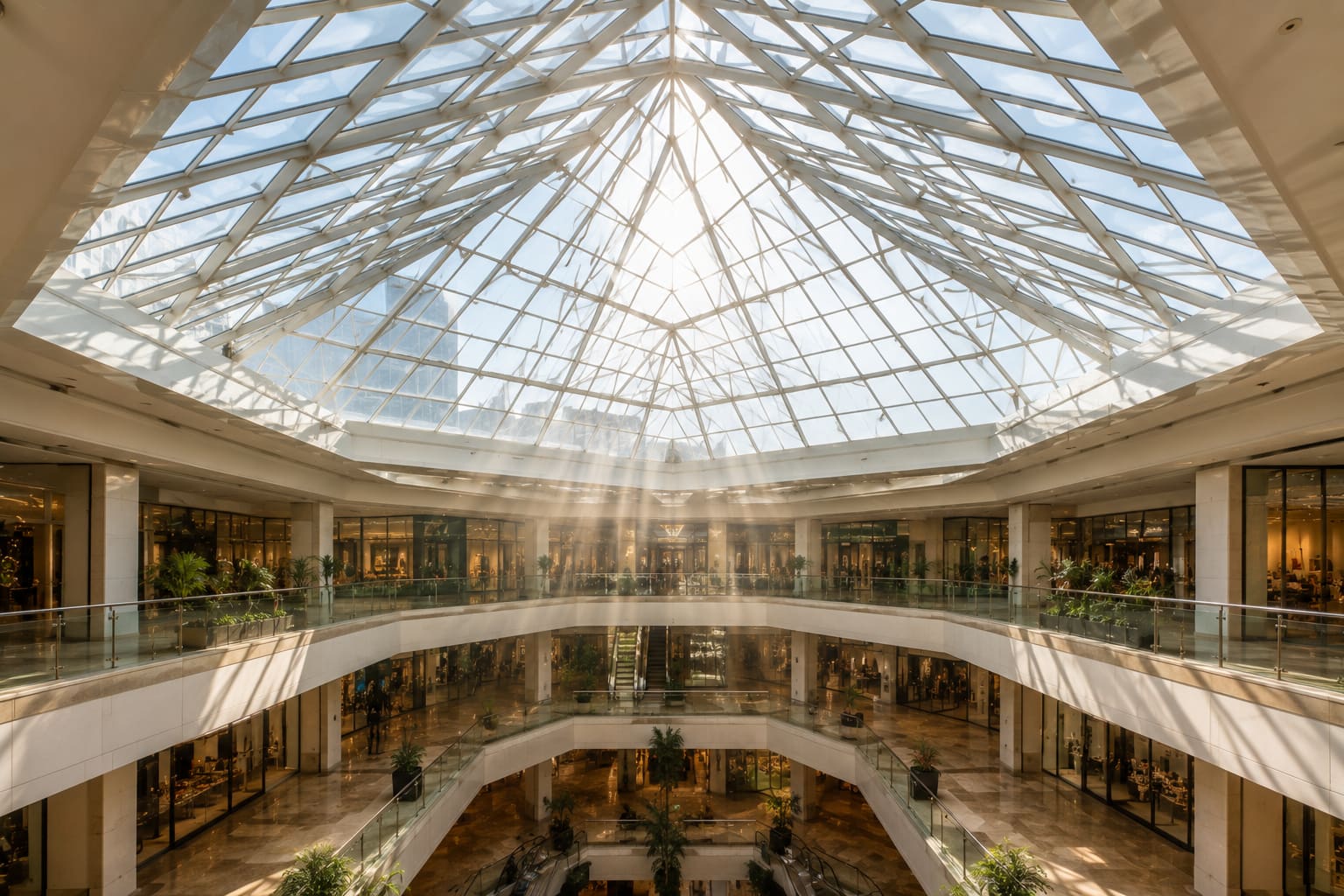
- Pyramid and lean-to glass roofs: architectural centrepieces over double-height spaces and entrance lobbies
- Ridge and barrel-vault glass roofs: long-span daylight solutions for offices, showrooms and mall atriums
- Walk-on skylights: laminated, non-slip glass floors that bring light to a lower level, engineered for foot load
Whatever the type, the frame and glass must be specified together as one system. Mismatched components, for example a heavy glass build-up in an under-rated frame, are a hidden cause of long-term sag, seal stress and eventual leaks. This is where single-source fabrication across our services pays off, because glazing and framing are engineered as a matched pair.
Monsoon waterproofing: the detail that makes or breaks a skylight
Waterproofing is what separates a skylight that survives a decade of Telangana monsoons from one that stains your ceiling in the first season. In Hyderabad, roughly nine out of ten skylight complaints trace back to water rather than glass, and almost all of those come from flat or under-sloped installations sealed with silicone alone. Slope, drainage and flashing, not sealant, are what keep water out.
Think of waterproofing as layered defence rather than a single seal. The slope moves water to a designed edge; the gutter carries it away; the gasket and silicone form a redundant seal at the glass line; and the flashing laps under the roof membrane so nothing can track back beneath the frame. Remove any one layer and the system starts relying on luck.
- Slope first: 5 to 15 degrees so water runs to a designed edge instead of pooling on the glass
- Concealed aluminium gutters carry runoff away from the joint between skylight and roof
- EPDM gaskets plus structural silicone create a two-line defence rather than a single bead of sealant
- Aluminium or lead flashing laps under the roof membrane so water cannot track back under the frame
- A curb or upstand raises the glass above the roof plane so standing water never reaches the seal
Insist that the waterproofing method is drawn and specified in the quote, not merely promised verbally. A specialist will show you a section detail of the slope, gutter and flashing; a general fabricator will say the words but not put them on paper. That written detail, backed by a 5 to 10 year waterproofing warranty, is your single best protection against a monsoon leak.
Skylight installation cost in Hyderabad and Secunderabad (2026)
Skylight installation in Hyderabad typically costs between 1,200 and 3,500 INR per square foot, depending on glass type, framing and structural work, with most residential jobs landing in the 60,000 to 3,00,000 INR range. Commercial atriums and large glass roofs are priced per project after a site survey and can run from 5,00,000 INR to several tens of lakhs, driven mainly by span, structural steel and access requirements.
- Basic toughened-glass skylight with aluminium frame: around 1,200 to 1,800 INR per sq ft
- Laminated safety-glass skylight: around 1,800 to 2,500 INR per sq ft
- Double-glazed low-E heat-control skylight: around 2,500 to 3,500 INR per sq ft
- Openable or motorised vented skylights: add roughly 15,000 to 60,000 INR per unit for the mechanism
- Structural steel or extra waterproofing on old roofs: quoted separately after inspection
Prices are broadly similar across Hyderabad, Secunderabad and nearby Andhra Pradesh towns such as Vijayawada and Guntur, but premium localities like Banjara Hills and Jubilee Hills often involve larger custom spans, which lifts the total. The most common costing trap is an unusually low quote: it almost always omits flashing, hardware, or post-install cleanup, so the cheap number balloons once the omissions surface mid-project. Always confirm exactly what is and is not included before comparing two quotes, and treat any bid that skips the structural survey as incomplete by definition.
Residential vs commercial skylight projects
Residential and commercial skylights obey the same physics but operate at very different scopes, and the best installers scale their approach accordingly. A home job is fundamentally about daylight and comfort; a commercial job layers on structural spans, wind loads, maintenance access and, frequently, building-approval documentation and fire-safety coordination.
- Homes: stairwell, courtyard and pooja-room skylights, usually 20 to 100 sq ft, prioritising heat control and a clean interior finish
- Villas: pyramid and lean-to glass roofs over double-height living areas in Jubilee Hills, Kokapet and Tellapur
- Offices and retail: ridge and barrel-vault glass roofs over atriums in HITEC City, Gachibowli and the Financial District
- Institutions and malls: large-span engineered glass atriums built with steel and glass fins for column-free daylight
For residential clients, the deciding factors are glass specification and a tidy internal reveal. For commercial clients, the deciding factors shift toward load engineering, cleaning and maintenance access at height, and coordination with the building's overall MEP and fire strategy. A specialist who does both can right-size the solution instead of over-engineering a home or under-engineering an office atrium, and can plan a maintenance-friendly design so cleaning a glass roof does not require dismantling it.
The installation process and typical timeline
A well-run skylight installation follows a clear sequence, and understanding it helps you judge whether an installer is thorough or cutting corners. The order matters: survey and design come before any glass is ordered, because the structural findings dictate the frame, the glass build-up and the waterproofing detail.
- Site survey: the installer inspects the RCC slab or steel truss, measures the opening, and checks orientation and drainage paths
- Design and quote: glass spec, frame system, slope and waterproofing detail are drawn up and itemised
- Opening preparation: the roof opening is cut and structurally reinforced where required, then made ready for the curb
- Framing and glazing: the aluminium frame and curb are fixed, then laminated or DGU glass is set on gaskets and structural silicone
- Waterproofing and flashing: gutters, EPDM seals and flashing are integrated with the existing roof membrane
- Finishing and testing: the interior reveal is finished and the assembly is water-tested before handover
For a typical residential skylight, expect a few days on site once materials arrive, with total lead time of one to three weeks including glass fabrication. Commercial atriums run longer, often several weeks, because of structural steel, larger glass lots and access scaffolding. Beware anyone who promises a same-day install on a fresh opening; skipping the survey and curb steps is the fastest route to a monsoon leak, because the curb and flashing cannot be retrofitted cleanly once the glass is set.
Common mistakes to avoid
Most skylight regret is preventable, and it clusters around a handful of avoidable mistakes. Knowing them in advance lets you steer the conversation and spot a weak installer before money changes hands.
- Building flat or nearly flat: without a real slope, water and dust pool, and the seal fails within a season or two
- Relying on silicone alone: sealant is a finishing layer, not a waterproofing strategy; it must sit on top of slope, gutters and flashing
- Using un-laminated toughened glass overhead: unsafe if it breaks, and rejected by any serious installer
- Choosing plain glass to save money: the air-conditioning penalty over a Hyderabad summer often outweighs the upfront saving
- Ignoring orientation: a west-facing skylight without low-E or solar control turns the room below into a greenhouse by afternoon
- Skipping the structural survey: cutting an opening without checking the slab or truss risks both leaks and structural weakness
- Chasing the lowest quote: the cheapest bid usually omits flashing, hardware or cleanup, and costs more once those reappear
The through-line in every one of these is short-term thinking. A skylight is an overhead, weather-exposed assembly that is expensive to access and repair later, so the money and diligence belong at the design stage, not in a warranty claim two monsoons on.
How to choose and questions to ask before you sign
Before hiring a skylight installer in Hyderabad, get at least three itemised quotes, verify the waterproofing warranty in writing, and ask to see a similar completed project in the twin cities. A short, direct set of questions filters specialists from general fabricators quickly, because a real specialist answers each one specifically while a generalist answers vaguely.
- What glass specification do you recommend for my roof orientation and Hyderabad heat, and why?
- What slope, drainage and flashing detail will you use, and can I see it drawn?
- What is the waterproofing warranty term, and exactly what does it cover?
- Do you handle the full scope in-house: structural survey, fabrication, glazing, waterproofing and cleanup?
- Can I visit or call references in areas like Gachibowli, Madhapur or Secunderabad?
- What is the timeline, and how are payments staged against milestones?
- What hardware brands do you use, and are they genuine with warranty?
When the answers are clear, specific and in writing, you have found a real specialist rather than a fabricator hoping to learn on your roof. If you would like a heat-controlled, monsoon-proof skylight engineered for your specific roof across Hyderabad, Secunderabad, Telangana or Andhra Pradesh, get a free quote and we will begin with an on-site structural survey and an itemised, no-surprises proposal.