The main types of aluminium doors are sliding doors, casement (hinged) doors, bi-fold or slide-and-fold doors, French doors, pivot doors and lift-and-slide (telescopic) doors, each defined by how the leaf moves and the amount of clear opening it provides. All share an extruded aluminium frame, usually alloy 6063-T5 or T6 with a wall thickness of 1.2 to 2.0 mm, and most are glazed with toughened safety glass from 8 to 12 mm thick conforming to IS 2553. Picking the right one comes down to how much swing space you have, how wide you want the opening to feel, and how airtight the seal needs to be against dust and monsoon rain.
Aluminium doors are chosen over timber and uPVC for their strength-to-weight ratio, corrosion resistance and slim sightlines, which allow larger glass panels and more daylight. In Hyderabad and Secunderabad, where summer temperatures cross 40 degrees Celsius and the monsoon brings driving rain and high humidity, aluminium resists warping, swelling and rust, giving realistic service lives of 25 to 40 years with minimal upkeep.
This guide breaks down every major door type with real profile depths, glass specs and 2026 Hyderabad pricing so you can specify with confidence. Hakimi Aluminium and Glass designs, fabricates and installs all of these systems across Gachibowli, Kokapet, Madhapur, Hitec City, Kondapur and the Financial District through our aluminium doors and windows division.
What Are the Main Types of Aluminium Doors?
There are six door types you will meet in practice, and they are distinguished purely by how the leaf moves. Get this mental model right and specification becomes simple.
- Sliding: leaves glide horizontally on a track and overlap; no swing space needed.
- Casement (hinged): the leaf swings on side hinges for a full clear opening and the tightest seal.
- Bi-fold (slide-and-fold): multiple hinged leaves concertina to one side, opening up to 90 percent of the aperture.
- French: a symmetrical pair of casement leaves meeting at a central stile.
- Pivot: the leaf rotates on a top-and-bottom spindle, ideal for oversized statement entrances.
- Lift-and-slide (telescopic): a heavy sliding variant that lifts off its seals to glide, then drops to seal tight.
Everything else on the market is a variation of these six. Once you know the movement, the frame series, glass and hardware follow. Our full range of aluminium sliding doors, French doors and slide-and-fold systems covers each of these movements.
Aluminium Sliding Doors
Aluminium sliding doors move horizontally on a track so leaves overlap rather than swinging, making them the most space-efficient type for balconies, patios and living-room openings. Because nothing swings into the room, they suit the compact 2 and 3 BHK layouts common across Kondapur and Manikonda apartments.
They run on stainless-steel or nylon rollers set in a bottom track, with two, three or four panels; the more tracks, the wider the clear opening.
- Profile depth: typically 27 mm to 92 mm depending on the series and number of tracks.
- Glass: 5 to 12 mm, single or double glazed; toughened glass per IS 2553 is recommended for full-height leaves.
- Best for: openings where swing space is limited and unobstructed views are wanted.
- Indicative price: INR 450 to INR 900 per sq ft for standard systems in Hyderabad.
Lift-and-slide (telescopic) variants raise the leaf off its seals when the handle is turned, allowing very large, heavy panels to glide smoothly and seal tightly against wind-driven rain. This is the type to specify for a wide terrace opening that faces the monsoon.
Aluminium Casement (Hinged) Doors
Aluminium casement doors are hinged on one side and swing open like a traditional door, giving a 100 percent clear opening and the tightest weather seal of any type. When shut, the leaf is pressed against a continuous gasket, so nothing beats a casement for keeping out the fine red dust that blows through Hyderabad in the dry pre-monsoon months.
Multi-point locking and continuous EPDM gaskets make them the best choice for security and for keeping out dust and monsoon rain.
- Configurations: single-leaf, double-leaf (French-style) or with fixed side and top panels.
- Frame thickness: 1.4 to 2.0 mm wall for structural rigidity on tall leaves.
- Best for: main entrances, utility doors and openings needing airtight sealing.
- Indicative price: INR 550 to INR 1,100 per sq ft.
Casement doors pair naturally with matching aluminium casement windows so an elevation reads as one consistent system rather than a patchwork of styles.
Bi-Fold and French Doors
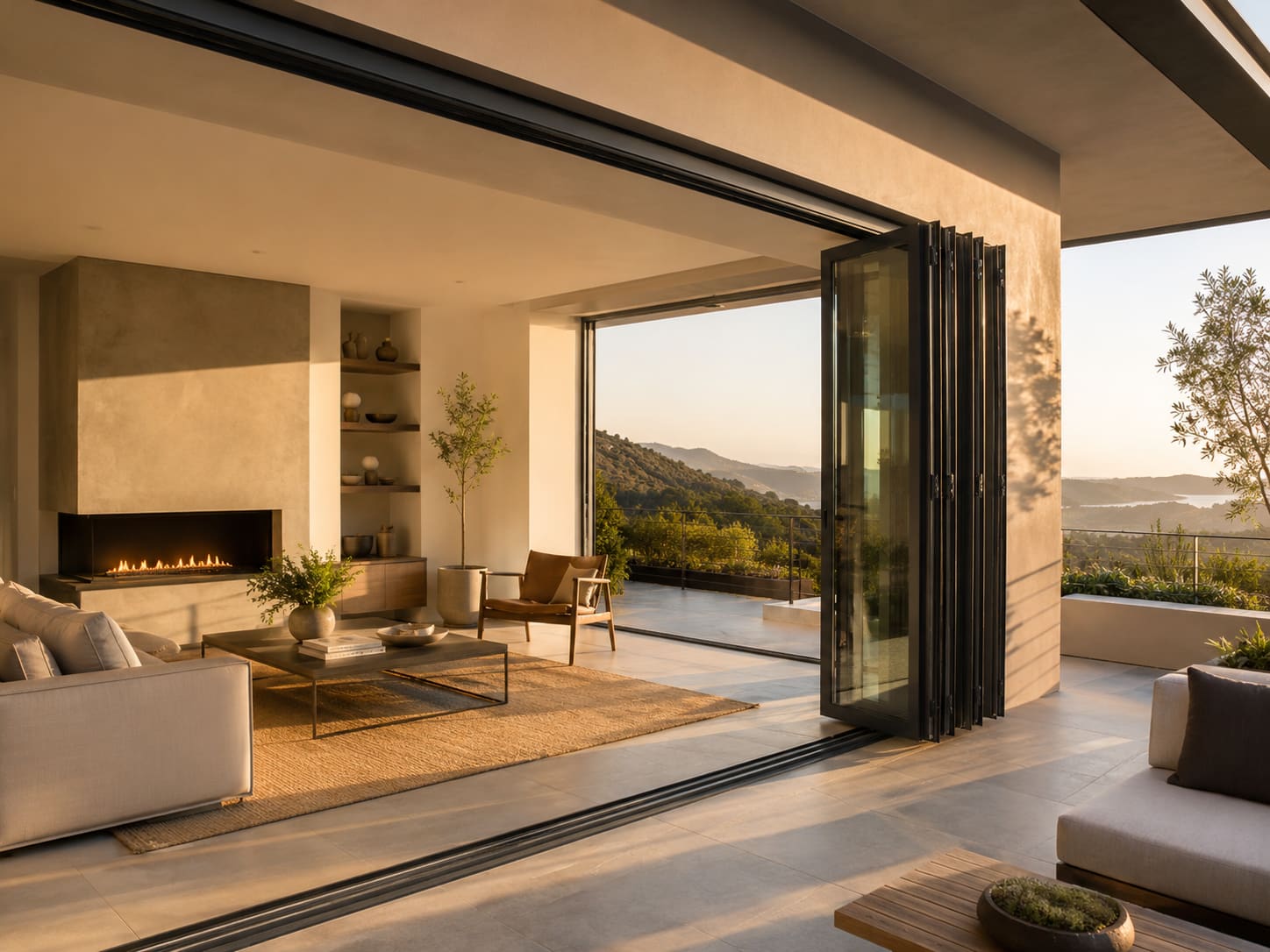
Bi-fold (slide-and-fold) aluminium doors are made of several leaves hinged together that concertina to one or both sides, opening up to 90 percent of the aperture to merge indoor and outdoor spaces. They are the go-to for villa living rooms in Kokapet and Financial District that open onto a deck or lawn.
French doors are a pair of casement leaves that open from a central meeting stile, offering a symmetrical, classic look with a full-width walk-through.
- Bi-fold leaf count: commonly 3 to 7 panels running on a top or bottom track.
- French door leaves: usually 2, with astragal seals at the meeting stile.
- Glass: toughened or laminated safety glass; laminated is preferred at ground level for security.
- Best for: patios, restaurants and living areas that open onto gardens or terraces.
- Indicative price: INR 900 to INR 2,200 per sq ft for bi-fold, INR 700 to INR 1,400 for French.
For a frameless, all-glass alternative that gives a similar sense of openness, some clients pair these with toughened glass doors at the interior threshold.
Pivot and Thermally Broken Doors
Pivot aluminium doors rotate on a central or offset spindle at the top and bottom rather than side hinges, allowing very large, heavy statement entrance leaves up to 3 metres tall. This is the entrance you see on premium office fronts and designer villas where the door itself is meant to make an impression.
Thermally broken doors insert a polyamide barrier between the inner and outer aluminium profiles, cutting heat transfer for energy efficiency. In a city where air conditioning runs eight months a year, this directly lowers running costs.
- Thermal break: reduces U-value to roughly 1.6 to 2.8 W/m2K with double glazing, supporting ECBC and BEE-aligned energy goals.
- Pivot hardware: floor-spring or hydraulic pivot sets rated for leaf weights of 100 to 300 kg.
- Best for: premium villa and commercial entrances, and air-conditioned interiors where cooling load matters.
- Indicative price: INR 1,500 to INR 4,000 per sq ft for premium thermally broken and pivot systems.
If energy performance is the priority, look at our dedicated thermal-break door systems, which combine the polyamide barrier with double glazing to keep interiors cooler through the Telangana summer.
Aluminium vs uPVC vs Wooden Doors: Which Wins in Hyderabad?
The question we hear most is whether aluminium is really worth it over uPVC or timber. In Hyderabad's climate, the answer usually favours aluminium for anything structural or large, with uPVC a value option for smaller openings.
- Strength: aluminium carries far larger glass spans than uPVC, so it wins for full-height and villa openings; timber can warp on wide leaves.
- Weather: aluminium and uPVC both shrug off monsoon humidity; solid timber can swell and stick in the rains and dry-crack in peak summer.
- Sightlines: aluminium profiles are the slimmest, meaning more glass and daylight for the same aperture.
- Maintenance: aluminium needs only occasional cleaning; powder-coated finishes hold up for decades against UV and dust.
- Cost: uPVC is cheaper upfront for standard windows and small doors, which is why buyers often compare the two; our uPVC doors and windows range covers that budget tier.
For a deeper cost and performance comparison, see our guide on aluminium versus uPVC windows, which applies equally to door decisions.
Profiles, Glass and Finishes: What to Specify
The door type sets the movement, but the profile series, glass and finish decide how long it lasts and how it performs. These are the details that separate a door that looks good for 3 years from one that performs for 30.
- Alloy and wall: extruded 6063-T5 or T6 with 1.2 to 2.0 mm wall thickness per IS 733 and IS 1285; thin, unbranded sections flex and rattle over time.
- Glass: 8 to 12 mm toughened per IS 2553 for full leaves; laminated at ground level for security and acoustic control.
- Finish: anodised or powder-coated at 15 to 25 microns; this coating is what defends the surface against Hyderabad's UV, dust and coastal-influenced humidity.
- Hardware: stainless-steel rollers, multi-point locks and EPDM gaskets rather than bargain fittings, because hardware fails long before the aluminium does.
- Gaskets and drainage: continuous EPDM seals and weep holes to shed monsoon water without leaks.
Precise fabrication matters here. Our in-house aluminium fabrication unit cuts and assembles profiles to tolerance so leaves seal evenly and slide without binding. You can see finished installations in our projects gallery.
How to Choose the Right Type
Choose the aluminium door type by matching the opening's function, available swing space, security needs and budget rather than looks alone.
- For maximum daylight and views with no swing space: sliding or lift-and-slide.
- For a fully open, seamless indoor-outdoor link: bi-fold.
- For security and airtight sealing at main entries: casement or French with multi-point locks.
- For a large architectural statement: pivot.
- For air-conditioned rooms and lower energy bills: thermally broken double-glazed systems.
Design against wind load per IS 875 Part 3 and follow the National Building Code of India (NBC) 2016 for glazing and egress; specify anodised or powder-coated finishes for durability in Hyderabad's climate. If you are unsure which type fits your opening, get a free quote and our team will survey the site and recommend the right system for your budget.