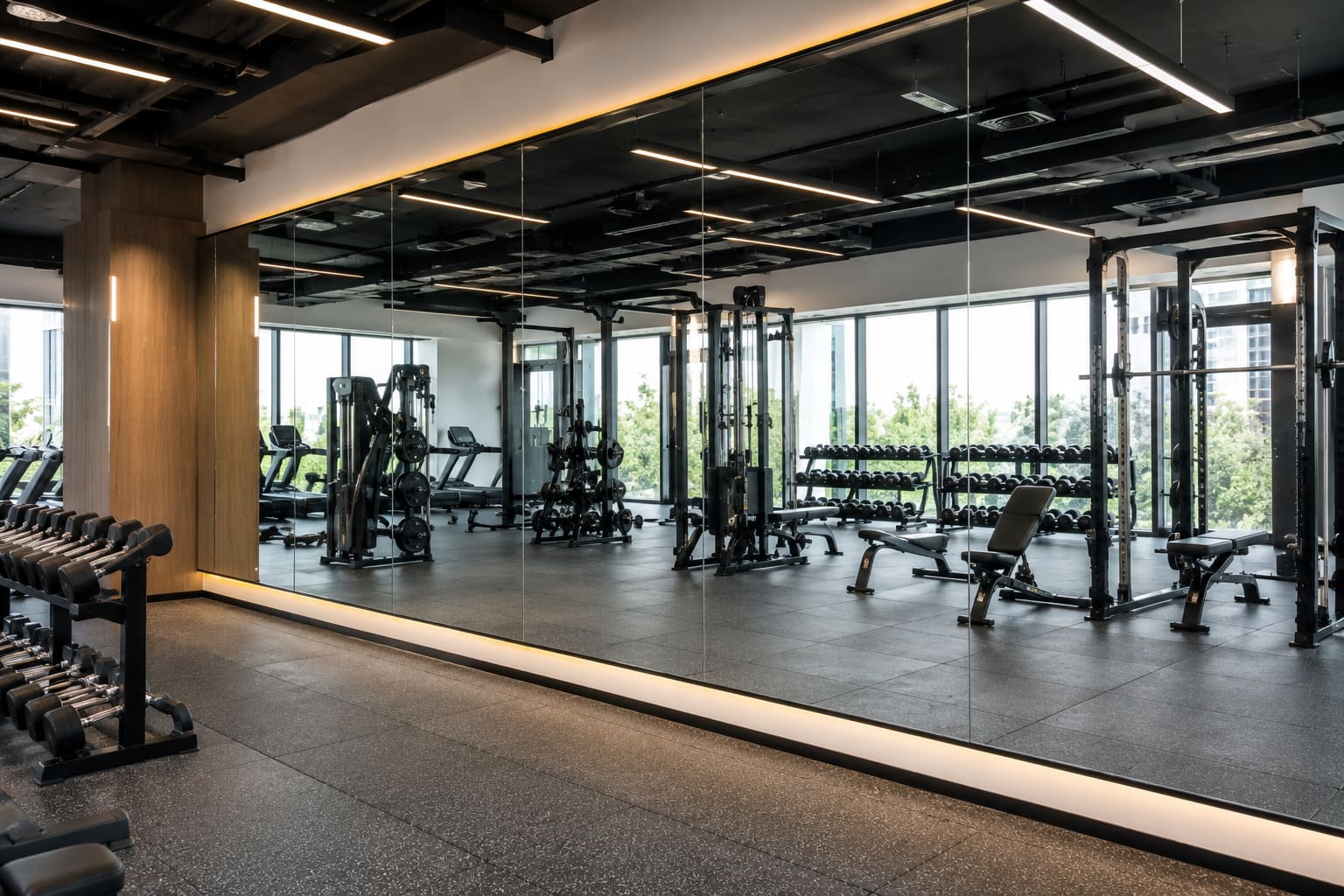
A gym mirror wall costs roughly ₹120–300 per sq ft installed in Hyderabad, and the single most important decision is to use safety-backed 5–6 mm mirror so that a struck panel cracks in place instead of shattering onto the floor. Beyond safety, a good gym mirror wall is planned to be large, dead-flat and distortion-free, with the fewest possible joints so lifters and instructors see a clean, true reflection across the whole room.
Mirrors are what make a training space feel professional. They let you check form under a squat bar, help instructors correct a class from across the room, and visually double the size of a compact home gym. But mirrors are also heavy, brittle and unforgiving of a bad wall or a rushed fixing - which is why sizing, backing and the fixing method matter as much as the glass itself.
This guide breaks down real costs, mirror specifications and safety options, then walks through how a full mirror wall is measured, made and installed for gyms and studios across Hyderabad, Secunderabad, Telangana and Andhra Pradesh. Use it to spec the job correctly the first time and avoid the wavy, joint-heavy, unsafe walls that plague cheaply built gyms.
What a Gym Mirror Wall Actually Is
A gym mirror wall is a run of large silvered-glass mirror panels fixed edge-to-edge across a wall to create one continuous reflective surface, usually from around knee height up to 2.1–2.4 m. Unlike a small bathroom mirror, it is engineered as a wall finish: the glass is thicker, the fixing is structural, and the layout is planned so the joints between panels fall in the least distracting places.
The mirror itself is float glass with a silver-and-copper reflective coating and protective paint on the back. For gyms this glass is normally 5 mm or 6 mm thick, because thinner glass bows slightly when fixed to an imperfect wall and that bow shows up as a funhouse-style distortion in your reflection - the last thing you want when checking squat or deadlift form.
Hakimi Aluminium and Glass supplies and fits these systems as a dedicated gym mirror wall service, and the same principles apply to dance and fitness studio mirror walls where a flawless reflection is even more critical.
Gym Mirror Wall Cost in India (Price Breakdown)
Installed pricing for gym mirror walls in Hyderabad generally falls in the range below. The wide band reflects mirror thickness, whether safety backing is added, the fixing system, and how much cutting and edge-finishing the layout needs.
- Standard 5 mm silver mirror, adhesive + clip fixed: ₹120–170 per sq ft installed
- 6 mm mirror with polished edges and J-channel framing: ₹170–230 per sq ft installed
- Safety-backed mirror (anti-shatter film): add roughly ₹40–80 per sq ft
- Laminated safety mirror (highest safety grade): ₹260–350+ per sq ft installed
As a rule of thumb, a full-wall home gym mirror comes to around ₹40,000–1,50,000 depending on wall size and grade, while a commercial gym or fitness chain covering 100–300 sq ft will run well beyond that. Get exact figures from a site measurement rather than a phone estimate - you can get a free quote with panel sizing worked out for your specific wall. Bundling the job with other glazing (partitions, shopfront or railings) often improves the per-sq-ft rate.
Choosing the Right Mirror Thickness and Type
Thickness is the specification that most affects how good the finished wall looks. The reflective quality of a gym mirror depends on the glass staying perfectly flat, so heavier glass on a well-prepared wall gives the truest image.
- 4 mm mirror: acceptable only for small framed pieces - flexes and distorts on large walls, avoid for gyms
- 5 mm mirror: the practical minimum and most common choice for full gym walls; good flatness at sensible cost
- 6 mm mirror: premium option for large commercial walls; noticeably flatter and more rigid, best distortion-free result
For the reflective coating, standard silver mirror is fine for indoor gyms. In humid or poorly ventilated rooms - a real consideration during the Telangana monsoon - specify a good-quality mirror with sealed, polished edges to slow the black-edge corrosion ("desilvering") that ruins cheap mirrors within a couple of years. Where you want a warmer, more decorative reflection for a boutique studio, tinted or antique options are available through our decorative mirror wall range.
Why Safety Backing Is Non-Negotiable
For any public, commercial or membership gym, safety-backed mirror is strongly recommended and, in our view, essential. A plain mirror that is struck by a dropped kettlebell, a swung barbell or a falling person can shatter into large, sharp shards that fall to the floor exactly where people stand - a serious injury risk and a liability exposure for the gym owner.
Safety backing solves this. A polymer film (or a vinyl interlayer in laminated mirror) is bonded to the back of the glass so that if the mirror breaks, the pieces stay stuck to the film instead of raining down. The wall may crack, but it holds together until it can be safely replaced.
- Anti-shatter film backing: cost-effective, suitable for most commercial gym walls
- Laminated safety mirror: highest grade, holds together even under heavy impact, ideal for high-traffic and functional-training zones
- Plain mirror: only advisable for private home gyms, and even there safety film is a cheap upgrade worth taking
Skipping safety backing to save ₹40–80 per sq ft is a false economy the moment a mirror breaks. It is one of the first things insurers and gym auditors look for.
Sizing and Layout to Minimise Joints
The visual quality of a mirror wall comes down to layout. Fewer, larger panels mean fewer joint lines interrupting the reflection, so the wall reads as one clean surface rather than a grid. A typical maximum single-panel size for gym mirror is around 1830 mm x 2440 mm (6 ft x 8 ft), so a long wall is made from several such panels butted together.
- Set the mirror bottom edge 20–30 cm above floor level to clear dropped weights, foot kicks and mop water
- Aim for a top edge around 2.1–2.4 m so tall members see their head and overhead lifts
- Plan panel widths so vertical joints avoid the centre of key training spots like the squat rack and mirror-facing benches
- Butt joints are near-invisible when panels are cut square and installed tight; avoid unnecessary trims mid-wall
A careful measure also accounts for switches, sockets, skirting and any wall that is out of plumb. Getting the setting-out right on paper before ordering glass prevents awkward slivers and mismatched heights. You can see how we handle large, joint-minimised runs in our recent projects.
The Installation Process, Step by Step
A durable gym mirror wall is built, not just stuck up. The fixing has to carry heavy glass safely for years in a high-vibration environment, so we combine adhesive with mechanical support rather than relying on glue alone.
- Survey and measure the wall for size, plumb and flatness; note obstructions and mark panel setting-out
- Prepare the substrate - the wall must be dry, sound, flat and free of loose plaster or damp
- Fit a bottom J-channel or support rail to physically carry the weight of each panel
- Apply mirror-safe construction adhesive (never ordinary silicone, which can attack the silver backing) in a proper bead pattern
- Set each panel flush and level, pressing to full contact, with edge clips or top retainers as mechanical backup
- Butt panels tight, clean the surface and allow the adhesive to cure before heavy use
The whole job for a typical home gym wall takes about half a day to a day on site once the mirrors are cut; larger commercial walls run one to three days depending on access and area. Curing time before you start slamming weights nearby should be respected - rushing it is a common cause of panels drifting or debonding.
Common Mistakes to Avoid
Most disappointing mirror walls fail for a handful of predictable reasons. Knowing them helps you brief the installer and check the work.
- Using 4 mm mirror on a big wall - it waves and distorts your reflection
- Relying on adhesive alone with no bottom support rail, so heavy panels slowly creep or fall
- Using ordinary acetic silicone that eats the silver backing and causes black edge stains
- Skipping safety backing in a commercial gym - an avoidable injury and liability risk
- Fixing to a damp or uneven wall, which shows every hollow as a ripple and traps moisture that desilvers the mirror
- Setting the mirror too low, so dropped dumbbells and mop water reach the vulnerable bottom edge
If you are unsure whether an existing wall is suitable, a quick site survey settles it. Our full range of glazing and mirror work is listed under our services, and we are happy to advise before you commit to glass.
Gym Mirror Walls in Hyderabad, Telangana & Andhra Pradesh
For gyms and studios across Hyderabad, Secunderabad, Gachibowli, HITEC City, Kondapur and the wider Telangana and Andhra Pradesh region, Hakimi Aluminium and Glass measures, supplies and installs safety-backed mirror walls to a commercial standard. Local fitness studios, apartment-community gyms, hotels and home setups all have different constraints, and a site-specific measure catches them before glass is ordered.
The regional climate matters too: humid monsoon months accelerate mirror desilvering, so we recommend sealed-edge, quality-backed mirror and proper ventilation for any gym here - a small upfront choice that adds years to the wall's life.
Whether you are fitting out a single-room home gym in the suburbs or a multi-wall commercial floor in the city, we can spec the right thickness, safety grade and layout for the space. Reach out to get a free quote with panel sizes and pricing worked out for your exact wall.