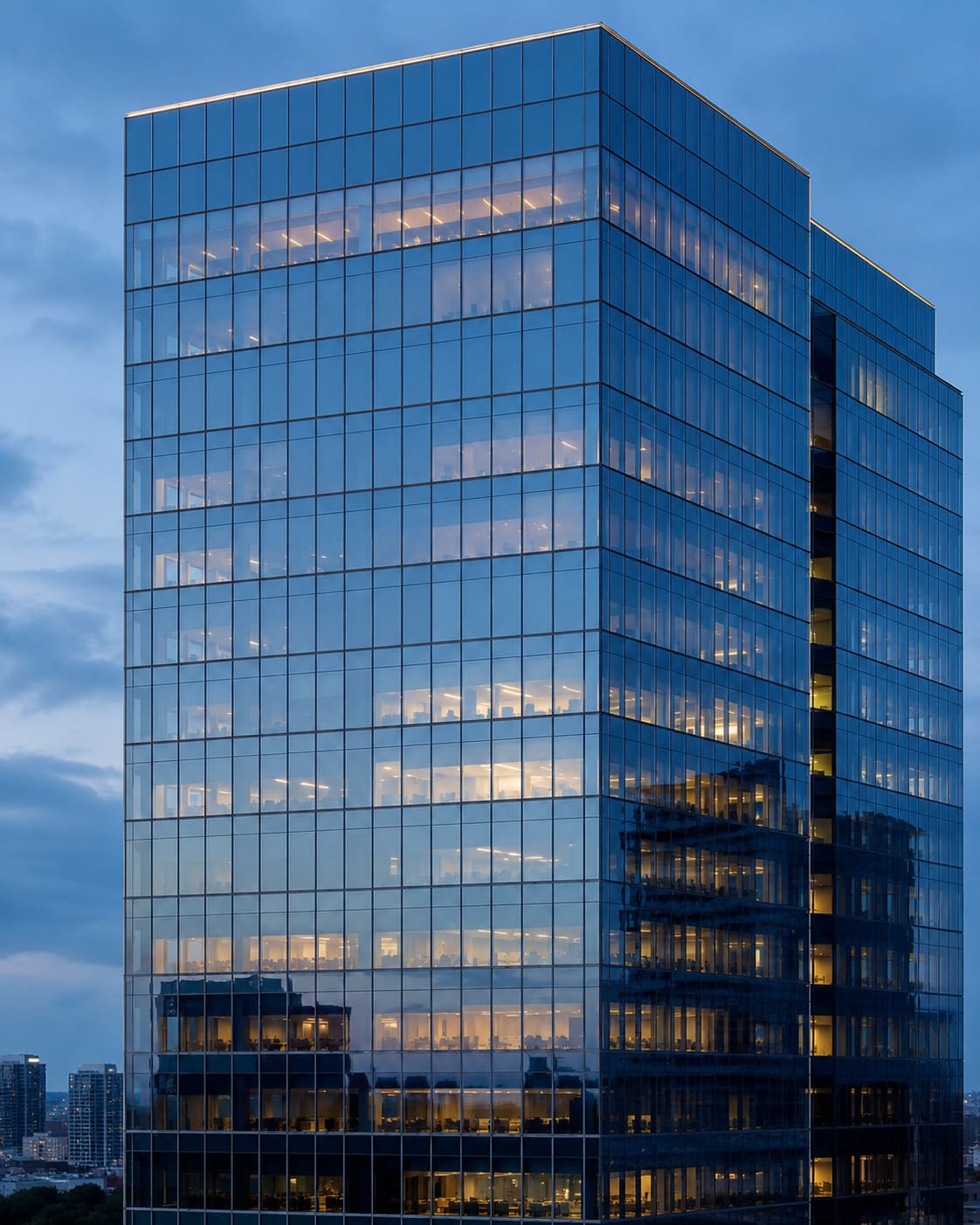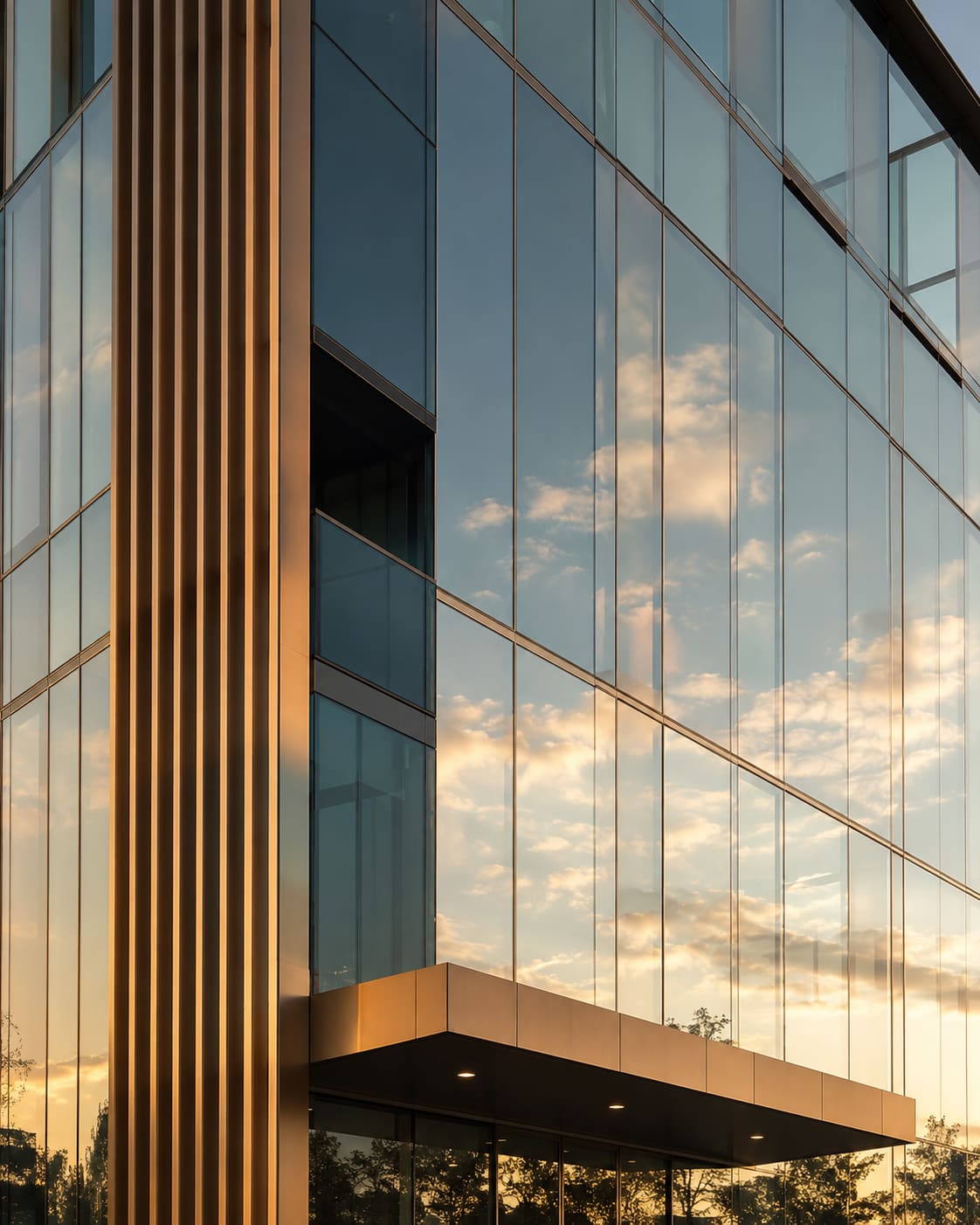

Facade lighting integration means treating each luminaire as a facade component with its own thermal, waterproofing, structural and maintenance envelope - not as an electrical afterthought bolted on once the cladding is set. The decisions that determine whether integrated facade lighting looks intentional and survives a decade - fixing to structure, drainage path, driver temperature, glare cut-off and service access - are all made on the shop drawings, alongside the glass facade work and ACP cladding details you are already coordinating.
For architects and facade designers in Hyderabad, Secunderabad and across Telangana and Andhra Pradesh, the two dominant constraints are heat and monsoon water. Rooftop and south/west cavity temperatures routinely push LED drivers past their rated ambient, and driving monsoon rain tests every joint you asked to double as a wet seal. Get either wrong and a beautiful night render becomes a maintenance liability - dead pixels, water-tracked drivers and colour-shifted runs within two summers.
This article sets out the specification language, detailing rules, indicative Indian pricing, performance criteria and interface responsibilities to get facade lighting integration right before it reaches site. Where the lighting cavity, drainage and glazing details must be resolved as one buildable system, browse our services for the wider facade package or get a free quote with your elevations.
What Facade Lighting Integration Actually Means
Integrated facade lighting is lighting designed into the building envelope - recessed into reveals, shadow gaps, soffits, fins and mullions - so the source disappears and only the lit effect reads at night. Unlike bolt-on floodlighting, it is fabricated and waterproofed as part of the cladding system itself.
That distinction matters because it changes who owns the risk. A surface-mounted floodlight is an electrical scope; an integrated cove line inside a curtain-wall reveal is a facade scope that happens to carry electricity. The luminaire now has to share the envelope's drainage, movement, fire and thermal-break strategy, and it has to be reachable for the ten to fifteen re-lamp cycles it will need over the building's life.
- Grazing / texture wash: fixture mounted close to the surface with a tight beam - reveals stone, ACP or fin texture, but is unforgiving of installation tolerance.
- Flood / area wash: fixture set off the surface for even coverage - needs a standoff distance you must find room for in the section before the build-up is frozen.
- Linear glow / cove: concealed linear LED in reveals, shadow gaps and soffits - the most common integrated approach on glazed and ACP facades, and the easiest to detail cleanly.
- Media / pixel facade: addressable nodes on a grid - brings data, controls, heat and maintenance density that reshape the whole envelope build-up and the sub-frame behind it.
Agree the target look in a night-condition mock-up. Colour temperature (typically 2700-4000K for architecture), CRI and beam spread all read very differently at 1:1 than on a render, and a mock-up is far cheaper than re-lamping a completed elevation.
Detailing the Interface With Glazing and ACP Cladding
Give every integrated luminaire a dedicated cavity that is drained, ventilated and serviceable from outside or from a defined access panel. This is the single most important detail in facade lighting integration, and it is decided on the same section drawings as your glazing rebate and panel returns.
- Waterproofing: keep the electrical waterproofing (the IP-rated luminaire and its gland) independent of the facade weather line; do not ask structural silicone or EPDM gaskets to also seal cabling. This is the same discipline that keeps structural glazing watertight through a monsoon.
- Drainage: slope the housing and provide weep paths so monsoon ingress escapes. A sealed cavity is simply a reservoir that will eventually drown the driver.
- Standoff and shadow gaps: dimension the reveal to hide the fixture body and conceal the diode array while delivering the intended beam - coordinate with glazing setting blocks and ACP cladding return depths.
- Fixings: mount luminaires back to primary structure or a dedicated sub-frame, isolated from the glass and infill panels so facade movement is not transferred into terminations.
- Thermal break and bimetallic contact: separate aluminium housings from dissimilar metals and maintain the envelope thermal break; avoid creating a cold bridge or a galvanic couple that corrodes at the fixing over time.
You can see how these cavity and reveal details translate into finished elevations in our recent projects, where the lighting and cladding were fabricated as a single package.
Performance Criteria to Specify on the Drawings
Write measurable criteria into the drawings and the fixture schedule so the sub-contractor cannot quietly value-engineer them away on site. Vague performance language is where integrated lighting quality leaks out of a project.
- Ingress protection: IP65 minimum for exposed vertical exterior; IP67/IP68 for grade-level, recessed and water-washed positions where standing water is likely.
- Impact / vandal resistance: IK08-IK10 for accessible ground-floor, podium and pedestrian-zone fixtures.
- Driver ambient (Ta): confirm the rated ambient and keep cavity temperature below it; specify remote drivers in accessible plant when cavities run hot.
- Glare and obtrusive light: set upward light ratio and backlight-uplight-glare (BUG) ratings per the CIE 150 / IS environmental-zone framework; shield sources from habitable-room sightlines.
- Colour and consistency: CRI, correlated colour temperature and a MacAdam binning tolerance (e.g. 3-step SDCM) to prevent visible colour drift across a continuous run.
- Electrical resilience: driver efficiency, surge protection (essential in a lightning-prone monsoon climate), and lumen maintenance (L70/L80 at rated hours).
- Energy: reconcile connected load against ECBC exterior lighting power density (LPD) allowances and any IGBC, GRIHA or LEED credit targets for light-pollution reduction.
Managing Heat: Driver Ambient in the Hyderabad Climate
Heat is the number-one killer of integrated facade lighting in Telangana and Andhra Pradesh, so design the thermal case as deliberately as the visual one. This is the failure mode we see most often on retrofits across Hyderabad and Secunderabad.
A sealed south or west cavity behind ACP or spandrel glass can sit 15-25 degrees C above the shaded air temperature. With Hyderabad summer air touching 42-44 degrees C, cavity temperatures of 55-65 degrees C are entirely realistic - well past the 45-50 degrees C Ta rating of most integral drivers.
- Ventilate the housing with baffled, insect-screened openings that let hot air convect out without letting driving rain in.
- Remote-mount drivers into an accessible, cooler service void or plant space, and keep the low-voltage run within the manufacturer's maximum cable length so voltage drop does not dim the far end.
- Choose fixtures with an aluminium heat-sink body and a documented Ta at the rated lumen output - not a headline figure measured in a 25 degrees C laboratory.
Every 10 degrees C over rated Ta roughly halves electrolytic-capacitor driver life. A cavity that runs 60 degrees C against a 45 degrees C rating can turn a claimed 50,000-hour life into well under 15,000 hours - the difference between one re-lamp in a building's life and an annual maintenance contract.
Structure, Movement and Thermal Coordination
Integrated fixtures must ride the same movements the facade is designed for, so coordinate their fixings with the structural and thermal design case rather than pinning them wherever is convenient on site.
- Wind and deflection: size fixings and cable service loops to accommodate facade deflection under IS 875 Part 3 wind loads without stressing terminations.
- Thermal movement: allow for aluminium expansion (roughly 24 x 10^-6 per degree C) across long linear runs - segment continuous LED lines and provide movement loops so a 6 m run does not tear itself apart across a 40 degrees C daily swing.
- Dead and live load: carry fixture and containment weight on the sub-frame, not on the glazing infill; where spider or point-fixed glass is involved, coordinate brackets so load paths stay clean.
- Fire and cavity: where luminaires sit in a ventilated cavity or rainscreen, coordinate cabling and penetrations with the cavity-barrier and NBC 2016 fire strategy.
- Do not compromise glazing performance: adding fixtures must never breach the insulated glass unit edge seal, the U-value, SHGC or acoustic Rw you specified.
This coordination is easiest when the same contractor owns the glass facade work and the lighting cavity, because one party is then accountable for both the movement joint and the termination that has to survive it.
Controls, Maintenance and Commissioning
Specify controls and access as part of the facade package, because a beautiful scheme fails fast if drivers cook and fixtures cannot be reached. Access strategy is a design decision, not a site improvisation.
- Control protocol: DALI, DMX/RDM (for pixel/media) or 0-10V - match to the effect; addressable systems need a documented mapping and spare data capacity.
- Zoning and scenes: define scenes, curfew dimming and astronomical time-clock behaviour to meet obtrusive-light curfews and reduce energy against the ECBC target.
- Maintenance access: show how every fixture and driver is reached - from a cradle, walkway, opening light or removable panel - and keep failure-prone drivers accessible without dismantling cladding.
- Redundancy: series/parallel wiring so a single failure does not black out a full run; specify spares (typically 2-5 percent of fixtures) held by the client from day one.
- Commissioning: require a night-time focusing and aiming visit, photometric verification and a signed-off scene library at handover, not a hurried switch-on the night before opening.
Budgeting Facade Lighting in Indian Rupees
Price integrated lighting as a system - fixture, driver, cavity fabrication, containment, controls and access - because the fixture is often the smallest line in the total. The numbers below are indicative Hyderabad-market ranges for planning; a firm figure needs your elevations and beam intent.
- Architectural linear LED (IP65/IP67, 3-step SDCM, quality driver): roughly Rs 1,800-4,500 per running metre supply-only, before mounting and containment.
- Cavity fabrication, brackets and drained housing detailing: often adds Rs 800-2,000 per metre once you account for the aluminium sub-frame and access provision.
- Media / pixel nodes on a grid: typically Rs 900-2,500 per node installed depending on pitch, plus a controller and mapping-software premium.
- Remote driver enclosures, surge protection and DALI/DMX controls: budget a further 15-25 percent of the fixture value for a robust, serviceable system.
For a mid-rise commercial elevation in Hyderabad or Secunderabad, a well-detailed integrated linear scheme frequently lands around Rs 3,500-7,000 per running metre installed. Spending on ventilation, drainage and access up front is far cheaper than a recurring re-lamp bill - get a free quote with your elevations and we will price the buildable detail, not just the fixtures.
Common Mistakes to Avoid
Most integrated facade lighting failures in the field trace back to a handful of avoidable decisions made too late in the design. Catching these on the shop drawings is nearly free; catching them on a completed elevation is not.
- Treating lighting as an MEP add-on: if the luminaire cavity is not on the facade section, the drainage and access will be improvised on site - badly.
- Trusting the IP seal alone: IP65 keeps water out of the fitting, but it does not drain a flooded cavity. Detail an independent weep path regardless of IP rating.
- Integral drivers in hot cavities: the most common cause of premature failure in Telangana. Remote-mount or ventilate; never seal a driver into a west-facing void.
- Continuous unsegmented runs: long rigid LED lines with no movement loop crack solder joints as the aluminium expands and contracts daily.
- No mock-up: signing off colour temperature and beam from a render alone almost always produces a visible mismatch or glare problem on the real elevation.
- Ignoring obtrusive-light limits: unshielded uplight invites neighbour complaints and can breach CIE 150 curfew expectations for the site's environmental zone.
A Local Angle: Facade Lighting in Hyderabad and Telangana
Hyderabad's climate and building stock shape every one of these decisions. The Financial District, Gachibowli, HITEC City and the growing commercial corridors of Secunderabad and Vijayawada are full of glazed and ACP elevations where integrated lighting is now an expectation rather than a luxury - and where the summer heat and monsoon intensity punish shortcuts.
Two climate facts drive the local detailing: pre-monsoon and summer air temperatures that regularly touch 42-44 degrees C, and short, violent monsoon downpours with frequent lightning. The first mandates ventilated or remote-mounted drivers; the second mandates independent drainage and serious surge protection on every circuit.
As a Hyderabad-based facade contractor and hardware dealer, Hakimi Aluminium and Glass detail the lighting cavity, glass facade work and ACP cladding as one coordinated package for clients across Telangana and Andhra Pradesh - so the party sealing the cavity is the same party accountable for the light staying on. Bring your elevations and night-time intent and get a free quote for a detail that survives a decade of Hyderabad summers, not just the opening-night photograph.