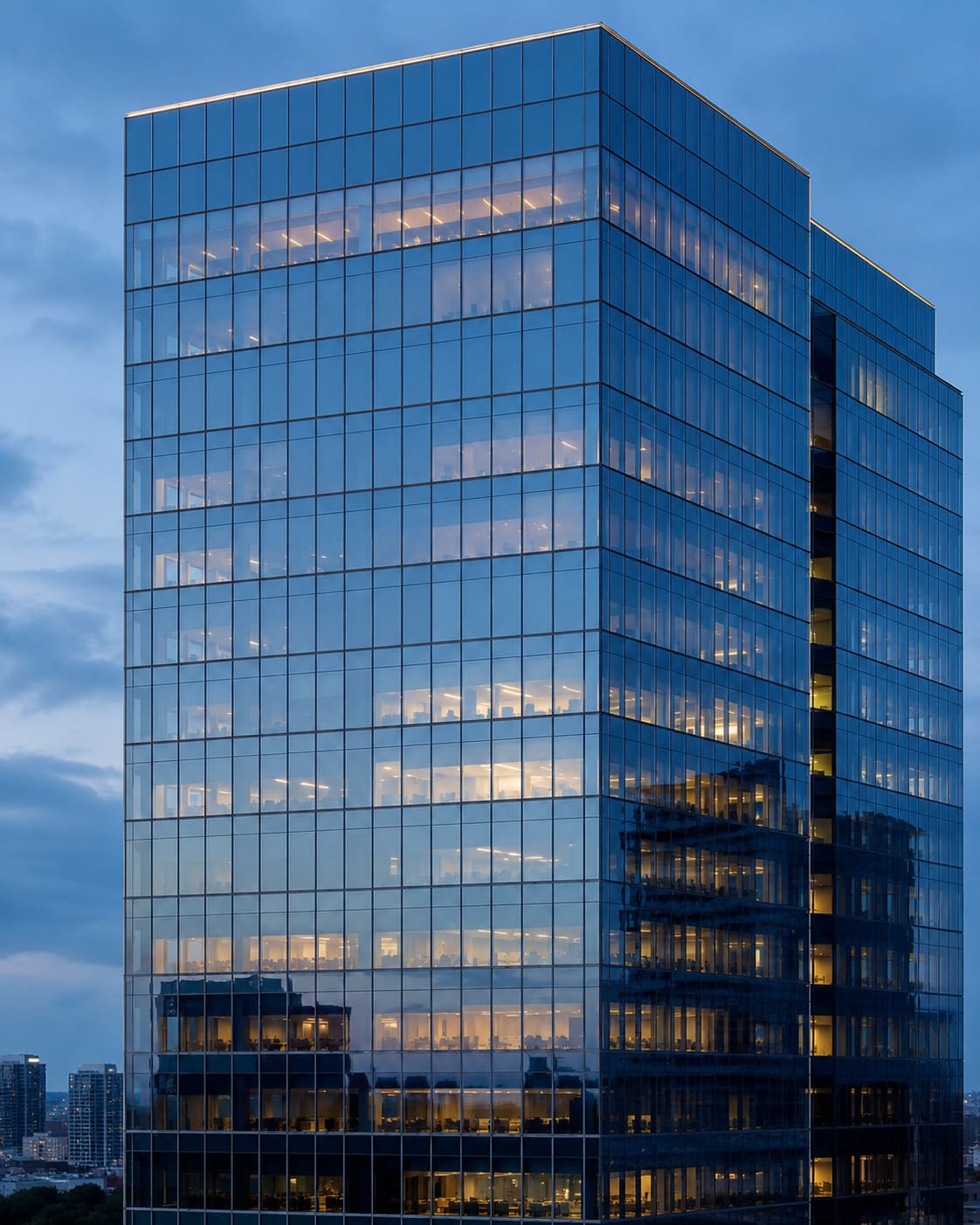

The facade procurement route you choose decides three things before a single panel is cut: who owns the detailing risk, who holds the performance warranty, and how much control you keep over the envelope you designed. The four main facade procurement routes are prescriptive design-bid-build, performance specification, design-assist, and full delegated (design-and-build) contractor design - and the right choice depends on how much authorship you want to retain versus how much risk you want to transfer. For architects and PMCs across Hyderabad's fast-moving commercial market, this is not an administrative tick-box; it directly shapes buildability, air and water tightness, thermal performance, programme and the quality of the joint you finally get on site.
This guide compares the four routes as they actually behave on Indian projects, with realistic 2026 INR budgets and named Indian and international standards, and shows how to write specification language that keeps performance intact regardless of who does the shop drawings. Whether you are procuring a unitised tower on the Outer Ring Road, a structural glazing shopfront in Secunderabad, or a spider-fitting atrium, the same principle holds: a procurement route only protects you if your criteria are numeric, your standards are named, and your acceptance testing is contractual rather than aspirational.
The recurring theme through every route below is control-through-criteria. You can hand geometry and detailing to a specialist and still bind the outcome tightly - but only if the brief fixes performance, tolerance and testing in writing. Where you leave gaps, the cheapest compliant reading fills them, and on a facade that reading rarely favours the building.
The four facade procurement routes, and who carries the risk
Every facade tender in Telangana ultimately maps to one of four procurement families. The difference between them is not paperwork - it is where the design risk and the warranty sit when something leaks in the second monsoon.
- Design-bid-build (prescriptive): You detail the system fully - sections, glass make-up, gaskets, anchors - and the contractor builds strictly to your drawings. You get maximum design control, but you retain detailing and buildability risk, and interface gaps become paid variations on site.
- Performance specification: You define the outcomes (U-value, SHGC, VLT, Rw, air/water/wind classes, deflection limits) and the specialist engineers a system to meet them. Control shifts toward criteria rather than geometry, and the fabricator warrants the performance they engineered.
- Design-assist: The facade specialist is engaged early, during design development, to validate spans, thermal breaks, waterproofing interfaces and cost against your intent before the package is priced or frozen. Risk is shared and coordinated rather than transferred at tender.
- Delegated / design-and-build: The contractor takes single-point responsibility for design, fabrication and installation against your employer's requirements. This carries the lowest coordination burden for you, but the weakest design control unless your performance brief is watertight.
A quick way to remember it: prescriptive keeps the risk with you, performance shares it at tender, design-assist shares it during design, and delegated transfers it wholesale. If you are unsure which fits your building and programme, get a free quote with your drawings attached and we will map the trade-offs before you commit to a route.
What a defensible performance specification must state
A performance route only works if the brief is unambiguous. Vague notes push the specialist toward the cheapest compliant reading, and you inherit the shortfall. State each of the following as a number tied to a named standard rather than an adjective:
- Thermal: maximum U-value (W/m2K) for vision and spandrel, plus SHGC and VLT ranges aligned to ECBC 2017 and your IGBC, GRIHA or LEED targets. For Hyderabad's composite-hot climate, SHGC control (often 0.25-0.35) usually matters more than U-value, and a double-silver low-E coating on 6-12-6 DGU is a sensible baseline.
- Acoustic: required Rw (or Rw+Ctr) for the assembly, tested to ISO 140/717 - critical near the ORR, the airport corridor and arterial-road sites, where 38-42 dB Rw is a common brief.
- Structural: wind pressures derived from IS 875 (Part 3) and NBC 2016 for the correct terrain category; framing deflection limit (commonly L/175 or 20 mm, whichever is less); anchor design to IS 456 / IS 800 as applicable.
- Air and water: air infiltration and water-penetration classes with the ASTM E283 / E331 test pressures stated, plus a site hose-test acceptance criterion to AAMA 501.2.
- Fire and safety: glazing to IS 2553 (safety glass), heat-soaked toughened glass where spontaneous breakage is a risk, and cavity barriers / fire-stopping at slab edges per NBC 2016 Part 4.
Every one of these clauses should carry a test method and a pass/fail threshold. A specification that says 'thermally efficient facade with good acoustic performance' is legally empty; a specification that says 'U-value <= 1.8 W/m2K, SHGC <= 0.30, Rw >= 40 dB to ISO 717, water tightness to ASTM E331 at 300 Pa' is enforceable. On a performance or delegated route, that difference is the entire protection you have.
Tolerances and interfaces - where facade routes actually fail
Most facade disputes are not about the panel; they are about the joint to the adjacent trade. In practice, well over half of the water-ingress claims on Hyderabad commercial jobs originate at junctions, not the glass. Fix these in the specification regardless of route:
- Slab-edge tolerance vs. facade adjustability: state the RCC construction tolerance you will guarantee, and require the bracket system to absorb it - typically +/-25 mm of three-dimensional adjustment at each anchor.
- Movement joints: accommodate inter-storey drift and thermal movement explicitly; do not let sealant do a structural job it was never engineered for.
- Interface schedule: name the responsible party for each junction - parapet, sill, soffit, expansion joint, waterproofing lap, and the transition to any aluminium doors, sliding systems or vents in the facade line. A delegated route without this schedule simply hides the gaps until the first wet season exposes them.
- Provisional dimensions: mark drawings as coordination dimensions until survey-verified, so the shop drawings carry the tolerance, not your general arrangement.
The lesson from repeated site audits across Secunderabad is blunt: an interface left unassigned is an interface that leaks and then gets argued about. You can see how disciplined junction detailing plays out in our recent projects, where the interface schedule is agreed before fabrication rather than negotiated after a leak. Assign every junction on paper before it is built.
Realistic INR budgets and programme by route
Procurement route choice moves cost and time, not just risk. Indicative Hyderabad and Telangana rates for 2026 (supply-and-install, before GST) give you a planning baseline - your actual number depends on glass make-up, floor height, mullion depth and access:
- Aluminium composite panel (ACP) cladding: roughly INR 550-950 per sqft depending on core grade (FR vs. non-FR) and PVDF coating.
- Structural glazing (stick, semi-unitised): roughly INR 3,500-6,500 per sqm.
- Unitised curtain wall: roughly INR 6,500-11,000 per sqm, driven by glass specification, floor height and mullion depth.
- Spider / point-fixed glazing for atriums and lobbies: roughly INR 8,000-16,000 per sqm including structural fittings and tempered glass.
- Project performance mock-up: typically INR 4-9 lakh, and worth every rupee before you commit to series fabrication.
On programme, design-assist front-loads four to eight weeks of coordination during design but typically cuts RFIs and cladding rework later, whereas design-bid-build looks faster on paper and then loses that time to on-site variations. A well-run curtain wall glazing package priced against a complete performance brief is almost always cheaper over the whole job than a low tender that reprices every interface as an extra. When you compare tenders, normalise them: a rate that excludes brackets, fire-stopping, mock-up or a real warranty is not the same scope as one that includes them, and the difference is exactly where budgets are blown.
Choosing the facade procurement route by project type
There is no single best route - only the right route for the building, the programme and how much authorship you want to keep.
- Bespoke / signature facades: design-assist. You keep authorship while the specialist de-risks spans, thermal breaks and waterproofing early, before geometry is frozen.
- Standard commercial curtain wall / unitised: performance specification, provided your criteria and testing regime are complete. This lets specialists optimise proprietary systems against clear targets.
- Fast-track or single-responsibility jobs: delegated design-and-build, but only with a rigorous employer's requirements brief and named standards; without them you trade coordination effort for performance risk.
- Heritage, complex retrofits or tight urban interfaces: prescriptive control on the sensitive zones, performance elsewhere. Hybrid packages are legitimate and common, and often the most honest response to a mixed building.
- Frameless glass shopfronts and entrances: prescriptive on the ironmongery and locks, fixed by make, with performance criteria on the glass and structural fixings.
Hakimi Aluminium and Glass offers design-assist, shop drawings, fabrication and installation for architects and PMCs across Hyderabad, Secunderabad, Telangana and Andhra Pradesh - useful when you want span and interface validation before a package is priced. Browse our services to see where we plug into your delivery model, from stick systems to unitised towers.
Making any facade route stick: testing and warranty
A procurement route is only as good as the acceptance regime attached to it. These clauses turn intent into something enforceable:
- Performance mock-up (PMU): mandate a project-specific mock-up tested for air (ASTM E283), static and dynamic water (ASTM E331 / AAMA 501.1) and structural load (ASTM E330) before series fabrication begins. Catching a gasket or drainage flaw in the mock-up costs lakhs; catching it on the facade costs crores.
- Site quality hold points: anchor pull-out tests, sealant adhesion (peel) tests, and hose testing per AAMA 501.2 at defined stages, with written sign-off before the next lift proceeds.
- Warranty: require a single-point facade warranty of 5-10 years covering system performance and weathertightness, with glass, coating and sealant warranties assigned into it - otherwise a delegated route leaves you chasing three suppliers who each blame the other two.
- Documentation: as-built shop drawings, structural calculation packages and test certificates as a condition of final payment, not a post-completion favour.
These four clauses cost almost nothing to write and are the difference between a warranty you can call on and a folder of promises. On a delegated route in particular, the single-point warranty is what stops liability fragmenting the moment something fails; make it non-negotiable in the employer's requirements.
Common facade procurement mistakes in Hyderabad tenders
The same avoidable errors recur across Telangana and Andhra Pradesh projects, regardless of the client's sophistication:
- Copy-paste specifications: performance clauses lifted from another city that ignore Hyderabad's SHGC-driven climate and the correct IS 875 wind zone, producing either over-cost or under-performance.
- Missing interface schedule: the single biggest source of leaks and disputes, and trivially cheap to fix at design stage.
- Awarding on lowest tender without a PMU clause: the saving evaporates in variations and re-work on the first wet facade.
- Under-specified hardware: a strong facade brief paired with generic ironmongery, so the entrance doors, locks and closers fail long before the glass does.
- No single-point warranty: liability fragments across the glass supplier, the fabricator and the sealant maker, and the client owns every gap between them.
Fixing these five items costs almost nothing at specification stage and prevents the majority of facade claims. If you would like a second set of eyes on a live tender package, get a free quote or send the drawings across and we will flag the gaps against the standards above before they become variations.