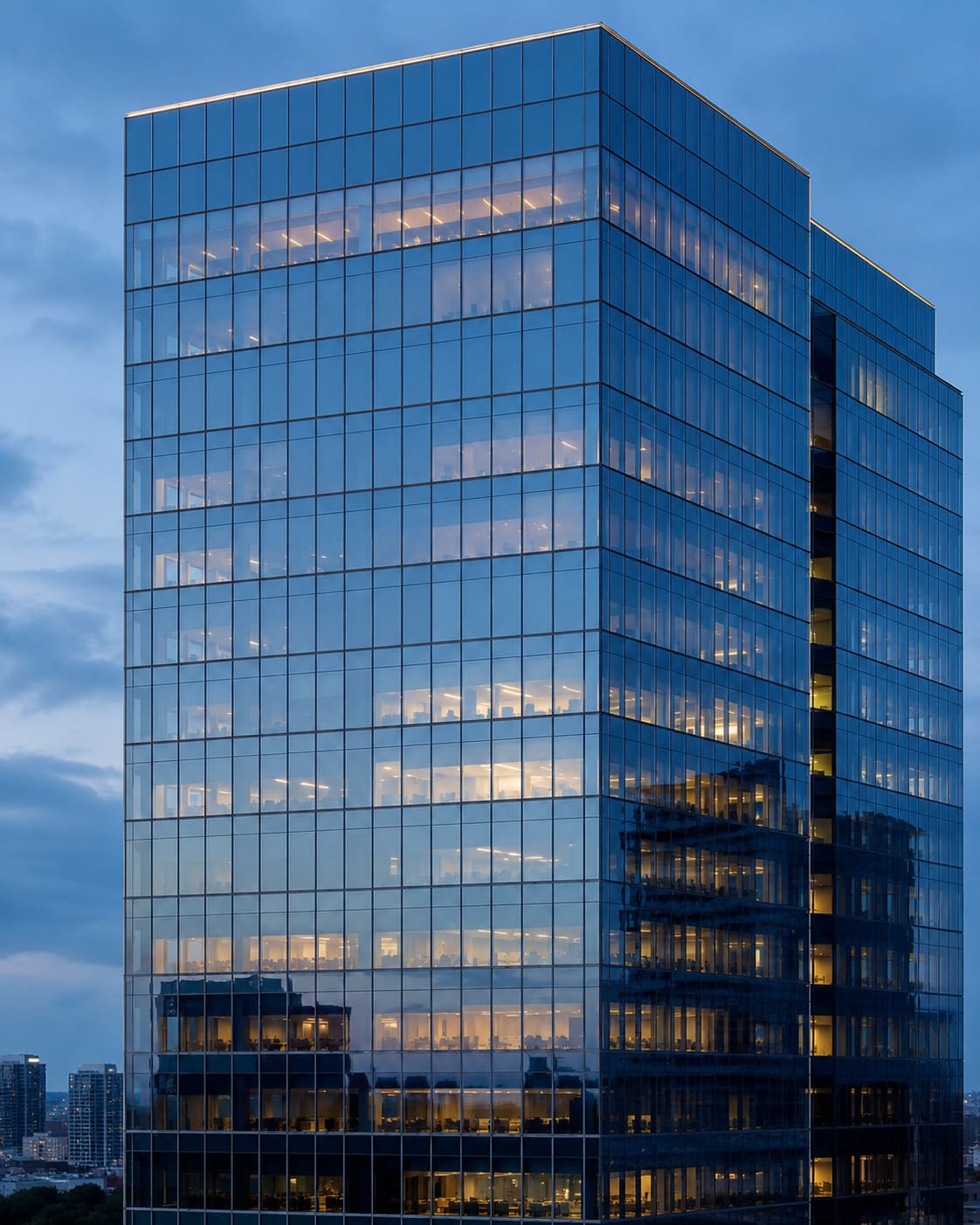

Facade value engineering is the disciplined removal of cost that the design does not depend on - not the quiet erosion of the performance and appearance you specified. Done well, it trims 10-20% off a facade package by attacking glass make-up, framing depth, panel-grid repetition and hardware selection, while leaving sightlines, coatings, U-value, SHGC and wind performance completely intact. Done badly, it widens mullions, drops coating tiers and slips acoustic ratings, all under the innocent-sounding heading of 'savings'. The difference is whether you separate design intent from cost intent before the first VE meeting rather than in a panic at tender stage.
The reason this works is that a large share of facade cost sits in decisions that are invisible on the finished building: framing depth, transom spacing, glass coating tier, bracket density, panel repetition and the number of bespoke interface details. Attack those and you protect exactly what architects, PMCs and owners actually judge - proportion, reveal depth, reflectivity and the crispness of a shadow gap - while still returning real numbers to the cost plan. On a typical mid-rise commercial tower in Hyderabad or Secunderabad, that discipline is worth roughly Rs 250-600 per square metre of facade without touching a single line of design intent.
This guide sets out how we approach it at Hakimi Aluminium and Glass, where we deliver glass facade and curtain wall work and ACP cladding for projects across Hyderabad, Secunderabad, Telangana and Andhra Pradesh. The principles apply equally to a boutique showroom on Road No. 36, a hospital block in Secunderabad and a lakefront IT campus in Gachibowli. Whether you are an architect defending a tender or an owner trying to understand where the money really goes, the logic is the same: cut the cost the building never shows.
What facade value engineering actually is (and isn't)
Value engineering is a structured method for delivering the same required function at lower whole-life cost. On a facade, 'function' means keeping weather out, controlling solar heat and glare, resisting wind, meeting acoustic and fire targets, and presenting the intended appearance. Anything that reduces cost without compromising those functions is legitimate VE. Anything that reduces cost by quietly lowering a function is just a specification cut wearing a VE badge.
The distinction matters because on Indian projects the two get blurred constantly. A quantity surveyor returns your elevation with a red pen, and 'value engineering' becomes shorthand for 'the cheapest thing that still looks roughly similar'. The specifier's job - and the owner's protection - is to insist on the harder discipline: keep every performance and appearance function fixed, and hunt cost only in the framing, fabrication, logistics and hardware that no one experiences directly.
- Genuine VE: standardising panel sizes, choosing a tested standard system section over a bespoke extrusion, matching hardware to real door weight, or moving labour into the factory.
- Not VE: dropping structural glass thickness below the wind-load requirement, deleting a laminated safety leaf, or swapping a specified coating for a cheaper tint that shifts the building's colour.
Get this framing right at the outset and every later conversation becomes easier, because both sides know which column a proposed change belongs in.
Separate design intent from cost intent before the first meeting
Before you negotiate, write down what is fixed and what is tradeable. This single act turns value engineering from a defensive scramble into a controlled optimisation, and it gives the contractor a boundary they cannot cross without written sign-off.
- Non-negotiable (design intent): external sightline width, reveal depth, glass reflectivity and colour, visible light transmittance (VLT), and any published sustainability target under IGBC, GRIHA or LEED.
- Non-negotiable (performance): wind-load capacity to IS 875 Part 3, structural glass thickness to IS 2553, deflection limits (commonly L/175 for glass-supporting mullions), acoustic Rw and fire compartmentation at the edge of slab.
- Tradeable: framing depth and system family, glass coating tier, spandrel construction, bracket spacing, panel grid, hardware brand and the factory-versus-site work split.
Anything in the tradeable column is fair game; anything above it requires a formal design change, not a VE note. Circulating this two-column list to the PMC and contractor at kick-off is the cheapest hour you will spend on the project, because it pre-empts the 'we assumed you were fine with...' conversations that surface after ordering. If you would like a template list tailored to your scheme, you can get a free quote and we will return one alongside indicative rates.
Where facade cost actually hides
Most VE savings come from a handful of line items. Knowing their relative weight lets you concede the cheap things gracefully and defend the expensive-looking ones with evidence rather than emotion.
- Glass: coating tier, low-iron versus standard clear, double-glazed unit (DGU) versus single glazing, and cavity or interlayer specification typically move cost more than any framing change - frequently 35-45% of a glazed facade's supply value.
- System type: unitised curtain wall carries a higher rate than stick, but recovers it on tall or fast-track projects through site labour and programme; on low-rise, stick or a composite window-wall may be the genuine value option.
- Framing depth and grid: deeper mullions and non-repeating panel sizes drive both aluminium weight (to IS 733 alloys) and the number of fabrication setups.
- Hardware and openings: floor springs, closers, locks and pivots on entrances are often over-specified; matching hardware to the real door weight and traffic trims cost with no visible change.
- Interfaces and brackets: bespoke corners, non-standard slab edges and dense anchor layouts multiply detailing, testing and installation hours faster than any other item.
Because glass and system type dominate, that is where your attention should concentrate - a rupee of effort spent optimising the glazing brief returns far more than the same effort spent haggling over gasket brands.
Indicative Hyderabad facade costs in INR
Owners planning a budget need real numbers, so the following supply-and-fix ranges reflect typical Hyderabad and Telangana market rates in 2026. Treat them as planning figures, not quotations - final pricing depends on height, access, glass make-up, wind zone and finish. For a like-for-like comparison against your own drawings, ask us to price the package.
- Structural (spider/frameless) glazing: Rs 1,100-2,200 per sq.ft depending on glass make-up and fitting grade.
- Unitised aluminium curtain wall: Rs 1,800-3,200 per sq.ft, including factory glazing and testing.
- Stick-system curtain wall: Rs 900-1,800 per sq.ft, lower supply rate but higher site labour.
- Aluminium composite panel (ACP) cladding: Rs 220-450 per sq.ft, driven by panel grade (FR versus standard core) and framing.
- Standard aluminium windows and glazing: Rs 550-1,100 per sq.ft depending on series and hardware.
As a rule of thumb, a well-engineered mid-rise commercial facade in Hyderabad lands around Rs 1,600-2,600 per sq.ft all-in, and disciplined value engineering can move you toward the lower end of that band without dropping a performance tier. You can see finished examples of this cost discipline in our recent projects.
Glass make-up: the highest-leverage VE conversation
Glass is where you can save the most and lose the most, so specify by performance band rather than by product name. Hyderabad's composite climate - hot, largely cooling-dominated, with a short humid monsoon - rewards solar control far more than heroic insulation, which changes the entire calculus.
- Anchor the brief to SHGC and VLT bands, for example SHGC 0.25-0.35 with VLT above 0.40 for daylight, and let the contractor propose any product that meets both. This opens genuine competition between suppliers without weakening intent.
- Treat U-value pragmatically: under ECBC, a modest air-filled DGU usually beats an argon triple on whole-life value in a Telangana climate where you almost never heat the building.
- Legitimate VE: swapping a named low-iron unit for standard clear where the tint is acceptable, or a double-silver coat for a single-silver where the SHGC band still allows it. On a 3,000 sq.m facade this alone can save Rs 8-15 lakh.
- Not VE: reducing structural glass thickness below the IS 2553 wind-load requirement, or deleting the laminated inner leaf where overhead or safety glazing demands it.
Where the design uses frameless assemblies, remember the glass is only as good as its edge support - spider and patch fittings must be rated for the actual pane weight rather than defaulted to the heaviest catalogue item. This is a recurring theme in our glass facade and curtain wall work: the glass brief and the fitting schedule have to be value-engineered together, never in isolation.
Framing, grid and fabrication savings the elevation never sees
The cheapest saving is a repeated detail. Rationalising geometry cuts tooling, drawing and site time while leaving the drawn elevation completely untouched - the ideal VE move because the architect signs it off in seconds.
- Standardise panel sizes onto a repeating module; collapsing a dozen odd widths to three or four can reduce fabrication and installation cost by roughly 10-20%.
- Reduce transom count where glass thickness and deflection (typically L/175 for glass-supporting members) still comply - fewer transoms means fewer gaskets, brackets, seals and potential leak paths.
- Prefer a manufacturer's system section that already carries test evidence over a bespoke extrusion needing a fresh performance mock-up; standard profiles with existing test data avoid tens of lakhs in re-testing.
- Move labour into the factory: pre-glazed or unitised panels shift quality control off a monsoon-exposed Hyderabad site and shorten the crane programme, which in turn cuts preliminaries.
- Consider ACP for opaque zones: replacing glass spandrels with well-detailed ACP cladding on non-vision areas can cut Rs 300-600 per sq.ft off those panels while adding colour and depth to the elevation.
None of these moves is visible to an occupant, yet together they routinely account for the majority of a clean VE saving on a repetitive tower.
Unitised versus stick: choosing the right system for the value case
The unitised-versus-stick decision is the largest single lever in a curtain wall budget, and the wrong default can either waste money or blow the programme.
- Unitised suits tall, fast-track or labour-constrained projects: panels arrive glazed and tested, installation is rapid, and site quality is far more predictable through Hyderabad's June-September monsoon.
- Stick suits low-rise, phased or geometrically irregular facades where the higher site labour is offset by lower tooling and greater on-site adjustability.
- A composite window-wall or punched-opening approach is frequently the true value option on residential and mid-rise commercial work in Secunderabad and across Andhra Pradesh, and is often overlooked because it lacks the prestige of full curtain wall.
Decide on building height, programme pressure, site access and repetition - not on the headline per-square-metre rate. A stick system that looks Rs 400/sq.m cheaper on paper can lose that and more in extended scaffolding, weather delays and rectification. When the numbers are close, browse our services and ask us to price both systems against your specification so the comparison is genuinely like-for-like.
Don't forget the hardware and openings budget
Doors, vents and operable panels are where facades are used every day, and where under-specified hardware quietly generates callbacks that erase any saving. As dealers for Taiton, Enox and Ozone, we see this cut both ways - over-specification wasting money, and false economies causing early failure.
- Match handles, locks and access hardware to real traffic: a low-footfall side entrance does not need a top-tier commercial cylinder rated for tens of thousands of cycles.
- Size floor springs and door closers to the tested door-leaf weight; an oversized closer is dead cost, an undersized one is a warranty claim waiting to happen.
- Standardise finishes and cylinders across the project so procurement, spares and maintenance stay simple for the facilities team.
- Settle on one family of sliding systems across balconies and terraces to reduce spares, training and site errors without the occupant ever noticing.
Getting hardware right is genuine value engineering: it protects the daily user experience while removing the padding that specifiers add out of caution. A Rs 20,000 saving on under-rated closers that triggers Rs 2 lakh of callbacks in year one is the opposite of value.
Process, timeline and governing the substitutions
VE fails when a low coating or a thinner section is swapped in without anyone tracking the consequence. A simple governance loop keeps the design honest, the warranty chain intact and the programme predictable.
- Timeline: on a typical Hyderabad mid-rise, design-assist and VE options take 1-2 weeks, shop drawings and approvals 3-5 weeks, fabrication 4-8 weeks, and installation runs in parallel with the structure - so front-loading VE before shop drawings is essential, because changes after ordering cost far more.
- Require a comparison matrix for every substitution: original versus proposed, with U-value, SHGC, VLT, Rw, wind capacity, hardware rating, warranty and cost delta set out side by side.
- Insist that any change touching performance is re-checked against IS 875 Part 3 and, where a mock-up exists, against the tested configuration (ASTM E283 and E330 air and water performance).
- Keep the reflectivity and colour sample on the approved swatch - a coating change that shifts external appearance is a design change, not VE, and must go back to the architect.
- Get the matrix signed by architect, PMC and contractor so the warranty chain and design authorship stay intact.
Hakimi Aluminium and Glass provides design-assist, shop drawings, fabrication and installation for owners and architects across Hyderabad, Secunderabad, Telangana and Andhra Pradesh, and can price like-for-like VE options against your original specification. If you want the trade-offs explicit on paper before anything is ordered, get a free quote and we will return a signed comparison matrix rather than a vague 'cheaper alternative'.
Common value-engineering mistakes to avoid
Even experienced teams repeat the same errors when cost pressure arrives late in the programme. Recognising them protects both the budget and the building.
- Cutting glass thickness or coating first because it is the biggest line item, without checking wind load, SHGC and safety-glazing rules - this is where most warranty disputes originate.
- Value-engineering by product name rather than performance band, which shuts down supplier competition and invites like-for-unlike swaps.
- Ignoring whole-life cost: a cheaper coating that raises the cooling load can cost more in electricity over five Hyderabad summers than it ever saved on supply.
- Leaving hardware and interfaces until last, then substituting on site under time pressure with whatever is in stock.
- Skipping the signed comparison matrix, so no one can trace who approved a change or whether the mock-up still represents the built facade.
Avoid these five and value engineering does exactly what it should - it hands back money the building never needed to spend, and defends every rupee of design intent the client is paying for.