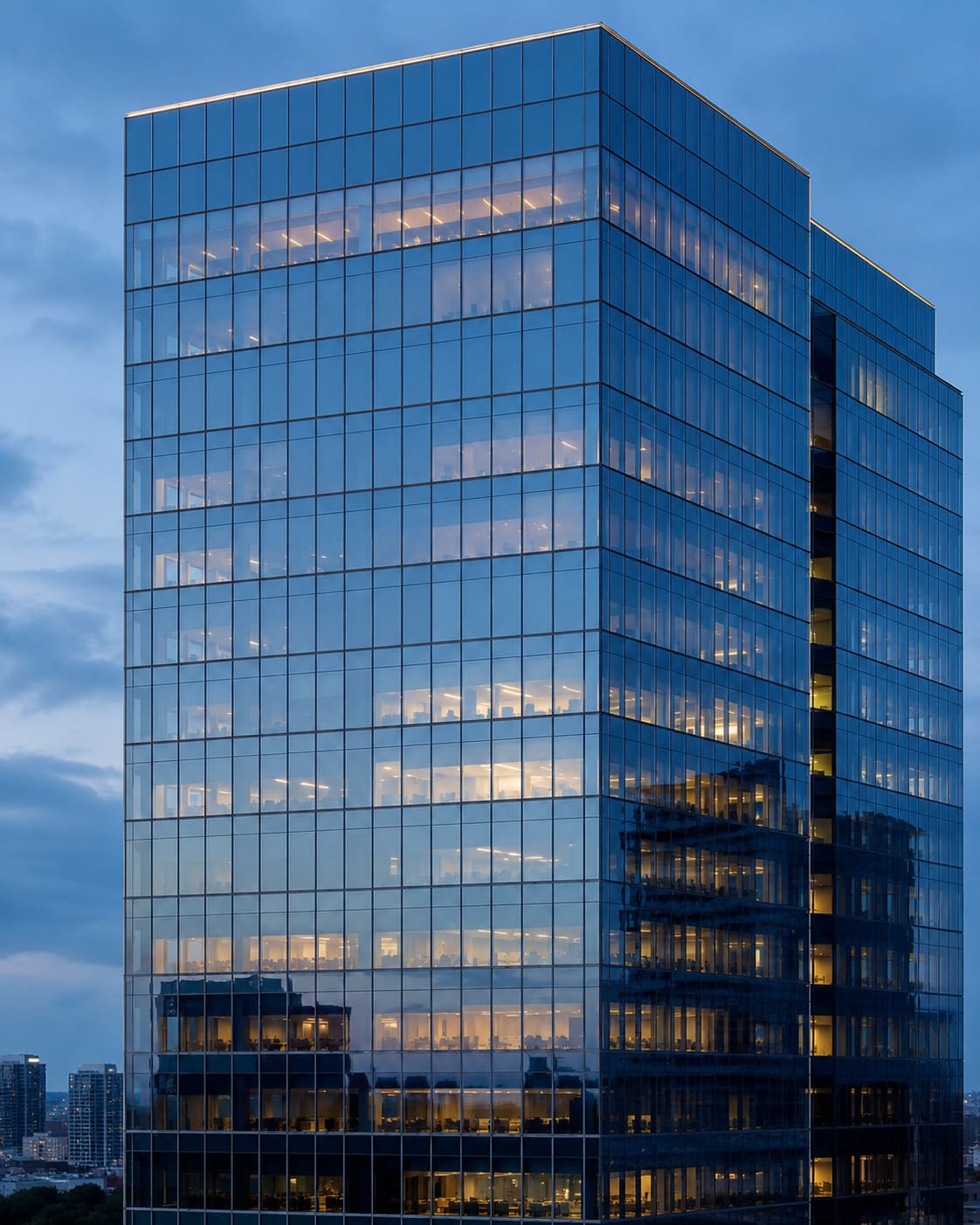

Facade warranties for architects are best understood as a stack of four overlapping instruments, not a single guarantee - the insulated glass unit carries a seal warranty, the aluminium carries a coating warranty, the joints carry a sealant warranty, and the assembled facade carries a workmanship warranty. Each is authored by a different party, with its own duration, trigger and list of exclusions, and the gaps between them are exactly where disputes live. When you specify a curtain wall or structural glazing system, reading these four as one coherent set - before the drawings are frozen - is what separates a facade that performs for its design life from one that becomes a costly liability at year six.
The critical point for a specifier is that warranties almost never guarantee performance. A 10-year IGU warranty promises the seal will not fail and fog; it says nothing about whether the glass sustains the SHGC, U-value or acoustic Rw you designed for. Those outcomes are locked in far earlier - through tested systems, correct glass build-up, sound detailing and site verification. Treat the warranty as insurance against defects, and treat your specification as the real guarantee of performance.
For architects working across Hyderabad, Secunderabad and the wider Telangana and Andhra Pradesh markets, this distinction is commercial as well as technical. A hot, composite climate with an aggressive monsoon and hard water punishes weak detailing, and a warranty that reads well in tender can collapse on a technicality when the first claim arrives. This guide walks through the four warranties, the exclusions that bite, the specification numbers that must anchor them, realistic INR costs, and a checklist you can drop straight into your tender documents. Where a claim eventually turns on a fixing or glazing detail, you can get a free quote for the exact scope so the cover you specify is the cover you actually get.
The Four Facade Warranties on Every Glazed Building
Most glazed facades carry four distinct instruments, and you should collect all of them - as named, dated, signed documents - before handover. Missing any one leaves an uncovered layer in the assembly:
- IGU / sealed-unit warranty: covers seal failure, moisture ingress and internal condensation between the panes. Typically 5-10 years; confirm it references dual-seal construction (PIB primary plus a secondary silicone or polysulphide) and EN 1279 or IGMA durability testing.
- Coating / finish warranty: PVDF (Kynar 500 / Hylar) coatings on aluminium are commonly warranted 10-15 years against chalking, fading and adhesion loss; powder-coat and anodising terms differ - check the colour-change limit stated in delta-E units.
- Sealant warranty: structural and weather silicone makers offer 10-20 year cover, but only where they have formally approved the substrates, joint design and adhesion test results for your specific project.
- Workmanship / installation warranty: the fabricator-installer's cover for water tightness, air tightness and structural integrity of the assembly, usually 1-10 years - and the one most often quoted too short.
The mismatch in durations is the real risk. A 20-year sealant behind a 5-year IGU behind a 2-year workmanship warranty leaves you exposed the moment the shortest instrument lapses. When you evaluate a glass and aluminium facade proposal, line the four durations up side by side and treat the shortest as your true exposure window, not the headline number the fabricator prints on the cover page.
What Facade Warranties Do NOT Cover - Read the Exclusions First
Exclusions decide whether a claim ever pays out, so read them before you read the coverage. On your review, flag these recurring traps:
- Performance drift: any reduction in thermal (U-value, SHGC) or acoustic (Rw) performance over time is almost universally excluded - this must be secured by specification and testing, never by the warranty.
- Installation-dependent voids: IGU warranties are void if units are glazed with incompatible setting blocks or gaskets, without drainage, or where water ponds on the secondary seal. Your glazing details directly control whether cover survives.
- Sealant incompatibility: staining or adhesion failure from contact with incompatible gaskets, backer rods, structural tapes or adjacent sealants is excluded unless the maker pre-approved every material in the joint.
- Movement and structure: failure caused by slab deflection beyond design limits, differential movement or building settlement is excluded - so your movement joints and dead-load/live-load allowances must be right at the detailing stage.
- Environmental and maintenance: coastal salt exposure, harsh chemical cleaning agents and skipped maintenance regimes commonly void finish warranties. For Hyderabad and Secunderabad projects, hard-water spotting and monsoon-driven wetting cycles make a written cleaning protocol worth attaching to the O&M file.
Many of these voids trace back to a fitting or a fixing - the wrong setting block, an unapproved gasket, a corroded fastener. Sourcing those from a single accountable supplier that keeps the documentation intact keeps the compatibility chain unbroken; you can see how that plays out on our recent projects where hardware, glass and sealant all came through one accountable trade.
Tie the Warranty to Specified Facade Performance
Because warranties do not guarantee performance, your specification must. Fix these numbers on the drawings and in the schedule of glazing, then require the tested system to match them:
- Thermal: state U-value and SHGC targets aligned to ECBC 2017 and your green rating (IGBC / GRIHA / LEED). Hyderabad's composite-to-hot climate rewards a low SHGC (often 0.25-0.35) without collapsing VLT below the daylighting you need.
- Wind: design pressures per IS 875 (Part 3) and NBC 2016; specify allowable deflection limits (commonly L/175 of the glass span or 19 mm, whichever is less) and require mullion sizing to suit the actual building height and exposure category.
- Glass: reference IS 2553 for safety and architectural glass; call out heat-soak testing for toughened glass to limit nickel-sulphide spontaneous breakage, which no warranty will otherwise cover.
- Acoustic: specify Rw (or Rw+Ctr) where the site - a road frontage in Secunderabad, an airport corridor near Shamshabad - demands it, and confirm the laminated or asymmetric build-up that actually delivers it.
- Air/water tightness: require field testing to ASTM E783 (air infiltration) and ASTM E1105 (water penetration under dynamic pressure), plus a full-scale project mock-up before mass fabrication begins.
These numbers are what make a warranty enforceable: if the tested system met them and the installation matched the mock-up, a defect claim has a documented baseline to sit on. Explore our services to see how design-assist can pin these values down at the drawing stage, long before a claim is ever contemplated.
Structural Glazing and Sealant Warranties - the Conditions That Matter
Structural silicone glazing (SSG) warranties are the most condition-heavy of all, because here the sealant is doing structural work - holding glass to frame against wind load. Before you accept any structural glazing warranty, verify each of the following in writing:
- Confirm the sealant maker has reviewed and approved the joint design, with the structural bite and glue-line sized per the design wind load and ASTM C1184 structural design principles.
- Require project-specific adhesion and compatibility testing on the actual substrates, gaskets and spacers - generic data sheets from a brochure are not enough to sustain a claim.
- Check that the warranty names this project by title and location; blanket product warranties issued without a project approval letter are weak and easily contested.
- Verify who installs: many sealant warranties are only valid when the SSG is factory-glazed under controlled temperature and humidity, not site-applied in monsoon conditions.
- For unitised systems, confirm the QA records - mixing ratios, snap/butterfly adhesion tests, cure logs and deglazing checks - are retained, because these are exactly what the maker will demand at claim time.
The same rigour applies to the spider and point fittings that carry glass in bolted assemblies and the patch fittings used at frameless entrances - a warranty on the glazing means little if the fitting behind it is uncertified or mismatched to the load. Insist that every load-bearing component is a named, certified product with its own documented cover.
Hardware, Fittings and the Warranties That Ride on Them
Architects often treat hardware as an afterthought, yet a surprising share of facade and glass-assembly claims fail on a fitting rather than the glass. The moving and load-bearing components carry their own manufacturer warranties, and those interact with the facade cover in ways worth mapping:
- Floor springs and door closers on glass entrances are warranted on cycle counts and correct load rating - over-specify the door-leaf weight and the closer warranty is void from day one.
- Architectural handles, patch and glass hardware carry finish and corrosion warranties that, like PVDF, exclude coastal salt and abrasive cleaning agents.
- Sliding systems for large glazed openings depend on correctly rated rollers and tracks; the warranty assumes the specified panel weight and a maintained track.
- Hinges, clamps and spider arms in frameless glass depend on correct glass thickness and edge condition - the wrong toughening or a chipped edge can void both the fitting and the glass warranty at once.
As a dealer for Taiton, Enox and Ozone hardware, Hakimi Aluminium and Glass supplies these fittings with their documentation intact, so the hardware warranties align with - rather than undercut - the facade cover. A mid-rise commercial facade in Hyderabad might carry INR 8-15 lakh of architectural hardware alone, and keeping that paperwork consolidated is what makes a later claim straightforward instead of a finger-pointing exercise between suppliers.
Realistic Warranty Costs and Durations for Telangana Projects
Warranties are not free - extended and single-point cover is priced into the tender, and understanding the numbers helps you negotiate the right term rather than the cheapest:
- A base supply-and-install facade scope in Hyderabad or Secunderabad might run INR 850-1,600 per sq ft depending on the system; a full, back-to-back warranty package with extended sealant and workmanship cover typically adds INR 250-600 per sq ft.
- Extending a workmanship warranty from 2 years to 10 years is usually the single most valuable negotiation, and often the cheapest per year of protection.
- PVDF finish upgrades (over powder coat) that unlock a 15-year coating warranty commonly add INR 120-250 per sq ft of aluminium - justified on tall or hard-to-access elevations where re-coating means expensive rope access or scaffolding.
- Project-specific SSG adhesion and compatibility testing is a fixed cost, often INR 40,000-1,20,000 depending on the number of substrate combinations, and it is the price of a sealant warranty that will actually pay out.
- A full-scale performance mock-up tested to ASTM E783 / E1105 can run INR 3-8 lakh on a large commercial job, but it converts your warranty from a promise into a documented baseline.
Set these expectations early. When you get a free quote for a Telangana or Andhra Pradesh project, ask for warranty cost and duration to be broken out as separate line items so the trade-off between price and protection is explicit rather than buried in the per-sq-ft rate.
Process and Timeline - When Each Warranty Actually Starts
Warranty start dates are a quiet source of dispute, because different instruments can begin on different milestones. Map the sequence early so you know exactly when each clock starts and stops:
- Design and specification: lock performance numbers, glass build-up and system selection; this is where enforceability is really created.
- Sealant approval and testing: submit shop drawings and substrates for the maker's written approval and run project-specific adhesion tests - typically 2-4 weeks before fabrication.
- Mock-up and field testing: build and test the mock-up to ASTM E783 / E1105; retain the reports as your evidence base.
- Fabrication and factory glazing: IGU and SSG warranties often date from the glazing/fabrication date, not site handover - meaning cover may quietly begin months before the building is occupied.
- Installation and practical completion: the workmanship warranty usually runs from practical completion or handover, so confirm in the contract whether the four instruments run concurrently or from staggered milestones.
The trap is a warranty that dates from fabrication rather than occupancy. On a project with a long fit-out, a 5-year IGU warranty timed from glazing can be down to three usable years by the time the client moves in - so pin the start date in the specification, not in a footnote.
Common Mistakes Architects Make With Facade Warranties
The same avoidable errors appear across tenders in Hyderabad and beyond. Guard against each of them:
- Accepting a single "facade warranty" line in the tender instead of demanding all four named instruments with their own durations.
- Assuming the warranty covers performance - it does not - and leaving U-value, SHGC and Rw unspecified or untested.
- Ignoring the start date, so a fabrication-dated instrument erodes during a long fit-out.
- Failing to check transferability, so cover lapses the moment the building changes ownership.
- Mixing hardware, gaskets and sealant from uncoordinated suppliers, breaking the compatibility chain that keeps the sealant warranty alive.
- Not attaching the manufacturer's cleaning and maintenance regime to the O&M file, giving the maker an easy ground for refusal at claim time.
Most of these are eliminated by a single accountable trade that carries the design-assist, glazing, sealant approval and hardware under one roof. That consolidation is precisely what keeps the four warranties pointing at one responsible party instead of four.
A Specifier's Facade Warranty Checklist
Put this checklist into your tender documents and verify every line at handover:
- Collect all four warranties - IGU, finish, sealant and workmanship - as named, dated, signed documents, not marketing brochures.
- Confirm durations, start dates (glazing date vs. practical completion) and whether they run concurrently or from different milestones.
- Require a single-point workmanship warranty for water and air tightness, so leaks are not disputed between glazier, sealant applicator and installer.
- Check transferability and that cover survives a change of building ownership or a fabricator restructuring.
- Attach the mock-up and field-test results (ASTM E783 / E1105) to the O&M file - they are your evidence base for any future claim.
- Include the manufacturer's cleaning and maintenance regime, and note in writing that skipping it is a common ground for refusal.
- Verify every fitting and fixing is from an approved, warrantied source and compatible with the sealant and glass - mismatched hardware is a frequent quiet voider.
For architects across Hyderabad, Secunderabad, Telangana and Andhra Pradesh, Hakimi Aluminium and Glass offers design-assist, shop drawings, fabrication, installation and a full range of certified glass and aluminium facade hardware - and can align these warranty conditions with the detailing and testing at the drawing stage. Review our recent projects or get a free quote so the cover you specify is the cover you actually receive.