Fire-rated glass explained simply: it is specialised glazing engineered to hold back flames, smoke and, in the higher grades, radiant heat for a defined number of minutes, buying occupants time to escape and firefighters time to respond. Unlike ordinary toughened or laminated glass, which can shatter or transmit intense heat within moments of a fire, fire-rated glass is tested to a certified performance standard and installed as a complete assembly, with matching frames, seals and hardware, so the whole unit behaves predictably in a blaze. That single distinction, glass sheet versus tested system, is the thread running through everything below.
For building owners, architects and facility managers across Hyderabad, Secunderabad and the wider Telangana and Andhra Pradesh region, fire-rated glazing is now a compliance requirement rather than a luxury, especially in high-rise offices, hospitals, malls, IT parks and hotels governed by the National Building Code (NBC 2016) and local fire department clearances. Our fire-rated glazing team specifies and installs certified systems every week, so this guide reflects what actually passes inspection on the ground rather than what a brochure promises.
This article breaks down the ratings, the real-world uses, the glass types, the frame-and-hardware rules and honest 2026 pricing, so you can specify with confidence and avoid the costly mistakes that surface at the fire NOC stage. If you already know your rating and just want numbers for a live project, you can jump straight to get a free quote and we will match the certificate to your fire strategy.
What the Fire Ratings Actually Mean (E, EW and EI)
Fire-rated glass is classified by two things at once: how long it resists fire, and which type of protection it provides. The rating is always a letter class paired with a time in minutes, tested to standards such as the European EN 13501-2, the British BS 476 Parts 20 to 22, or the Indian standard IS 3614. When someone says a panel is EI60, they mean it delivered 60 minutes of both integrity and insulation in a certified furnace test. The three core classifications you will see on every genuine certificate are:
- Integrity (E): The glass stops flames and hot smoke or gases from passing through, but does not block radiant heat. Ratings like E30, E60 and E120 mean 30, 60 or 120 minutes of integrity. The safe side still gets dangerously hot.
- Integrity + Radiation (EW): Adds partial control of radiant heat, reducing the temperature on the safe side so people can move past a nearby escape route without severe burns. It typically limits radiation to about 15 kW per square metre measured at one metre from the glass.
- Integrity + Insulation (EI): The highest protection. The glass blocks flames, smoke AND heat transfer, keeping the unexposed surface cool enough, below roughly a 140 C average rise, to prevent ignition of items on the other side. EI30, EI60, EI90 and EI120 are the common grades.
A simple rule for specifiers: use E-class where you only need to contain flames briefly and no one lingers next to the glass, and use EI-class where the glass separates escape corridors, stairwells or compartments that people must occupy or pass through safely while a fire is still active. Choosing E where EI is required is the single most common, and most dangerous, specification mistake we correct on site. It usually happens because the E product is cheaper and looks identical.
Where Fire-Rated Glass Is Used in Real Buildings
The right rating depends entirely on the location and the overall fire strategy for the building. There is no single correct answer for a whole project, because a stairwell door and a facade spandrel can carry very different ratings on the same floor plate. The application drives the class, and a good fire consultant marks every boundary on the plan before a single panel is ordered. Common applications we specify for clients across Hyderabad, Secunderabad and Andhra Pradesh include:
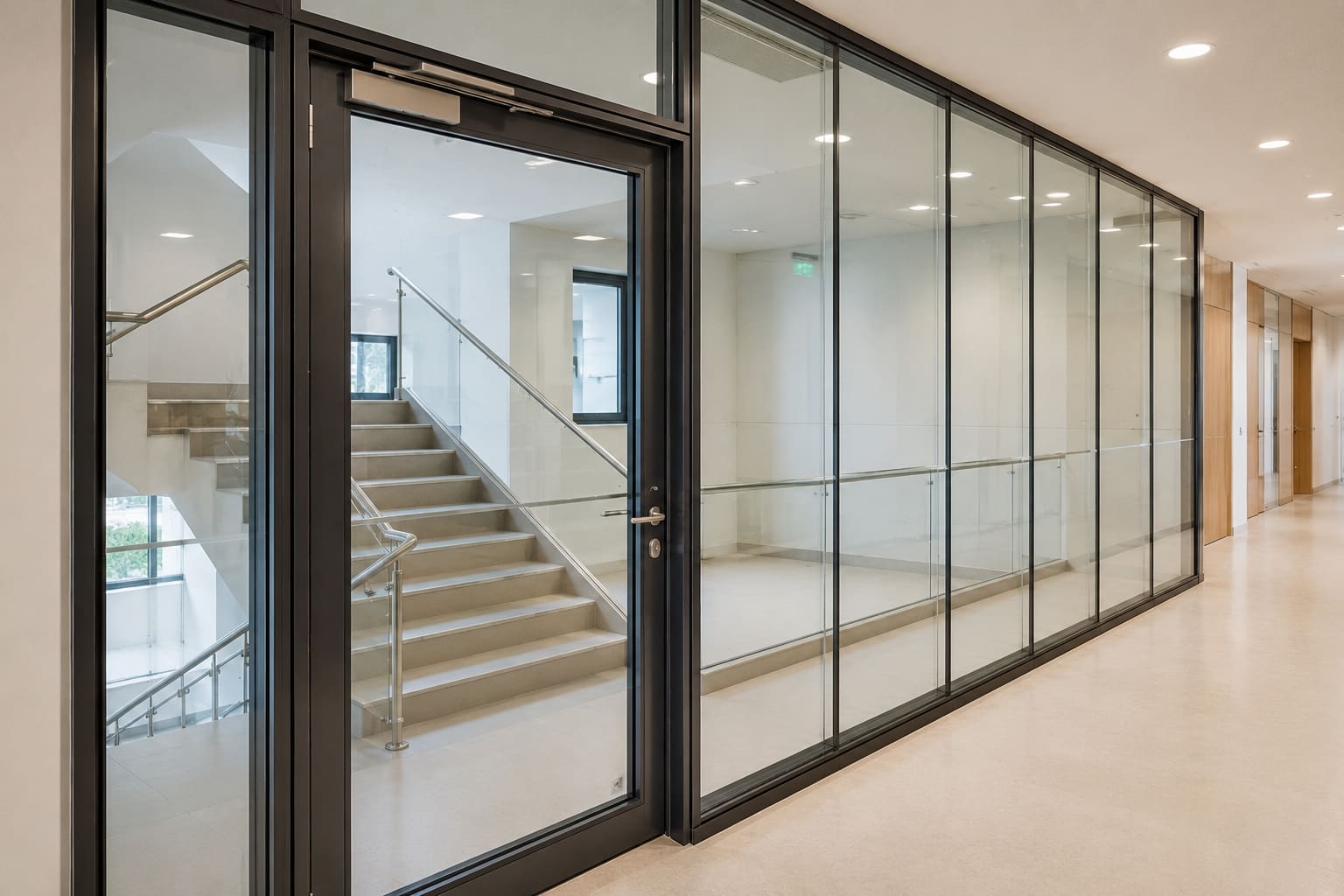
- Fire-rated doors and vision panels in stairwells, lobbies and corridors, typically EI30 to EI60, paired with a self-closing device and rated ironmongery so the leaf latches shut in a fire.
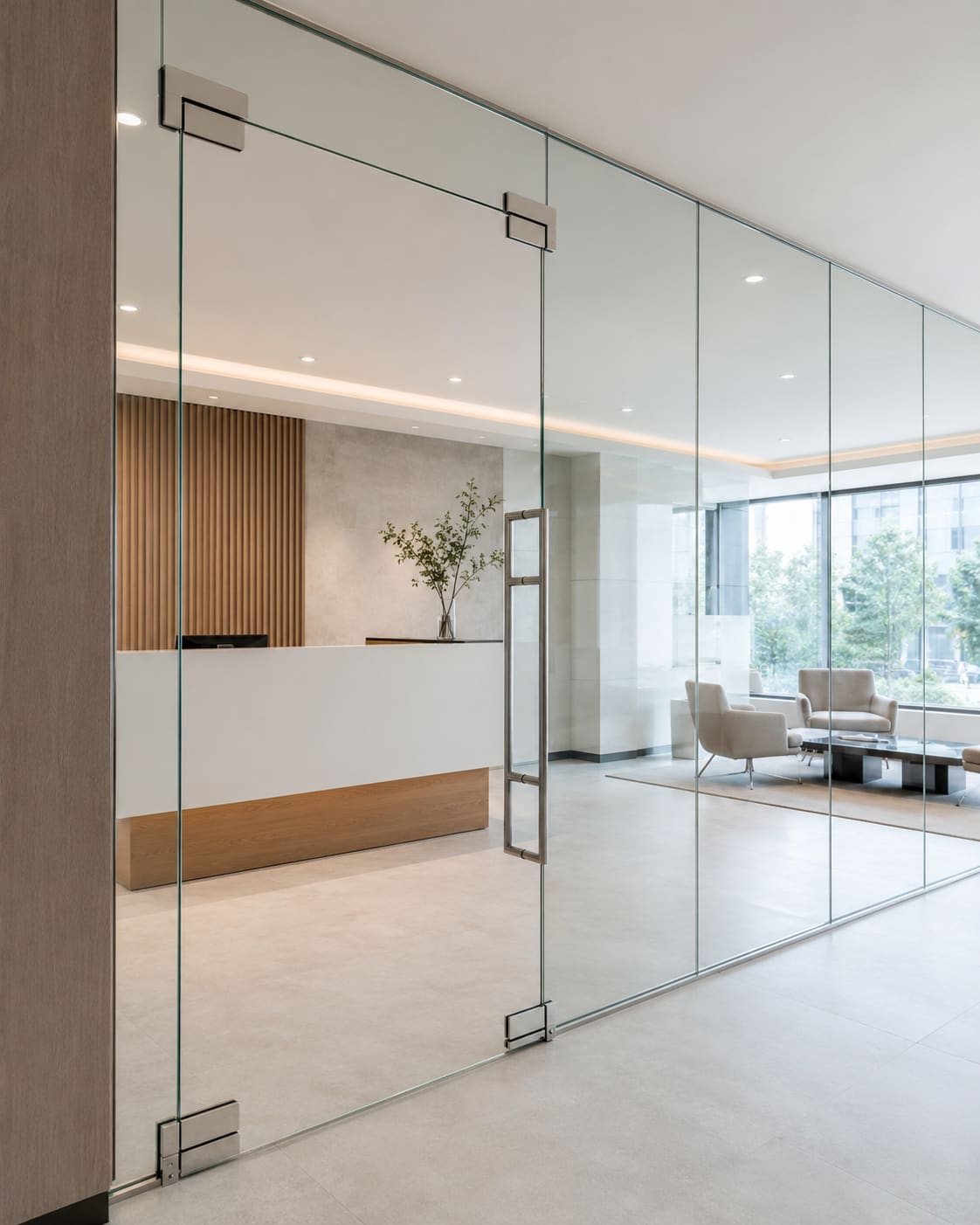
- Compartment partitions and internal screens that separate one fire zone from another, often EI60 to EI120 in hospitals, laboratories and data centres. These frequently integrate with our glass partitions systems so the office keeps an open, glazed look without giving up its fire boundary.
- Facade and curtain-wall spandrels where floor-to-floor fire spread must be controlled up the outside of a high-rise tower.
- Atrium and lift-lobby glazing in malls and IT parks, where large open volumes need protected boundaries to stop a fire jumping between levels.
In healthcare and hotel projects, EI-rated glazing is strongly preferred because it protects patients and guests who may evacuate slowly, while E or EW glass is often acceptable for short-duration containment in smaller commercial units. If your fit-out mixes fire-rated boundaries with purely decorative screens, it pays to detail both together from the start; you can see how we handle that split across our recent projects.
Types of Fire-Rated Glass and How They Differ
Not all fire glass is built the same way, and the construction drives both performance and price. Understanding the three main families helps you challenge a quote that looks suspiciously cheap, because the wrong family simply cannot reach the rating on your drawing no matter how the vendor labels it.
- Ceramic and borosilicate glass: Withstands extreme thermal shock and is ideal for E and EW integrity ratings and slim vision panels. It is thin and beautifully clear, but it does not insulate against heat, so the safe side still gets hot. Excellent for a door vision panel, wrong for a wall people must stand beside.
- Wired glass: An older, low-cost option with embedded steel mesh that provides basic integrity. It is steadily being phased out wherever impact safety matters, because the embedded wire does not make it a safety glass and it can injure on breakage.
- Intumescent laminated glass: Multiple glass layers bonded with clear intumescent interlayers that foam up opaque when heated, physically blocking radiant heat. This is the technology behind almost every EI rating and premium clear fire glass on the market, and it is the only route to genuine insulation in a transparent panel.
For most modern Hyderabad projects seeking a clean, transparent look with true insulation, intumescent EI laminated units are the default specification. They cost more, but they are the only way to get real EI performance in a see-through panel, a distinction that matters the moment the fire officer checks your certificate against the approved drawing.
Frames, Seals and Hardware: The System Matters
A fire rating belongs to a tested assembly, not to the glass sheet alone. Fire will always exploit the weakest point, so the frame, glazing seals, intumescent gaskets and ironmongery must all be certified together as one system. Swapping in a cheaper closer or an untested frame profile can invalidate the entire rating even when the glass itself is genuine, and that is exactly the kind of substitution a fire officer is trained to catch.
- Frames are usually steel or specially engineered fire-grade aluminium, glazed with intumescent tape that expands to grip the glass as temperatures climb.
- Fire doors need certified self-closing devices, floor springs or closers, so the leaf reliably latches shut in a fire rather than swinging open and feeding the blaze oxygen.
- All-glass fire screens and butt-jointed panels rely on rated patch fittings and architectural hardware that carry their own documented test evidence, not generic fittings borrowed from a non-rated screen.
Because the whole assembly stands or falls together, we supply hardware whose fire ratings are documented and matched to the frame and glass. Coordinating the glass partitions framing with the rated infill early keeps the visual line clean and stops a costly re-order when the site engineer asks for certificates that a random off-the-shelf closer cannot produce.
Fire-Rated Glass vs Ordinary Toughened and Laminated Glass
It is worth being blunt about a myth we hear constantly in Hyderabad fit-outs: toughened glass is not fire glass. Toughened (tempered) glass is a safety glass, it resists impact and breaks into blunt granules, but it typically fails within a few minutes of direct flame contact as thermal stress builds across the pane. Standard laminated glass holds together a little longer thanks to its PVB interlayer, yet that interlayer softens and the assembly loses integrity well before a rated product would.
- Toughened glass: excellent impact safety, essentially zero fire rating.
- Standard laminated glass: good for safety and security, but not a substitute for a fire certificate.
- Fire-rated glass: tested and certified for a defined E, EW or EI performance over 30 to 120 minutes.
Because the products look almost identical to the naked eye, the certificate and the etched marking on the glass are your only real proof of performance. When a facade blends structural elements with fire-rated infill, the two have to be coordinated deliberately so the visual line stays clean while each panel keeps its correct rating; that coordination is part of every certified job we deliver, and it is worth confirming it is in scope before you sign off a quote.
Indicative Fire-Rated Glass Prices in Hyderabad & Telangana (2026)
Fire-rated glazing is a certified system, so pricing reflects the glass, the tested frame and the hardware together, never the glass in isolation. Any quote that prices only the glass sheet is incomplete by definition. As of 2026, indicative supply-and-install rates across the Hyderabad, Secunderabad and wider Telangana and Andhra Pradesh market are roughly:
- E30 to E60 ceramic glass panels: around INR 4,500 to INR 8,500 per sq ft.
- EW60 radiation-control units: around INR 7,500 to INR 12,000 per sq ft.
- EI60 intumescent laminated glazing: around INR 9,000 to INR 16,000 per sq ft.
- EI90 to EI120 high-performance insulated units: INR 16,000 to INR 28,000+ per sq ft.
- Complete fire-rated glazed doors with frame, seals and closer: INR 45,000 to INR 1,20,000 per leaf depending on rating and size.
Prices move with panel size, permitted vision-area limits, glass thickness and whether the frame is steel or fire-grade aluminium. Larger clear vision panels almost always cost more per square foot than smaller ones at the same rating. Always insist on valid third-party test certificates and a system that is tested as a whole, glass plus frame plus seals plus hardware. A cheaper uncertified panel can void your fire NOC and, more importantly, fail when it matters most. For a firm figure against your actual drawings, send them over and get a free quote; a live take-off is far more accurate than any rate card.
How to Choose the Right Fire Glass, and Mistakes to Avoid
Choosing correctly is less about the glass and more about reading the fire strategy first. Start with the fire consultant's compartment plan, identify which boundaries are life-safety escape routes versus short-duration containment, then match the class and time to each line before you shop on price. Working the other way round, picking a product and hoping it fits the rule, is how projects end up ripping out glass after inspection.
- Match the rating to the boundary, not the budget: an EI stairwell wall cannot be value-engineered down to E without changing the fire strategy.
- Confirm the test certificate covers the exact configuration installed, including maximum pane size, orientation and frame type, not merely a similar assembly.
- Check the vision-area and dimension limits in the certificate; oversizing a panel beyond its tested maximum silently voids the rating.
- Never mix an uncertified frame, gasket or closer into a rated assembly to save a few thousand rupees, because it invalidates the whole panel.
- Keep the etched marking visible and the paperwork filed; a rating you cannot prove on paper is a rating the fire officer will treat as absent.
If you are unsure how a mixed office fit-out should split between rated boundaries and ordinary glass partitions, it is worth a short design review before procurement rather than after. Browse our services to see the full range we detail together so nothing falls between two trades.
Process, Lead Times and Installation
A certified fire-glazing package runs on a slightly longer timeline than ordinary glazing because the certificates, sizes and hardware all have to be locked before manufacture. Rushing the front end is where most site delays are actually created. A typical project with us moves through these stages:
- Survey and fire-strategy review: we walk the plan with your architect or fire consultant and mark every rated boundary, its class and its time. Usually 2 to 4 days.
- Specification and quotation: glass family, frame material, hardware and certificates are fixed, and a firm rate is issued against the take-off.
- Manufacture and certificate matching: rated units are made to the exact tested sizes, typically 2 to 4 weeks for EI intumescent panels depending on volume and import content.
- Installation and documentation: certified fitting by trained installers, followed by a handover file with test reports and etched markings verified against the drawing.
Building the certificate trail into the install means your consultant and the fire officer see one matching set of paperwork, which is what keeps the occupancy certificate on schedule. Coordinating the fire-rated glazing sequence with the rest of the facade programme early also avoids the classic clash where a rated door arrives before its rated frame is ready to receive it.
Compliance, Certification and NBC 2016 in Telangana
In India, fire glazing requirements flow largely from the National Building Code (NBC 2016) and are enforced locally through the Telangana State Disaster Response and Fire Services Department when it issues a fire No Objection Certificate (NOC). Getting this right is not optional paperwork, because an occupancy certificate can hinge directly on it, and a single unrated boundary can hold up an entire handover.
- High-rise and commercial buildings must protect stairwells, lift lobbies and compartment walls with rated assemblies matched to their occupancy type.
- Every rated element should carry a permanent etched or labelled marking showing its class and time, traceable back to a specific test report.
- Test evidence should come from an accredited laboratory and cover the exact configuration installed, not a broadly similar one.
- Retain the certificates in the building fire file, because officers in Hyderabad and Secunderabad routinely ask to see them during inspection and at each renewal.
Handling documentation as part of the install means your consultant and the fire officer see a matching paper trail from day one. If you are unsure which parts of a floor plate need rating, walking the fire strategy with your architect before procurement, and flagging every location that needs a certified panel, is the cheapest insurance on the whole project. When that groundwork is done properly, the NOC stage becomes a formality rather than a fire drill.