Glass facade heat gain is the amount of solar radiation and conductive heat that enters a building through its glazed envelope, and it is quantified primarily by the Solar Heat Gain Coefficient (SHGC), a dimensionless number from 0 to 1 where a lower value means less heat is admitted. Every square metre of a glass facade behaves like a solar collector: sunlight in the visible and near-infrared bands passes through the glass, strikes interior surfaces, and is re-radiated as heat that raises indoor temperature and air-conditioning load.
In a hot composite climate like that of Hyderabad and Secunderabad, where peak solar irradiance on a vertical facade can exceed 700-900 W/m2 and outdoor temperatures routinely cross 40 degrees C in summer, uncontrolled facade heat gain is the single largest driver of building cooling energy. The good news is that the physics is well understood and fully controllable: by choosing the right glass build-up, framing and shading, you can cut solar heat gain by 60-75% while keeping natural daylight and views intact.
This guide breaks down the three governing properties (SHGC, U-value and visible light transmittance), compares real glass types with numbers, explains the Indian code limits that apply in Telangana and Andhra Pradesh, gives indicative INR costs, and shows how a properly detailed glass facade with structural glazing keeps interiors cool. If you are planning a project, you can get a free quote at any point for glass, aluminium and facade hardware.
The Three Numbers That Define Glass Facade Heat Gain
Glass facade heat gain is controlled by three measurable glass properties, and every performance datasheet lists them. Master these three numbers and you can read any glass specification with confidence.
- SHGC (Solar Heat Gain Coefficient): the fraction of solar heat admitted, from 0 to 1. Lower is better in hot climates. Clear glass is around 0.82; high-performance low-E glass reaches 0.20-0.28.
- U-value (W/m2K): the rate of conductive heat flow through the glass driven by the indoor-outdoor temperature difference. Lower resists heat better. Single glass is about 5.7-6.0; insulated low-E double glazing is 1.1-1.8.
- VLT (Visible Light Transmittance): the fraction of daylight admitted, from 0 to 1. Higher means brighter interiors and less artificial lighting.
A fourth, derived figure ties them together: the Light-to-Solar-Gain ratio (LSG = VLT divided by SHGC). A spectrally selective glass with an LSG above 1.25 lets in plenty of daylight while blocking most of the heat, which is exactly what a hot, bright city like Hyderabad wants. Chasing a very low SHGC alone can leave interiors dark and push up lighting loads, so the LSG ratio is the number that balances visual comfort against energy performance.
How the Solar Spectrum Enters Through Glass
Solar heat gain happens because the sun's energy spans three bands and ordinary glass is transparent to most of them. Roughly 3% of solar energy is ultraviolet, about 44% is visible light, and about 53% is near-infrared heat you cannot see but can certainly feel.
- Clear float glass transmits most visible and near-infrared radiation, which is why it feels hot near an unshaded window even with the air conditioner running.
- A low-emissivity (low-E) coating is a microscopically thin metal-oxide layer, usually silver-based, that reflects near-infrared and long-wave heat while passing visible light, directly lowering SHGC without darkening the glass.
- Solar heat reaches the interior in two ways: direct transmission of shortwave radiation, plus heat the glass absorbs and re-radiates inward. Both are captured together in the single SHGC figure, which is why SHGC, not tint colour, is the honest measure of heat performance.
This is also why a lightly tinted low-E glass can outperform a dark reflective glass: the coating, not the visible shade, does the real heat blocking. A pale, high-clarity unit can quietly reject more solar energy than a heavily bronzed pane that merely looks protective.
Glass Types Compared (Typical Numbers)
Heat gain drops sharply as glazing moves from single clear glass to coated insulated units. Here are representative values for a vertical facade:
- Clear single glazing (6 mm): SHGC ~0.82, U-value ~5.7 W/m2K, VLT ~88%.
- Tinted / heat-absorbing single glazing (6 mm): SHGC ~0.55-0.65, U-value ~5.7, VLT ~45-55%.
- Reflective coated single glazing: SHGC ~0.35-0.50, U-value ~5.4, VLT ~20-35%.
- Clear double glazing / DGU (6-12-6): SHGC ~0.70, U-value ~2.7-3.0, VLT ~78%.
- Low-E double glazing (argon filled): SHGC ~0.25-0.35, U-value ~1.6-1.8, VLT ~55-70%.
- Double-silver / triple-silver spectrally selective low-E DGU: SHGC ~0.20-0.27, U-value ~1.1-1.6, VLT ~40-60%.
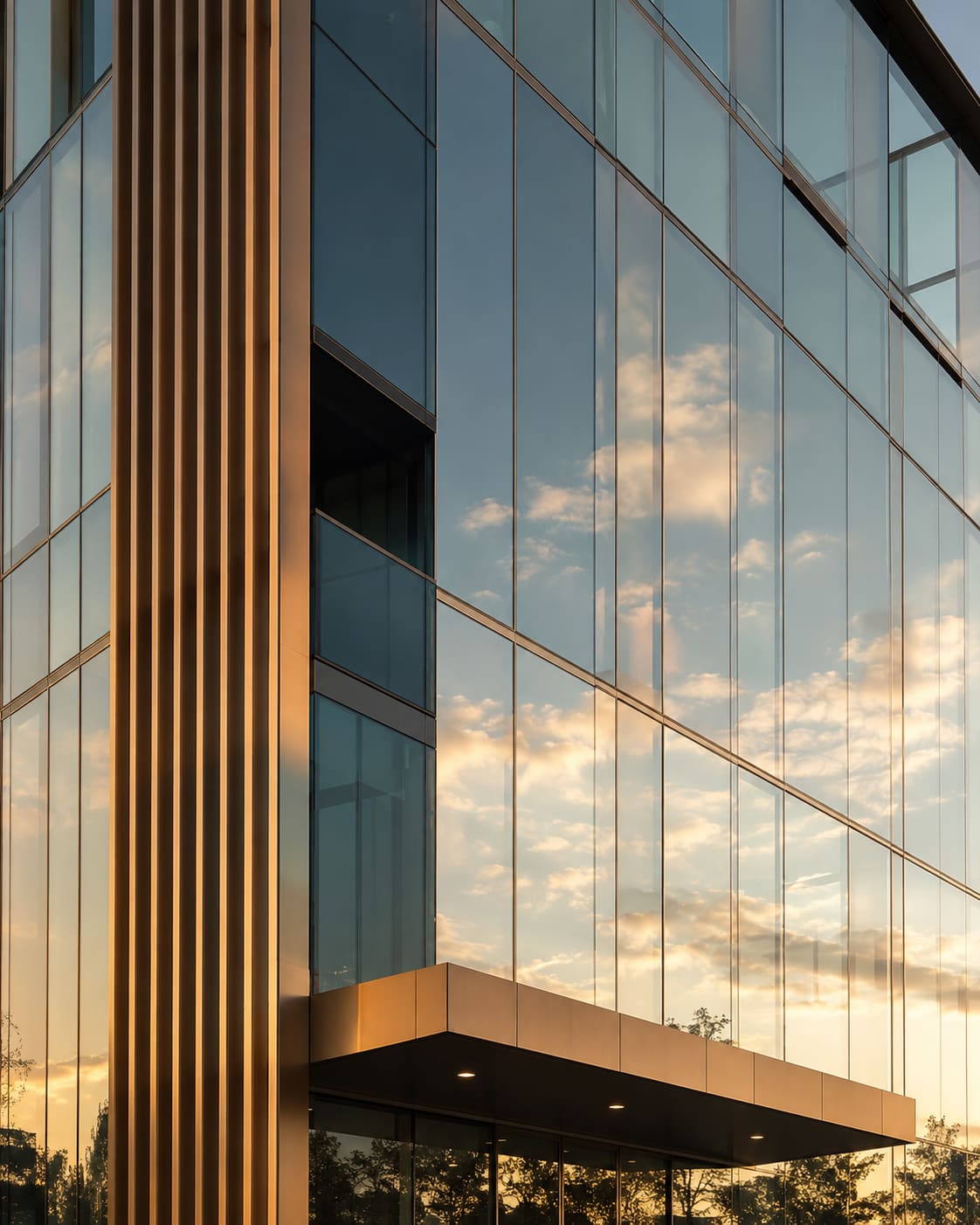
For a 700 W/m2 peak load on a Hyderabad facade, that difference means about 574 W/m2 of gain through clear glass versus roughly 140-190 W/m2 through good low-E glass, a reduction of 65-75%. On a 500 sq ft glazed wall that is the equivalent of removing several tonnes of refrigeration from your cooling plant. You can see how these build-ups look on completed buildings among our recent projects.
What Facade Heat Gain Costs in Hyderabad (INR Figures)
The heat that enters through glass is paid for twice: once in the monthly electricity bill and once in the size of the air-conditioning plant you must install. Realistic Hyderabad and Secunderabad numbers help frame the decision.
- Clear single glazing: roughly INR 90-160 per sq ft supplied. The cheapest glass to buy and the most expensive to cool.
- Reflective single glazing: roughly INR 160-280 per sq ft, a common mid-market choice for older commercial fronts.
- Clear double glazed units (DGU): roughly INR 320-600 per sq ft installed.
- Low-E double glazed units: roughly INR 550-1,400 per sq ft installed depending on coating (single, double or triple silver) and frame.
- Thermally broken aluminium framing adds around 20-35% over standard sections but protects the glass specification from being wasted at the frame.
As a rule of thumb, every 0.1 reduction in SHGC on a large glazed facade trims measurable tonnage from the HVAC design, and the low-E premium is often recovered in 3-5 years through lower running costs and a smaller chiller. For a project-specific estimate covering glass, aluminium and hardware, get a free quote or browse our services to see what we cover.
Indian Standards and Code Limits for Facade Glazing
Facade glazing in India is governed by named energy and safety standards that set explicit heat-gain and structural limits. Compliance is not optional for most commercial buildings in Telangana and Andhra Pradesh.
- The Energy Conservation Building Code (ECBC) 2017 sets maximum SHGC and U-factor values for commercial building envelopes based on climate zone and window-to-wall ratio (WWR), typically requiring facade SHGC in the 0.25-0.50 band, with stricter values applying at higher WWR in hot climates like Hyderabad's composite zone.
- The National Building Code of India (NBC) 2016 covers fenestration, safety and general building envelope requirements.
- IS 2553 covers toughened (tempered) safety glass used in facades and structural glazing.
- IS 875 Part 3 governs the wind loads a facade must resist, critical for large glazed spans and tall buildings.
- ASTM C1401 is the guide for structural silicone glazing, the sealant system that bonds glass to aluminium framing in unitised and structural glazing facades.
- BEE star ratings and product-level thermal certification help you specify compliant glass and framing.
Designing to these codes from day one avoids costly retrofits and keeps the building eligible for green-building ratings such as IGBC and GRIHA, both of which reward a low-SHGC, well-detailed envelope.
Framing and Shading That Protect the Glass Specification
A world-class glass specification can be quietly undone by a poor frame or missing shade, because heat also conducts through aluminium and pours in around unprotected glass. The framing and shading are part of the thermal system, not an afterthought.
- Thermally broken aluminium sections place an insulating polyamide barrier between the inner and outer profile, cutting frame conduction. A non-broken frame can conduct significant heat and undermine an otherwise excellent glass unit.
- External shading (fins, overhangs, projecting mullions) intercepts sunlight before it reaches the glass. Shading the beam can cut effective gain further than any coating alone, because energy stopped outside never becomes an indoor cooling load.
- Warm-edge spacers and continuous structural silicone at the perimeter reduce condensation and heat leakage around the edge of each insulated unit.
- Operable, well-gasketed vents allow night purging so a building can dump accumulated heat after dark without leaking cool air by day.
Hakimi Aluminium and Glass integrates the glass, thermally broken framing and structural silicone as one system, so a low-E facade actually performs to its datasheet on site rather than only on paper.
Cutting Heat Gain in Hyderabad Practice
In Hyderabad's hot composite climate, the most cost-effective strategy is a spectrally selective low-E double-glazed unit combined with external shading and a thermally broken aluminium frame. This attacks solar gain at the glass while limiting conductive gain through the frame.
- Specify glass with an SHGC at or below the ECBC limit for your design WWR, and prioritise a high LSG ratio so daylight is preserved and lighting loads stay low.
- Add external shading appropriate to orientation; shading the glass before sunlight lands on it consistently outperforms glass coatings working alone.
- Mind orientation: west and east facades receive the most intense low-angle summer sun and benefit most from low-SHGC glass and vertical fins, while south facades respond well to horizontal overhangs.
- Do not over-glaze. A slightly lower window-to-wall ratio with better glass often beats a fully glazed wall of cheap glass on both comfort and running cost.
- Detail the edges and joints carefully, because a leaky perimeter can waste the performance you paid for at the centre of the pane.
Hakimi Aluminium and Glass designs and installs low-E structural glazing and thermally broken glass facade systems for homes, offices and showrooms across Hyderabad, Secunderabad and the wider Telangana and Andhra Pradesh region.
A Simple Heat-Gain Worked Example
To make the numbers concrete, consider a 100 sq m (about 1,076 sq ft) west-facing facade in Hyderabad at 700 W/m2 peak irradiance.
- With clear single glazing at SHGC 0.82, instantaneous solar gain is about 100 x 700 x 0.82 = 57,400 W, or roughly 57 kW of heat load.
- With low-E DGU at SHGC 0.25, the same facade admits about 100 x 700 x 0.25 = 17,500 W, or roughly 17.5 kW.
- That is a reduction of about 39.9 kW, equivalent to more than 11 tonnes of refrigeration removed at peak on a single wall.
Add external shading that blocks even 40% of the remaining beam radiation and the effective load drops again. The lesson is that facade heat gain is not a fixed penalty of choosing glass; it is a design variable you control through SHGC, framing and shading. Get the specification right up front and the building stays comfortable on the hottest Telangana afternoons while running a smaller, cheaper cooling plant.
Common Mistakes to Avoid
Most facade heat-gain problems trace back to a handful of avoidable errors made at the specification or ordering stage, not to the glass technology itself.
- Judging glass by tint colour instead of SHGC, and assuming a dark reflective pane must block more heat than a pale low-E unit.
- Pairing an expensive low-E glass with an ordinary, non-thermally-broken aluminium frame, so the frame becomes the weak thermal link.
- Ignoring orientation and applying the same glass on all four elevations when the west and east faces need the most protection.
- Skipping external shading to save cost, then paying far more over the building's life in oversized air conditioning and higher power bills.
- Buying on lowest first cost alone. Clear single glazing wins the quote and loses on every summer electricity bill for the next two decades.
Avoiding these mistakes is mostly about deciding the SHGC target, frame type and shading strategy together, early, before the glass is ordered.