Glass safety standards in India are defined primarily by IS 2553, the Bureau of Indian Standards (BIS) specification for safety glass, whose Part 1 sets the strength, fragmentation and quality requirements for toughened and laminated glass used in buildings and facades. In plain terms: if glass is to be legally described and installed as "safety glass" in doors, railings, shower cubicles or a curtain wall, it must meet the criteria laid down in IS 2553, and Indian building approvals increasingly demand documented proof of compliance.
This matters because ordinary annealed glass breaks into large, dagger-like shards that cause severe lacerations, whereas IS 2553-compliant glass either crumbles into small blunt granules (toughened) or clings to a plastic interlayer (laminated). Whether you are commissioning a shopfront, a staircase balustrade or full-height glazing for a commercial tower, the standard is what separates a safe installation from a serious liability. It governs not just the pane but everything hung on it, from the corner patches on a glass door to the clamps and spigots on a glass railing.
Alongside IS 2553, a cluster of related codes governs how glass is selected, sized and installed in Indian buildings: IS 875 Part 3 (wind load), the National Building Code of India (NBC) 2016 (which mandates safety glazing in impact-prone locations), and the Energy Conservation Building Code (ECBC). All of these are especially relevant in the hot, high-glare climate of Hyderabad, Secunderabad and the wider Telangana and Andhra Pradesh belt, where thermal stress and cooling loads shape glass choice as much as safety does. If you want the correct specification for a specific project, you can get a free quote and we will size it to code.
What IS 2553 Covers and Why It Exists
IS 2553 is India's core specification for safety glass, defining the materials, mechanical strength and breakage behaviour that qualify glass as "safe" for human occupancy. It exists to remove ambiguity. Rather than sellers loosely calling any thick glass "safety glass", the standard sets measurable pass-or-fail tests. The specification is published in parts:
- IS 2553 (Part 1): Safety glass for architectural, building and general applications, covering toughened (tempered) and laminated glass.
- IS 2553 (Part 2): Safety glass for road transport, such as automobile windscreens and windows.
- The standard prescribes visual quality limits, dimensional tolerances, mechanical strength, fragmentation behaviour, impact resistance and, for laminated products, boil and radiation (weathering) resistance.
Products meeting IS 2553 carry BIS certification and may bear the ISI mark. Buyers in Hyderabad and Secunderabad should insist on this and verify it two ways: on the tax invoice or mill test certificate, and as a small etched stamp in a corner of the pane. A missing mark is the single most common sign of substandard, re-labelled or grey-market glass. The standard aligns broadly with international benchmarks such as EN 12150 (toughened) and EN 14449 (laminated), so a compliant Indian pane is comparable to what a global facade consultant would specify.
Toughened (Tempered) Glass Requirements Under IS 2553
Toughened glass under IS 2553 is annealed float glass heated to roughly 620 to 650 degrees C and then rapidly quenched with jets of cool air, locking the surfaces into compression and the core into tension. That stored energy is what makes it strong and, crucially, what makes it fail safely. The key requirements are:
- Surface compression of at least 69 MPa (N/mm2), delivering strength roughly 4 to 5 times that of ordinary annealed glass of the same thickness, and much better resistance to thermal shock.
- Fragmentation test: a sample must shatter into small, granular, relatively blunt particles, typically counted as 40 or more fragments within a 50 mm x 50 mm square, with no large dagger-like slivers.
- It cannot be cut, drilled or edge-worked after toughening. Every hole, notch, cut-out and edge finish must be completed before the glass enters the furnace, so accurate templates and measurements are essential.
- Optional heat-soak testing (holding the glass at around 290 degrees C) forces out unstable nickel sulphide inclusions, sharply reducing the rare risk of spontaneous breakage in facades and overhead glazing.
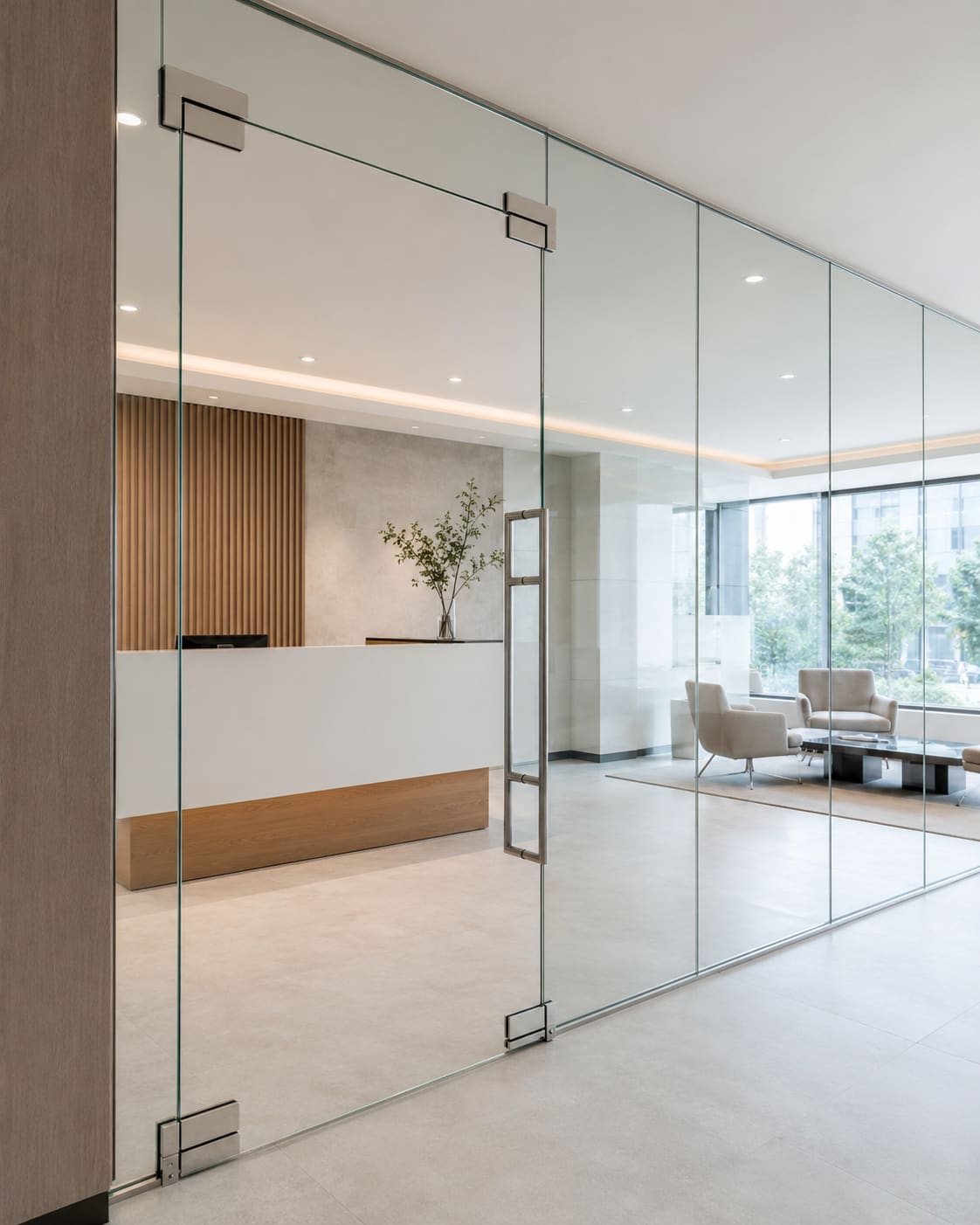
Toughened glass is the workhorse of frameless installations. Our toughened glass work covers entrance doors, office partitions and shopfronts, all of which rely on properly tempered panes so that impact loads and door-swing forces are carried safely at the corners rather than cracking the glass. The one trade-off to remember is that its strength cannot be recovered once it is compromised: a nick to a toughened edge can trigger a full shatter, so edge protection during handling matters.
Standard Glass Thicknesses Used in India
Choosing the correct thickness is a safety decision, not just a cost one, because an undersized pane can deflect, whistle in the wind or fail under load. In Indian practice the common toughened thicknesses and their typical uses are:
- 4 mm and 5 mm: small windows, cabinet fronts and light interior glazing.
- 6 mm: standard windows, partitions, shopfront panels and most shower screens.
- 8 mm: larger partitions, heavier shower enclosures and mid-size doors.
- 10 mm: frameless glass doors, tall partitions and many balustrades.
- 12 mm: frameless entrance doors, staircase railings and large structural panels.
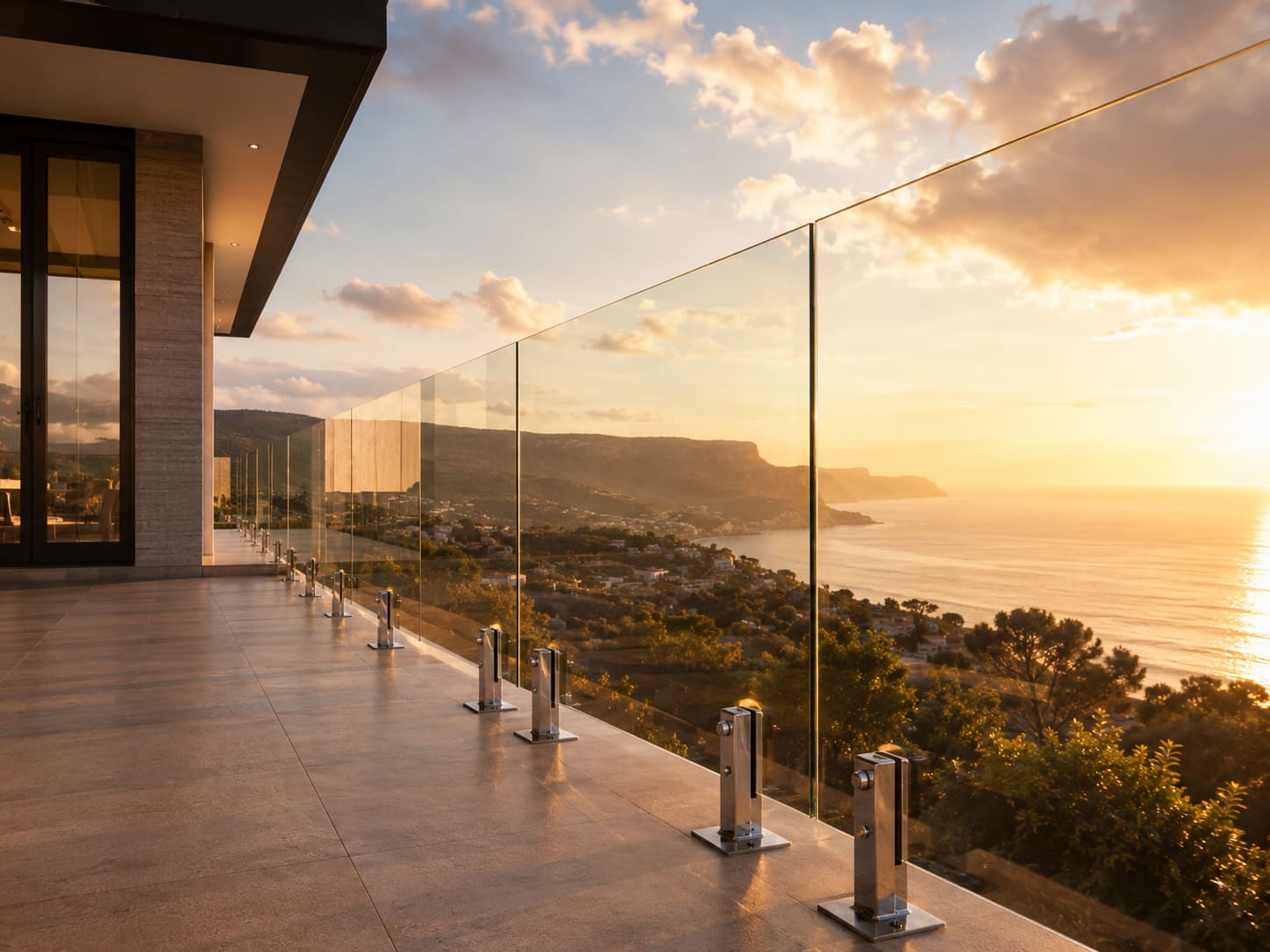
Thicker options of 15 mm and 19 mm exist for oversized structural fins, glass floors and long-span canopies, but these are specialist items. As a rule, the taller or more exposed the glass, the thicker the pane and the more important a wind-load check to IS 875 Part 3 becomes. For frameless glass railing in particular, 12 mm toughened or 13.52 mm toughened-laminated is the safe default, because a balustrade must resist a horizontal line load without excessive deflection and must never allow fall-through if it does break.
Laminated Safety Glass Explained
Laminated safety glass consists of two or more glass plies permanently bonded by a polyvinyl butyral (PVB) interlayer that holds the assembly together when broken. Under IS 2553 it qualifies as safety glass because, on impact, the fragments adhere to the tough plastic film instead of raining down. Its defining traits:
- Standard PVB interlayers are 0.38 mm or 0.76 mm, with thicker multi-layer builds for security, blast, cyclone or bullet-resistant applications.
- It provides retained integrity after breakage, making it the preferred choice for overhead glazing, skylights, canopies, facades and balustrades where fall-through must be prevented.
- It improves acoustic insulation and blocks around 99% of UV radiation, protecting furnishings and reducing glare in the intense sunlight of Telangana and Andhra Pradesh.
- Unlike toughened glass, laminated units can combine annealed, heat-strengthened or fully toughened plies, and the two technologies are often merged as toughened-laminated for the best of both.
Because laminated glass keeps working after it cracks, it is the safer default for anything above head height or anywhere a fall risk exists. The main trade-offs are cost and weight, since two glass plies plus an interlayer are heavier and dearer than a single toughened pane. For most homes and offices, the practical rule is simple: use toughened for vertical, at-reach glazing and laminated (or toughened-laminated) for overhead and edge-protection duties.
Where Safety Glass Is Mandatory Under NBC 2016
The National Building Code of India (NBC) 2016 requires safety glazing wherever accidental human impact is likely, and municipal approvals across Hyderabad and Secunderabad increasingly enforce it during plan sanction and completion checks. Locations that are mandatory or strongly recommended include:
- Glass entrance doors, side-lights, shower enclosures and full-height glazed partitions.
- Windows and glazing set at low sill heights within easy reach of occupants (generally where the pane sits below about 800 mm from floor level).
- Staircase glazing, balustrades, railings and balcony guards, where fall protection is critical.
- Overhead glazing, canopies and skylights, where laminated glass is strongly preferred over toughened alone.
- Facades and structural glazing, which must additionally be designed for wind load to IS 875 Part 3 and, for structural silicone joints, referenced to standards such as ASTM C1401.
You can see how these requirements translate into finished installations across our recent projects, from frameless shopfronts to balcony balustrades. The practical takeaway for any owner or architect is to treat safety glass not as an upgrade but as a baseline: specifying annealed glass in any of the positions above is both unsafe and, under NBC 2016, non-compliant.
Energy Codes, Wind Load and How They Shape Glass Choice
Beyond safety, two engineering considerations drive glass selection in India: structural (wind) load and energy performance. Both are acute in a hot, occasionally storm-exposed region like coastal Andhra Pradesh and the Deccan plateau around Hyderabad.
- IS 875 (Part 3): wind loads used to calculate the required glass thickness and support spacing for facades, railings and tall panels.
- Energy Conservation Building Code (ECBC) and BEE star ratings: these govern the U-value and Solar Heat Gain Coefficient (SHGC) of glazing to cut cooling loads.
- Insulated Glass Units (IGUs) and low-E coatings dramatically reduce heat gain, helping projects hit ECBC targets in cities where air-conditioning dominates energy bills.
- Double-glazed and low-E units also improve comfort near west-facing glass, a common pain point in Hyderabad and Secunderabad offices during the summer.
In practice, a single facade pane may need to satisfy IS 2553 (safety), IS 875 Part 3 (wind) and ECBC (energy) at the same time, which is why specification is best done with an experienced installer rather than off a bare price list. Explore our services to see how safety, structural and energy requirements are combined into a single, buildable glazing solution.
How to Choose, and Common Mistakes to Avoid
Getting safety glass right is mostly about matching the product to the position and then verifying what actually arrives on site. A quick decision framework:
- Vertical glass at arm's reach (doors, partitions, shower screens): 8 to 12 mm toughened to IS 2553.
- Balustrades and railings: 12 mm toughened, or 13.52 mm toughened-laminated where fall protection or a continuous barrier is needed.
- Overhead, skylights and canopies: always laminated or toughened-laminated, never bare toughened.
- Large facades and west-facing elevations: toughened or heat-strengthened with a low-E or reflective coating, sized to IS 875 Part 3 wind load.
The most common and costly mistakes we see are: buying uncertified glass with no ISI mark to save a few rupees per square foot; specifying single toughened glass overhead where laminated is required; ordering the wrong hole or cut-out positions (which cannot be corrected after tempering); using undersized thickness on tall or exposed panels; and skipping heat-soak testing on large facade units, which leaves a small but real risk of spontaneous breakage. Each of these is far cheaper to avoid at the drawing stage than to fix after installation.
Process, Timeline and Local Hyderabad Angle
A typical safety-glass job follows a predictable sequence: site survey and measurement, glass and hardware specification to code, template or shop-drawing approval, factory cutting and toughening or lamination, and finally delivery and installation. Because toughened glass cannot be altered after the furnace, the measurement and template stage is the single most important step, and it is where an experienced local installer earns their fee.
Indicative timelines in the Hyderabad and Secunderabad market are usually 3 to 7 days for standard toughened panels and 7 to 14 days for laminated, coated or imported specialist glass, subject to processor load. Monsoon and peak construction seasons can stretch these, so ordering early on time-critical projects is wise.
Hakimi Aluminium and Glass supplies and installs IS 2553-compliant toughened and laminated safety glass across Hyderabad, Secunderabad and the wider Telangana and Andhra Pradesh region. Working with a local specialist means the wind-load, energy and safety codes are read together for the local climate, the paperwork satisfies GHMC and municipal approvals, and the hardware is matched to the glass so the finished assembly performs as a system. When you are ready for a code-correct specification and a firm price, get a free quote and we will size the glazing to your exact opening.
Indicative Costs and How to Verify Compliance
Safety glass costs more than ordinary annealed glass, but the premium is modest against the liability it removes. Indicative supply figures for the Hyderabad and Secunderabad market are:
- Toughened (clear) glass: roughly INR 150 to INR 350 per sq ft depending on thickness (6 mm to 12 mm).
- Laminated safety glass: roughly INR 250 to INR 500 per sq ft depending on ply and interlayer build.
- Low-E and insulated glass units (IGUs): typically INR 400 to INR 900 per sq ft, offset by lower cooling bills over time.
- Heat-soak testing and custom edge or hole work add a small per-panel premium but are worth it for facades and doors.
To verify what you are buying, insist on the BIS or ISI mark etched on the glass and the test certificate attached to the invoice, confirm the thickness with a gauge, and check that any toughened pane shows the faint roller-wave distortion and edge iridescence that genuine tempering leaves. These few minutes of checking are the cheapest insurance you will ever buy on a glazing project, because the cost of a failure, in both safety and rework, dwarfs the price difference between genuine and grey-market glass.