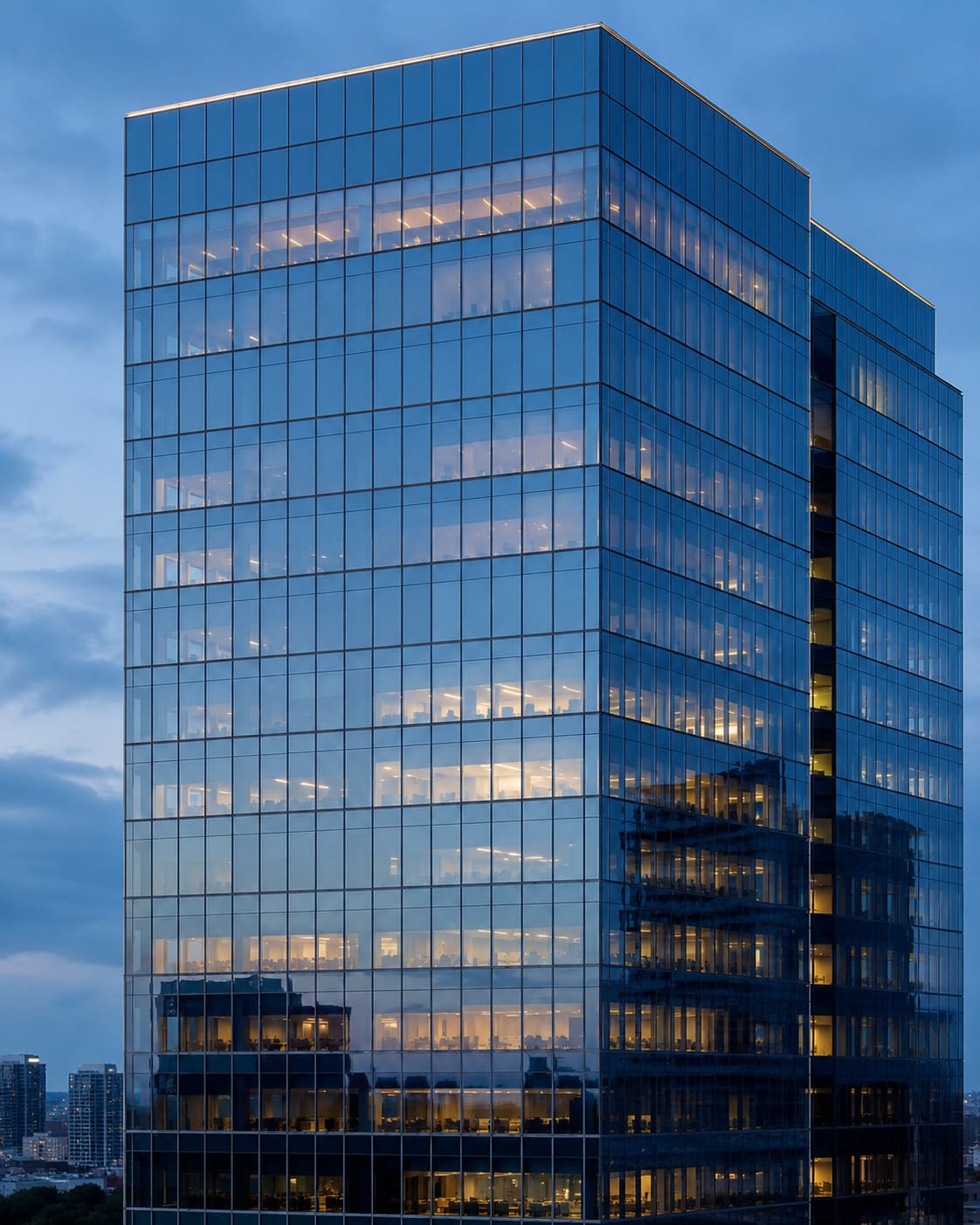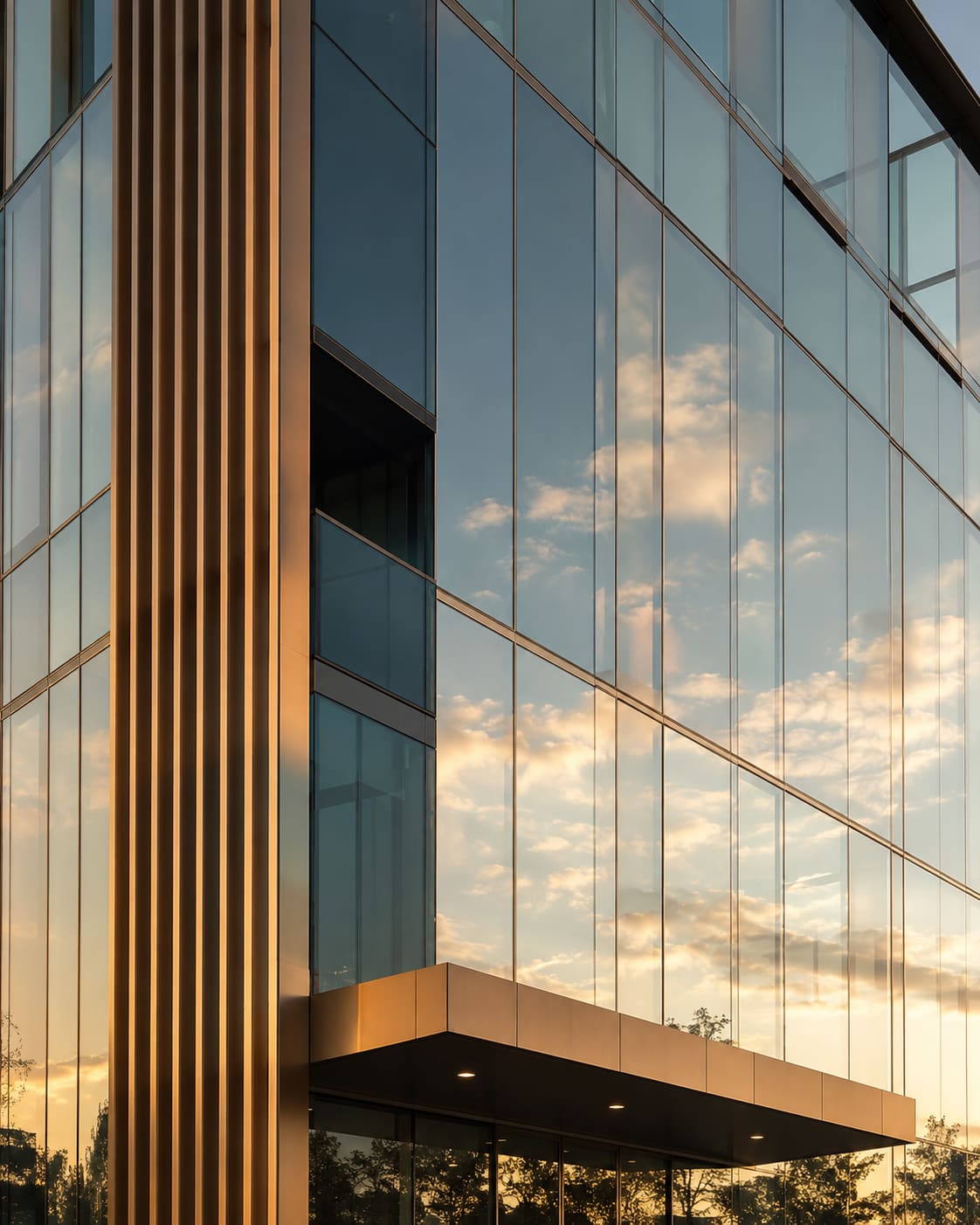
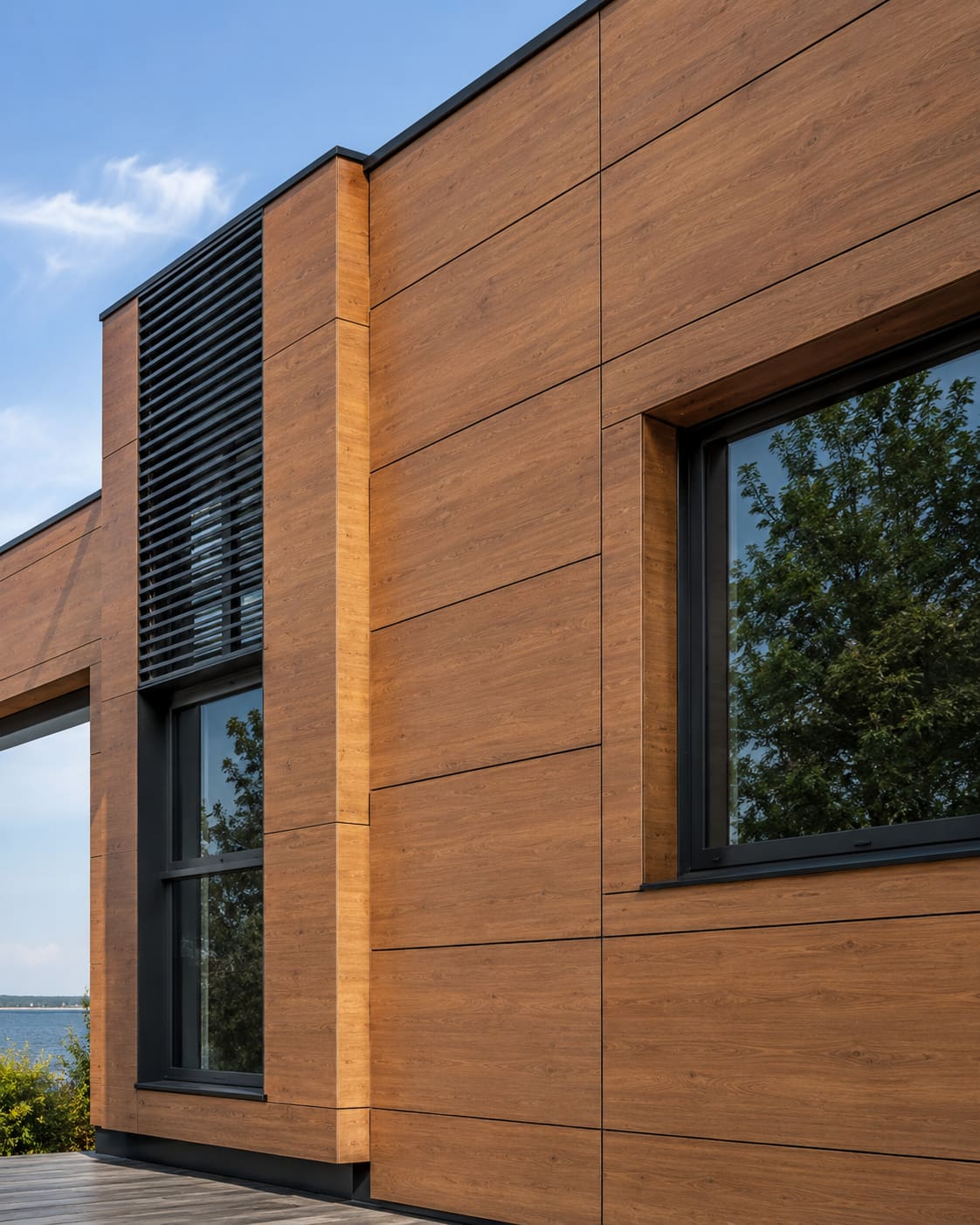
Green facade materials are envelope materials that carry a verified low embodied-carbon story and an in-use performance number strong enough to let the building meet ECBC without oversized air-conditioning. In practice that means the primary green facade materials for a Hyderabad project are recycled-content aluminium framing, low-carbon coated glass, and mechanically fixed rainscreen cladding such as HPL, terracotta and fibre-cement - each backed by an Environmental Product Declaration (EPD) and a measured U-value, SHGC and VLT. A material is not green because a brochure calls it green; it is green because the numbers are declared, third-party verified and hold up on the drawings.
When you specify a green facade material you are really buying two things at once: how the envelope performs while the building is occupied for the next 40 years, and how much carbon it embodied before it ever reached the site in Hyderabad or Secunderabad. This guide walks through the material families you will actually detail in a hot, humid composite climate, and gives you the specification language, Indian standards, indicative INR budgets and honest trade-offs that separate a genuinely sustainable envelope from greenwash.
Whether you are designing a corporate tower in the Financial District, a campus in Gachibowli or a retail facade in Secunderabad, the same evidence trail applies. The team at Hakimi Aluminium and Glass offers design-assist across our services, and you can get a free quote with your elevation drawings to have material options costed directly against your green-rating targets.
What actually makes a facade material green
Green performance is measured across the full life cycle, not just the datasheet on the front of a sample. When you evaluate any facade product for a Telangana project, demand evidence against each of the lines below and make every one a formal submittal:
- Embodied carbon: a product EPD to ISO 14025 / EN 15804 giving cradle-to-gate kgCO2e per square metre or per kilogram.
- Recycled content: pre- and post-consumer percentages, ideally third-party certified rather than self-declared.
- Regional content: distance from source to site, which feeds LEED and IGBC regional-material credits.
- Durability and service life: longer-lived cladding amortises its embodied carbon over more years, so specify finish warranties, not just product warranties.
- End-of-life: recyclability or reuse potential - aluminium and glass score very well, bonded composite panels much less so.
Without an EPD, a recycled-content claim is just marketing. Put the words "EPD required" in the specification, make it a mandatory submittal alongside test certificates, and reject substitutions that arrive without one. This single act of discipline eliminates most greenwash before it ever reaches your facade, and it costs nothing to write.
Recycled aluminium framing: content, thermal breaks and finish
Aluminium is the workhorse of unitised and semi-unitised facades, and it is where your embodied-carbon decisions bite hardest. Primary aluminium is extremely energy-intensive to smelt; recycled (secondary) billet uses roughly 5 percent of that energy, so specifying a minimum recycled content materially cuts the facade's carbon without changing a single structural detail. Correctly produced secondary billet meets the same alloy and temper as primary, so the design remains identical - the saving is close to free.
- Specify billet by recycled content and, where available, by a low-carbon smelter EPD.
- Require polyamide thermal-break profiles on all framing to control the frame U-value and prevent interstitial condensation during Hyderabad's humid monsoon.
- Call out powder-coat or anodised finishes to the relevant durability class; anodising is inert and highly durable in the humid coastal air of Andhra Pradesh.
- Reference the IS 733 and IS 1285 families for extrusion alloy and temper, and confirm structural sections against IS 875 Part 3 wind loads for the specific site.
Hold deflection to L/175 or 20 mm (whichever is less) for members supporting glass, and coordinate the thermal break so it does not interrupt structural continuity. A well-detailed aluminium frame is the durable, fully recyclable backbone that makes the rest of the green facade credible - you can see how we detail it across our recent projects.
Low-carbon glass: balancing SHGC, VLT and embodied carbon
In Hyderabad's composite climate the single biggest lever the facade has on operational energy is solar control, so coated-glass selection is a sustainability decision, not merely an aesthetic one. The goal is a low solar-heat-gain coefficient without collapsing useful daylight - get that balance wrong and either the cooling load or the lighting load rises.
- Target an SHGC of around 0.25-0.27 for high-glazing-ratio elevations, with VLT high enough (roughly 0.40 or above) to preserve daylight credits and reduce artificial lighting load.
- Use double-silver or triple-silver low-E coatings on double-glazed units, and specify the U-value for the full insulated glass unit, not the centre-of-glass figure alone.
- Ask for low-carbon float glass where available; several manufacturers now publish EPDs showing reduced cradle-to-gate carbon from recycled cullet and cleaner furnaces.
- Confirm safety glazing to IS 2553 and check structural thickness against IS 875 Part 3 wind pressure with the appropriate deflection limits.
Where the design calls for minimal framing, a bolted structural glass facade keeps the same solar-control performance while opening up the elevation. Watch one trade-off: aggressive low-SHGC coatings can push exterior reflectance up, so check reflectance against neighbouring buildings and any nuisance-glare concerns before you lock the coating. Expect performance DGU supply-and-install in Hyderabad to run roughly Rs 900-1,800 per sq ft depending on coating and build-up.
Opaque cladding: HPL, terracotta, fibre-cement and ACP
For rainscreen and spandrel zones you have genuine choice, and the panel you pick changes both the carbon profile and the long-term maintenance story. Detail these as a back-ventilated rainscreen wherever possible - the drained-and-ventilated cavity improves thermal performance and moisture management, while the open, mechanically fixed joint aids disassembly and recycling at end of life.
- High-Pressure Laminate (HPL): light, dimensionally stable and available in a wide colour and woodgrain range; specify fire performance to the required class and check EPD-declared carbon. See our HPL cladding service for sub-frame and fixing detailing.
- Terracotta: durable, inert, highly recyclable and with strong regional-material potential in South India; it is heavier, so coordinate the sub-frame and wind load early.
- Fibre-cement: robust and cost-effective; confirm through-colour versus coated finish and note impact resistance at low level - freeze-thaw is a non-issue in Telangana.
- Aluminium composite panel (ACP): where it is used, specify a mineral-filled fire-rated A2 core rather than standard polyethylene, and accept that bonded composite panels are harder to recycle.
As a budget reference for Hyderabad and Secunderabad, a ventilated HPL or fibre-cement rainscreen with sub-frame typically lands around Rs 350-650 per sq ft installed, terracotta higher at Rs 700-1,400 per sq ft, while fire-rated ACP sits at the lower end but concedes on recyclability.
Rainscreen sub-frames, fixings and back-ventilation
The visible panel gets all the attention, but the carbon and durability of a rainscreen actually live in the carrier system behind it. A well-detailed cavity is what turns an ordinary cladding panel into a performing green envelope, and a poorly detailed one is where thermal bridging quietly wrecks the calculated U-value.
- Use aluminium or stainless-steel sub-frame brackets with thermal isolators to limit point thermal bridging through the insulation line.
- Maintain a continuous drained-and-ventilated cavity of at least 25-38 mm so moisture drains and dries rather than soaking the insulation.
- Specify concealed or open-joint fixings appropriate to the panel, and detail them so panels can be individually removed for repair.
- Design the whole system for disassembly: mechanically fixed, non-bonded panels can be taken down and recycled, which supports circular-economy credits.
Coordinate bracket spacing with IS 875 Part 3 wind pressures early. Retro-fitting brackets after the insulation is already set is the most common source of thermal-bridge non-compliance on Hyderabad rainscreen jobs, and it is entirely avoidable with a proper shop-drawing stage.
Aligning material choices with IGBC, GRIHA and LEED
Rating systems reward the same evidence, so gather it once and apply it across the whole assessment rather than chasing each credit product by product. The envelope baseline itself is mandatory and comes from ECBC and NBC 2016; the material credits come from whichever green-rating framework you are pursuing.
- Envelope compliance: demonstrate the assembly U-value and SHGC against the ECBC prescriptive path or the whole-building performance path.
- Recycled and regional content: aggregate the declared percentages across framing, glass and cladding to claim IGBC and LEED materials credits together.
- Regional sourcing within roughly 800 km supports regional-material credits and cuts transport carbon - directly relevant for Telangana and Andhra Pradesh projects served from Hyderabad.
- Low-emitting materials: specify sealants and adhesives to the applicable VOC limits and keep their certificates in the same submittal pack as the EPDs.
IGBC-rated projects in Hyderabad routinely stack a low-SHGC glazing credit with recycled-aluminium and regional-terracotta credits to clear the envelope and materials sections in one coordinated move, which is far cheaper than optimising each product in isolation after the design is frozen.
Common mistakes that quietly turn a green facade grey
Most sustainability failures on a facade are not exotic - they are ordinary coordination errors that erode the numbers you promised the client. Watch for these:
- Quoting a centre-of-glass U-value instead of the whole-IGU value, which flatters the datasheet and fails the ECBC calculation.
- Accepting a recycled-content claim with no EPD, then discovering at audit that it cannot be substantiated.
- Bridging the insulation line with continuous metal brackets and no thermal isolators, wiping out the assembly U-value.
- Choosing an ultra-low-SHGC coating so dark that lighting energy and glare complaints rise even as cooling falls.
- Bonding composite panels that cannot be separated at end of life, forfeiting the recyclability that made the material attractive.
Every one of these is caught by a disciplined submittal review and a full-size mock-up. Building a visual and performance mock-up before bulk fabrication is the cheapest insurance a green facade can buy, because it exposes these gaps while they are still corrections on paper rather than defects on a tower.
Buildability, budgets and choosing a Hyderabad fabricator
A green material only stays green if it is fabricated and installed to the performance you specified. The gap between a datasheet SHGC and a leaking, thermally bridged installation is closed by workmanship and mock-ups, not by the brochure - so the fabricator you appoint is as important as the material you draw.
- Require a visual and performance mock-up before bulk fabrication, and test it for water penetration and air leakage on representative elevations.
- Ask the fabricator for their recycled-content and EPD submittals up front; an installer who cannot produce them cannot support your green-rating claim.
- Budget realistically: a performance-glazed, recycled-aluminium unitised facade in Hyderabad typically runs Rs 6,500-11,000 per sq ft installed, while a ventilated HPL or ACP rainscreen runs Rs 350-650 per sq ft and terracotta Rs 700-1,400.
- Build in a realistic programme: for a mid-rise commercial facade, allow roughly 4-8 weeks for design-assist and shop drawings, 6-10 weeks for fabrication and mock-up approval, and phased installation thereafter.
Hakimi Aluminium and Glass provides design-assist, shop drawings, fabrication and installation for architects across Hyderabad, Secunderabad, Telangana and Andhra Pradesh - including help assembling EPDs, recycled-content data and mock-up performance for green-rating submissions. To see delivered structural glazing and cladding work in the region, review our recent projects, or get a free quote to have your facade materials costed against your IGBC targets.