A thermal break in an aluminium window works by inserting a low-conductivity polyamide (nylon) barrier between the inner and outer halves of the metal frame, interrupting the path that heat and cold would otherwise take straight through the aluminium. Because aluminium is an excellent conductor, an un-broken frame acts like a bridge that carries outdoor heat inside in summer and drains cooled or heated air out again; the polyamide strip breaks that bridge, forcing heat to cross an insulating gap instead of solid metal. The measurable result is a frame U-value that drops by roughly 40-60%.
The payoff is a frame that behaves thermally more like timber or uPVC while keeping aluminium's slim sightlines, large glazed spans and structural strength. In Hyderabad and Secunderabad, where afternoon temperatures regularly cross 40 C in April and May, a thermal break reduces heat gain through the frame, eases air-conditioning load, and prevents the sweating and condensation that plain aluminium suffers around chilled interiors. If you are comparing systems, our thermal break aluminium profiles are engineered specifically for this climate.
Hakimi Aluminium and Glass supplies, fabricates and installs thermally broken window and facade systems across Hyderabad, Secunderabad and the wider Telangana and Andhra Pradesh region. This guide explains exactly how the barrier works, the U-value physics behind it, realistic INR pricing, the Indian standards involved, the mistakes to avoid, and when the upgrade is genuinely worth paying for. If you already know your requirement, you can get a free quote at any point, or study finished installations among our recent projects.
What a thermal break physically is inside the frame
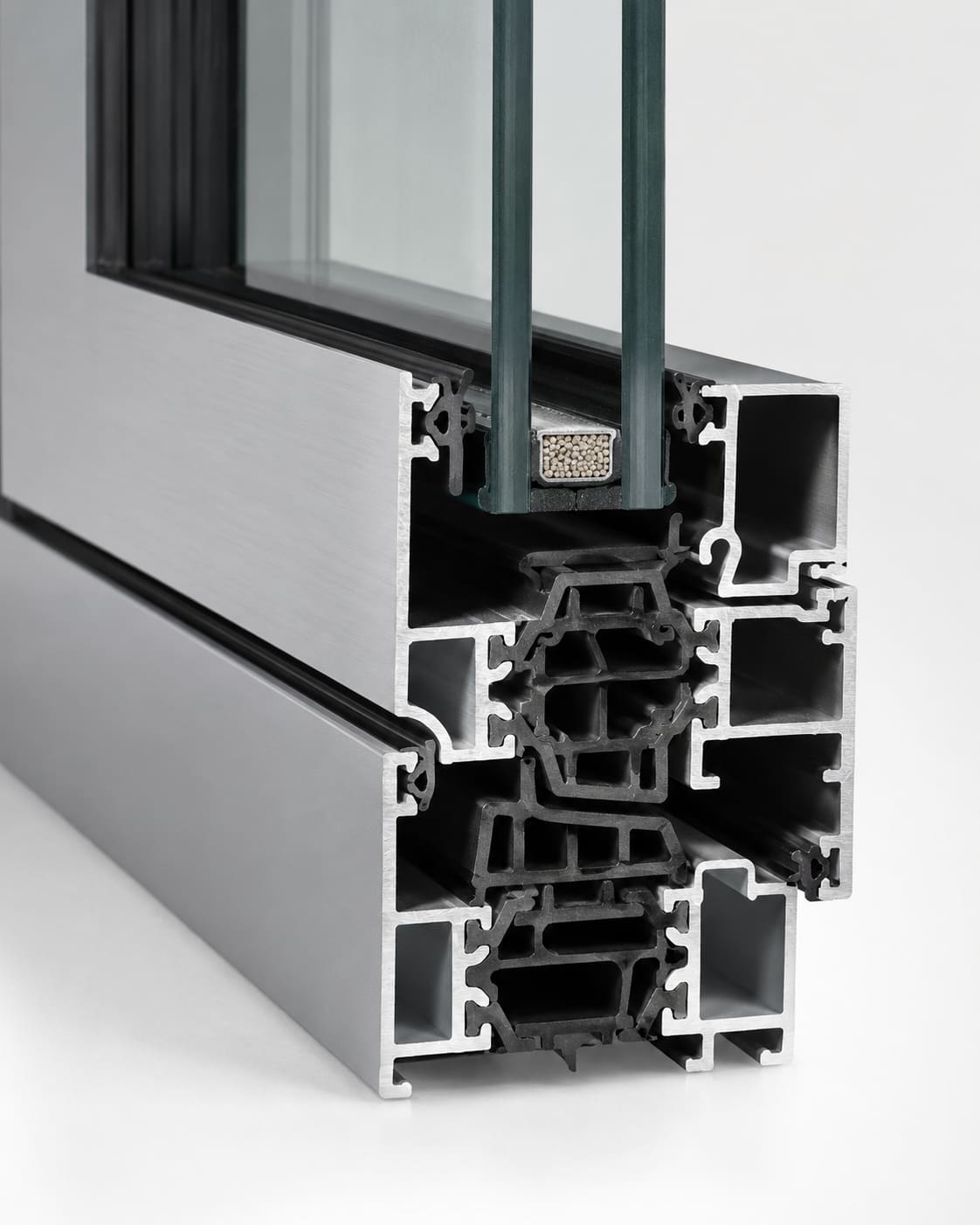
A thermal break is a rigid, non-metallic insulating bar - almost always polyamide (nylon) reinforced with about 25% glass fibre - that is mechanically locked between two separate aluminium extrusions. Instead of one solid profile spanning from outside to inside, you have two aluminium shells joined only through the plastic bars.
The two aluminium profiles, one facing outdoors and one facing indoors, are crimped (rolled) onto the polyamide strips under pressure so the assembly behaves as one structural unit while remaining thermally divided. This crimping is the core difference between a genuine thermally broken window and a cheaper single-piece profile that merely looks similar in a showroom.
- Material: polyamide PA66 GF25 (nylon with 25% glass fibre) is the industry standard for its strength, dimensional stability and low conductivity.
- Width: polyamide bars typically range from 14 mm to 34 mm; wider bars create a larger insulating gap and a lower U-value.
- Thermal conductivity: polyamide is around 0.25-0.30 W/mK versus roughly 160-210 W/mK for aluminium - close to a 1,000-fold difference.
- Expansion match: the glass-fibre reinforcement tunes the polyamide's thermal expansion to sit near aluminium's, preventing bowing or warping across repeated hot-cold cycles.
These frames belong to the same family as our aluminium windows range, so the hinges, rollers and locking hardware carry across without any redesign, and the visible frame stays as slim as standard architectural aluminium.
How the heat-flow interruption actually works
The thermal break works by replacing a continuous metal heat path with an insulating gap, so conduction slows dramatically at the barrier. Heat always moves from hot to cold, and in solid aluminium it races across the frame almost unimpeded; when it reaches the polyamide bar, the low-conductivity plastic and the trapped air chambers around it resist that flow.
The barrier effectively splits one metal profile into two thermally independent zones. On a hot Telangana afternoon the outer half of the frame can be baking in the sun while the inner half stays close to room temperature - a difference you can literally feel by placing one hand on each surface.
- Summer: outdoor heat is stopped at the break, so far less warmth leaks into an air-conditioned room through the frame.
- Winter: indoor warmth is retained rather than conducted out, useful on Hyderabad's cooler December and January nights.
- Condensation: the inner aluminium surface stays warmer, so it does not fall below the dew point and bead with water droplets.
- Acoustics: the broken profile and the sealed glazing unit it hosts also dampen traffic noise, a welcome side benefit near busy corridors like the ORR or main city roads.
The same principle scales up to large curtain walls and shopfronts, which is why serious facades use thermally broken mullions and transoms rather than bare aluminium that would otherwise conduct heat across the whole building envelope.
The numbers: U-values, SHGC and measurable performance
Thermally broken aluminium frames typically deliver U-values of 1.8-3.5 W/m2K, compared with 5.5-7.0 W/m2K for conventional non-broken aluminium - a frame heat-transfer reduction of roughly 40-60%. Lower U-value means less heat passes through per degree of temperature difference, so the window loses and gains heat more slowly.
U-value is only half the story in a hot climate. Solar Heat Gain Coefficient (SHGC) measures how much of the sun's radiant energy the glazing lets through; for Andhra Pradesh and Telangana you generally want a low SHGC as well, achieved with Low-E coatings or tinted and reflective glass.
- Non-thermally-broken aluminium frame: about 5.5-7.0 W/m2K.
- Thermally broken frame with double glazing: about 1.8-3.5 W/m2K.
- Pairing the break with insulated double-glazed or Low-E units compounds the benefit, because the whole-window U-value drops together rather than the frame alone.
- The Energy Conservation Building Code (ECBC) sets maximum window U-value and SHGC limits that thermally broken systems help commercial projects meet.
In practice, a west-facing office in Gachibowli or HITEC City fitted with thermally broken double-glazed windows can shave a meaningful slice off its peak cooling load compared with the same building in plain single-glazed aluminium - which directly reduces the size and running cost of the chiller or split units it needs.
Structural integrity, wind load and Indian standards
A thermal break does not weaken the window, because the crimped polyamide-aluminium assembly is engineered to transfer wind and dead loads as a single composite section. The polyamide bars are load-bearing components, not just spacers, and reputable systems are shear-tested across the joint.
That structural credibility matters for the growing number of high-rises across Hyderabad and Secunderabad, where wind pressure at height and large glazed openings put real demands on every frame. Specification and workmanship decide whether the theoretical performance survives on site.
- IS 875 Part 3 governs wind-load design, which the frame and its anchoring must satisfy for the building's height and exposure zone.
- The National Building Code of India (NBC) 2016 covers the overall building envelope, fire safety and glazing requirements.
- Glass in the sealed unit should meet IS 2553 for toughened and laminated safety glass wherever impact safety applies.
- Structural glazing that relies on silicone bonding follows ASTM C1401 guidance for structural sealant performance.
The composite load path only holds if the frame is correctly anchored to the structure and the corners are properly cleated and sealed, so a genuine thermally broken profile installed carelessly can still leak and rattle. This is where an experienced fabricator earns their fee - browse our services to see how these systems are detailed for local buildings.
Thermal break vs standard aluminium vs uPVC
Compared with standard aluminium, a thermal break slashes conductivity; compared with uPVC, it keeps aluminium's slim frames and superior structural span while getting close on insulation. Choosing between them comes down to opening size, exposure and budget.
- Standard aluminium: cheapest option, but U-value 5.5-7.0 W/m2K, prone to condensation and high heat gain - a poor match for air-conditioned interiors.
- Thermally broken aluminium: U-value 1.8-3.5 W/m2K, slim strong frames, large spans, and the best all-round choice for facades, high-rises and premium homes.
- uPVC: good insulation at low cost, but bulkier frames and less strength, so it struggles with very large openings or tall exposed facades.
For most premium homes, offices and hotels in Hyderabad, thermally broken aluminium is the sweet spot: it looks like architectural aluminium but performs close to insulated frames, and it comfortably handles the big glazed spans that modern Telangana architecture favours. uPVC still makes sense on tight budgets in smaller residential windows where the opening sizes are modest.
The decision is rarely all-or-nothing across a whole building. Many projects use thermally broken aluminium on sun-exposed and air-conditioned elevations and plainer systems on shaded, naturally ventilated faces to control cost without losing performance where it counts.
Cost, lifespan and when a thermal break is worth it
Thermally broken aluminium windows cost roughly 20-40% more than standard aluminium - often around INR 750-1,400 per sq ft installed depending on profile depth, glazing and hardware - but the insulated frame lasts the life of the window, typically 25-40 years, with no separate maintenance for the break itself.
The premium is usually recovered through lower cooling bills and better comfort, especially in air-conditioned homes, offices and hotels across Hyderabad and Secunderabad. The payback period shortens the more hours a day the space is actively cooled.
- Best value: air-conditioned interiors, west and south-facing glazing that catches the harsh afternoon sun, and high-rise facades exposed to wind and heat.
- Strong case: condensation-prone spaces such as heavily cooled conference rooms, server rooms and areas next to cold storage.
- Less critical: naturally ventilated, non-air-conditioned rooms where the energy payback is smaller and standard aluminium may be adequate.
- Durability: polyamide bars are UV-stable and rot-proof, so they do not degrade like foam or timber over the decades.
If you are weighing the upgrade for a specific building, send your window schedule and orientation when you get a free quote and we will model the sizes, glazing and hardware so you can see the numbers before committing.
Common mistakes to avoid when buying
The most common mistake is comparing quotes on price per square foot alone, because a genuine thermally broken profile and a cheap look-alike can appear almost identical in a brochure yet perform completely differently in your building.
- Fake or shallow breaks: some low-cost profiles use a thin plastic insert that adds little insulation; always confirm the polyamide bar width and that it is a crimped structural break.
- Ignoring the glazing: fitting a thermally broken frame with single glazing wastes most of the benefit, since the glass then dominates the whole-window U-value.
- Poor sealing and drainage: gaps around a badly fitted sash let air leak and quietly cancel the insulation you paid for, so gasket quality and weep-hole detailing matter.
- Wrong orientation priority: spending on thermal breaks for a shaded north face while leaving a bare west face untreated puts money where it is least needed.
- Mismatched hardware: heavy double-glazed sashes need locking and sliding gear rated for the weight, or the frame will sag and lose its seal over time.
Avoiding these traps is mostly about specifying clearly up front. A frame is only as good as its weakest detail, and the break, the glass, the seal and the hardware have to be treated as one system rather than four separate line items.
How to specify and buy thermally broken windows in Hyderabad
To specify thermally broken windows correctly, define the profile depth, glazing type, target U-value, wind zone and hardware before you compare prices - not after. A clear specification lets fabricators quote like-for-like and stops the cheapest bid from quietly dropping performance.
- Confirm the polyamide bar width (14-34 mm) and that the quote is a genuine crimped thermal break, not a look-alike profile.
- Specify the glazing: double-glazed and Low-E units pair best with the break for Telangana's heat and glare.
- Match the wind load to IS 875 Part 3 for the building's height and exposure zone.
- Choose locking and sliding hardware rated to the sash weight and opening style, so the seal stays tight for years.
- Ask for gasket, glazing-bead and drainage details, because sealing quality is what protects the U-value in the real world.
Hakimi Aluminium and Glass handles supply, fabrication and installation across Hyderabad, Secunderabad and neighbouring Andhra Pradesh, and we can match the right thermal break aluminium system to your drawings and budget. Explore our recent projects to see comparable work, then send your window schedule to get started.