Glass is toughened through a controlled heat-treatment process called thermal tempering, in which annealed float glass is heated to approximately 620-650C (near its softening point) and then rapidly cooled by high-pressure jets of cold air in a step known as quenching. This rapid, uneven cooling causes the outer surfaces to solidify first while the hot core keeps contracting, permanently locking the surfaces in compression and the interior in tension. The resulting compressive surface stress of 69 MPa or more makes the glass 4-5 times stronger than ordinary annealed glass and gives it the safe-breakage behaviour that defines safety glass.
In India, toughened (fully tempered) glass is governed by IS 2553 (Part 1), the standard for safety glass, which specifies fragmentation, surface-stress and strength requirements. Because the built-in stress pattern is exactly what gives toughened glass its strength, every pane must be cut, drilled, notched and edge-polished to its final size BEFORE tempering. Any attempt to cut or grind it afterwards releases that stored energy and shatters the whole sheet into granules in an instant.
Hakimi Aluminium and Glass supplies and installs certified toughened glass and frameless glass doors for facades, partitions, shopfronts, shower enclosures and railings across Hyderabad, Secunderabad and wider Telangana and Andhra Pradesh. In this guide we walk through the tempering process step by step, compare toughened glass with heat-strengthened and laminated options, explain the heat-soak test, and cover the thicknesses, standards and realistic INR costs you can expect on a project.
How Glass Is Toughened: The Tempering Process Step by Step
Toughening is a five-stage sequence performed on a horizontal roller-hearth tempering furnace, and every fabrication step must be finished before quenching because the glass can never be altered once toughened.
- Inspection and cutting: annealed float glass is cut to exact size and checked for bubbles, scratches and edge chips, since its dimensions are final after tempering.
- Edge working and drilling: edges are ground and polished (seamed, arrised or flat-polished) and any holes or cut-outs for hinges, patch fittings and locks are drilled while the glass is still annealed.
- Washing: the glass is washed with deionised water and dried to remove dust, oils and cutting residue that could cause optical distortion or coating defects after heating.
- Heating: the pane travels through the furnace on ceramic rollers and is heated uniformly to about 620-650C over roughly 3-5 minutes, depending on thickness.
- Quenching: rows of nozzles blast cold air onto both faces, cooling the surfaces within seconds while the core cools slowly, setting up the permanent compression-tension stress balance.
The whole cycle for a typical 10-12 mm pane takes only a few minutes, but temperature uniformity and precise air-pressure control during quenching are what determine whether the finished glass passes the IS 2553 fragmentation test. Under-heating produces weak, poorly toughened glass; overheating causes bow, roller-wave distortion and edge kinks that can spoil the appearance of a large facade panel.
The Science: Why Compression Makes Glass Stronger
Toughened glass is stronger because its surfaces are held permanently in compression, and a crack cannot begin or spread until an applied load first overcomes that built-in compressive stress. Ordinary glass is actually very strong in compression but weak in tension: it fails when microscopic surface flaws are pulled open under a tensile load. Tempering pre-loads the surface in compression, so those flaws stay closed until far higher loads are reached.
The trade-off is a zone of tension locked into the core of the glass, balancing the surface compression. This is why a single deep scratch, an edge chip or a drilled hole in tempered glass is so dangerous: once a crack reaches the tension zone, the stored energy is released all at once and the pane disintegrates. It also explains why toughened glass can never be re-cut.
- Surface compression: a minimum of 69 MPa (10,000 psi) for fully tempered glass; heat-strengthened glass reaches only 24-52 MPa.
- Strength: 4-5 times the bending and impact resistance of annealed glass of equal thickness.
- Thermal resistance: tolerates thermal gradients of roughly 200-250C, versus about 40C for annealed glass, so it resists the thermal shock of direct Deccan sun on one edge and shade on another.
- Breakage pattern: fractures into small cuboidal granules rather than long, sharp shards, sharply reducing the risk of laceration injuries.
Toughened vs Heat-Strengthened vs Laminated Glass
Toughened glass, heat-strengthened glass and laminated glass differ in how they are processed and how they behave when broken, and each suits a different application. Choosing correctly is a code and safety decision, not just a budget one.
- Toughened (fully tempered): 69 MPa+ surface compression, 4-5x strength, dices into small granules; the default for glass doors, railings, shower enclosures and spandrels.
- Heat-strengthened: 24-52 MPa surface compression, about 2x strength, breaks into larger shards that tend to stay in the frame; used where thermal safety is needed but full toughening is not, such as some facade spandrel panels.
- Laminated: two or more panes bonded with a PVB or SGP interlayer; it holds together on breakage and is used for overhead glazing, security screens and acoustic control.
- Toughened-laminated: combines both, offering maximum strength plus post-breakage retention, ideal for skylights, canopies and structural balustrades where falling glass must be prevented.
For most residential and commercial jobs in Hyderabad and Secunderabad, fully toughened glass is the standard for doors and partitions, while toughened-laminated is specified for anything overhead or safety-critical. If you are unsure which grade a particular opening needs, you can get a free quote and our team will specify to NBC and IS requirements.
The Heat-Soak Test and Spontaneous Breakage
Toughened glass can occasionally shatter spontaneously due to microscopic nickel sulphide (NiS) inclusions that expand slowly over time, and the heat-soak test is used to greatly reduce this risk. During heat soaking, tempered panes are held at approximately 290C for a set holding period to force unstable NiS inclusions to convert and fail in the factory rather than months or years after installation.
- Cause: microscopic nickel sulphide inclusions undergo a slow phase change that expands them within the tension zone at the glass core, eventually triggering fracture with no external impact.
- Risk level: spontaneous breakage affects only a small fraction of panes but is more likely in large facades, dark tints and hot climates.
- Mitigation: heat-soak testing to EN 14179 is specified for critical, overhead or hard-to-access glazing to destroy suspect panes before dispatch.
- Relevance to Telangana: high summer surface temperatures across Hyderabad, Secunderabad and Andhra Pradesh make heat-soaked toughened glass a prudent specification for large south- and west-facing curtain walls and structural glazing.
Heat soaking adds cost and lead time and destroys a few panels by design, but for a tall facade over a public footpath it is far cheaper than a fallen panel. You can see how we detail high-rise glazing in our recent projects.
Applications and Thicknesses
Toughened glass is specified by thickness according to load, span and function, with Indian projects commonly using 4 mm to 19 mm glass. Wind loads for facades are calculated under IS 875 (Part 3), and energy performance for glazed buildings is guided by the Energy Conservation Building Code (ECBC) and BEE star ratings.
- 4-6 mm: shelves, cabinet fronts, tabletops, small partitions and appliance glass.
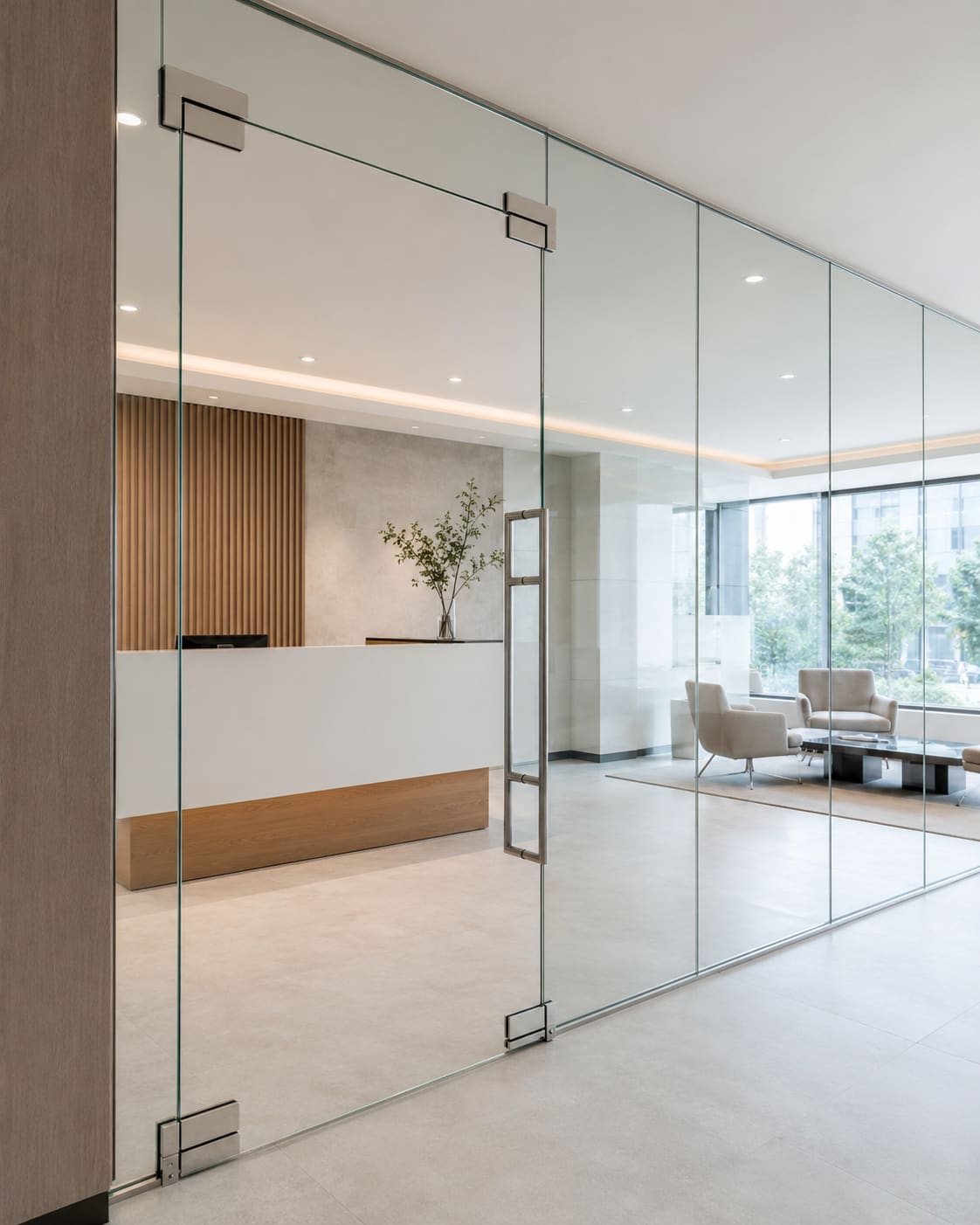
- 8-10 mm: shower enclosures, office partitions, frameless glass doors and shopfronts.
- 12 mm: frameless swing doors, balustrades, staircase railings and structural glazing.
- 15-19 mm: glass floors, load-bearing fins, canopies and large uninterrupted spans.
As a rule of thumb, doors and partitions people push against start at 10-12 mm, balustrades that must resist a horizontal crowd load use 12 mm toughened or toughened-laminated, and anything walked on or overhead is always laminated as well as toughened. Getting the thickness right is the single biggest factor in both safety and cost, which is why we size every panel against its actual span and wind zone rather than a default.
Toughened Glass Price in Hyderabad: A Realistic Breakdown
Plain clear toughened glass typically costs about INR 130 to INR 350 per square foot in Hyderabad, with the final rate driven by thickness, tint, coating and edge work. The glass itself is only part of a finished installation; hardware, fabrication and fitting are quoted separately.
- 8 mm clear toughened: roughly INR 130-180 per sq ft.
- 10 mm clear toughened: roughly INR 160-230 per sq ft.
- 12 mm clear toughened: roughly INR 220-320 per sq ft.
- Tints, reflective and low-E coatings, and heat-soaking each add a premium over these base rates.
- Edge polishing, cut-outs, holes and notches are charged per operation and add to the panel cost.
On top of the glass, a frameless door needs floor springs or patch fittings and locks, a shower enclosure needs hinges, clamps and seals, and a spider-glazed facade needs bolted structural fittings. These are matched to the panel and add meaningfully to the finished price. For an accurate figure for your opening, sizes and site, it is best to get a free quote rather than rely on a per-square-foot average, because installation access, height and hardware quality move the number significantly.
Common Mistakes to Avoid With Toughened Glass
Most toughened-glass problems on site trace back to a handful of avoidable errors, and knowing them up front protects both safety and budget.
- Trying to trim or re-drill on site: toughened glass cannot be modified after the furnace, so a mis-measured hole means a scrapped and re-ordered panel, not a quick fix. Confirm every dimension before ordering.
- Skipping edge polishing: raw or nipped edges concentrate stress and are a leading cause of unexplained breakage. Insist on properly seamed or polished edges on exposed glass.
- Omitting the heat-soak test on tall facades: for overhead and high-level glazing, the small saving is not worth the risk of a spontaneous fall.
- Under-specifying thickness for balustrades and doors: a panel that flexes alarmingly under hand pressure is under-designed for its span and load.
- Ignoring edge and setting-block support: toughened glass must sit on correctly placed setting blocks with adequate edge cover so point loads and metal-to-glass contact are avoided.
- Accepting glass with no bug mark or certificate: without the permanent stamp and fragmentation report you have no proof the glass is genuinely toughened to IS 2553.
How to Identify and Specify Genuine Toughened Glass
You can identify genuine toughened glass by its permanent manufacturer stamp, its optical characteristics and its documented test certificates. Insisting on these markers protects you from lower-priced annealed or under-tempered glass being passed off as safety glass.
- Bug mark: fully tempered glass carries a sand-blasted or ceramic-fired stamp in a corner citing the maker and the standard (for example IS 2553).
- Roller wave and strain pattern: viewed through polarised sunglasses, toughened glass shows faint iridescent strain patterns caused by the quenching rollers.
- Edge quality: certified toughened panels have properly seamed or polished edges, since raw edges concentrate stress and trigger breakage.
- Fragmentation certificate: reputable processors provide a test report showing the required number of fragments in a 50 mm x 50 mm area per IS 2553.
When specifying for a project in Hyderabad, Secunderabad or across Andhra Pradesh, state the thickness, tint, coating, edge finish and whether heat-soaking is required, and always ask for the test certificate on delivery so the installed glass matches what was quoted. As a specialist supplier and installer, Hakimi Aluminium and Glass matches every toughened panel to correctly rated hardware so load, span and warranty all line up; you can explore the full range through our services to see how toughened glass and fittings are supplied together on a single job.