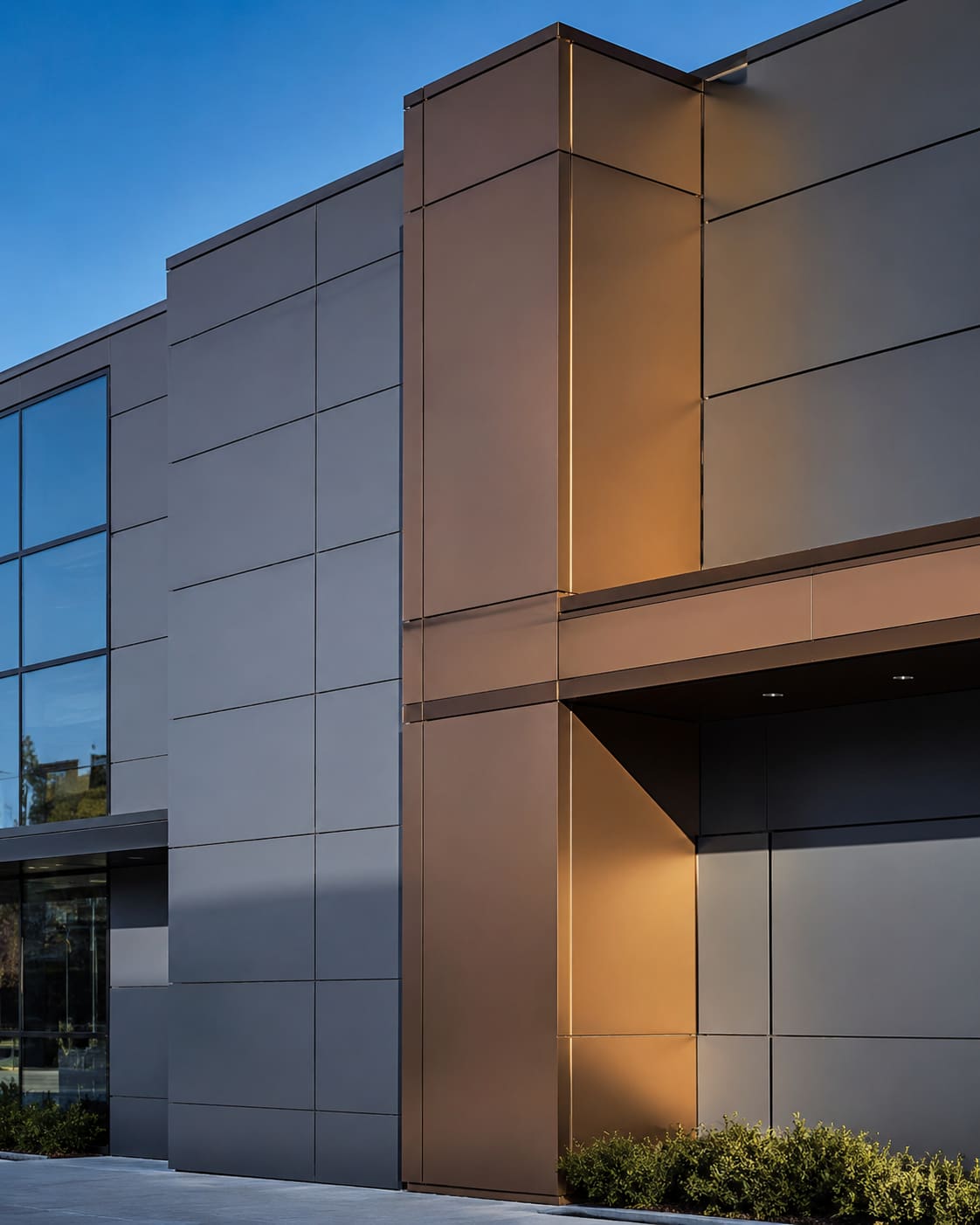
ACP (Aluminium Composite Panel) cladding typically lasts 15 to 25 years, and premium PVDF-coated panels can last 25 to 30 years or more when correctly specified and installed. The lifespan depends primarily on the coating type (PVDF versus polyester), aluminium skin thickness (0.25 mm to 0.50 mm), core grade (standard PE versus Fire-Retardant), and the quality of the sub-frame and installation. Panels rarely fail structurally; instead the surface coating fades, the polyethylene core can delaminate, or fixings corrode long before the aluminium itself does. Our ACP cladding service matches panel grade to building height, budget and exposure so the facade reaches its full design life.
Because the aluminium skins are inherently corrosion-resistant and do not rust like steel, the practical life of ACP is governed by its finish and by how it is engineered onto the building. A high-grade PVDF panel on a properly ventilated, well-drained aluminium frame in a dry inland city like Hyderabad will comfortably outlast a low-cost polyester panel fixed to an undersized frame in a humid coastal location. Understanding these variables lets architects, builders and owners in Hyderabad, Secunderabad and across Telangana predict and extend service life.
This guide breaks down realistic lifespans by grade, the five factors that decide durability, warranty and code benchmarks, how the Telangana and Andhra Pradesh climate behaves, and the maintenance that keeps panels looking new. If you are comparing options, our aluminium and glass facade services and our shop for Taiton, Enox and Ozone hardware cover the full build-up from panel to fixing.
Typical ACP Cladding Lifespan by Grade
ACP cladding lifespan ranges from roughly 7 years for the cheapest polyester panels to 30+ years for premium PVDF, FR-grade panels. The coating and core grade are the two biggest determinants of how long a facade stays presentable and watertight.
- Economy polyester (PE) coated ACP: 7 to 12 years before noticeable fade and chalking.
- Standard PVDF-coated ACP: 15 to 20 years of stable colour and adhesion.
- Premium PVDF (Kynar 500 / Hylar 5000, 70% resin): 25 to 30+ years with minimal fade.
- Fire-Retardant (FR) mineral-core ACP: comparable coating life plus superior fire and structural performance for high-rise use.
- The aluminium alloy skin (typically AA3003 / AA5005) resists corrosion for 40+ years independent of the coating.
In pricing terms, Hyderabad supply-and-fix rates run from roughly INR 180 to 320 per sq ft for economy PE panels, INR 320 to 520 per sq ft for genuine PVDF, and INR 520 to 850+ per sq ft for branded FR-grade PVDF cladding including the aluminium sub-frame. Paying for the higher coating grade is almost always cheaper per year of service than re-cladding early.
What Determines How Long ACP Cladding Lasts
The service life of ACP cladding is set by five measurable factors: coating chemistry, skin thickness, core type, installation quality and exposure environment. Get all five right and 25+ years is realistic; compromise on any one and life can halve.
- Coating: PVDF (polyvinylidene fluoride) retains colour and gloss far longer than polyester; nano-PVDF and FEVE finishes extend this further.
- Aluminium skin thickness: genuine 0.30 mm to 0.50 mm skins resist denting and oil-canning; sub-0.20 mm skins on counterfeit panels warp and fail early.
- Core: FR (mineral-filled) cores are more dimensionally stable and far safer than combustible pure-PE cores.
- Installation: a rigid, thermally accommodating aluminium sub-frame with correct expansion gaps prevents panel buckling and joint failure.
- Environment: UV intensity, pollution, humidity and salt air all accelerate coating degradation and edge corrosion.
The sub-structure matters as much as the panel. Extruded aluminium framing members and quality aluminium profiles give the flat, stable, corrosion-free grid that keeps panels aligned and joints sealed for decades. Undersized or mild-steel framing is the most common reason a good panel fails early.
PVDF vs Polyester Coatings: The Single Biggest Factor
The coating decides most of an ACP panel's visible life, so PVDF versus polyester is the first specification decision to get right. PVDF is a fluoropolymer resin engineered specifically to resist ultraviolet breakdown, which is exactly the stressor that dominates the Telangana and Andhra Pradesh climate.
- PVDF (70% Kynar 500 / Hylar 5000): holds colour to a tight Delta-E limit for 20 to 30 years; ideal for facades and high-rise elevations.
- FEVE and nano-PVDF: premium self-cleaning finishes that shed dust and pollution, extending clean-looking life further.
- Polyester (PE): cheaper, fine for low-cost interior or signage work, but chalks and fades outdoors within 7 to 12 years.
- A simple field test: PVDF resists a marker/solvent wipe and keeps its sheen, while polyester dulls and chalks off on a cloth.
For any external elevation in Hyderabad or Secunderabad, PVDF is the default recommendation. Polyester should be reserved for sheltered interior linings where UV exposure is minimal. If you want a comparison with mineral cladding, our HPL cladding service covers an alternative facade material with different weathering behaviour.
Warranties and Standards That Predict ACP Life
Reputable ACP manufacturers back PVDF panels with 10 to 20 year written warranties covering colour retention, gloss and coating adhesion. Warranty length is a reliable proxy for expected life, so always ask for the written coating warranty document, not just a verbal claim.
- PVDF coating warranties: commonly 10, 15 or 20 years for film integrity and colour Delta-E limits.
- Polyester coating warranties: typically only 3 to 7 years.
- Fire performance: FR-grade ACP is tested to standards such as ASTM E84, BS 476 Part 6/7 and EN 13501; the National Building Code of India (NBC) 2016 governs facade fire safety for tall buildings.
- Wind and structural loading on the cladding sub-structure is designed to IS 875 (Part 3) for wind loads.
- Structural sealant joints, where used, follow structural silicone glazing practice (ASTM C1401) for long-term durability.
Warranties are only valid when panels are installed to the maker's method statement. That is why professional aluminium fabrication and installation is not an optional extra; a mis-fixed panel voids the warranty and shortens life regardless of grade. To get a specified, warranty-backed quotation, request a quote with your building height and elevation area.
ACP Lifespan in Hyderabad, Secunderabad and Indian Climates
In Hyderabad and Secunderabad's hot, semi-arid climate, quality PVDF ACP typically achieves the upper end of its service range because low humidity and the absence of salt air slow coating fade and edge corrosion. Intense summer UV is the main stressor, which is precisely what PVDF coatings are formulated to resist.
- Inland dry cities (Hyderabad, Secunderabad, Bengaluru): favourable; expect 20 to 30 years from PVDF panels.
- Coastal salt-air cities (Visakhapatnam, Chennai, Mumbai): faster corrosion and fade; specify PVDF plus higher-grade 0.50 mm skins.
- High-pollution industrial zones around the city: acidic deposition dulls coatings, so periodic cleaning matters more.
- Monsoon-driven water ingress is the biggest installation risk; well-drained, ventilated rear cavities protect the core and fixings.
For Andhra Pradesh projects on the coast, the specification should step up a grade compared with an equivalent inland Telangana building. The panel is the same aluminium, but salt air attacks fixings and cut edges, so drainage detailing and skin thickness become the deciding factors in reaching 25+ years.
Installation and Sub-Frame: Why Fixing Quality Decides Longevity
Even a 30-year PVDF panel will fail early on a poor sub-frame, so installation quality is inseparable from lifespan. The rear cavity, drainage, expansion allowance and fixing corrosion resistance all determine whether the panel reaches its rated life.
- Use a rigid, true aluminium grid with designed expansion gaps so panels can move with temperature without buckling.
- Maintain a ventilated, drained rear cavity so any water that gets behind panels escapes rather than soaking the core.
- Specify stainless or aluminium fixings; corroding mild-steel fasteners cause rust streaks and loose panels within a few years.
- Detail parapets, sills and openings to shed water outward, keeping cut panel edges dry.
- Integrate cladding cleanly with adjacent glazing and structural elements; our structural glazing service and spider and structural fittings handle those transitions on mixed glass-and-ACP elevations.
Where cladding meets entrance systems and glass doors, quality floor springs and door closers and door handles and hardware from Taiton, Enox and Ozone keep the whole facade performing as one durable assembly rather than a patchwork that ages unevenly.
Maintenance to Maximise ACP Service Life
Simple, low-cost maintenance can add years to ACP cladding life by preventing coating erosion and joint failure. ACP is largely maintenance-free but benefits from periodic cleaning and sealant checks, and the cost of doing so is trivial next to re-cladding.
- Clean panels 1 to 2 times a year with mild pH-neutral detergent and water; avoid abrasive pads and strong solvents.
- Inspect and re-seal weathering silicone joints roughly every 8 to 12 years, as sealant often ages before the panel does.
- Check fixings and the sub-frame for corrosion, especially at ground level and near roof drainage.
- Repair scratches or edge damage promptly to stop core exposure and moisture ingress.
- Never pressure-wash at high force close to joints, which can drive water behind panels.
A budget of roughly INR 8 to 20 per sq ft per cleaning cycle is typical for accessible elevations in Hyderabad, with rope-access or scaffold work costing more on high-rise towers. Even so, planned cleaning is far cheaper than the fade and staining that follow years of neglect.
When ACP Cladding Needs Replacing
ACP cladding should be replaced when the coating has visibly faded or chalked, panels have delaminated or oil-canned, or the core is exposed to moisture. These signal end-of-life rather than the aluminium wearing out.
- Widespread colour fade or chalking indicates the coating has reached the end of its protective life.
- Bubbling, delamination or swelling shows the polyethylene or mineral core bond has failed, often from water ingress.
- Loose, rattling or bowing panels point to sub-frame or fixing failure requiring re-cladding.
- Older combustible pure-PE cored ACP is increasingly replaced with FR-grade panels to meet current NBC 2016 fire codes.
Re-cladding is also an opportunity to upgrade the whole envelope, moving from PE to PVDF FR panels and correcting drainage and fixing details that shortened the first installation's life. Hakimi Aluminium and Glass supplies and installs PVDF and FR-grade ACP cladding across Hyderabad, Secunderabad and Telangana, and can survey an ageing facade before you decide between repair and full replacement. Browse our services or contact us for an on-site assessment.