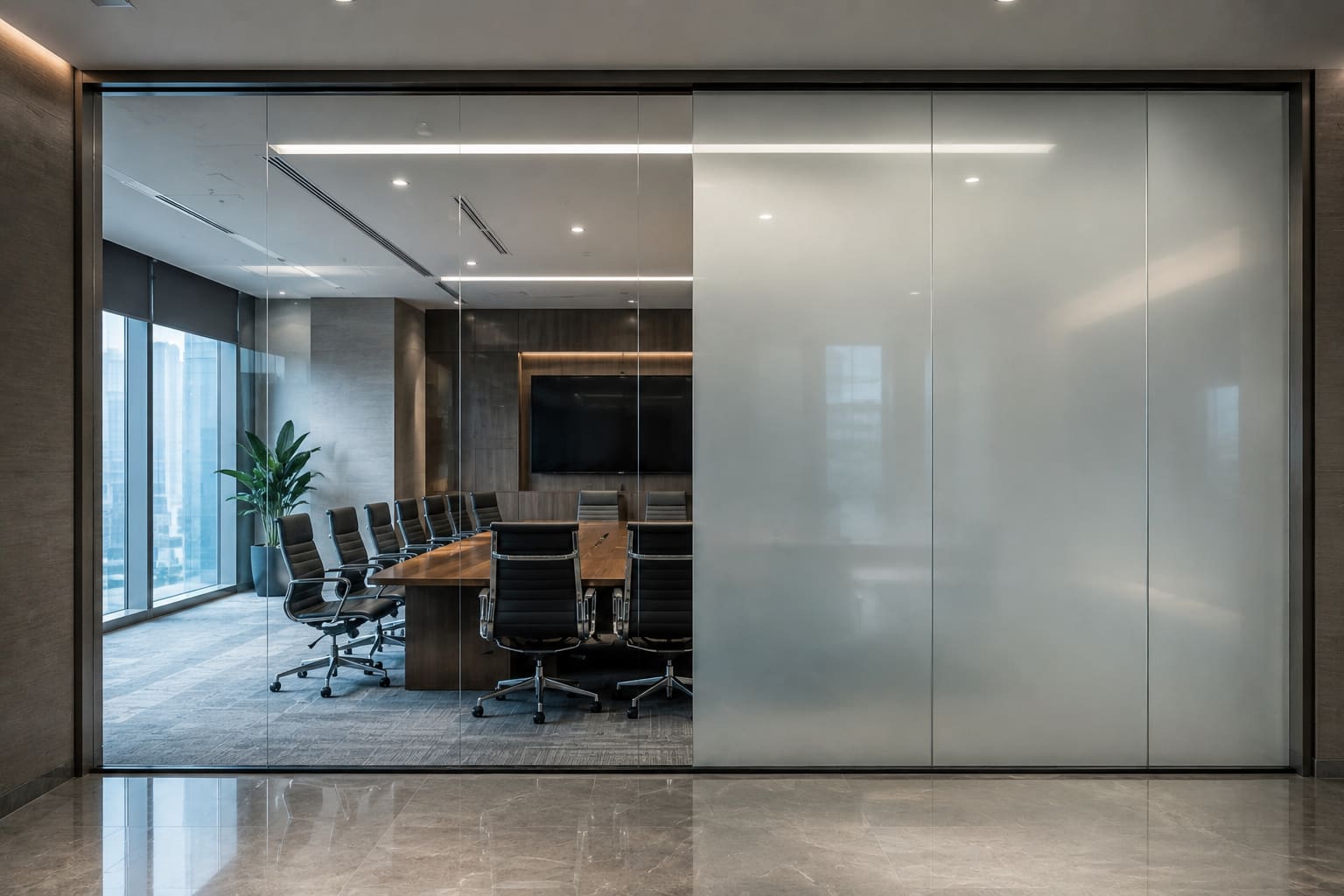
Smart glass works by sandwiching a thin, electrically responsive layer - either a liquid-crystal film or a metal-oxide coating - inside laminated glass, and passing a low-voltage current through it changes how much light the layer transmits, switching the pane between clear, opaque and tinted states. The two dominant technologies are PDLC (Polymer Dispersed Liquid Crystal), which flips between an opaque-white privacy state and full transparency almost instantly, and electrochromic glass, which darkens gradually to control solar heat and glare. Because the active layer is permanently sealed between glass panes, the electronics never touch air or moisture - which is why switchable smart glass can be used safely on facades, cabins, shower screens and other wet or exposed areas.
The core difference is what each technology is designed to do. PDLC controls privacy (opaque versus see-through), while electrochromic controls solar energy and light (tinted versus clear). PDLC needs continuous power to stay transparent and defaults to opaque when switched off; electrochromic is bistable, holding its tint with little or no power once set. That makes them complementary rather than competing - many premium projects use PDLC for internal glass partitions and cabins, and electrochromic for the outward-facing skin that has to fight the afternoon sun.
In the hot, high-glare climate of Hyderabad, Secunderabad and the wider Telangana and Andhra Pradesh region, both are specified for conference rooms, doctor cabins, ICUs, luxury villas, facades and skylights. Hakimi Aluminium and Glass supplies, fabricates and installs switchable smart glass - along with the Taiton, Enox and Ozone hardware that frames and operates it - across the region. If you already have a project in mind, you can get a free quote with your panel sizes and we will size the film, controller and framing for you.
How PDLC (Polymer Dispersed Liquid Crystal) Glass Works
PDLC glass works by suspending microscopic liquid-crystal droplets in a polymer film laminated between two glass panes. Without power, the droplets sit in random orientations and scatter light, so the glass looks opaque-white; when a current is applied, the droplets align and let light pass straight through, turning the pane clear. The switch is near-instantaneous - typically under one second - which makes PDLC ideal for on-demand privacy in meeting rooms, bank cabins and hospital wards where a room needs to go private the moment a switch is flipped.
Think of PDLC as an electrically controlled frosting effect. In its off state it behaves like acid-etched or sandblasted glass, letting soft light through while blocking any clear view; in its on state it looks like ordinary clear glass. It is fundamentally a privacy device, not an energy device - it will not meaningfully reduce the heat coming through a sun-facing window.
- Power: normally 48V-65V AC (some films run at 24V-110V), drawing roughly 3-5 watts per square metre while clear.
- Default state: OFF = opaque (translucent white); ON = transparent.
- Privacy only: it always blocks the view when off, but it does not significantly reduce solar heat gain.
- Construction: film bonded via EVA or PVB lamination between two toughened panes, total thickness commonly 8mm-13mm.
- Panel size: a single PDLC sheet is usually limited to about 1.2m-1.5m wide, so very large walls are made from tiled panels with slim seams.
- Fail-safe: a power cut instantly returns the glass to opaque - which many clients treat as a built-in privacy safeguard.
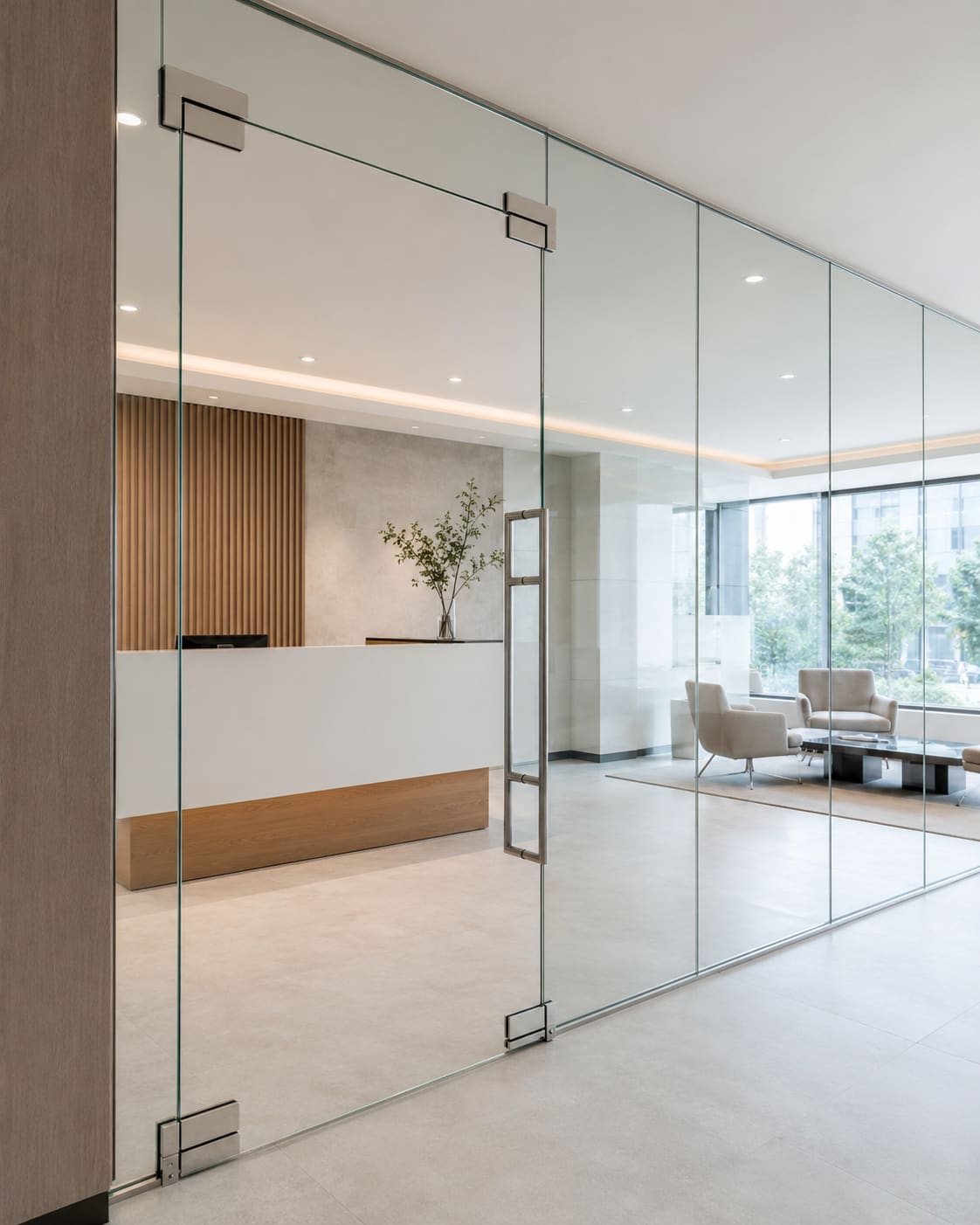
Because PDLC is essentially a privacy tool that gets built into doors, cabins and movable walls, it is almost always used alongside conventional framing, patch fittings and door hardware. When we fit it into glass partition systems, the switchable panel still relies on quality ironmongery to hang, seal and operate cleanly over years of daily use.
How Electrochromic Glass Works
Electrochromic glass works by passing a small voltage through stacked metal-oxide coatings (typically tungsten oxide) so that lithium ions migrate into the layer and darken it; reversing the polarity drives the ions back out and returns the glass to clear. Unlike PDLC, the tint changes gradually over roughly 3-10 minutes and the glass stays see-through in every state - it dims like a pair of photochromic sunglasses rather than becoming truly opaque.
The pay-off for that slower response is energy performance. Because electrochromic glass is bistable, once it reaches a chosen tint it holds that state with almost no power, and it can reject a large share of incoming solar radiation. On a west-facing facade in Hyderabad, that translates directly into a lower air-conditioning bill through the long summer.
- Power: very low voltage (about 0-5V DC) and bistable, holding its state with near-zero standby power.
- Solar control: can block up to 98% of visible light and sharply cut solar heat gain, lowering cooling loads by 20% or more.
- U-value: built into insulated glass units (IGUs), it can reach U-values around 1.6-1.8 W/m2K, aiding ECBC compliance.
- Use case: facades, skylights and windows where glare and heat control matter more than instant privacy.
- Trade-off: slower switching and a higher price than PDLC, but no continuous power is needed to hold a tint.
Electrochromic panels are most powerful when they form part of a full glazed envelope, so they are frequently combined with structural glazing and spider-fitting facades. You can see the scale of glazed envelopes we handle in our recent projects, which gives a realistic sense of where solar-control smart glass earns its cost.
PDLC vs Electrochromic: Side-by-Side Comparison
The right choice depends on a single question: do you need instant privacy (PDLC) or solar and glare control (electrochromic)? The two technologies solve different problems, and on many premium projects both are specified in different zones of the same building - PDLC for the interiors, electrochromic for the skin.
- Switching speed: PDLC under 1 second; electrochromic 3-10 minutes.
- States: PDLC opaque versus clear; electrochromic clear versus graduated tint (never fully opaque).
- Power draw: PDLC needs constant power to stay clear; electrochromic holds its state with almost no power.
- Primary function: PDLC = privacy; electrochromic = solar heat and glare reduction.
- Fail-safe on power loss: PDLC becomes opaque; electrochromic remains transparent at its last state.
- Typical cost: PDLC is the more affordable option; electrochromic IGUs command a premium.
- Best for: PDLC for cabins, partitions and meeting rooms; electrochromic for facades, skylights and west-facing windows.
For most offices and clinics in Hyderabad and Secunderabad, PDLC is the practical starting point because privacy is the immediate need and the entry cost is lower. Electrochromic is chosen when reducing the summer cooling bill and controlling glare on workstations is the primary driver, and budget allows for insulated units.
Where Smart Glass Is Used in Hyderabad and Secunderabad
In Hyderabad, Secunderabad and across Telangana and Andhra Pradesh, smart glass shows up wherever privacy, glare or heat needs to be controlled at the touch of a switch. The intense summer sun - with surface temperatures regularly crossing 40 degrees C - makes solar-control glass genuinely cost-effective rather than just a design statement, while the region's booming IT parks and hospitals create constant demand for switchable privacy.
- Corporate offices and IT parks: PDLC conference-room walls that go opaque during confidential meetings, and electrochromic curtain walls that cut afternoon glare on workstations.
- Hospitals and clinics: PDLC on ICU, consultation and operation-theatre partitions for instant, hygienic privacy without curtains that gather dust.
- Luxury villas and apartments: bathroom shower screens, bedroom windows and skylights that switch from open views to full privacy.
- Retail and showrooms: switchable shopfronts and display cases that reveal or conceal merchandise on cue.
- Banks and government offices: private cabins and cash-counter screens where confidentiality is a compliance requirement.
Whichever application you have in mind, the switchable glass is only one part of the assembly - it is integrated with framing, doors and sealing systems drawn from the full range on our services page, so the finished installation performs as a complete, weather-tight system.
Safety, Standards and Durability
All smart glass sold for building use in India must be laminated safety glass, because the switchable film or coating is permanently bonded between panes that also meet impact-safety requirements. This is a code obligation, not an upgrade, and it is what allows switchable glass to be used overhead in skylights and in doors that people push through every day.
- Safety glass: toughened components conform to IS 2553 (Part 1) for architectural safety glass, and the laminated construction retains fragments if the glass is ever broken.
- Wind and structural load: facade and skylight applications are designed to IS 875 (Part 3) for wind load and the National Building Code of India (NBC) 2016.
- Energy performance: solar-control smart glass supports the Energy Conservation Building Code (ECBC) and BEE-linked efficiency targets for commercial buildings.
- Structural glazing: where smart glass is structurally bonded into a facade, silicone sealants follow ASTM C1401 guidance.
- Lifespan: a properly sealed unit lasts 10-20 years; PDLC films are typically warranted for around 3-5 years, and electrochromic units generally longer.
- Electrical safety: transformers and controllers should be low-voltage and enclosed, and wiring must follow standard Indian electrical codes.
Durability in the field comes down to two things: keeping the busbar and power-tab edges permanently dry and concealed, and using hardware sized to the panel weight. Heavy switchable-glass doors need floor springs, patch fittings and closers rated for the load; when those are undersized the glass sags, the seal fails and the film's life is cut short. Getting the specification right at the drawing stage is far cheaper than a rework.
Cost, Installation and Control Options
Smart glass in Hyderabad typically costs Rs. 3,500-Rs. 12,000 per square foot installed, with PDLC sitting at the lower-to-mid range and premium electrochromic IGUs at the top. As a worked example, a single 4ft x 3ft PDLC conference-room panel commonly lands in the Rs. 45,000-Rs. 90,000 range once film, lamination, controller and fitting are included - while an equivalent electrochromic insulated unit can run well above that.
- Pricing drivers: technology type, pane thickness, lamination interlayer, controller or dimmer, and whether panels are single-glazed or insulated units.
- Control options: wall switch, remote, timer, mobile app or building-management system (BMS); PDLC also supports dimming through frequency control for a frosted-to-clear range.
- Hyderabad climate fit: with long hot summers and intense glare, electrochromic and solar-control glass cut cooling costs, while PDLC delivers instant privacy for offices and clinics.
- Design tip: keep panel sizes within the film manufacturer's maximum width to avoid visible seams on large walls, and plan seam positions to line up with mullions.
- Installation: panels must be handled with the power tabs protected, wired by a qualified electrician, and framed so the busbar edge stays dry and concealed.
Because the wiring runs to every panel, the electrical plan has to be settled early - retro-fitting a power route behind a finished wall is disruptive and expensive. Send us your drawings through the get a free quote form and we will map the panel layout, controller and cable routes before any glass is ordered.
Common Mistakes to Avoid With Smart Glass
Most smart-glass disappointments trace back to a handful of avoidable errors made during specification and installation rather than to the technology itself. Knowing them in advance protects both your budget and the finished result.
- Buying PDLC for solar control: PDLC blocks views, not heat - choosing it for a sun-facing window will not reduce your air-conditioning load.
- Ignoring the power plan: PDLC needs a dedicated low-voltage supply to each panel; discovering this after the walls are closed forces ugly surface conduit or rework.
- Oversizing single panels: exceeding the film's maximum sheet width causes seams or, worse, uneven switching - large walls should be designed as tiled panels from the start.
- Under-rating the hardware: heavy switchable doors need floor springs, patch fittings and closers matched to the glass weight, or the panel sags and the seal fails.
- Exposed busbar edges: if the powered edge is left near moisture, the film delaminates early - the connection must be sealed and concealed within the frame.
- Skipping the safety-glass requirement: any switchable pane in a door, partition or overhead position must be laminated safety glass to IS 2553 - a non-negotiable that some low-cost quotes quietly omit.
Working with an experienced fabricator removes most of this risk, because the framing, wiring and glass are specified together as one system rather than bolted on afterwards.
How to Choose the Right Smart Glass for Your Project
Choosing between PDLC and electrochromic comes down to matching the technology to the problem you are actually solving, then confirming budget, panel size and control method. Start from the function, not the finish - the look is similar in the clear state, but the behaviour and the cost are very different.
- Choose PDLC if: you need instant, switchable privacy for interior partitions, cabins or shower screens and want the lowest entry cost.
- Choose electrochromic if: your main goal is cutting solar heat and glare on a facade, skylight or west-facing window, and you want the glass to stay transparent even on power failure.
- Consider both if: you are fitting out a high-end office or villa where interiors need privacy and the envelope needs solar control.
- Check the power plan: PDLC needs a dedicated low-voltage supply routed to each panel, so plan wiring early with your electrician.
- Confirm the framing: heavy switchable-glass doors and movable walls need patch fittings and hardware sized to the panel weight.
Hakimi Aluminium and Glass supplies, fabricates and installs both PDLC and electrochromic smart glass - and the matching Taiton, Enox and Ozone hardware - across Hyderabad, Secunderabad and the wider Telangana and Andhra Pradesh region. Share your drawings and we will recommend the technology, panel layout and control system that fits your budget.