Toughened glass is approximately four to five times stronger than ordinary annealed glass of the same thickness, resisting surface and bending stresses of roughly 90 to 200 MPa compared with about 40 MPa for untreated glass. That strength comes from a controlled heat treatment: the glass is heated to about 620 to 650 degrees C and then rapidly cooled with jets of air, locking the outer surfaces into permanent compression while the core stays in tension. At Hakimi Aluminium and Glass, this is the single most common question we field from homeowners, architects and builders across Hyderabad, Secunderabad and the wider Telangana market before they commission a facade, railing or shopfront.
That built-in surface compression is exactly what makes toughened glass so hard to break. Any crack must first overcome the compressive layer before it can spread, so the pane tolerates far greater impact, bending and thermal stress than ordinary glass. In India, toughened glass sold as safety glazing must comply with IS 2553 (Safety Glass), and it is specified throughout the National Building Code of India (NBC) 2016 for doors, railings, facades and overhead glazing. Whether you are planning toughened glass work for a single door or a full commercial elevation, understanding the real strength figures helps you specify the right thickness and avoid costly over- or under-engineering.
When toughened glass does finally break, it fragments into thousands of small, relatively blunt granules instead of dangerous knife-like shards. Below we break down exactly how strong toughened glass is in measurable terms, why the tempering process delivers that strength, how thickness maps to load, how it compares to laminated and heat-strengthened glass, and what certified toughened glazing actually costs in Hyderabad and Andhra Pradesh. If you already know your requirement, you can get a free quote and our team will size the glass against your wind zone and span.
How much stronger is toughened glass, in numbers?
Toughened glass typically carries 4 to 5 times the mechanical strength of annealed glass of identical thickness, driven by its engineered surface-compression layer. This is not a marketing figure; it is measurable, standardised and testable under both Indian and international codes.
- Surface compression: about 90 to 150 MPa in fully toughened glass; IS 2553 requires a minimum of 69 MPa.
- Bending / flexural strength: roughly 120 to 200 MPa, versus about 40 MPa for annealed glass.
- Impact resistance: withstands a far heavier ball-drop and knock without failing, which is the physical basis of its safety-glass classification.
- Thermal shock tolerance: up to around 250 degrees C differential, compared with about 40 degrees C for ordinary glass, which matters in Hyderabad summers where facade surfaces can reach 60 to 70 degrees C.
- Heat-strengthened glass (a lighter treatment) reaches only about 2 times annealed strength and does NOT qualify as safety glass.
In practical terms, this is why a frameless glass door or a large shopfront in Secunderabad can survive daily knocks, slamming and thermal cycling that would crack an ordinary pane within weeks. The strength is uniform across the surface, but as we will see, the edges remain the critical weak point.
Why the tempering process creates strength
The strength of toughened glass comes from residual compressive stress deliberately locked into its surfaces during rapid cooling. It is a physics story, not a coating: nothing is added to the glass, its internal stress state is simply re-engineered.
- The pane is heated close to its softening point (about 620 to 650 degrees C) in a horizontal roller furnace.
- High-pressure air quenches the surfaces first; they solidify while the core is still hot and fluid.
- As the core cools and contracts, it pulls the already-rigid surfaces into permanent compression, leaving the interior in balancing tension.
- Because glass fails in tension, any crack must first spend energy overcoming this surface compression, so far more load is needed to start a fracture.
- This is also why toughened glass cannot be cut, drilled or edge-worked afterward: any breach of the surface releases the stored energy and shatters the entire pane instantly.
The practical takeaway for anyone ordering glass in Telangana is that every hole, cut-out, hinge notch and countersink must be finalised BEFORE tempering. A single site modification after the fact means a brand-new pane, so accurate measurement and a confirmed hardware layout upfront save both time and money. This is where working with an experienced fabricator, rather than a general contractor, pays for itself.
How glass thickness affects load capacity
Thicker toughened glass carries proportionally higher wind and point loads, and thickness is selected against wind pressure per IS 875 Part 3 and NBC 2016. Doubling thickness roughly quadruples bending stiffness, so the correct thickness is an engineering decision, not a guess.
- 6 mm: common for internal partitions, small windows and light screens.
- 8 to 10 mm: typical for doors, shopfronts and medium spandrel or vision facade panels.
- 12 mm: standard for frameless glass railings, large frameless doors and structural glazing.
- 15 to 19 mm: used for wide-span facades, canopies and high wind-load zones.
- For balustrades, laminated-toughened glass (two toughened plies bonded with a PVB or SGP interlayer) is recommended so the barrier stays in place even if one ply breaks.
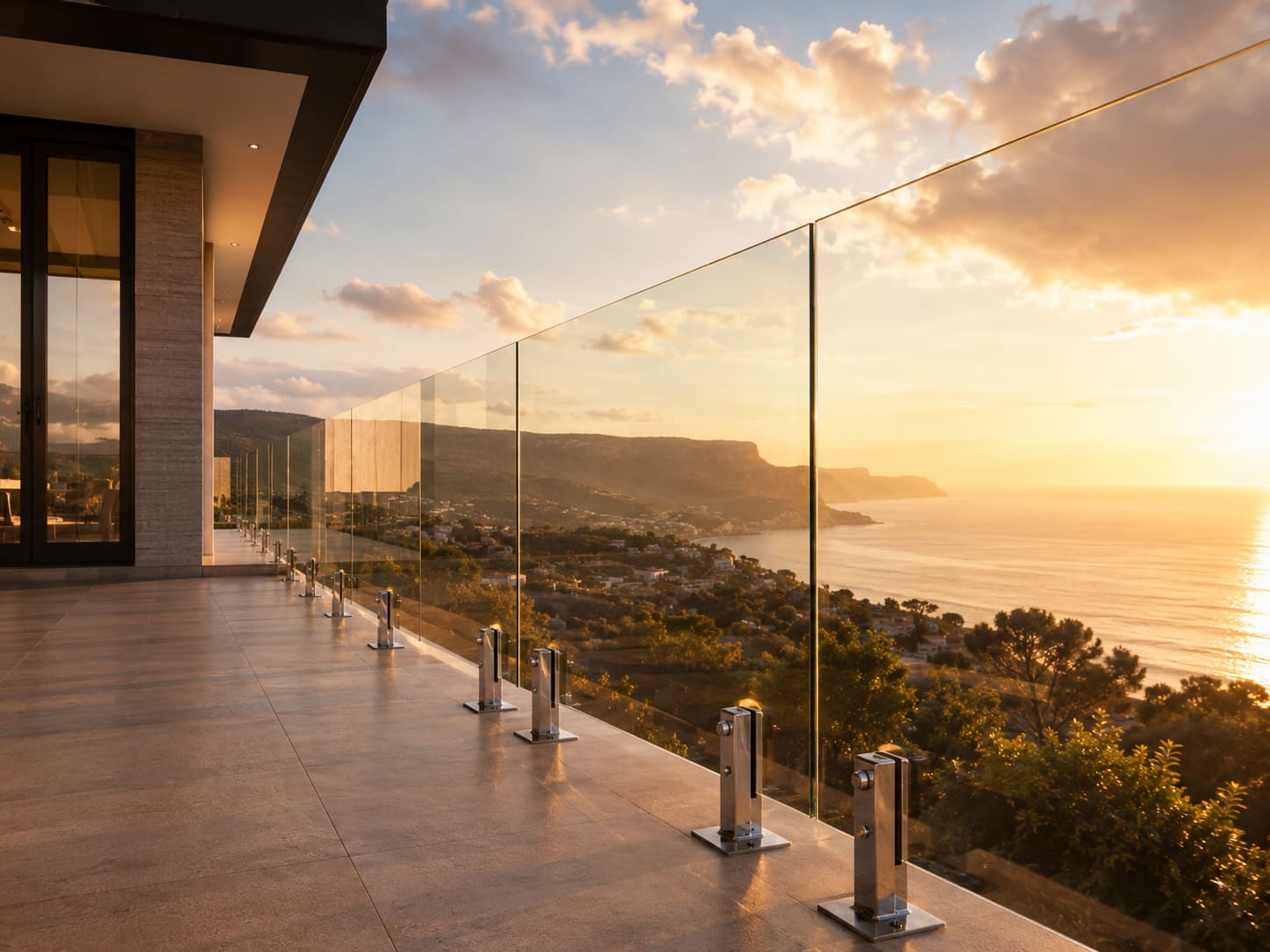
For a frameless glass railing on a balcony or staircase, we almost always specify 12 mm toughened or laminated-toughened glass, because the barrier must resist a horizontal line load as well as accidental human impact. Getting the thickness right also depends on the free-standing height of the panel and whether the glass is bottom-clamped in a base channel or supported by spider fittings, both of which change the effective span.
Toughened glass load capacity in real applications
In real buildings, the strength of a toughened pane is only ever as good as the hardware and framing that transfer load into the structure. A high-MPa pane held by weak or badly positioned fittings is a false economy, and most real-world failures trace back to this mismatch rather than to the glass itself.
- Facades and curtain walls rely on toughened or laminated-toughened glass captured in aluminium framing or bonded with structural silicone that is rated for the local wind load.
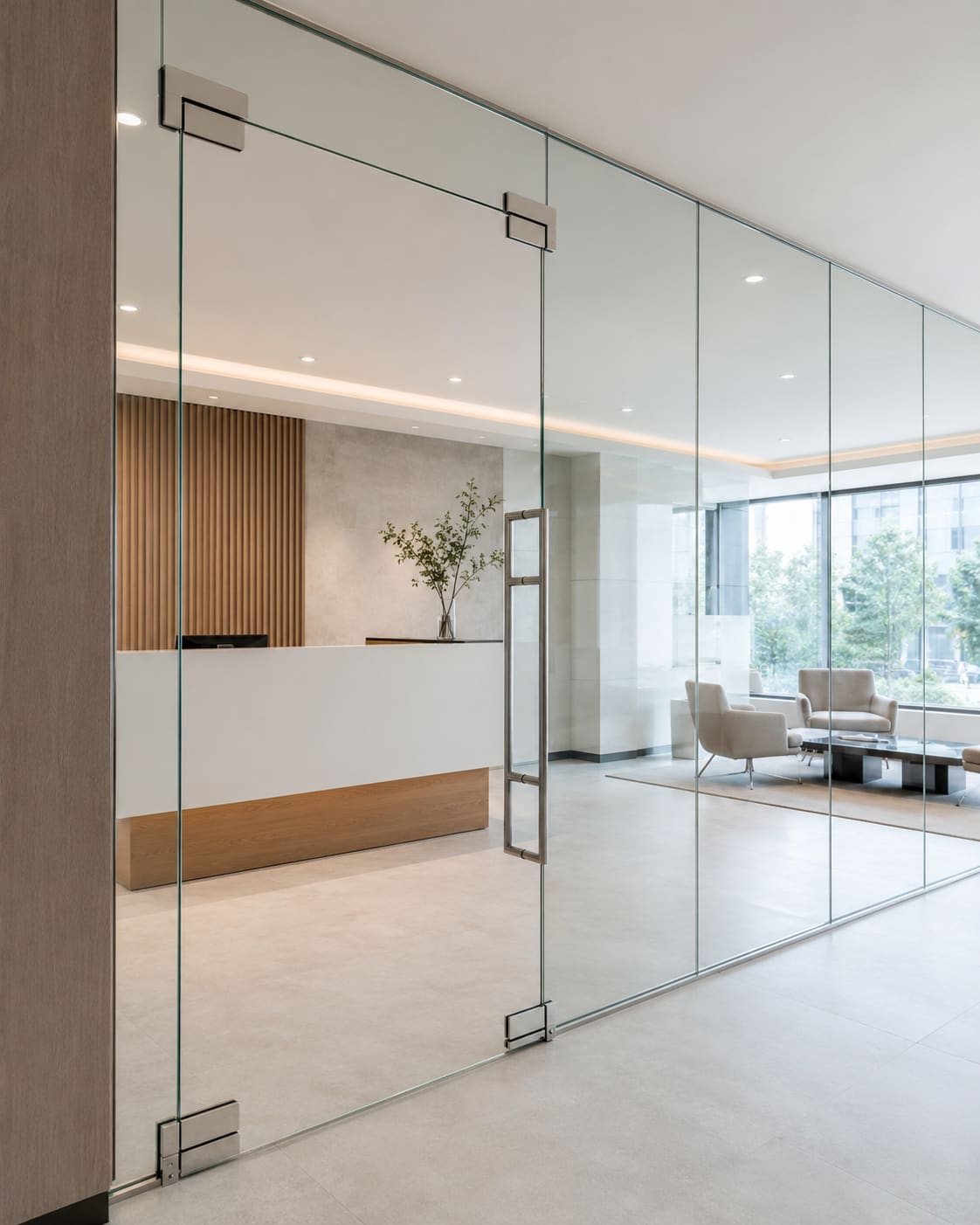
- Frameless doors use toughened glass with patch fittings and floor springs sized to carry the full leaf weight and control the swing without stressing the corners.
- Sliding facades and large openings mount toughened panels in engineered sliding tracks so heavy glass glides safely without edge contact.
- Shower enclosures use 8 to 10 mm toughened glass with dedicated fittings that clamp evenly rather than pinching a single point.
- Balustrades transfer a code-defined horizontal line load into the base channel or standoffs, so the fixing detail matters as much as the glass grade.
You can see how we combine glass and load-rated hardware in our recent projects across Hyderabad. The lesson from every one of them is the same: match the load rating of the fittings to the strength of the glass, and protect the edges at all costs.
How it breaks: strength plus safety
Toughened glass is classified as safety glass because it fractures into small, blunt cubic granules rather than sharp slivers, sharply reducing injury risk. Strength and safe failure are two separate properties, and fully toughened glass delivers both at once.
- Fragmentation is a mandated test under IS 2553, which sets a minimum particle count within a defined 50 mm x 50 mm area.
- The stored core tension makes the whole pane disintegrate at once, so on its own it should never be the sole line of fall protection at height without lamination.
- A rare failure mode is spontaneous breakage from nickel-sulphide inclusions; heat-soak testing (per EN 14179, widely referenced in India) greatly reduces this risk in critical facades.
- Overhead and sloped glazing generally requires laminated-toughened glass under NBC 2016 so fragments are retained by the interlayer.
- Edges and corners are the weakest points; a chip or nick concentrates stress and can trigger delayed breakage weeks or even months later.
This is why professional handling, protected polished edges and correctly torqued fittings are as important to real-world durability as the raw strength rating printed on paper. Strength on the test bench means little if the pane is chipped during a careless installation.
Toughened vs laminated, heat-strengthened and annealed glass
Choosing the right glass is about matching failure behaviour to the risk, not simply picking the strongest pane. Here is how the common options compare on strength and safety.
- Annealed (ordinary) glass: baseline strength (about 40 MPa), breaks into large sharp shards, and is not safety glass.
- Heat-strengthened glass: about 2x annealed strength, resists thermal stress well but breaks into large pieces and is not classed as safety glass.
- Fully toughened glass: 4 to 5x annealed strength, breaks into blunt granules, and qualifies as safety glass under IS 2553.
- Laminated glass: two panes bonded by an interlayer; fragments stay stuck to the film, making it ideal for overhead, security and fall-protection uses.
- Laminated-toughened glass: combines high strength with fragment retention, the go-to choice for railings, skylights and structural glazing.
For most homes and offices in Hyderabad and Secunderabad, fully toughened glass is the right balance of strength, safety and cost, while laminated-toughened is reserved for overhead, high-fall-risk or high-security applications. If you are unsure which grade a particular opening needs, browse our services or ask us to specify the correct glass against your drawings.
The fabrication process and typical timeline
Because toughened glass cannot be altered after tempering, the process runs strictly front to back: measure, fabricate, temper, then install. Understanding the sequence helps you plan a project realistically and avoid the delays that come from late design changes.
- Site measurement: exact sizes, hole positions and cut-outs are captured and confirmed against the hardware.
- Cutting and edgework: the annealed sheet is cut to size and all edges are ground and polished; holes and notches are drilled at this stage.
- Tempering: the finished pane passes through the furnace and quench, after which no further machining is possible.
- Quality and optional heat-soak: fragmentation and surface-compression checks are done, plus heat-soak testing for critical facades.
- Delivery and installation: panels are transported edge-protected and set into their framing, channels or fittings.
For a typical residential order in Hyderabad, expect roughly 3 to 7 working days from confirmed measurement to installation for plain toughened glass, and a little longer for laminated, coated or heat-soaked units. Large facade contracts are phased over the build programme. Confirming your hardware and openings early is the single best way to keep to this timeline.
Common mistakes to avoid with toughened glass
Most toughened glass problems on site come from a handful of avoidable errors, almost none of which are about the glass being under-strength. Knowing them in advance protects both your budget and your safety.
- Assuming it can be trimmed on site: it cannot, so any late size change means a fresh pane and a lost lead time.
- Ignoring edge protection: chipped or nicked edges are the number-one cause of delayed spontaneous breakage.
- Under-specifying thickness: skipping a proper wind-load check under IS 875 Part 3 to save money often leads to flexing, noise or failure.
- Using unrated or mismatched hardware: quality glass in weak fittings shifts the failure point to the hinge, patch or clamp.
- Skipping certification: without a fragmentation and surface-compression report, you have no proof the pane is genuinely toughened.
- Omitting lamination overhead: plain toughened glass in a skylight or canopy can shower granules if it breaks, so laminated-toughened is required.
A genuine toughened pane always carries a permanently etched manufacturer stamp in one corner. If that stamp is missing, treat the strength claims with suspicion. Insisting on certified glass and correctly rated fittings is the simplest way to guarantee the strength figures actually hold up in service.
Indian standards, testing and certification
In India, toughened glass strength and safety are governed by IS 2553, with structural and wind requirements from NBC 2016, IS 875 Part 3, and ECBC for energy performance. Insisting on certified glass is the simplest way to guarantee the strength figures actually hold on site.
- IS 2553: covers mechanical strength, fragmentation and safety-glass classification.
- IS 875 Part 3: sets the wind-load basis for selecting glass thickness in a given zone.
- NBC 2016: mandates safety glazing for doors, railings, facades and overhead glass.
- EN 12150 / ASTM C1048: international references for tempered glass quality and strength.
- Heat-soak testing per EN 14179: recommended for critical facades to reduce nickel-sulphide risk.
Always ask your supplier for the surface-compression and fragmentation test reports for the batch you are buying. Reputable installers across Telangana and Andhra Pradesh supply this documentation as standard for any facade, railing or overhead job, and it is your best protection against uncertified glass being passed off as safety-grade.
Toughened glass prices in Hyderabad and Secunderabad
Certified plain toughened glass in the Hyderabad market runs about INR 120 to 350 per sq ft depending on thickness, with laminated and coated units costing more. Pricing scales with thickness, panel size, edgework and any coatings, holes or cut-outs.
- 6 mm plain toughened: approximately INR 120 to 160 per sq ft.
- 8 to 10 mm plain toughened: approximately INR 180 to 260 per sq ft.
- 12 mm plain toughened: approximately INR 280 to 350 per sq ft.
- Laminated-toughened (for example 6+6 mm with PVB): roughly INR 400 to 650 per sq ft.
- Low-E / reflective toughened facade glass: typically INR 500 per sq ft and up.
- Hardware, fabrication and installation are quoted separately based on the fittings, springs and channels chosen.
Hakimi Aluminium and Glass supplies and installs certified toughened glass, railings, shopfronts and facades across Hyderabad, Secunderabad and the wider Telangana and Andhra Pradesh region, backed by branded hardware. To get an exact figure for your span and wind zone, get a free quote with your sizes and we will engineer the right thickness and grade for the job.