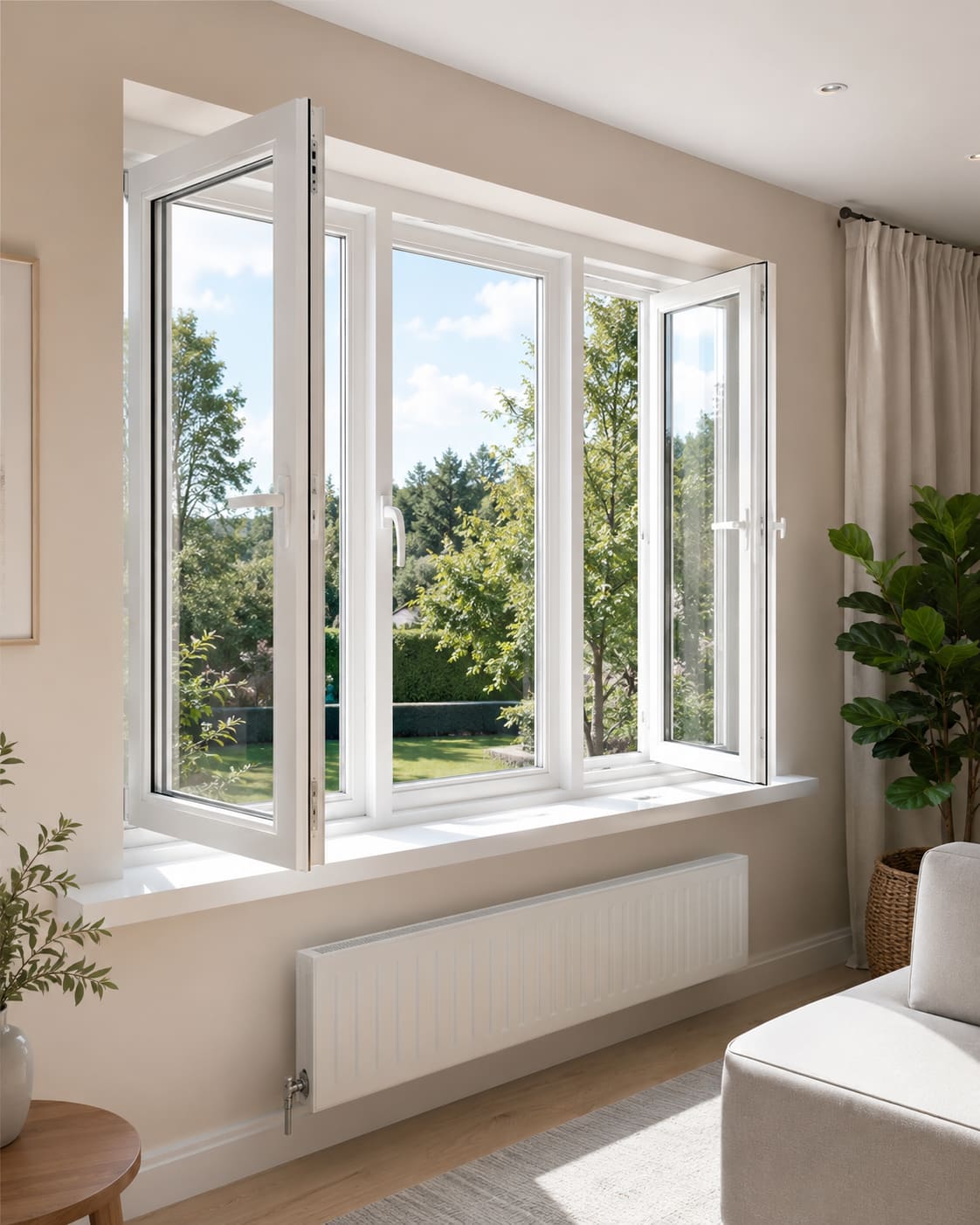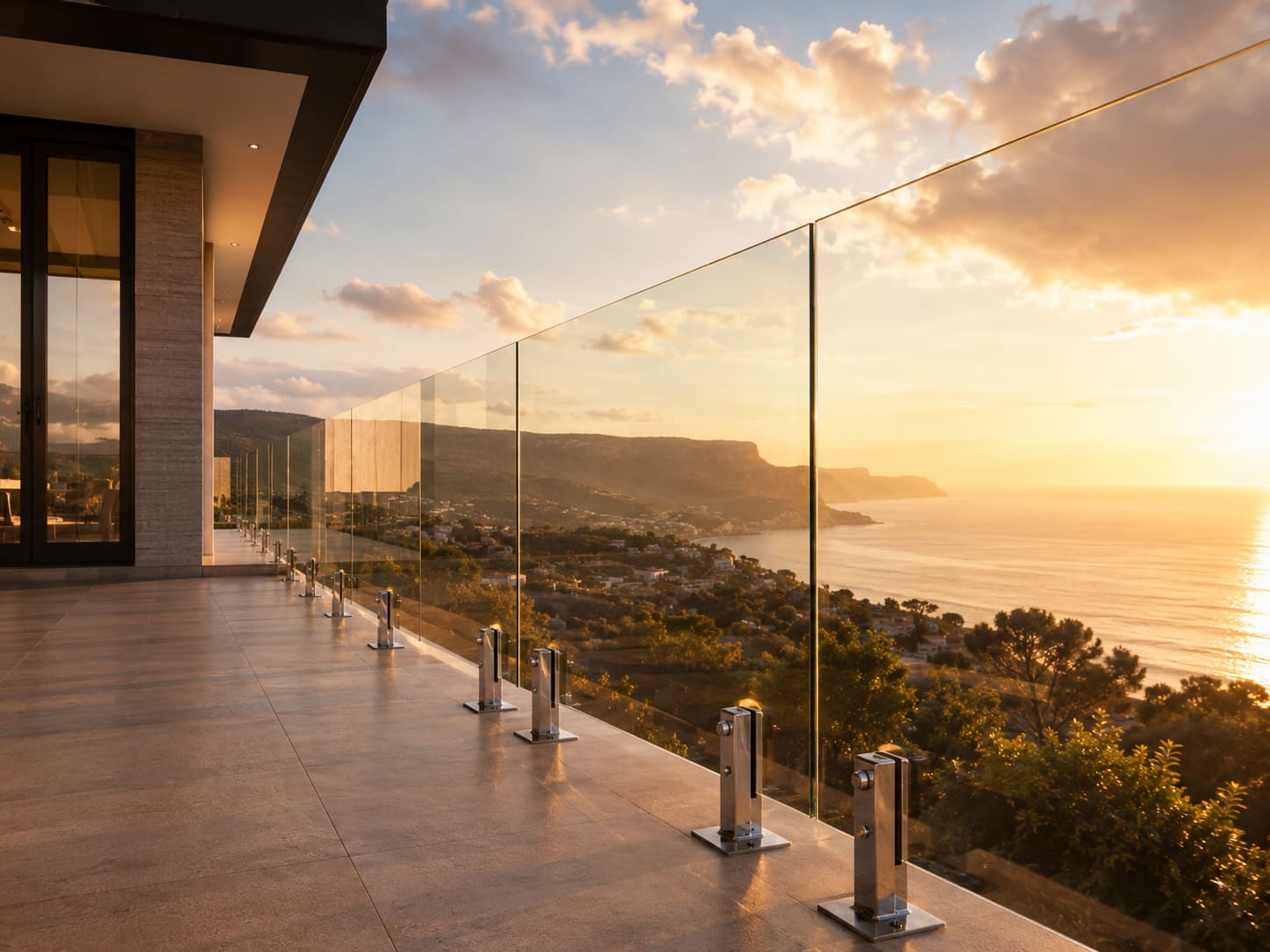
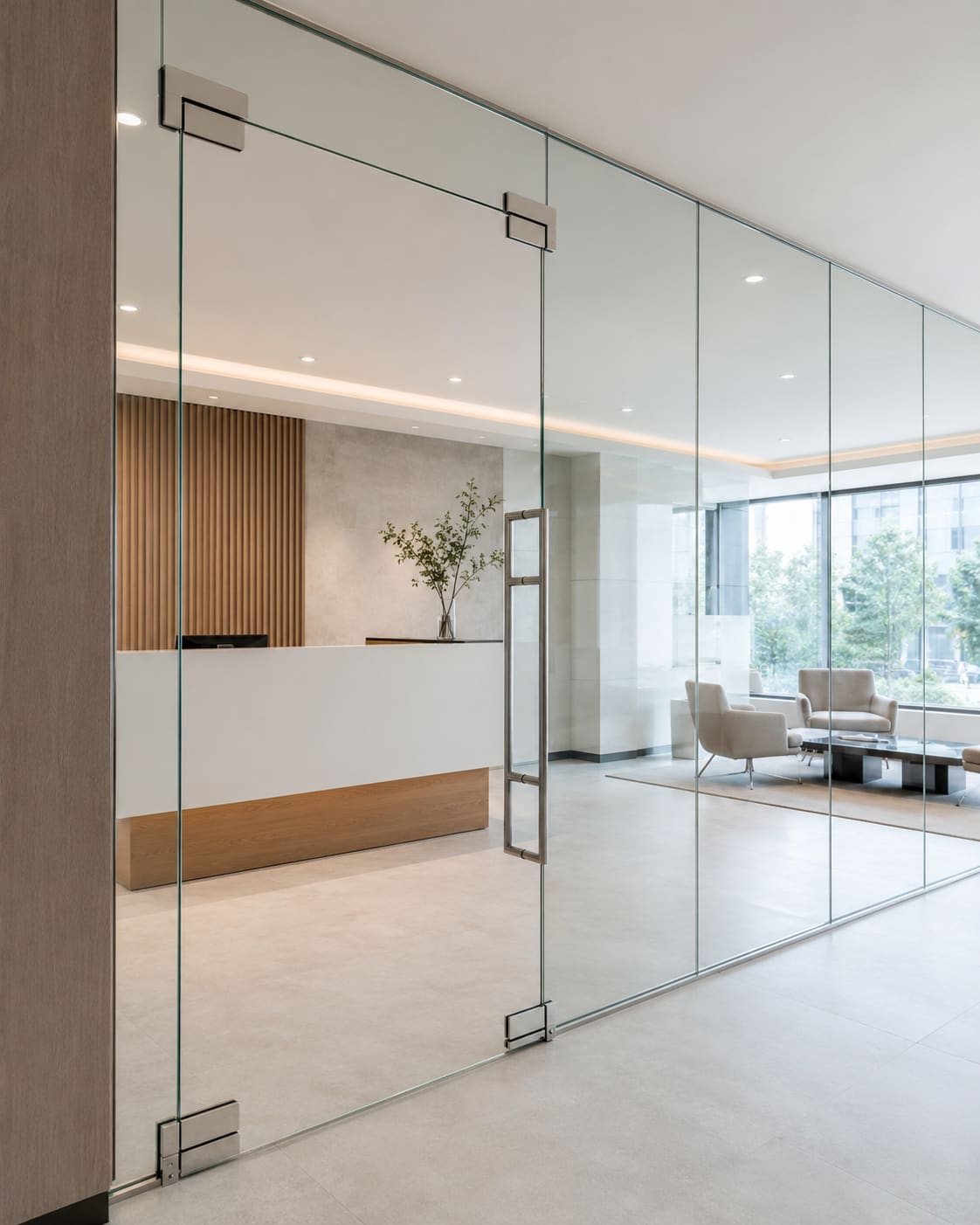
Yes, toughened glass is genuinely safe. It is a heat-treated safety glass that is about 4 to 5 times stronger than ordinary annealed glass of the same thickness, and when it does break it disintegrates into thousands of small, relatively blunt granules rather than long, dagger-like shards. This controlled fracture behaviour is precisely why building codes classify it as "safety glazing" and why it is required in high-risk locations such as doors, low-level windows, shower enclosures, glass railings, facades and shopfronts.
The strength and safe-breakage both come from the manufacturing process. A sheet of float glass is heated to around 620 to 700 degrees Celsius and then rapidly cooled with high-pressure air jets. This locks the outer surfaces into compression while the core stays in tension, storing energy that resists impact and forces the pane to crumble on failure. In India this glass is produced and certified to IS 2553 (Part 1: Architectural), and correct thickness selection for wind and human-impact loads follows IS 875 (Part 3) and the National Building Code of India (NBC) 2016.
For homeowners, architects and builders across Hyderabad, Secunderabad and the wider Telangana and Andhra Pradesh region, the practical question is not really "is it safe?" but "where is it safe, where do I need laminated instead, and what should it cost?" This guide answers all three, drawing on the real specifications we work to every day at Hakimi Aluminium and Glass.
How strong is toughened glass, really?
Toughened glass withstands roughly 4 to 5 times the impact and bending stress of annealed glass of identical thickness, and it tolerates far greater thermal shock. This is not marketing - it is a measurable consequence of the compressive stress locked into its surfaces during tempering.
- Surface compression: certified fully tempered safety glass carries a surface compressive stress of at least 69 MPa (megapascals), the internationally accepted threshold.
- Bending strength: typical design strength is around 120 to 200 MPa, compared with roughly 40 MPa for ordinary annealed glass.
- Thermal resistance: it withstands sudden temperature differentials of about 200 to 250 degrees Celsius, versus only around 40 degrees Celsius for ordinary glass - a real advantage on Hyderabad's west-facing, direct-sun facades.
- It does not soften, sag or warp at normal building temperatures and retains its full rated strength across the service life of the glazing.
In practice this means a properly specified toughened panel shrugs off a slammed door, a knock from furniture, a cricket ball or the daily thermal cycling of a Telangana summer. If you want us to size and supply panels for a specific opening, you can get a free quote with your measurements.
Why the breakage pattern is the real safety feature
The defining safety property of toughened glass is not just its strength but how it fails. When it finally breaks, it shatters into thousands of small cuboidal granules with dull edges instead of long, sharp shards that can cause deep wounds.
- IS 2553 (Part 1) fragmentation test: a fractured 6 mm pane must produce a minimum number of small particles within a 50 mm x 50 mm square, confirming safe crumbling behaviour rather than large sharp fragments.
- Because the granules are blunt and light, they are far less likely to cause the deep lacerations associated with broken annealed glass - which is exactly why toughened glass is mandated in doors, side panels and bathroom enclosures.
- For locations where glass must stay in place even after breaking (overhead glazing, skylights, some balustrades), laminated or laminated-toughened glass is preferred because the interlayer holds the fragments together.
- Important distinction: toughened glass is a safety glass, not a security glass. It resists impact and fails safely, but it is not designed to stop determined forced entry or ballistic threats.
This is why our toughened glass work always starts by matching the glass type to how the panel will behave if it ever fails, not just to how it looks when installed.
The one real weakness: spontaneous breakage
The main genuine limitation of toughened glass is rare spontaneous breakage caused by microscopic nickel sulphide (NiS) inclusions. These tiny impurities can slowly expand over months or years and trigger a fracture with no impact at all.
- Incidence is low - typically on the order of a few panels per thousand - and it is concentrated in the first few years after installation.
- Heat-soak testing (holding panels at about 290 degrees Celsius for several hours) deliberately fails vulnerable panels in the factory before they ship, dramatically reducing in-service breakage risk.
- Specify heat-soaked toughened glass for large facades, overhead glazing, frameless railings and any location where a fall from height or a heavy public footfall is possible.
- Edge and surface damage during transport or handling can also cause later failure, so panels arriving on site with chipped or nibbled edges should be rejected outright.
For any elevated or public application, we recommend heat-soaked glass and careful edge protection - the small premium is trivial compared with the cost and risk of a panel failing above head height.
Toughened glass price in Hyderabad: an indicative breakdown
Toughened glass in Hyderabad is priced per square foot, and the total you pay is glass cost plus fabrication, hardware and installation. Understanding the split helps you compare quotes fairly instead of chasing the lowest headline rate.
- Plain clear toughened glass (8-12 mm): approximately Rs 130 to Rs 250 per sq ft supplied, depending on thickness and brand.
- Tinted, frosted or reflective toughened glass: roughly Rs 180 to Rs 350 per sq ft.
- Laminated-toughened glass (e.g. 13.52 mm for railings): about Rs 350 to Rs 600 per sq ft.
- Cut-outs, holes, notches and edge polishing: often Rs 100 to Rs 500 per panel depending on complexity, because all of it must be done before tempering.
- Hardware (spider fittings, patch fittings, SS standoffs, sliding kits) and installation are charged separately and frequently rival the glass cost on frameless work.
As a rough guide, a completed frameless glass railing using 12 mm toughened glass with stainless standoffs commonly lands between Rs 550 and Rs 1,200 per running foot in the Hyderabad and Secunderabad market, and a walk-in shower enclosure in 10 mm toughened glass often falls between Rs 18,000 and Rs 40,000 depending on size and hardware. Prices move with raw-glass rates, so treat these as planning figures and confirm with a current quote.
Thickness, sizing and correct specification
Toughened glass thickness is chosen by calculation, not habit. The right number depends on pane size, wind load and application, using IS 875 (Part 3) for wind pressure and the relevant human-impact provisions of NBC 2016.
- Common architectural thicknesses: 4, 5, 6, 8, 10, 12, 15 and 19 mm.
- Shower screens and internal partitions: typically 8 to 10 mm toughened.
- Glass railings and balustrades: usually 12 mm toughened, or 13.52 mm laminated-toughened where the code requires post-breakage retention.
- Structural facades and large spans: 10 to 19 mm, often as double-glazed or laminated units, with structural silicone glazing designed to recognised standards.
- Critical rule: cutting, drilling, notching and edge polishing must all be completed before tempering, because toughened glass will shatter if it is worked afterwards.
This last point trips up many first-time buyers. If a hole for a lock or a hinge is forgotten, the entire panel has to be re-made - there is no field modification. Accurate site measurement before ordering is the single biggest factor in avoiding costly re-fabrication. You can see how we specify this across real installations in our recent projects.
Toughened vs laminated: which is safer for what
Toughened and laminated glass solve different safety problems, and the safest choice depends on whether broken fragments should fall away or stay in place. They are complementary, not competitors.
- Toughened glass: highest impact and thermal strength, crumbles into blunt granules, ideal for doors, windows, shower screens and shopfronts.
- Laminated glass: two or more plies bonded by a PVB or SGP interlayer; on breakage the fragments cling to the interlayer, ideal for overhead glazing, skylights and fall-protection.
- Laminated-toughened combines both: tempered strength plus fragment retention, the preferred specification for frameless railings, glass floors and glass canopies.
- Both qualify as safety glazing under NBC 2016 when correctly selected for the location, so the decision is about consequence-of-failure, not prestige.
The simple rule we use: if a person could fall through the glass, or the glass is above people's heads, laminated or laminated-toughened is the safer answer. Everywhere else, plain toughened is usually the right, cost-effective choice.
Installation, timeline and process
A safe toughened glass job is as much about process as about the glass itself. Getting the sequence right prevents both breakage and the expensive re-orders that come from mistakes made after tempering.
- Survey and measure: accurate site measurement of openings, levels and hardware positions, ideally after civil and tiling work is complete.
- Design and cutting list: finalise sizes, cut-outs, holes and edgework, since none of it can be changed later.
- Toughening (and heat-soaking where specified): panels are heat-treated and, for critical applications, heat-soak tested.
- Delivery and inspection: every panel is checked for edge chips, bow and surface defects before it goes up.
- Installation: framing, fittings or standoffs are fixed, panels set with correct edge clearance and setting blocks, and joints sealed.
For a typical residential job in Hyderabad - a shower enclosure or a balcony railing - expect roughly 5 to 10 working days from confirmed measurement to installation, most of which is the toughening lead time. Larger facades run longer. You can browse the full range in our services to see how each application is handled.
Common mistakes to avoid
Most toughened glass problems trace back to a handful of avoidable errors, not to the glass being unsafe. Knowing them upfront protects both your budget and your safety.
- Skipping heat-soak testing on elevated or public glass, then paying far more when a NiS-induced panel fails later.
- Ordering before every hole and cut-out is confirmed, forcing a full re-make because toughened glass cannot be drilled afterwards.
- Under-specifying thickness for large or wind-exposed panels instead of calculating to IS 875 (Part 3).
- Accepting panels with chipped or damaged edges - edge damage is a leading trigger of later breakage.
- Using plain toughened where laminated is required (overhead glazing, fall-protection railings), which meets the look but not the safety intent of the code.
- Fitting glass directly against metal or masonry with no setting blocks or edge clearance, creating point loads that cause cracks over time.
Every one of these is easy to avoid with a proper survey and an experienced fabricator. In the Telangana and Andhra Pradesh climate, where facades face intense summer heat and monsoon wind loads, getting the specification right the first time is what keeps toughened glass performing safely for decades.