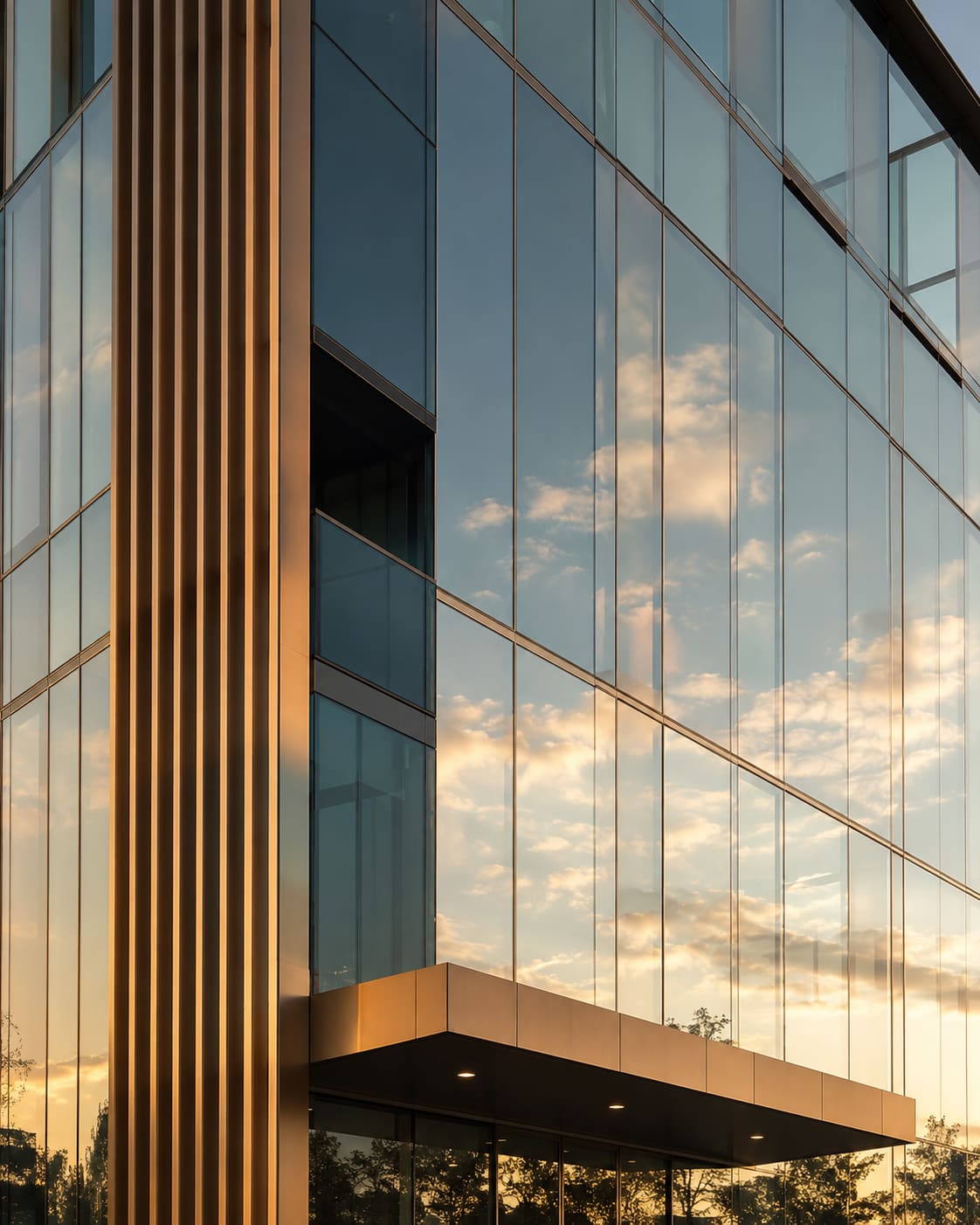
The payback period for solar control glass is typically 3 to 7 years in Indian conditions, recovered through the electricity saved on air-conditioning once the glass reduces solar heat gain into the building. This period is simply the time for cumulative cooling-energy savings to equal the extra cost of the glass over ordinary clear float glass, and it depends chiefly on the glass Solar Heat Gain Coefficient (SHGC), the local electricity tariff, the number of annual cooling hours, and the glazed area exposed to sun. In Hyderabad's hot, sun-heavy climate, well-oriented commercial facades commonly reach the shorter 3-5 year end of that range.
Solar control glass carries a coating (typically pyrolytic hard-coat or magnetron-sputtered soft-coat low-E silver layers) that reflects and absorbs a large share of near-infrared solar radiation while still admitting useful visible daylight. In hot climates such as Hyderabad and Secunderabad, this lowers the peak cooling load and the connected HVAC tonnage, so the return comes not only from lower monthly running costs but sometimes from installing a smaller, cheaper chiller or split-AC system in the first place.
This guide walks through exactly how the payback is calculated, what makes it faster or slower, the Indian codes that apply, a worked example for a real Hyderabad office, and the value that keeps compounding for 15+ years after the glass has paid for itself. If you are weighing a reflective glass facade or a full DGU facade for a project here, these numbers give you a defensible business case.
How is the payback period calculated?
Payback period equals the extra cost of solar control glass divided by the annual cooling-energy cost it saves. Everything else is detail feeding those two numbers. The core variables are:
- Cost premium: the price difference over clear glass, roughly INR 250-800 per sq ft of glazing depending on single-silver, double-silver, or triple-silver low-E coating and single-pane versus insulated unit.
- SHGC reduction: clear glass admits about 78-82% of incident solar heat (SHGC 0.78-0.82); solar control glass admits only 25-45% (SHGC 0.25-0.45), a swing of roughly half.
- Cooling hours: Hyderabad sees roughly 2,000-2,500 air-conditioned hours per year across a long March-to-October summer, so heat rejected by the glass is being paid for by the chiller most of the year.
- Electricity tariff: commercial tariffs in Telangana run about INR 7-10 per kWh, which linearly scales the rupee value of every kWh saved.
A simplified working estimate: each sq ft of west or south glazing in Hyderabad can save 15-30 kWh per year of cooling energy, worth roughly INR 120-270 annually, recovering a typical premium in about 3-6 years. Because the maths is dominated by orientation and SHGC, the same glass on a shaded north wall may take twice as long to pay back as it does on a blazing west elevation. A quick facade consultancy review of your specific elevations sharpens these assumptions before you commit.
What drives a faster or slower payback?
Payback is fastest on large, sun-exposed, air-conditioned facades and slowest on small, shaded, or naturally ventilated openings. The main levers, in rough order of impact:
- Orientation: east and west facades receive intense low-angle morning and evening sun that side-lights straight through glass, so they return the investment fastest; north glazing saves the least in Hyderabad.
- Window-to-Wall Ratio (WWR): a higher glazed area multiplies both the overheating problem and the savings, which is why glassy towers in Hitec City benefit most.
- Coating grade: double-silver low-E (SHGC around 0.27 with a Light-to-Solar-Gain ratio above 1.7) rejects far more heat while keeping daylight than a basic single-silver body-tinted product.
- Insulated glass units: a double-glazed low-E IGU with a U-value near 1.6-1.8 W/m2K cuts both radiant and conductive gain, deepening savings, especially where the AC runs long hours.
- HVAC downsizing: cutting peak load can shrink the installed tonnage, delivering an immediate first-cost credit that effectively shortens payback before a single utility bill arrives.
In practice the difference between the best and worst case on a single building is huge. A west-facing curtain wall in Kokapet with 70% WWR and double-silver glass may pay back in under three years, while a shaded north stairwell window may never justify the premium on energy alone, and is chosen for comfort or code instead.
Which standards and codes apply in India?
Solar control glazing in India is governed primarily by the Energy Conservation Building Code (ECBC) and the National Building Code of India (NBC) 2016, along with several material and safety standards your fabricator must respect. The references that matter:
- ECBC prescribes maximum facade SHGC and U-value tiers by WWR and climate zone (Hyderabad sits in the Composite/Hot zone), so large glazed commercial buildings often cannot comply without solar control glass.
- Bureau of Energy Efficiency (BEE) star ratings and BEE-labelled glass help quantify a product's SHGC and U-value for documentation and compliance.
- IS 2553 covers safety (toughened and heat-strengthened) glass, which most facade solar control glass is processed to; see our toughened glass work for how the coating survives tempering.
- IS 875 Part 3 governs wind-load design for the glazing and its framing, critical for high-rise elevations exposed to monsoon gusts.
- IS 14900 covers transparent float glass specifications used as the base substrate before coating.
- ASTM C1401 is the standard guide for structural sealant (silicone) glazing where the glass is bonded into a structural glazing curtain wall.
Getting the compliance paperwork right is not just bureaucracy: BEE-labelled SHGC values are what a green-building assessor and the local sanctioning authority will actually check against your ECBC calculation.
Worked example for a Hyderabad office
For a typical 1,000 sq ft Hyderabad office facade, solar control glass can pay back in roughly 3-5 years. Here are illustrative figures you can adapt to your own drawing:
- Glazed area: 1,000 sq ft, predominantly west-facing and air-conditioned during working hours.
- Cost premium over clear glass: about INR 400 per sq ft, so INR 4,00,000 extra on the glass line item.
- Annual cooling energy saved: about 20 kWh per sq ft, giving 20,000 kWh a year off the chiller.
- Value of savings at INR 8 per kWh: INR 1,60,000 per year.
- Simple payback: INR 4,00,000 divided by INR 1,60,000 equals roughly 2.5 years, before even counting the reduced HVAC first cost.
Add the downsized AC and the number improves further; ignore shading and the number worsens. Actual results vary with occupancy hours, coating grade, and how much external shading the elevation already has, but sun-exposed Hyderabad facades in Gachibowli, Madhapur and Kondapur commonly land in the 3-5 year band. You can see the kind of glazing this applies to across our completed projects, and the same logic scales to a front elevation glazing job on a showroom or a full tower curtain wall.
How does Hyderabad's climate change the numbers?
Hyderabad's climate shortens solar control glass payback compared with cooler Indian cities because the cooling season is long, the sun is strong, and the AC runs hard for most of the year. Three local factors dominate:
- Heat and long summers: from March to October, dry-bulb temperatures routinely cross 38-42 degrees C, meaning any square foot of hot glass is fighting the chiller for eight months, not two.
- Intense solar radiation: at Hyderabad's latitude the sun is high and clear-sky irradiance is severe, so a low-SHGC coating rejects a large absolute quantity of watts, not just a percentage.
- Monsoon dust and humidity: the July-September monsoon brings dust films and high humidity; solar control coatings sealed inside an IGU stay clean and stable, while the reduced heat gain also eases the latent load the AC must remove.
The practical takeaway for Financial District and Kokapet developers is that the ROI case here is stronger than the pan-India 3-7 year average implies. The same glass specified for a Bengaluru or Pune facade, where cooling hours are fewer, will pay back more slowly, so do not borrow their payback assumptions wholesale for a Telangana project.
Which glass and system should you specify?
The right specification balances SHGC, daylight, appearance and budget rather than simply chasing the lowest SHGC. A sensible decision path:
- For daylight-hungry offices, choose a double-silver low-E with high Light-to-Solar-Gain ratio so you keep visible light while rejecting heat, avoiding the cave-like feel of heavy body tints.
- For west and south blast walls, prioritise the lowest practical SHGC, and consider an IGU / DGU facade to add a conductive barrier on top of the coating.
- For showrooms and retail fronts that need clarity, a neutral high-performance coating on a reflective glass facade keeps merchandise visible while cutting glare.
- Where the glass is bonded into a bespoke curtain wall, coordinate the coating with the structural glazing or curtain wall glazing system so silicone compatibility and edge-deletion are handled correctly.
- Do not forget the frame: pairing high-performance glass with thermal break aluminium prevents the aluminium from conducting heat around the coating you just paid for.
Specifying blindly for the lowest SHGC can cost daylight and force more artificial lighting, quietly eroding the very energy savings you are chasing. A short conversation about orientation, WWR and use pattern usually points to one or two ideal products.
What value comes after the payback period?
Solar control glass keeps delivering returns for well beyond the metered energy payback, across its 20-25 year functional coating life. The additional value stack:
- Occupant comfort and reduced glare, cutting perimeter overheating so the space right next to the glass becomes usable floor area rather than a hot zone people avoid.
- Reduced interior fading, as the coating also trims transmitted heat and a share of UV that bleaches furnishings and merchandise.
- Lower peak demand charges, which matter on commercial tariffs with demand-based (kVA) billing, not just energy (kWh) billing.
- Compliance and green-building credits under ECBC, IGBC and GRIHA rating systems, which can lift asset value and rentability.
Because the glass typically outlasts its payback period several times over, the remaining 15-plus years of cooling savings are effectively net-positive return, plus the comfort and compliance benefits that never show up on the electricity bill at all. When you are ready to put real numbers against your elevations, get a free quote and we will size the premium, the SHGC and the payback for your specific building.