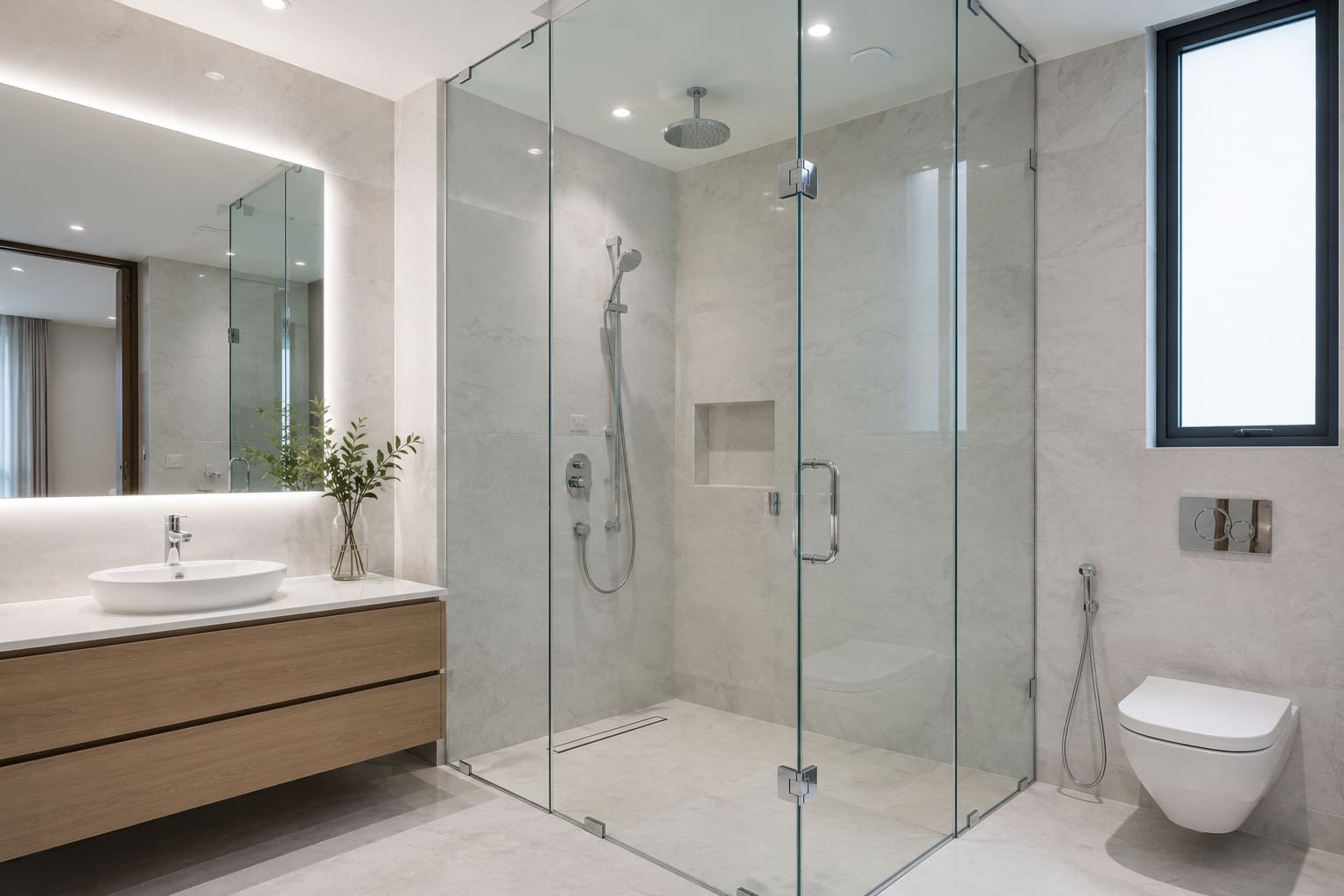
Shower glass safety standards require the use of toughened (tempered) safety glass, typically 8mm to 12mm thick and conforming to IS 2553 Part 1 in India, so that if the panel breaks it disintegrates into small, blunt, relatively harmless granules rather than large sharp shards. Ordinary annealed float glass is not permitted for any shower screen, door or enclosure because it fractures into dagger-like pieces that cause serious laceration injuries. Beyond the glass itself, a compliant enclosure demands corrosion-rated hardware, correct hinge and clamp placement, polished edges, and heat-soak testing to reduce the risk of spontaneous breakage. If you are specifying a frameless shower enclosure for a home or hotel project, these are the non-negotiables to check before you pay.
In India, shower glass falls under the safety glazing provisions of the National Building Code of India (NBC) 2016, which references IS 2553 for toughened safety glass, while globally the equivalents are EN 12150 (Europe) and ANSI Z97.1 with 16 CFR 1201 (USA). These standards govern minimum thickness, edge treatment, fragmentation behaviour and mandatory permanent marking. Because Hyderabad, Secunderabad and the wider Telangana region see hard water, 40-plus degree summers, dust and heavy daily bathroom use, correct thickness, quality toughened glass work and heat-soak testing matter as much for long-term durability as for injury prevention.
This guide breaks down exactly what compliance looks like in the field: which glass is mandatory, the right thickness for each enclosure type, the lab tests behind the certification stamp, the hardware that keeps a heavy pane safely in place, and realistic INR pricing for Gachibowli, Kokapet, Madhapur and Financial District projects.
Which glass type is mandatory for showers?
Only toughened (tempered) or laminated safety glass may be used for shower enclosures; annealed and ordinary float glass are prohibited. Toughened glass is heated to roughly 620 to 650 degrees Celsius and rapidly quenched with jets of cold air, placing the surfaces in compression and the core in tension. That locked-in stress makes it far stronger than ordinary glass and, crucially, changes how it fails: instead of cracking into blades, it dices into thousands of small cuboidal granules.
- Toughened glass: 4 to 5 times stronger than annealed glass; shatters into small blunt granules; the standard choice for shower screens and doors.
- Laminated glass: two glass layers bonded by a PVB interlayer that holds fragments in place; used where fall-through risk exists, such as overhead panels or steam-room roofs.
- Annealed / ordinary float glass: NOT permitted for showers because it breaks into large, sharp, dagger-shaped shards.
- Applicable standards: IS 2553 Part 1 (India), EN 12150 (Europe), ASTM C1048 and ANSI Z97.1 (USA).
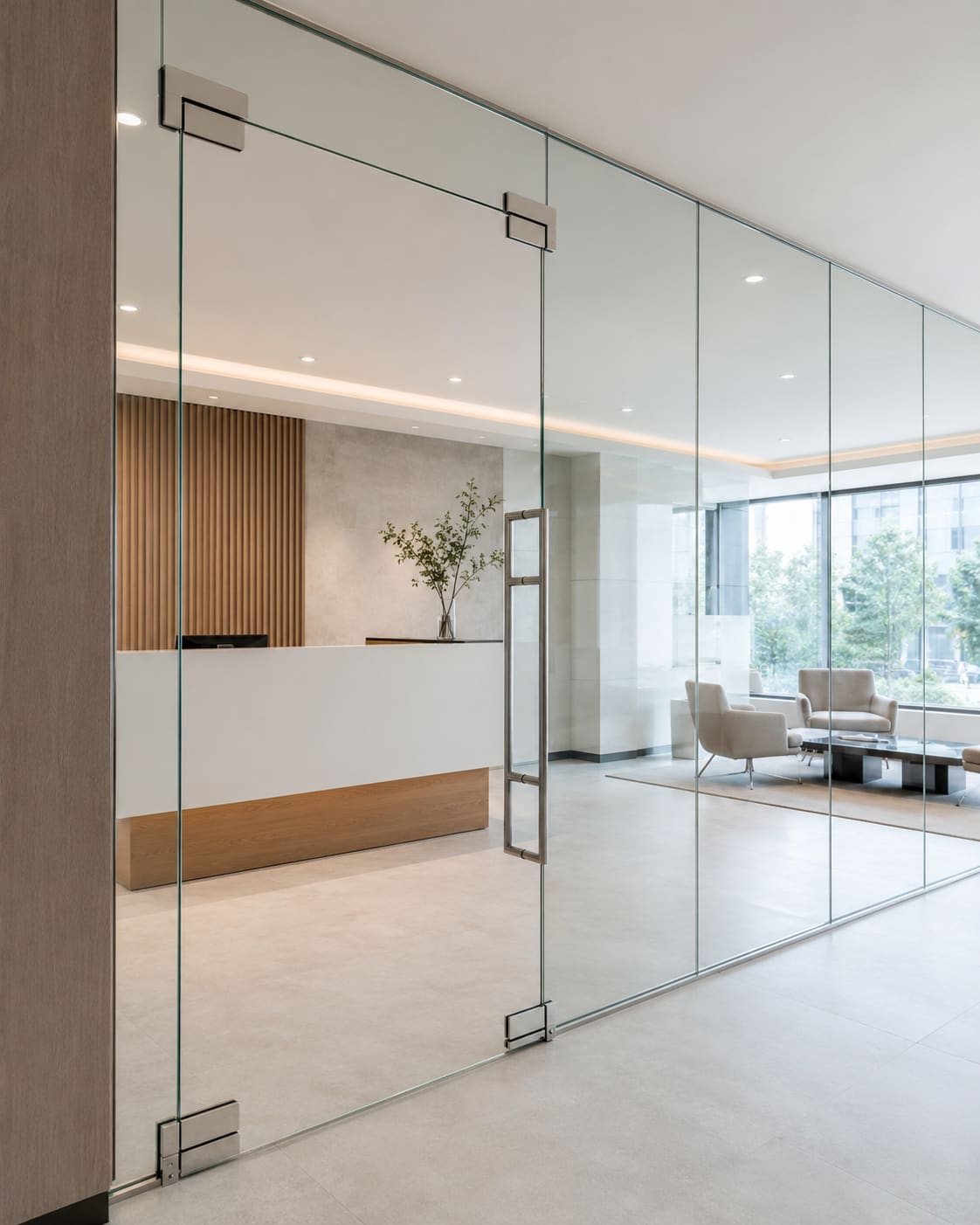
The same toughened-glass logic applies across bathroom and interior glazing, which is why toughened glass doors and glass partitions in wet or high-traffic zones follow identical material rules.
What thickness of shower glass do I need?
Shower glass thickness is dictated by the framing system: frameless enclosures require 10mm or 12mm toughened glass, while framed and semi-frameless units may use 8mm. Thicker glass resists deflection, feels reassuringly rigid when the door swings, and carries the weight of hinges and clamps without concentrating stress at the fixing points.
- Frameless shower doors and enclosures: 10mm or 12mm toughened glass.
- Semi-frameless enclosures: 8mm to 10mm toughened glass.
- Framed shower screens: 6mm to 8mm toughened glass (6mm only in fully framed, channel-supported systems).
- Fixed splash panels and small screens: 8mm minimum for a rigid, stable panel that does not flex when wiped.
- Any panel over 0.5 sq m in a door position should be safety glazed per NBC 2016.
For tall enclosures above 2.1 metres, walk-in wet rooms, or wide sliding doors, go with 12mm. The extra rigidity keeps a large pane from bowing and protects the drilled hinge holes from long-term fatigue. If you are choosing between a swing door and a space-saving runner system, our sliding shower enclosure and semi-frameless options each have a recommended minimum thickness that installers should confirm in writing.
The fragmentation and strength tests explained
Certified shower glass must pass a fragmentation test proving that a broken pane crumbles into small blunt particles, not sharp splinters. Under IS 2553 and EN 12150, a sample panel is deliberately broken with a sharp punch and the particle count is assessed inside a 50mm x 50mm square placed on the broken glass, away from the point of impact and the edges.
- Fragmentation: a minimum of around 40 particles must form within a 50mm x 50mm square, with a limit on the maximum length of any single fragment.
- Surface compression: typically 69 MPa or higher, which is what gives toughened glass its four-to-five-times strength advantage.
- Impact test: ANSI Z97.1 and 16 CFR 1201 use a drop-bag impact test; Category II safety glass withstands a 400 ft-lb impact without dangerous failure.
- Heat-soak test: recommended to EN 14179, holding the glass at around 290 degrees Celsius to force flawed panels to fail in the factory rather than in your bathroom.
These are laboratory type-tests carried out on production samples, not something you can perform on site. What you can do is insist on documentation and the permanent stamp, which is your proof the glass came from a batch that passed.
How do I check the certification and marking?
Genuine safety glass carries a permanent, etched or sandblasted stamp in a corner identifying the standard and manufacturer; unmarked glass should be rejected outright. This mark is fired or blasted into the surface, so it cannot be washed off or peeled away like a sticker, and it is your single most reliable field check for compliance.
- The stamp typically shows the standard (for example IS 2553, EN 12150, or ANSI Z97.1), the maker's name, and the glass type or thickness.
- In India, look for BIS certification and the ISI mark referencing IS 2553.
- Edges must be ground and polished (flat-polished or pencil-polished) so there are no stress-raising chips or nibbles that can trigger cracks.
- Holes and cut-outs for hinges must be made before toughening; toughened glass cannot be cut or drilled afterward without shattering the entire pane.
A common Hyderabad market shortcut is selling ordinary annealed glass with a fake or sticker mark at a lower rate. Ask to see the toughening or heat-soak test certificate for your batch, and if a supplier cannot produce a permanently etched stamp, walk away. You can see how we document compliant enclosures in our completed projects.
Hardware, installation and clearances
Safe shower glass performance depends as much on rated hardware and correct installation as on the pane itself. Hinges, clamps and channels must be sized for the glass weight and anchored into solid substrate, using proper wall plugs and, where possible, backing behind the tile, rather than relying on a hollow tile bed alone.
- Use stainless steel (SS 304, or SS 316 for constantly wet zones) hinges, clamps and spigots to resist corrosion from Hyderabad's hard, mineral-heavy water.
- Maintain a small expansion gap and use a continuous neutral-cure silicone sealant of a recognised weatherproofing grade.
- Shower doors should open outward or both ways so an occupant is never trapped inside if they slip and fall against the door.
- Glass-to-glass and glass-to-wall gaps are kept minimal and sealed to prevent leakage while still allowing slight thermal movement.
- Self-closing hydraulic hinges should return the door to the closed position gently, without slamming the glass against the jamb.
Poor anchoring is the most common failure we are called to fix in the twin cities. A perfectly certified 12mm panel is still dangerous if its clamps are screwed into crumbling tile adhesive. Insist your installer confirms the fixing method, especially in older Secunderabad apartments where wall build quality varies.
Why does the Hyderabad climate change your specification?
Local conditions in Telangana and Andhra Pradesh push you toward the safer end of every choice. The region's hard water leaves stubborn mineral scale on glass, high summer temperatures and daytime-to-night swings stress the pane and its seals, and monsoon humidity accelerates corrosion of anything but quality stainless steel.
- Hard water staining: within months, untreated glass in Gachibowli, Kondapur and Hitec City homes develops a milky mineral film that etches the surface if not wiped and treated.
- Heat and thermal cycling: bathrooms on west-facing walls can get very hot, so heat-soaked toughened glass is a sensible insurance against spontaneous breakage.
- Humidity and corrosion: monsoon dampness rusts cheap hinges, which is exactly why SS 316 is worth the premium near constant water contact.
- Dust: fine construction and road dust in fast-developing areas like Kokapet and the Financial District settles into tracks and hinges, so choose hardware that is easy to clean.
An anti-hard-water nano coating is one of the highest-value add-ons in this market: it seals the microscopic pores in the glass so scale wipes off instead of bonding. The same durability thinking carries into our aluminium doors and windows and other wet-exposed glazing across the twin cities.
What does a compliant shower enclosure cost in Hyderabad?
A compliant frameless toughened shower enclosure in Hyderabad and Secunderabad typically costs INR 550 to INR 1,200 per square foot, with 12mm frameless systems and premium SS 316 hardware sitting at the top of that range. A correctly toughened and heat-soaked enclosure with quality fittings lasts 15 to 20 years or more, so the small premium for doing it right is easily justified over the life of the bathroom.
- 8mm framed / semi-frameless: approximately INR 400 to INR 700 per sq ft installed.
- 10mm frameless: approximately INR 650 to INR 950 per sq ft installed.
- 12mm frameless with premium hardware: approximately INR 900 to INR 1,200 per sq ft installed.
- Anti-hard-water nano coatings: roughly INR 40 to INR 90 per sq ft, reducing the mineral staining common in local water.
- Frosted, tinted or fluted specialty finishes and custom cut-outs add to the base rate.
Prices vary with panel size, the number of hinges and clamps, glass finish and site access. For a firm figure on your bathroom, send dimensions and a photo and we will get you a free quote; you can also compare finish options through our specialty glass range if you want frosted or tinted privacy panels.
Common mistakes and how to avoid them
Most unsafe shower installations we encounter fail on one of a handful of predictable points. Knowing them lets you brief your contractor precisely and inspect the finished job with confidence.
- Accepting unmarked glass: no permanent etched stamp means no proof of toughening. Reject it.
- Under-speccing thickness: 8mm on a tall frameless door will flex and stress the hinge holes; use 10mm or 12mm.
- Cheap hinges: mild steel or low-grade fittings rust and stain within a monsoon or two in this climate.
- Drilling on site: any attempt to cut or drill a toughened pane after manufacture destroys it; all holes must be pre-fabricated.
- Skipping heat soak: for large or west-facing enclosures, unheat-soaked glass carries a small but real spontaneous-breakage risk.
- Poor sealing and slope: water that pools or leaks damages surrounding joinery and voids the neat frameless look you paid for.
Handled by an experienced fabricator, none of these are difficult to get right. The difference between a bargain job and a compliant one is usually a few hundred rupees per square foot and a supplier willing to show their certification.