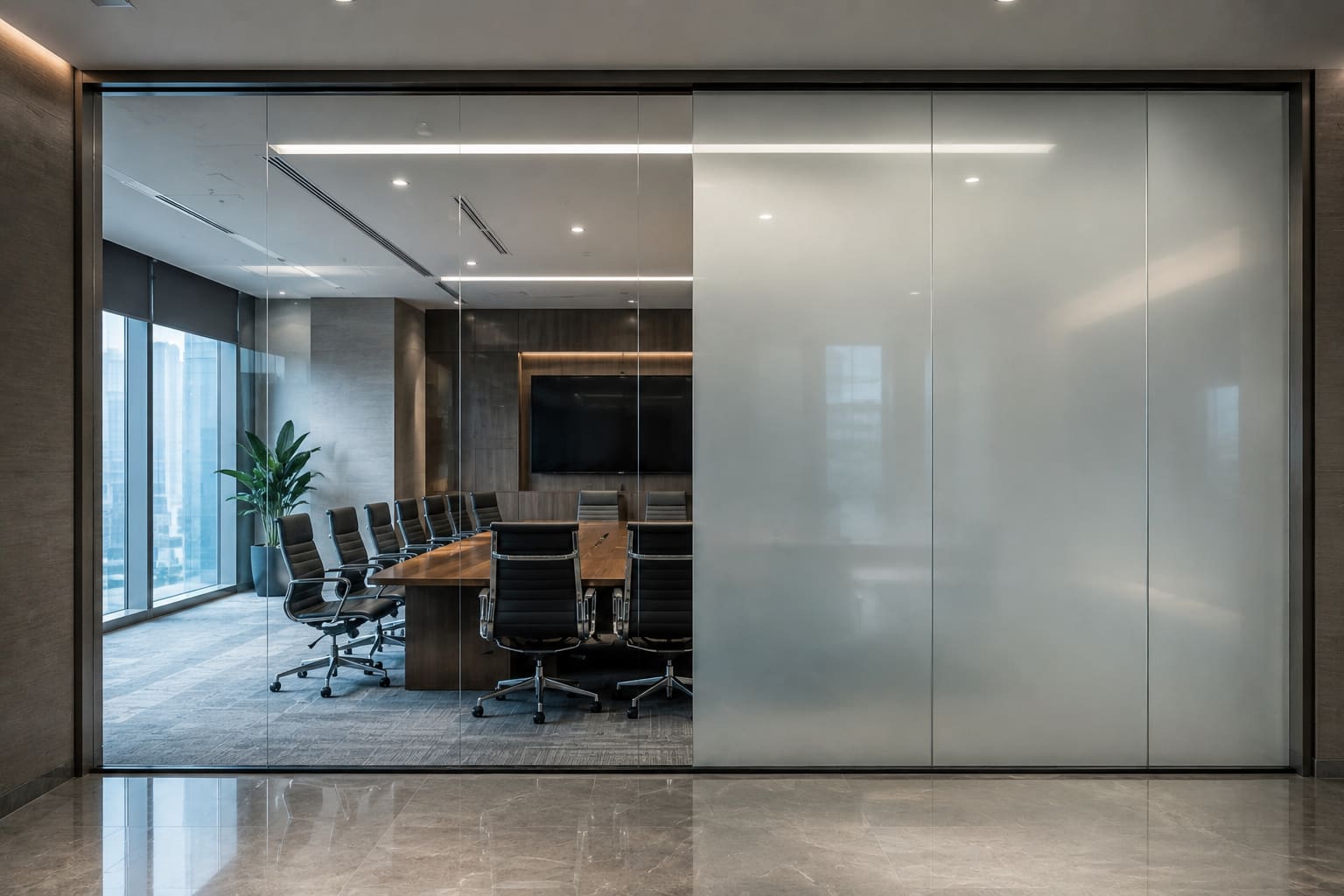
Smart glass explained simply: it is a single pane that switches from frosted-opaque to crystal-clear the instant you flip a switch. The technology behind almost every Indian installation is called PDLC, short for Polymer Dispersed Liquid Crystal. There are no blinds, no curtains and no moving parts, just a low-voltage electrical current that rearranges microscopic liquid crystals inside a film buried in the glass. Cut the power and it defaults back to a private, frosted white.
For homes, clinics, showrooms and offices across Hyderabad, Secunderabad and the wider Telangana and Andhra Pradesh region, PDLC has moved from a novelty to a genuinely practical privacy and design tool. It solves a real problem here: fabric blinds trap the fine dust that blows in during the dry months and sag in monsoon humidity, while a switchable pane wipes clean in seconds. This guide breaks down exactly how PDLC works, where it earns its keep, the mistakes to avoid, and what you should realistically budget in INR before booking a site measurement for our smart glass service.
What Is PDLC Smart Glass, Exactly?
PDLC smart glass is a laminated pane with a switchable film at its core. That film is a wafer-thin layer sandwiched between two sheets of glass, or bonded onto one. Inside it, millions of tiny liquid-crystal droplets sit suspended in a clear polymer, like specks floating in set jelly. Two ultra-thin transparent conductive coatings on either side of the film carry a low-voltage current across it.
In every other respect the sandwich behaves like ordinary toughened or laminated safety glass. It is rigid, holds together if broken, and can be built as a double-glazed or acoustic unit. The switchable magic is purely down to that internal film; the glass around it is standard architectural glazing you would recognise from any quality glass partition job.
Two thin electrical tails, usually tucked into the frame or a channel, run from the film's coatings to a small controller. That is the entire system: glass, film, wires, controller. There is nothing mechanical to jam, wear out or collect dust.
How Does the Frosted-to-Clear Switch Actually Work?
The switch works by aligning or scattering the liquid crystals inside the film. It is genuinely simple once you picture the droplets.
When the power is OFF, the liquid-crystal droplets point in random directions. Light hitting the pane scatters every which way, so the glass looks milky and frosted and you get full visual privacy. When you switch the power ON, the current lines all those droplets up in the same direction. Light now passes straight through and the glass turns transparent, typically in under a second.
The facts worth remembering before you specify a system:
- PDLC needs power to stay CLEAR. It defaults to frosted when off, so a power cut simply gives you privacy, never accidental exposure.
- It runs on low-voltage AC, usually 48V to 65V, delivered by a small transformer or controller. It is never wired straight to mains voltage.
- Switching is instant and can be triggered from a wall switch, remote, smartphone app or a building-management system.
- Power draw is modest, roughly 5 to 7 watts per square metre, and only while the pane is held clear. Left frosted, it draws nothing.
- The film blocks a useful share of UV, which helps protect furniture and flooring from fading in strong Deccan sunlight.
Where Does Smart Glass Make Sense in Hyderabad Homes and Offices?
PDLC shines wherever you want privacy on demand without giving up daylight. Across our Telangana and AP projects, the recurring winners are:
- Conference and boardroom partitions that frost instantly for a confidential meeting, then clear to feel open again. This pairs naturally with meeting-room glass and MD cabin glazing in Financial District and Hitec City offices.
- Clinic, ICU and consultation rooms where hygiene rules out fabric blinds and staff need instant privacy for a patient.
- Master-bath and bedroom glass in premium apartments and villas around Kokapet, Narsingi and Gachibowli, including frameless shower enclosures that turn opaque on demand.
- Retail and showroom displays in Banjara Hills and Jubilee Hills that reveal or conceal products on a timer or for launch events.
- Balcony, pooja-room and staircase screens where hanging curtains just gather the city's dust.
Because there are no slats or fabric, PDLC wipes clean with a damp cloth and copes with Hyderabad's dusty, humid climate far better than traditional blinds. In open-plan offices around Madhapur and Kondapur it also lets you split space without building permanent walls, which keeps floor plates flexible and daylight flowing. If your priority is acoustic separation as well, we can build the switchable pane into an acoustic glass partition so it dampens sound while it manages sightlines.
Ready-Made Switchable Glass vs Retrofit PDLC Film
There are two ways to get PDLC into your space, and choosing correctly saves both money and disappointment.
Factory-laminated switchable glass is the premium route. The film is laminated between two glass panes under heat and pressure in controlled conditions, giving the clearest optics, the longest life and the best edge sealing. It is the right choice for new partitions, shopfronts and anything you want to last a decade or more. We supply this as part of our dedicated PDLC smart glass work.
Retrofit self-adhesive PDLC film is applied onto the surface of glass you already own. It is far cheaper and quick to fit, which makes it attractive for existing cabins or rented offices. The trade-offs: optics are slightly less crisp, the exposed edge needs careful sealing against Hyderabad humidity, and lifespan is shorter than a laminated unit. For temporary fit-outs or a fast upgrade our switchable smart film option is a sensible middle ground.
As a rule of thumb: specify laminated glass for anything permanent, wet, or where clarity really matters, and consider film only where budget or speed dominates and the glass is already in place.
What PDLC Smart Glass Does NOT Do
Managing expectations here prevents the most common regret. PDLC is a privacy product first and foremost, not a shading or blackout product.
- It is not a blackout. Frosted PDLC blocks sightlines but still transmits plenty of diffused light, so a bright room behind it will glow. For a bedroom you may still want a blind for sleeping.
- It does not block heat on its own. To cut solar heat gain on a west-facing Hyderabad elevation you need the film built into a double-glazed unit with a low-e or reflective coating, not PDLC alone.
- It is not for full external facades exposed to weather and rain. For building envelopes we use engineered systems from our specialty glass and facade range instead.
- Silhouettes can show. A person pressed right against a strongly backlit frosted pane may register as a soft shadow, though at any normal distance privacy is complete.
How Much Does PDLC Smart Glass Cost in Hyderabad? (Indicative INR)
PDLC is a premium product, so set expectations accordingly. As an indicative guide for the Hyderabad market in 2026:
- Ready-made PDLC switchable glass units: roughly INR 2,200 to INR 4,500 per square foot, depending on glass thickness, pane size and single versus double glazing.
- Retrofit self-adhesive PDLC film onto existing glass: roughly INR 1,200 to INR 2,200 per square foot, including application.
- Controllers, transformers and remote or app modules: typically INR 3,000 to INR 12,000 per switching zone.
Larger single panes cost more per square foot because both film and glass have maximum size limits and wastage rises as sheets get bigger. Splitting one wide opening into two or three panes often works out cheaper and lets you switch zones independently. A precise quote always depends on a site measurement, opening sizes and how many switching zones you need. We provide free measured quotations across Hyderabad, Secunderabad and surrounding districts; the fastest way to a firm number is to request a free site visit.
Installation, Wiring and What to Plan For
A clean PDLC installation is mostly about planning the electrics before the glass arrives. Retrofitting wiring after the fact is where budgets and finishes suffer.
- Plan the controller location early. Each switching zone needs a discreet transformer or controller within cable reach, usually hidden above a false ceiling or inside a nearby cabinet.
- Decide your control method up front: simple wall switch, remote, smartphone app, or integration into a building-automation system. This affects the wiring you rough in.
- Keep the electrical tails protected. The film's connection tails must sit inside the frame or a channel, sealed against moisture, which matters in humid, monsoon-prone Hyderabad.
- Allow for edge deletion and framing. Laminated switchable panes have a small non-switching border and need proper framing or glass-partition detailing to hide it.
- Use a specialist installer. Because the film is electrical and the edges must be sealed, this is not a general handyman job; poor sealing shortens life dramatically.
Done properly, a PDLC system is essentially maintenance-free: no tracks to lubricate, no fabric to launder, just an occasional wipe. You can see finished switchable and frameless glass work in our project gallery to gauge the finish quality before committing.
How Long Does It Last and How Do You Care for It?
A well-made, correctly installed PDLC unit typically holds good performance for around 10 years or more, and quality film is rated for a very high number of switching cycles, so daily use is not a concern. Lifespan depends far more on manufacturing quality and edge sealing than on how often you flip the switch.
Care is minimal. Clean with a soft, damp cloth and a mild glass cleaner, never harsh solvents or abrasive pads that could damage the surface. Keep standing water away from the film's edges, which is the one genuine vulnerability, particularly in bathrooms and during monsoon. Avoid over-voltage by using only the controller supplied with the system.
The usual failure modes are avoidable: moisture creeping in at a poorly sealed edge, or a cheap controller feeding the wrong voltage. Buy a properly laminated unit, insist on clean edge sealing and a reputable controller, and PDLC is one of the lowest-maintenance glazing choices you can make. If you are still weighing options, our team can talk you through it during a no-obligation consultation and quote.