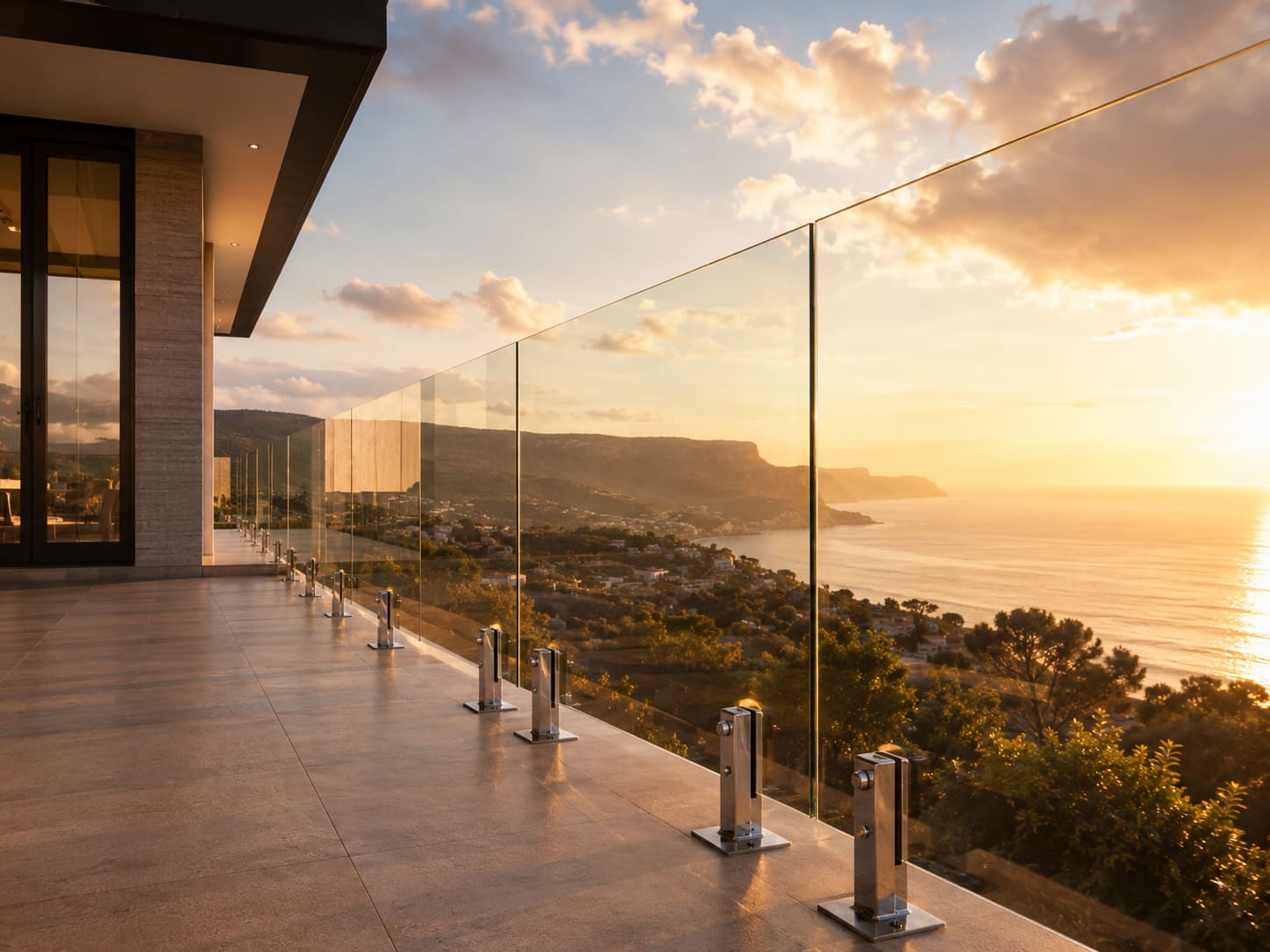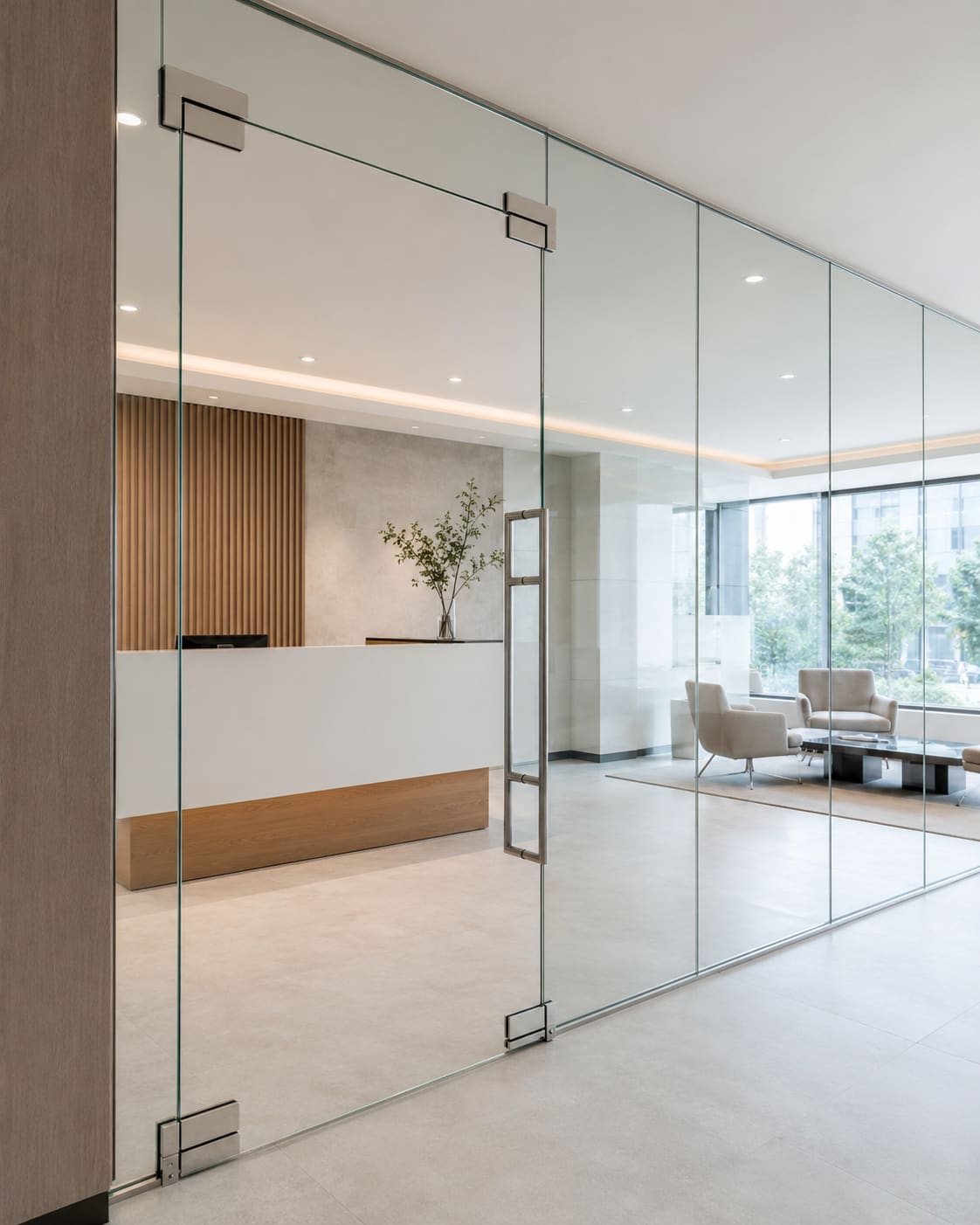
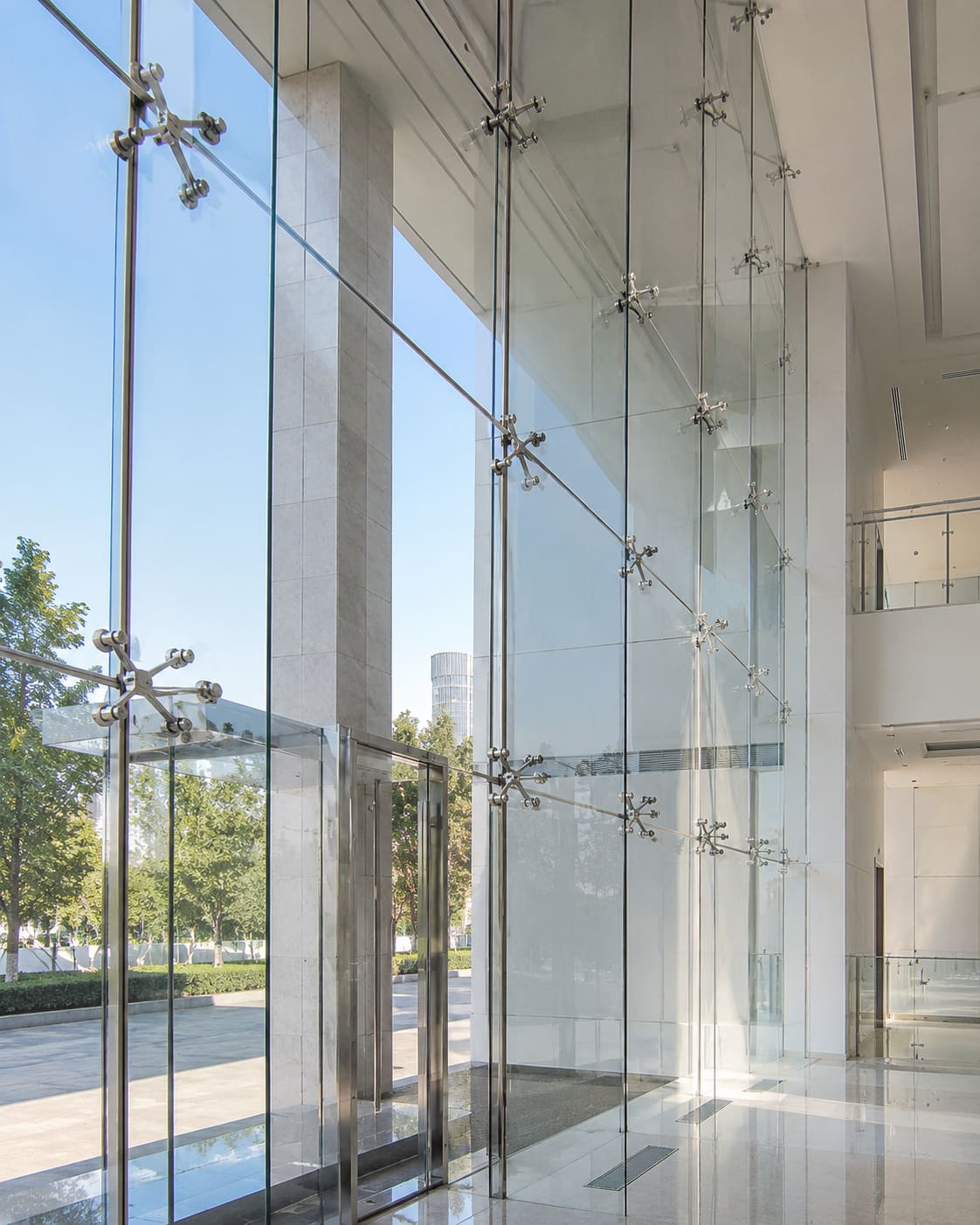
Spider fitting glazing is a point-fixed glass system where large panels are held not by a continuous frame but by four-legged stainless steel brackets, called spiders, that bolt through the corners of the glass. The load from each panel passes through articulated bolts into these spider arms and then back to a support structure of steel, glass fins or tension cables. The result is a near-frameless, transparent facade where the glass appears to float, which is exactly why you see it on showrooms, atriums, corporate lobbies and mall entrances across Hyderabad and Secunderabad.
Unlike conventional structural glazing where glass is silicone-bonded to an aluminium grid, point-fixed glazing transfers loads through discrete bolts rather than a hidden frame. That single difference changes everything about how the system is engineered, priced and detailed. Each bolt becomes a stress point that has to handle wind, self-weight and thermal movement, so the glass must be heat-treated and the geometry must be calculated, not eyeballed.
This guide explains how spider systems actually work, the glass and hardware they need, where they suit Hyderabad's climate and building types, and what they realistically cost per square foot in 2026. If you are weighing spider glazing against a framed alternative for an entrance or double-height lobby, this covers the decisions that matter.
How Does a Spider Fitting System Work?
A spider system has four coordinated parts that work together to hold glass safely with the minimum of visible framing. Understanding each one makes it clear why the engineering, not the glass alone, is what you are paying for.
- Spider brackets: 2-arm, 3-arm or 4-arm stainless steel castings (SS 316 for exteriors) that fan out from a single node to meet the corners of adjacent glass panels.
- Routel or bolt connectors: articulated bolts that pass through pre-drilled holes in the glass and pivot slightly so the pane can rotate under load instead of bending sharply at the hole.
- Countersunk or button holes: each glass corner is factory-drilled and edge-polished under controlled conditions; site drilling of toughened glass is never allowed because it shatters.
- Support structure: MS or SS members, structural glass fins, or stainless tension rods and cables that carry the spiders back to the building slab or steel.
Because the bolt articulates, wind pressure and thermal expansion are converted into small rotations rather than concentrated bending stress. That is the core principle: a spider system deliberately lets the glass move a little so it never has to absorb force it cannot handle. Get the articulation or the hole edge polishing wrong and the glass fails at the bolt, which is why fabrication quality is non-negotiable.
What Glass and Hardware Do You Need?
Point-fixed glazing only works with heat-treated glass, because ordinary annealed glass would crack instantly at the drilled holes. The specification is where most of the safety and durability is decided.
- Glass type: toughened (tempered) or heat-strengthened; for overhead, canopy or very large spans, toughened laminated for post-breakage safety.
- Thickness: 10mm and 12mm are common for single glass; 13.52mm or thicker laminated for canopies and high-wind elevations.
- Heat-soaking: heat-soaked glass (tested to EN 14179) is strongly recommended to reduce the risk of spontaneous nickel-sulphide breakage, which is the single most common cause of unexplained failures.
- Spiders and bolts: SS 316 grade for outdoor Hyderabad facades; SS 304 is acceptable only for protected interior atria.
A common mistake on budget jobs is using SS 304 or chrome-plated mild steel outdoors to shave cost. In Telangana's monsoon humidity and airborne dust these corrode within a few years, bleed rust stains onto the glass and eventually weaken the fixing. For anything exposed to weather, specify 316. If you are comparing this with an insulated option, our note on DGU facades explains where double-glazed units earn their extra cost in a spider system.
Spider Glazing vs Structural and Curtain Wall Glazing
Clients often ask which frameless-looking system they actually need. The three are not interchangeable, and the right pick depends on transparency, span and budget.
- Spider glazing: maximum transparency, expressed stainless hardware, best for entrances, showrooms and double-height volumes where you want the glass to disappear. Higher cost per sq ft.
- Curtain wall glazing: a continuous framed skin for full building elevations; more economical over large areas but with visible grid lines.
- Facade structural glazing: glass bonded to a concealed aluminium frame, giving flush glass lines at lower cost than spiders across a whole tower.
In practice, many Hyderabad buildings combine them: a spider-glazed feature entrance set into a curtain-walled elevation. If your goal is a signature lobby rather than cladding an entire block, spiders are the right tool. If it is the whole envelope, a framed system is usually more sensible. A facade consultant can model both, and our facade consultancy work often starts by comparing the two on cost and buildability before anything is fabricated.
Support Options: Fins, Cables and Steel
The spiders themselves only hold the glass; something has to hold the spiders. This backing structure is what defines the look and cost of the whole wall, and there are three mainstream choices in Hyderabad.
- Steel-supported: vertical MS or SS mullions behind the glass line carry the spiders. Robust, economical and forgiving of tall spans; the structure is visible but slim.
- Glass-fin spider glazing: toughened glass fins run perpendicular to the facade as structural ribs, so the entire wall reads as glass with almost no metal. The most transparent, and the most expensive.
- Cable-net glazing: pre-tensioned stainless cables form a lightweight net that the spiders clip to, ideal for very large, flat spans like airport-scale entrances.
For a double-height showroom in Kokapet or a hotel atrium in Banjara Hills, glass fins deliver the wow factor. For a taller, wind-exposed elevation in the Financial District, steel or a tension cable facade is usually more practical. The choice is an engineering decision driven by span, wind zone and budget, not just aesthetics.
Where Is Spider Glazing Used in Hyderabad and AP?
Point-fixed glazing suits spaces that want maximum transparency and a premium, signature look. Across Hyderabad, Secunderabad and the growth corridors of Andhra Pradesh it is specified for automobile showrooms, IT park lobbies, shopping mall entrances, hotel atriums and double-height corporate receptions.
It is a functional choice as much as an aesthetic one. The slim spiders and uninterrupted glass let daylight travel deep into large volumes, cutting artificial lighting load during the day, which matters when Telangana afternoons already push cooling demand hard. For a client in Gachibowli, Madhapur or Vijayawada wanting a landmark entrance, spider glazing delivers a far more open feel than framed curtain walling.
We see strong demand in the tech belt around Hitec City, Kondapur and the Financial District, where IT campuses use spider-glazed lobbies as a brand statement, and along retail corridors where showrooms compete on frontage visibility. You can see the range of frameless and point-fixed work we have delivered on our projects page.
Designing for Hyderabad's Heat, Monsoon and Dust
A spider facade that looks flawless on install day can disappoint within two years if it is not detailed for the local climate. Three conditions dominate here.
- Heat and thermal movement: summer surface temperatures on glass can swing widely, so the articulated bolts and expansion allowances must be sized to let panels grow and shrink freely. Reflective or low-e coatings and DGUs cut solar heat gain and reduce that stress.
- Monsoon water management: wind-driven rain finds every joint. Structural silicone weather-sealing between panels must be done in dry conditions with the right primer, or it fails at the edges within a couple of seasons.
- Dust and cleaning access: Hyderabad's dust settles fast on large glass. Plan for maintenance access from day one, because a spider wall with no cleaning strategy looks neglected quickly.
This is also where corrosion resistance pays off: the combination of humidity and dust is exactly what attacks under-specified 304 or plated steel. Spending on 316 spiders and proper heat-soaked glass up front is far cheaper than a mid-life re-glaze. When in doubt, get a free quote that spells out the glass make, steel grade and sealing method rather than a single lump-sum rate.
What Does Spider Glazing Cost in INR?
Spider glazing is a premium system, so budget accordingly. These are indicative Hyderabad market rates for supply and installation in 2026, and they move with span, glass make and structural complexity.
- Basic spider glazing with 12mm toughened glass and SS 304 fittings (interior or protected use): around INR 950 to 1,400 per sq ft.
- Standard exterior system with 12mm toughened, heat-soaked glass and SS 316 spiders: roughly INR 1,500 to 2,200 per sq ft.
- High-spec laminated or DGU glass with glass-fin or tension-rod support: INR 2,400 to 3,800+ per sq ft.
Prices vary with the glass brand (Saint-Gobain, AIS, Guardian), spider count per panel, span and the type of backing structure. The single biggest false economy is under-specifying glass thickness or steel grade to hit a lower headline number, on a facade that must perform for 20+ years. Always insist on a site-specific wind-load calculation before finalising thickness. If you also need framed elements nearby, budget those separately using our guidance on aluminium doors and windows, since mixing systems is common on real entrances.
Installation, Maintenance and Common Mistakes
The performance of a spider wall is decided as much on site as in the factory. A few disciplines separate a facade that lasts from one that leaks or fails.
- Never drill or cut glass on site. Every hole, notch and edge is factory-processed on the toughened pane; any site alteration cracks it.
- Torque bolts to spec. Over-tightened point fixings crush the bushing and pre-stress the glass at the hole; under-tightened ones rattle and leak.
- Check alignment across the whole grid. Spiders must sit in plane so no single arm carries more than its share, which is why survey and setting-out precision matters.
- Plan maintenance. Bolts, bushings and silicone seals should be inspected periodically, especially after the first monsoon, and cleaning access designed in.
Choosing an experienced fabricator is the real risk control here. Point-fixed systems are unforgiving of shortcuts, and the failures, whether corrosion staining, edge leaks or cracked panels, almost always trace back to spec compromises or rushed installation. If you are planning an entrance, atrium or showroom front, talk through the glass, steel grade and support option early, and request a detailed quote that documents each of them.