A thermal break is an insulating strip, usually polyamide (glass-fibre-reinforced nylon), built into the middle of an aluminium window or door frame to stop heat from conducting straight through the metal. In short: it splits the frame into an outer half and an inner half joined by a low-conductivity bar, so Hyderabad's outdoor heat can no longer ride the aluminium directly into your air-conditioned room. That single change can cut frame heat transfer by 50 to 70 percent and largely eliminate the condensation that plagues plain aluminium during the monsoon.
If you have shopped for premium aluminium windows in Gachibowli, Kokapet or the Financial District, you have almost certainly seen "thermal break" on a quotation and wondered whether it is a real feature or just a way to justify a higher price. This guide has thermal break windows explained in plain language, so you can decide what actually belongs in your home or project.
Aluminium is prized for slim sightlines, strength and durability, but it is also an excellent conductor of heat, roughly a thousand times more conductive than the polyamide used in a thermal break. A plain aluminium frame carries a 42 degrees C afternoon straight into an air-conditioned bedroom, and on cooler Telangana and Andhra Pradesh nights it carries warmth back out. A thermal break is the engineering answer to that problem, and this article covers how it works, when it pays for itself, and what it costs here in 2026.
What is a thermal break, exactly?
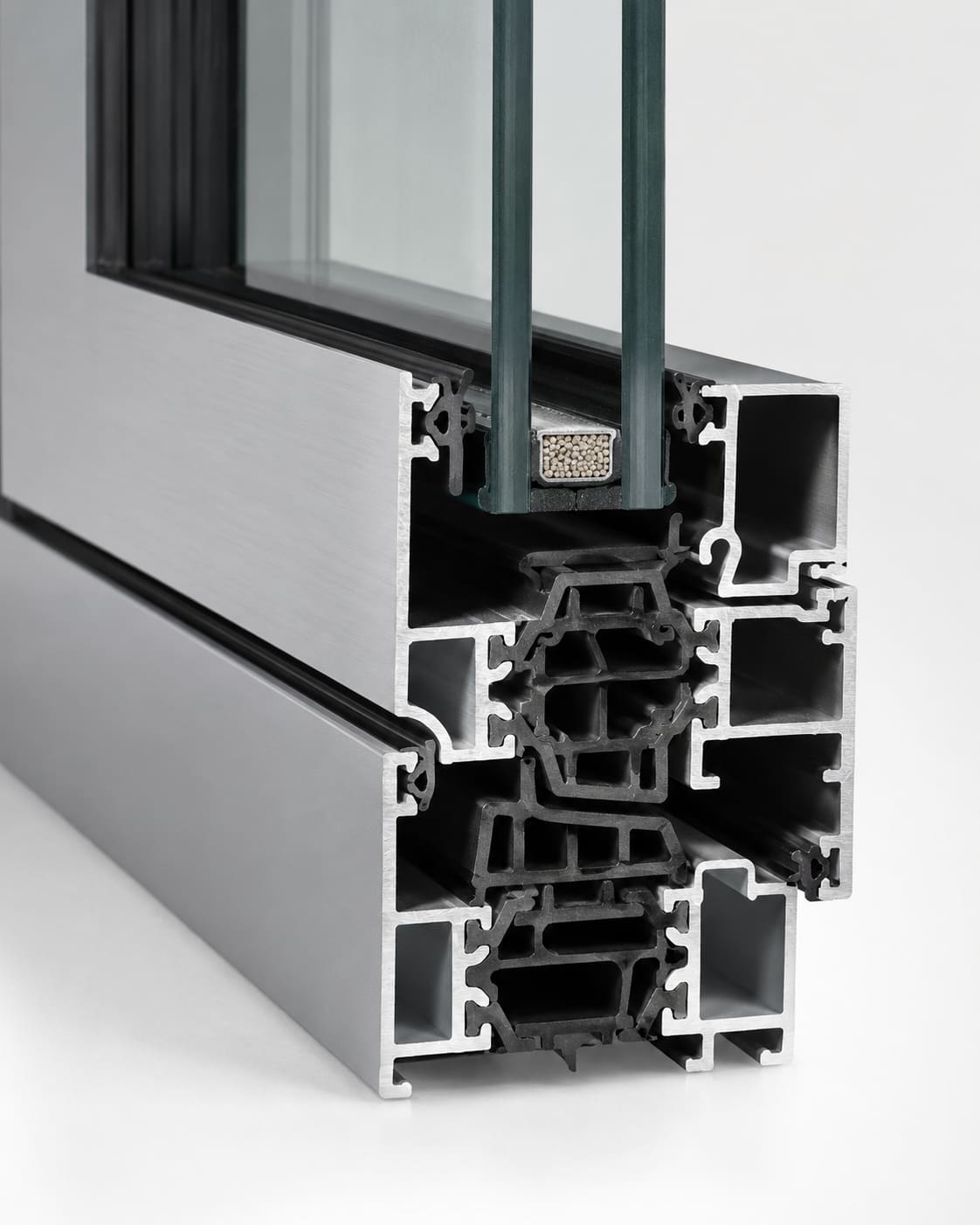
A thermal break is an insulating barrier built into the middle of an aluminium window or door frame. Instead of one solid piece of metal spanning the inside and outside faces, the profile is split into two aluminium halves that are mechanically joined by a low-conductivity strip. The two halves stay perfectly aligned and rigid, but heat can no longer travel across the frame in an unbroken metal path.
That strip is almost always polyamide, a tough, glass-fibre-reinforced nylon, and occasionally polyurethane resin. Because polyamide conducts heat roughly a thousand times worse than aluminium, it interrupts the bridge heat would otherwise cross. A thermally broken profile is what makes genuine thermal break aluminium windows worth specifying over ordinary frames.
- Outer aluminium shell: faces the weather, sun and dust
- Polyamide bars: the insulating "break" locked into rolled channels in each half
- Inner aluminium shell: faces your conditioned room
The result is one strong, rigid profile that no longer behaves like a single block of conductive metal. Structurally it performs like solid aluminium; thermally it behaves like a frame with insulation built into its core.
How is a thermal break made?
Understanding the manufacturing helps you judge quality on site. The fabricator extrudes two separate aluminium profiles, the inner and outer shells, each with a small rolled groove. Two polyamide bars are threaded into these grooves, and the aluminium is then mechanically crimped (knurled and rolled) so the bars are locked in under tension. This is the "pour and debridge" alternative you may also hear about, where polyurethane resin is poured into a channel and the connecting bridge is later milled away.
The crimping step matters. A poorly crimped frame can allow the two halves to shear or the polyamide to slip, which is why reputable aluminium fabrication shops in Hyderabad use calibrated rolling machines and test the shear strength of the joint. When you inspect a sample, a genuine thermally broken profile shows two clearly separate aluminium bodies with a visible amber or black polyamide strip sandwiched between them.
This is also why thermally broken frames cost more to produce: extra extrusion tooling, the polyamide bar itself, specialised crimping machinery and tighter quality control all add to the price before a single window is even glazed.
How it works and why it matters in Hyderabad
Heat always moves from hot to cool. On a 42 degrees C Hyderabad afternoon, a non-broken aluminium frame becomes genuinely hot to the touch on the inside and radiates that heat into the room, forcing your air conditioner to run longer and harder. The frame effectively acts as a heat pipe feeding the outdoors straight into your living space.
A thermally broken frame stays far closer to indoor temperature because the polyamide bars stop the heat crossing over. That same barrier keeps the inner surface warm enough to stay above the dew point, which is what prevents the condensation and water dripping you see on plain aluminium frames during humid monsoon weeks across Telangana and coastal Andhra Pradesh.
- Lower heat gain means measurably reduced cooling loads and lower electricity bills
- A warmer inner frame surface means less condensation and no black mould around the reveals
- Better acoustic damping, useful on busy corridors like the Outer Ring Road, Kondapur and Kukatpally
- Reduced thermal expansion stress, so paint and sealants last longer against the dust and heat cycling
For homes in Kokapet or Narsingi with large west-facing glazing, this difference is not subtle: the inner frame of a thermally broken window can sit 10 to 15 degrees cooler than a plain aluminium equivalent at peak afternoon.
Thermal break vs standard aluminium: is it worth it?
For a naturally ventilated utility room, staircase or balcony that is rarely air conditioned, a standard aluminium window is perfectly fine and more economical. The moment a room is regularly cooled, the maths shifts firmly in favour of a thermal break because the frame stops quietly undoing your AC's work all day.
The single most common mistake is buying a thermally broken frame and pairing it with single glazing. A thermal break with single glass gives only part of the gain because the glass then becomes the weak link. Pair the broken frame with an insulated glass unit (double glazing) for the full benefit; the two work as a system, not as separate upgrades.
As a rule of thumb, prioritise thermally broken frames on west- and south-facing rooms that take the harshest Hyderabad sun, and on bedrooms and home offices where comfort and quiet matter most. If your project uses aluminium sliding windows or casement windows in these orientations, that is exactly where the upgrade earns its keep. You can see how we have specified these across residential and commercial jobs in our project gallery.
- Choose a thermal break: air-conditioned bedrooms, living rooms, home offices, west and south facades
- Standard aluminium is fine: open balconies, service areas, non-AC utility rooms and passages
Does uPVC do the same job as a thermal break?
This is one of the most common questions we get from buyers comparing quotations. uPVC is a naturally low-conductivity material, so a good uPVC frame is inherently insulating without needing a separate break. The trade-off is that uPVC has bulkier profiles and can soften under prolonged direct sun if it is not properly reinforced, whereas thermally broken aluminium keeps slim sightlines and superior structural strength for large openings.
For very large spans, sliding stacks and tall glazing, thermally broken aluminium usually wins on strength and looks. For standard-sized windows where budget is tight, uPVC windows can deliver comparable thermal comfort at a lower price. Neither is universally "better"; the right pick depends on the opening size, orientation and how much you value slim frames.
If you are weighing the two, our uPVC vs aluminium comparison breaks the decision down room by room for the Hyderabad climate, so you are not choosing blind.
How much do thermally broken windows cost in Telangana and AP?
Thermally broken aluminium costs more than plain aluminium because of the extra polyamide, the crimping machinery and the higher-grade hardware it is usually paired with. As an indicative guide for the Hyderabad market in 2026:
- Standard (non-broken) aluminium windows: roughly INR 550 to 950 per sq ft
- Thermally broken aluminium frames: roughly INR 1,100 to 2,200 per sq ft
- Add double glazing (IGU): typically INR 350 to 700 per sq ft extra
- Premium wood-finish or matte powder-coat colours: add roughly 10 to 20 percent
For a typical 5 x 4 ft (20 sq ft) window, a thermally broken frame with double glazing might land somewhere between INR 30,000 and INR 55,000 depending on the profile system, glass specification, hardware brand and finish. Imported German systems sit at the top of that range; well-made Indian systems offer most of the benefit for less.
Final pricing always depends on the profile, glass build-up and hardware, so treat these as planning figures rather than a fixed quote. For an exact figure on your openings you can get a free quote with your window sizes and orientations, and always ask to see the polyamide bar in a cut section so you know the break is genuine.
How to check a thermal break is genuine on site
Because the polyamide is hidden inside the profile once the window is assembled, some suppliers label a plain frame as "thermal break" to win a job. A few simple checks protect you:
- Ask for a cut section of the actual profile and look for two separate aluminium bodies joined by a visible polyamide strip
- Confirm the polyamide is glass-fibre-reinforced, not a thin plastic gasket masquerading as a break
- Check the joint by trying to twist the two halves; on a genuine crimped profile they behave as one rigid piece
- Ask for the system name and thermal performance data (Uf value for the frame, U value for the whole window)
- Verify the glazing: a real energy-efficient window pairs the break with a sealed IGU, not single glass
The same rigour applies to thermal break doors and larger aluminium doors and windows packages, where the joint carries more structural load. A reputable fabricator will happily show you all of this; hesitation is a red flag.
Maintenance and lifespan
A thermally broken aluminium window needs no special maintenance beyond what any quality aluminium window requires: periodic cleaning of frames and tracks, occasional lubrication of rollers and hinges, and checking that drainage weep holes stay clear during the monsoon so water does not pool. The polyamide bar itself is inert, UV-stable and rated for the same multi-decade lifespan as the aluminium around it.
In Hyderabad's dust, the biggest real-world enemy of any window is grit in the sliding tracks, not the thermal break. Keep tracks clean and the frame will comfortably outlast 20 to 30 years. Because the inner surface never gets extreme, sealants and internal finishes around the window also age more gently than they would beside a plain conductive frame.
If you are planning a whole facade rather than a few windows, the same insulating principle scales up into thermally broken structural glazing and curtain wall systems, where controlling heat gain across a large glass envelope has an even bigger impact on running costs.