Toughened glass and laminated glass are both 'safety glass', but the short answer is this: choose **toughened** when you need impact strength that shatters into harmless blunt granules (doors, partitions, shopfronts), and choose **laminated** when the glass must stay in place after it cracks (overhead skylights, railings at height, security and acoustic glazing). For the most demanding jobs - a balcony railing on a 15th-floor apartment in Gachibowli or a glass canopy over a showroom entrance in Madhapur - you combine them into toughened-laminated glass and get both benefits at once.
The difference comes down to how each is manufactured and, critically, how each behaves at the moment it fails. Toughened glass is heat-treated so it is roughly 4–5 times stronger than ordinary annealed glass and disintegrates into small pebble-like pieces. Laminated glass sandwiches a plastic interlayer between two sheets so that even when both plies crack, the fragments cling to the film and the panel holds its shape.
This guide breaks down the manufacturing, breakage behaviour, real-world applications, and realistic Hyderabad pricing so you can specify the right glass the first time. Getting this decision right matters for occupant safety, for passing facade audits, and for avoiding expensive re-work - because toughened glass cannot be cut or drilled after tempering, a wrong order means a scrapped panel.
How is toughened glass made?
Toughened glass (also called tempered glass) starts as ordinary annealed float glass that is cut, drilled, notched and edge-polished to its final shape. It is then heated in a furnace to around 620–650°C and rapidly cooled with jets of air. This 'quenching' locks the outer surfaces into compression while the core stays in tension.
That built-in stress is what gives toughened glass its strength - roughly 4 to 5 times that of the same thickness of ordinary glass. It resists impact, wind load and thermal stress far better, which is why it is the default for toughened glass doors, shower enclosures and large glass shopfronts.
The one rule you cannot break: **all cutting, drilling and edge work must happen before tempering.** Once a panel is toughened, any attempt to cut or drill it makes the whole sheet explode into granules. This is exactly why accurate site measurement matters - a hole drilled 5mm out of position means an entirely new panel.
How is laminated glass made?
Laminated glass bonds two or more sheets of glass together with a tough plastic interlayer - usually PVB (polyvinyl butyral) or, for structural work, the stiffer SGP (SentryGlas). The assembly is passed through heated rollers and then an autoclave under heat and pressure, which fuses the layers into one solid panel.
The individual glass sheets can themselves be ordinary, toughened or heat-strengthened. So 'laminated' describes the construction (glass + interlayer + glass), while 'toughened' describes a heat treatment. This is the single biggest source of confusion - they are not two ends of the same scale, they are different properties that can be combined.
The interlayer does more than hold fragments together. It blocks around 99% of UV radiation, dampens sound significantly, and can be tinted or coloured. That makes laminated glass work a favourite for facades where sun control and noise reduction both matter.
What happens when each one breaks?
This is the decisive difference, so it deserves its own section.
- **Toughened glass** breaks all at once into thousands of small, blunt-edged granules roughly the size of rock salt. There are almost no long sharp shards, so the injury risk from a broken panel is low. But the entire panel fails instantly and the opening is left completely empty.
- **Laminated glass** cracks but does not fall out. The plastic interlayer grips the broken pieces, so the panel stays in its frame - spider-web cracks and all. It keeps acting as a barrier against falls, weather and intruders even after it is damaged.
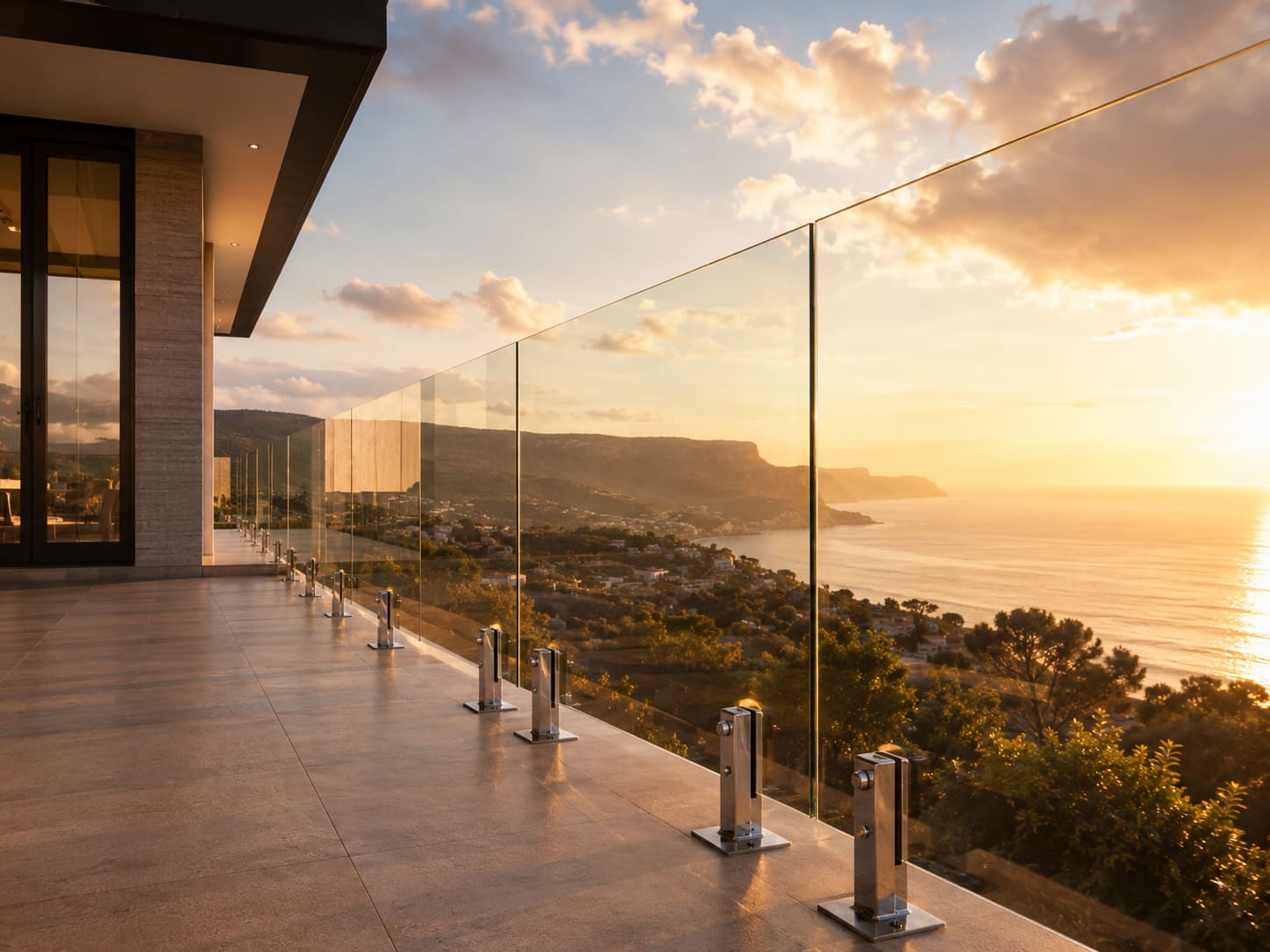
So the question is never simply 'which is stronger'. It is 'when this glass fails, do I need a safe pile of granules, or do I need the glass to stay in place?' A frameless balcony 12 floors up must stay in place, which is why frameless glass railings at height are almost always toughened-laminated.
There is one more nuance worth knowing. Toughened glass can, very rarely, break on its own with no impact at all - a phenomenon called spontaneous breakage, caused by tiny nickel-sulphide inclusions inside the glass. It is uncommon, but on a large facade even a small failure rate is worth eliminating, which is where heat-soak testing comes in. Laminated glass is immune to the consequences of this: even if one ply fails, the interlayer keeps everything in place.
Toughened vs laminated: side-by-side comparison
- **Strength:** Toughened wins on raw impact and thermal strength. Laminated's strength depends on the glass plies used inside it.
- **Breakage:** Toughened crumbles into blunt granules; laminated stays intact and held in the frame.
- **Post-fabrication:** Toughened cannot be cut or drilled after treatment; laminated also cannot be cut cleanly once bonded - both must be made to final size.
- **Acoustics:** Laminated clearly better - the interlayer damps sound. Toughened offers no acoustic advantage over ordinary glass of the same thickness.
- **UV control:** Laminated blocks ~99% of UV; toughened does not.
- **Overhead safety:** Only laminated is acceptable overhead, because toughened can drop as loose granules.
- **Cost:** Toughened is cheaper; laminated costs more due to the extra ply and interlayer.
For projects that need both - resistance to impact and hold-together safety - toughened-laminated glass is the answer, and it is standard on most modern structural glazing facades in Hyderabad's IT corridor.
Which glass should you choose for each application?
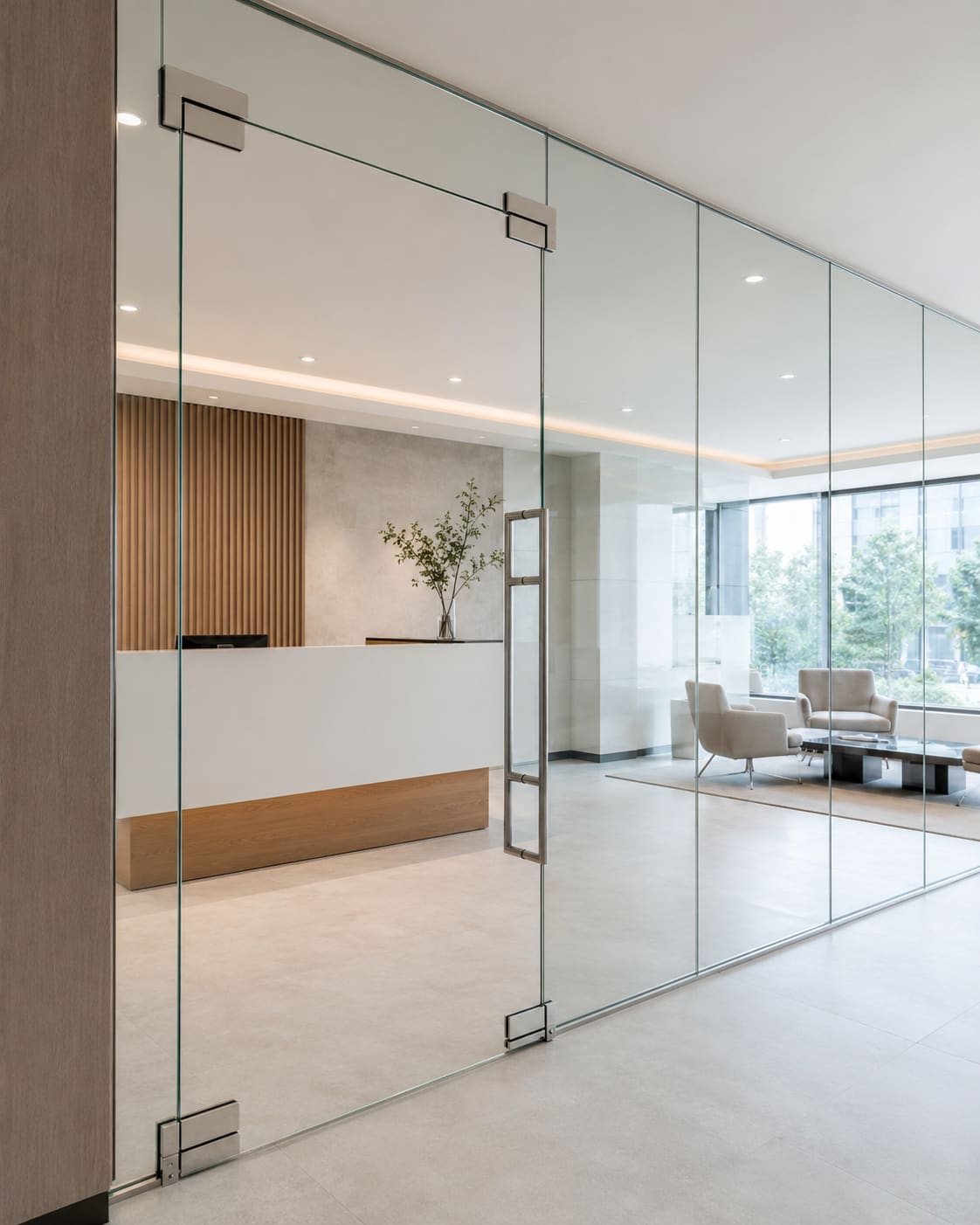
- **Internal doors and partitions:** Toughened is the standard and most cost-effective choice for toughened glass partitions and office cabins.
- **Shower enclosures:** Toughened, typically 8–10mm, for strength and the safe granular break.
- **Shopfronts and showroom fronts:** Toughened for strength; laminated or toughened-laminated where security or street noise is a concern.
- **Railings and balconies at height:** Toughened-laminated, so a cracked panel never leaves an open edge - critical for the high-rise apartments in Kokapet and the Financial District.
- **Skylights, canopies and overhead glazing:** Laminated is essential. Never use plain toughened overhead. See our glass canopy and skylight work.
- **Security glazing:** Laminated (often multi-ply) resists forced entry because the interlayer keeps absorbing blows.
- **Acoustic glazing near main roads:** Laminated or acoustic glass partitions for the noise reduction the interlayer provides.
Why the choice matters more in Hyderabad's climate
Telangana and coastal Andhra Pradesh put glass under real stress, and each type responds differently.
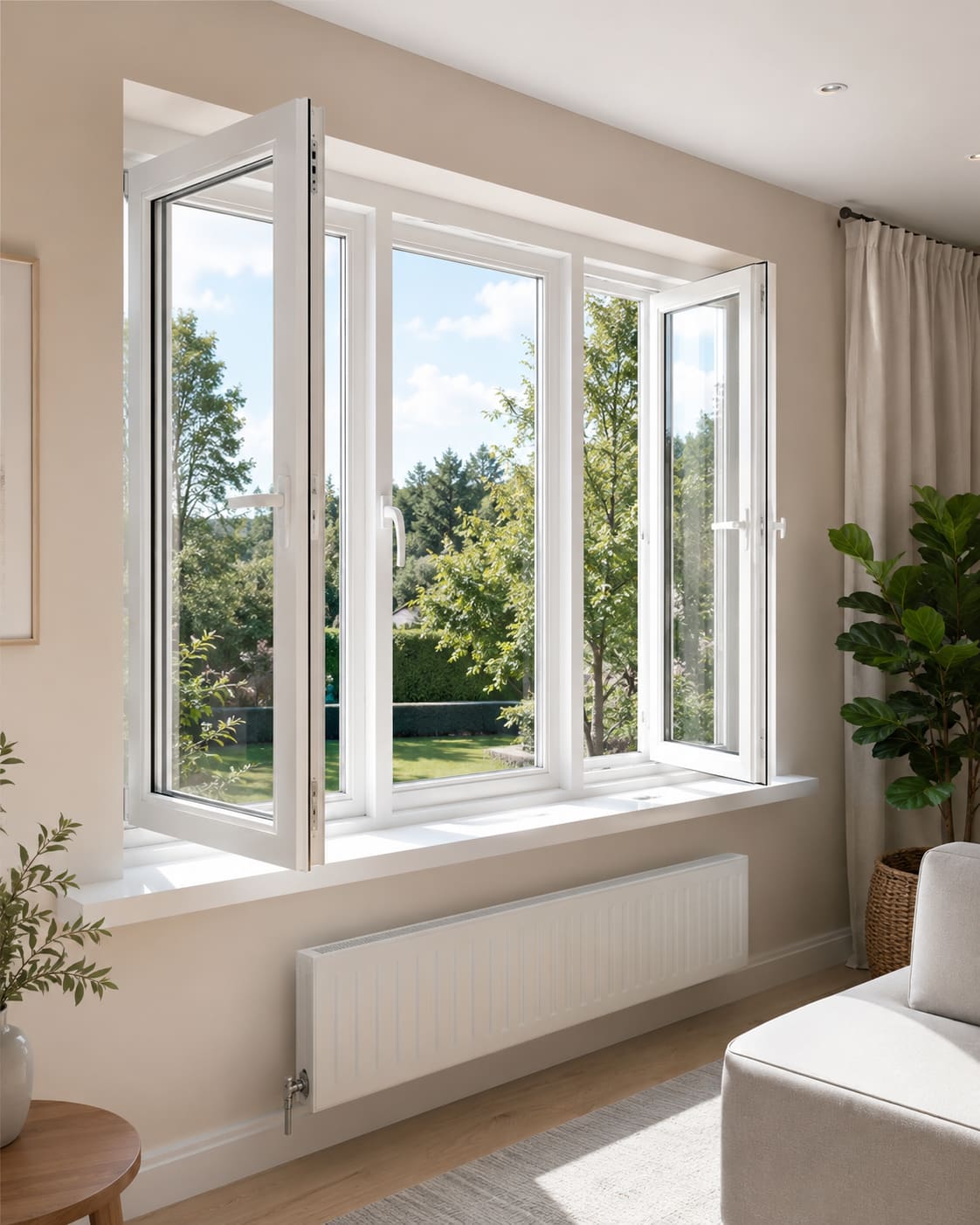
Summer surface temperatures in Hyderabad can push glass past 60°C, and partial shading from louvres or overhangs creates uneven heating. That thermal gradient can crack ordinary glass - toughened glass resists it far better, which is why west-facing aluminium windows and doors in Gachibowli and Kondapur are usually specified in toughened.
The monsoon and coastal AP wind loads matter for facade and cladding work - high panels need the strength of toughened glass plus, where they are large or overhead, the retention of a laminated build.
Then there is UV. The intense sun that fades interiors is blocked almost entirely by laminated glass, so showrooms in Madhapur and Hitec City often specify laminated on sun-facing elevations to protect merchandise and reduce glare. If you want an assessment for a specific elevation, our team can help - get a free site assessment and we will recommend the exact make-up.
What does toughened vs laminated glass cost in Hyderabad?
Prices move with thickness, brand, tint and order size, but as a 2026 working guide for the Hyderabad market:
- **Toughened glass:** roughly INR 130–220 per sq ft for clear 8–12mm, before fittings and installation.
- **Laminated glass:** roughly INR 260–450 per sq ft depending on the plies and interlayer (SGP costs more than PVB).
- **Toughened-laminated glass:** typically INR 380–650+ per sq ft, since it combines two toughened plies and an interlayer.
Fittings such as spider fittings, spigots, patch fittings and channels, plus site installation and access equipment, are additional. For a high-rise railing or a large skylight, the hardware and installation can equal or exceed the glass cost.
Laminated is more expensive, but it is specified because of what it does - hold together, block UV, cut noise - not to inflate the bill. Choosing plain toughened where laminated is required is a false economy that can fail an audit. You can browse completed examples in our projects gallery to see where each type is used.
Common mistakes to avoid when specifying safety glass
- **Using plain toughened overhead.** If it breaks, the granules fall. Overhead always needs laminated.
- **Ordering before final measurement.** Neither type can be cut or drilled after fabrication - measure once the frame or sub-structure is fixed.
- **Assuming toughened blocks sound or UV.** It does not; those are laminated's strengths.
- **Under-speccing frameless railings.** At height, toughened-laminated is the safe standard, not single-ply toughened.
- **Ignoring the interlayer grade.** PVB is fine for most work; structural and large spans often need SGP for stiffness and edge stability.
- **Skipping heat-soak testing on large toughened facades.** Heat-soaking screens out the rare nickel-sulphide inclusions that cause spontaneous breakage - worth insisting on for big glass facade jobs.
When in doubt, ask a fabricator to specify against the actual load, height and exposure rather than guessing. A quick free quote with your drawings will get you a make-up matched to the application.