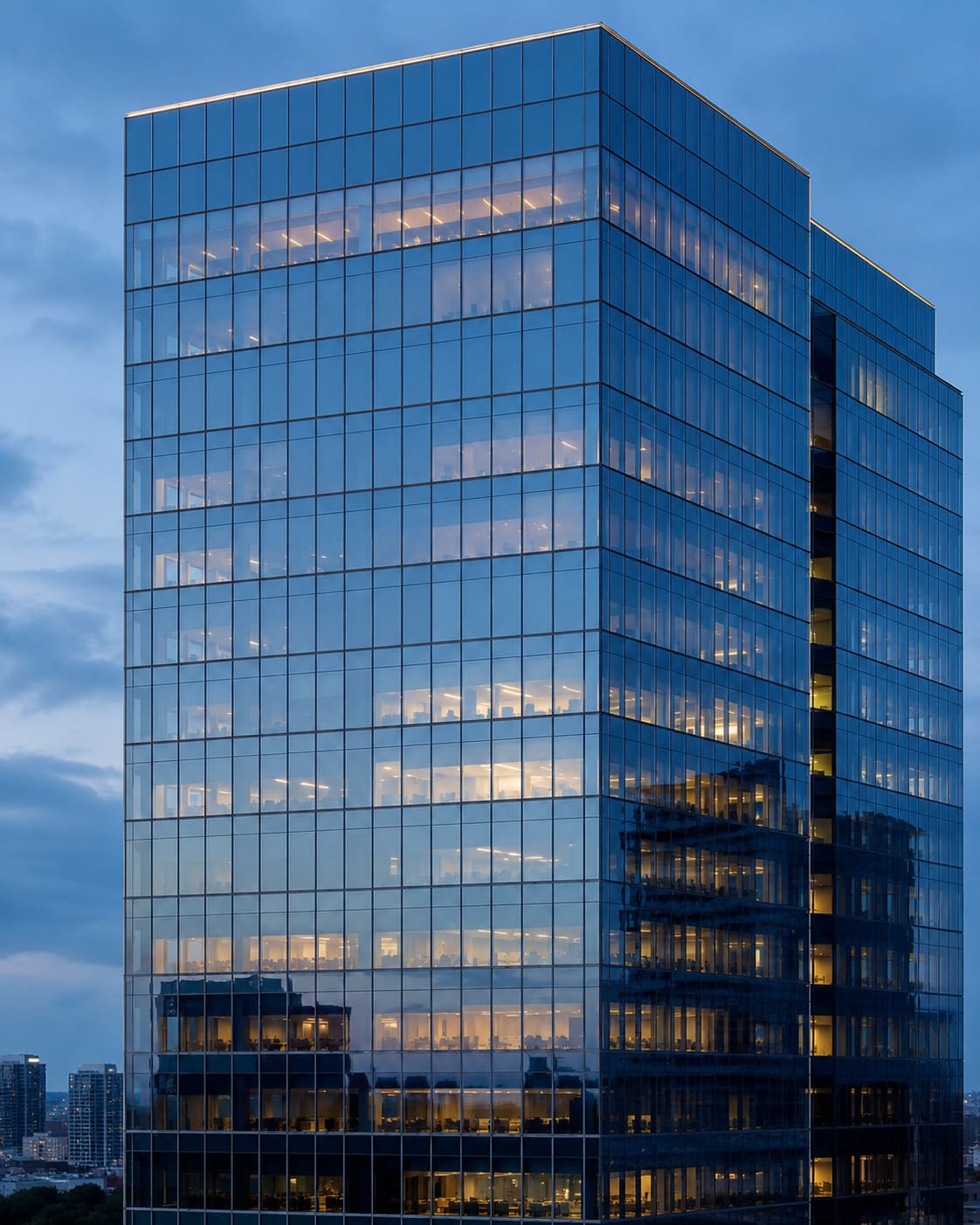

When you specify glazing, U-value and SHGC are the two numbers that decide how your facade performs against heat, cooling load and comfort - and in Hyderabad's cooling-dominated climate, SHGC is usually the one that governs. U-value (W/m2K) describes how readily heat conducts through the assembly by temperature difference; SHGC (a dimensionless 0-1 fraction) describes how much of the incident solar radiation ends up as heat inside the space. They are independent properties: two units of glass can share a U-value yet behave completely differently in the sun.
The distinction matters because getting it wrong is expensive and permanent. Over-specify U-value in a hot climate and you pay for insulation you barely use; ignore SHGC and you hand the HVAC engineer a cooling load your glass created - one that runs every summer for the life of the building. On a west-facing tower in Gachibowli or the Financial District, the difference between SHGC 0.27 and SHGC 0.55 can be tens of tonnes of installed chiller capacity and a visibly different electricity bill.
This guide covers how to read these values, how ECBC and NBC frame them, how the Telangana climate should shift your priorities, and how to write them onto your drawings so what gets fabricated on a structural glazing facade matches what you designed on paper.
U-value vs SHGC: what does each number actually control?
U-value governs heat driven by the indoor-outdoor temperature difference - it dominates in heating climates and at night. SHGC governs heat driven by the sun and dominates whenever glass faces direct radiation, which for most Hyderabad facades is the controlling case from March through June when ambient temperatures push past 40 degrees C.
- U-value: lower is better; a single glazed unit sits around 5.7 W/m2K, a standard DGU near 2.7-3.0, and a high-performance argon-filled Low-E DGU can reach 1.6-1.8 W/m2K.
- SHGC: lower rejects more solar heat; clear DGU is roughly 0.70-0.78, a solar-control Low-E coating brings it to 0.25-0.35.
- VLT (visible light transmittance): keep this decoupled from SHGC using a spectrally selective coating so you get daylight without the heat.
For a cooling-dominated project, prioritise SHGC first, then U-value, then tune VLT for glare and daylight. The one exception is a mixed-use or hospitality block with large night-time conditioned volumes, where U-value earns back more of its premium - but even there, the daytime solar load in Telangana keeps SHGC in the driving seat.
Why does Hyderabad's climate flip the usual priorities?
Much of the imported glazing wisdom in architectural education is written for temperate, heating-dominated climates where a low U-value is the headline. Telangana and coastal Andhra Pradesh are the opposite: long, intense cooling seasons, high solar altitude, a dusty pre-monsoon, and a humid monsoon that adds latent load. The building spends far more hours rejecting heat than retaining it.
- Solar intensity: clear-sky direct radiation on an unshaded east or west facade in April is punishing; SHGC is the lever that directly cuts this gain before it becomes a cooling bill.
- Dust and haze: pre-monsoon dust films a facade quickly in areas like Kokapet and the Outer Ring Road corridor, which is one more reason not to rely on deep tints or fragile external films for solar control.
- Monsoon humidity: warm-edge spacers and good edge seals matter for condensation control and long DGU life through Hyderabad's humid months.
- Orientation: north glazing can run higher VLT and SHGC safely; east and west need the tightest SHGC because of low-angle sun that vertical fins struggle to block. Coordinate the glazing schedule with any aluminium louvers or facade fins that share the shading job.
The practical takeaway: for a typical Hitec City or Madhapur office tower, write SHGC as the primary energy criterion and treat U-value as a secondary comfort-and-code number.
Which codes set your U-value and SHGC limits?
Your ceiling values come from the Energy Conservation Building Code (ECBC) and the National Building Code (NBC 2016), read alongside your green-rating target.
- ECBC prescribes maximum U-value and maximum SHGC by climate zone and window-to-wall ratio (WWR) - as WWR rises, the permitted SHGC tightens, because more glass area means more potential solar gain to control.
- Hyderabad lies in the Composite / Hot-Dry band, so the code and the climate both push you toward low-SHGC, spectrally selective glazing.
- IGBC, GRIHA and LEED credits reward glazing that beats the ECBC baseline; carry the exact U-value and SHGC used in the energy model onto the glazing schedule so the compliance submission and the fabricated facade agree.
- Structural glazing is governed by IS 875 (Part 3) for wind load and the relevant IS glass-selection and structural-sealant provisions - coordinate glass thickness and DGU make-up with these, not with thermal numbers alone.
A common failure is to model a beating-the-baseline SHGC for the energy report, then let procurement substitute a cheaper coating on site. The schedule, not the model, is what the DGU facade fabricator reads - so the model number must be pinned to the schedule as a pass/fail requirement.
Whole-window vs centre-of-glass: which do you specify?
Manufacturers often quote centre-of-glass values because they flatter the datasheet, but the assembly you build always performs worse. Frame conduction, the spacer edge and installation details all add heat paths that the centre-of-glass figure ignores.
- Specify whole-window (or whole-assembly) U-value and SHGC, and state the test/calculation basis (for example NFRC-style whole-product rating or simulation per project spec).
- Watch the spacer: a warm-edge spacer instead of aluminium meaningfully cuts edge conduction and reduces condensation risk through the monsoon.
- For thermally broken aluminium systems, call out the polyamide break in the section, not just in the notes - a thermal-break aluminium window can shift whole-window U-value by a full point versus a plain extrusion.
- Remember SHGC applies to the vision glass area; opaque spandrel glazing and shadow-box zones are handled separately in the energy model with their own U-value and back-pan insulation.
The gap between centre-of-glass and whole-window widens as frame area rises, so it bites hardest on punched windows and heavily transomed grids - exactly the cases where an optimistic datasheet is most tempting.
How do you read SHGC and VLT together (LSG)?
Low SHGC alone can produce dark, tinted glass that kills daylight and drives up lighting load - defeating the purpose, and making interiors feel cave-like in a city that has abundant daylight to give. The Light-to-Solar-Gain ratio (LSG = VLT / SHGC) tells you how efficiently a coating separates light from heat.
- LSG above 1.25 indicates a spectrally selective product; premium double-silver and triple-silver coatings reach 1.6-2.0.
- Example: VLT 0.45 with SHGC 0.27 gives LSG 1.67 - bright interiors, low cooling load.
- Avoid solving glare with a low-VLT tint when a selective coating gives you both daylight and heat rejection; the tint wastes the daylight you designed the glass line to capture.
- Coordinate VLT with any IGBC/GRIHA daylight credit and with interior glare criteria before you lock the coating, because raising VLT late can quietly breach the SHGC you promised the energy model.
For reflective glass facades the temptation is to chase a mirror aesthetic that crushes VLT; a good selective coating lets you keep the look while holding LSG high enough to daylight the perimeter zones.
What does high-performance glazing cost in Hyderabad?
Budgets are where good thermal specs live or die, so it helps to carry realistic supply-and-fix numbers into the design conversation rather than discovering them at tender. These are indicative Hyderabad-market ranges for supplied-and-installed glazing; confirm against a live quote for your make-up and quantity.
- Standard clear DGU in an aluminium frame: roughly INR 550-850 per sq ft, with poor SHGC (0.70+) - cheap up front, expensive on the chiller for 25 years.
- Single-silver Low-E solar-control DGU: roughly INR 900-1,400 per sq ft, SHGC around 0.30-0.40.
- Double or triple-silver high-performance DGU: roughly INR 1,400-2,200 per sq ft, SHGC 0.22-0.30 with high VLT.
- Thermal-break framing and warm-edge spacer add a premium but are what let the whole-window number match the glass number.
The honest framing for a client is lifecycle: a better coating adds a few hundred rupees per square foot once, and pays it back in reduced chiller tonnage and annual energy across the building's life. For a large curtain wall facade, that trade usually favours the higher-performance glass. When you want the numbers pressure-tested against real buildable make-ups, get a free quote rather than designing against a generic datasheet.
How do you write it onto your drawings?
Ambiguous schedules get value-engineered into cheaper glass. Write performance as pass/fail criteria tied to standards so the fabricator has no room to substitute down.
- State for each glazing type: maximum whole-assembly U-value, maximum SHGC, minimum VLT, minimum acoustic Rw, and design wind pressure per IS 875 (Part 3).
- Define deflection limits (commonly span/175 or L/175 for framing members, and a glass edge limit) and interstorey movement the system must absorb.
- Specify DGU make-up (for example 6 Low-E + 12 argon + 6), coating surface position (usually surface 2), edge seal and spacer type.
- Call out tolerances, interface details at slab edge and jamb, and the water/air/structural test standard the mock-up must pass.
- Pin the energy-model SHGC and U-value directly onto the schedule as the compliance basis, so no one can quietly swap the coating after the green submission is filed.
Hakimi Aluminium and Glass offers design-assist, shop drawings, fabrication and installation for architects across Hyderabad, Telangana and Andhra Pradesh - useful when you want the glazing schedule pressure-tested against buildable DGU make-ups and system sections early. You can see the range of delivered facades in our completed projects before you lock a system.
Where do windows differ from curtain walls on these numbers?
The same two properties apply to punched windows and to full glazed facades, but the framing arithmetic is different, and that changes how hard you have to work on each number.
- Punched windows have a higher frame-to-glass ratio, so the frame's U-value and thermal break matter more to the whole-window figure than they do on a large vision panel.
- Where a design uses operable vents, a thermal-break casement or tilt-turn window protects the whole-window U-value that a plain sliding section would erode through the meeting rails.
- For residential and mid-rise work, uPVC windows inherently offer a lower frame U-value than un-broken aluminium, which can be the simpler route to an ECBC-friendly assembly on smaller openings.
- On a unitized or stick curtain wall, the glass dominates the area, so SHGC and the coating do most of the energy work - but you still owe the fabricator the full wind, deflection and movement package alongside the thermal criteria.
Matching the framing system to the opening type early keeps the whole-assembly numbers honest and avoids a late scramble when the energy model and the shop drawings finally meet.