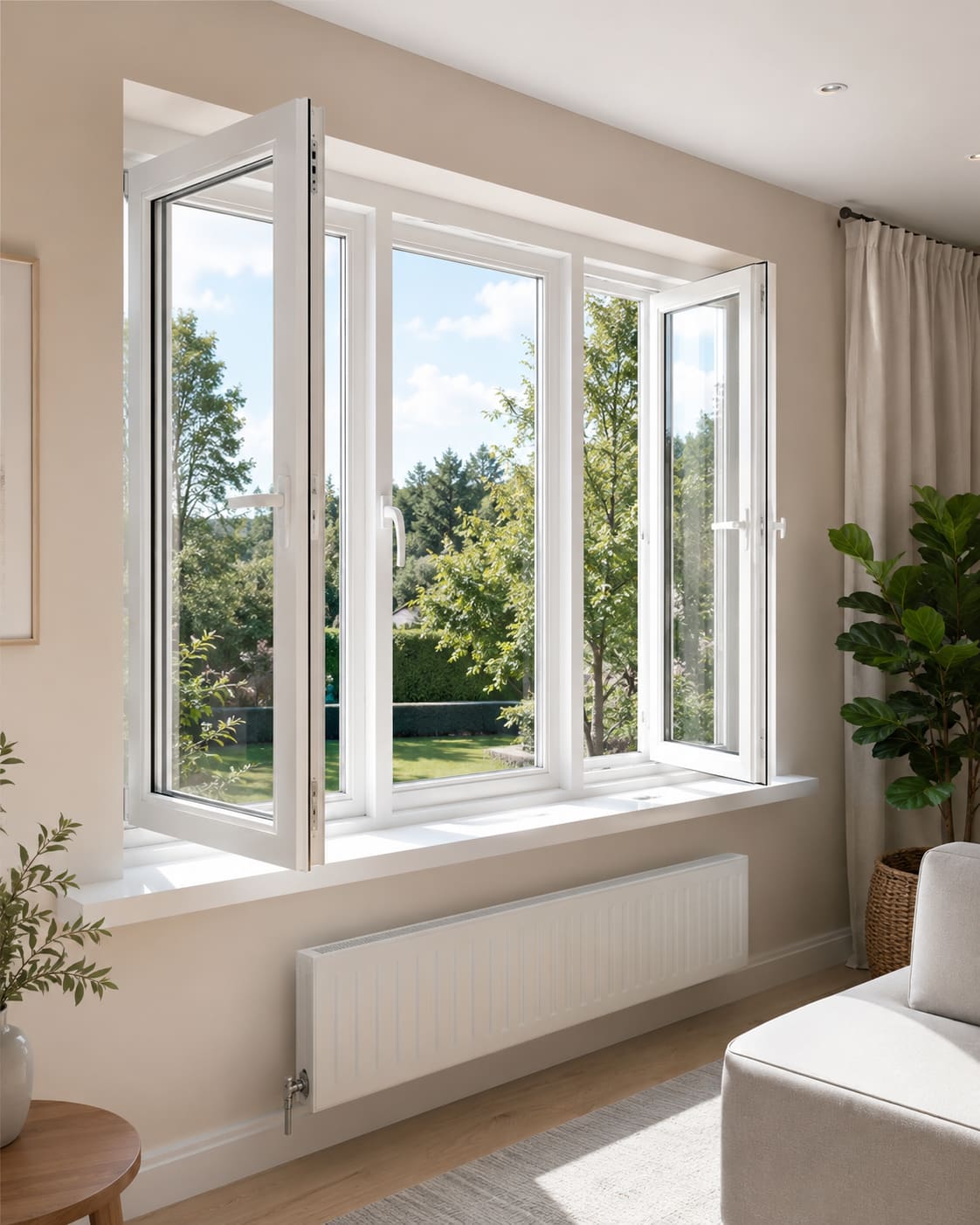
uPVC windows are frames made from unplasticised polyvinyl chloride, a rigid, weather-resistant polymer reinforced internally with galvanised steel, and the most popular criticisms of them, that they warp in heat, yellow and crack within a few years, or make a building a fire risk, are simply not supported by material data or Indian building standards. Most of these beliefs date from early-generation vinyl products of the 1980s and are outdated for the modern lead-free, UV-stabilised profiles that fabricators like ours install today across Hyderabad.
In the Indian context, and specifically the hot, dusty and monsoon-heavy climate of Hyderabad and Secunderabad, the questions that actually matter are heat deflection, UV stability, structural rigidity, acoustic comfort and cost over the window's whole life. A frame in Gachibowli or Kokapet faces four to five months of 40-plus-degree afternoons, then weeks of driving monsoon rain and airborne construction dust, so the material has to be judged on how it behaves through that full cycle, not on a decades-old reputation.
This article addresses each widely repeated myth with concrete figures, the relevant IS codes, and where the real trade-offs genuinely lie, so you can decide between uPVC windows and aluminium windows on evidence rather than hearsay. Where a job is better suited to metal, we say so plainly.
Myth 1: uPVC windows warp and sag in Indian heat
uPVC does not warp under normal Indian temperatures because quality profiles have a heat-deflection temperature of about 70 to 80 degrees C, while Hyderabad's hottest recorded air temperatures sit around 42 to 46 degrees C. The surface of a south-facing frame in Kondapur can feel hot to the touch in May, but the polymer stays far below its softening point, and the reinforced core keeps the section rigid.
The confusion almost always comes from thermal expansion, which is a normal, engineered-for behaviour rather than a defect. Every material moves with temperature; the question is whether the system is designed to absorb that movement. Reputable systems address it directly:
- Galvanised steel reinforcement (typically 1.2 to 2.0 mm thick) is inserted into the frame and sash chambers to lock in rigidity and carry wind and dead loads.
- Multi-chambered profiles, usually three to five chambers, distribute stress and slow heat transfer through the section.
- White and light-coloured profiles reflect solar radiation; darker woodgrain laminates are specified with higher-grade or co-extruded acrylic caps engineered for heat.
- Correct installation gaps, packers and fixing intervals let the frame expand a millimetre or two without distorting the sash or breaking the seal.
Where a genuine warping risk exists is with unbranded profiles that skip the steel reinforcement to shave cost. That is a fabrication and specification failure, not a property of uPVC. If you want the same steel-and-thermal logic in metal, our thermal break aluminium windows apply an insulating barrier inside the frame for exactly this reason.
Myth 2: uPVC turns yellow, brittle and cracks within a few years
Modern uPVC does not yellow or turn brittle quickly because profiles are compounded with UV stabilisers and titanium dioxide (TiO2), giving a realistic service life of about 25 to 40 years with minimal colour change. The chalking and yellowing people remember came from lead-based, poorly stabilised vinyl formulations that are now largely obsolete in reputable supply chains.
Contemporary lead-free, calcium-zinc stabilised compounds are engineered specifically for high-UV climates like the Deccan plateau, where clear-sky solar exposure is intense for most of the year.
- TiO2 loading shields the polymer surface from UV degradation, the mechanism behind chalking.
- Accelerated weathering tests (xenon-arc and QUV cycles) simulate years of sun before a profile is certified for sale.
- Frames need no painting or sealing over their life, only occasional cleaning with soapy water to clear Hyderabad's fine construction dust.
- Brittleness claims almost always trace back to thin-walled profiles below the recommended Class A wall thickness of about 2.5 to 3.0 mm.
This is why profile grade matters far more than the material label. The same frame logic runs through our uPVC casement windows and uPVC sliding windows: specify a Class A section from a stabilised, lead-free compound and the yellowing myth simply does not apply.
Myth 3: Is uPVC a fire hazard?
No, uPVC is self-extinguishing rather than a fire accelerant, because PVC has a Limiting Oxygen Index (LOI) of about 42 to 45 percent, well above the roughly 21 percent oxygen content of ordinary air. In practice that means the material will not continue to burn once the ignition source is removed. Any material with an LOI above 28 percent is generally classified as flame-retardant, and uPVC comfortably clears that bar.
That makes uPVC safer in a fire than several common building materials, not more dangerous.
- uPVC has a high ignition temperature of around 400 degrees C, compared with roughly 250 degrees C for seasoned timber.
- It does not support flame spread and tends to char in place rather than drip flaming material onto the floor below.
- Projects should specify products with declared fire performance in line with the National Building Code of India (NBC) 2016 fire and life-safety provisions.
- Where a rated barrier is required, the opening itself can be upgraded with fire rated glazing or fire rated glass doors rather than relying on the frame alone.
The glazing can be upgraded independently too; toughened safety glass supplied under IS 2553 protects occupants from injury during breakage regardless of the frame material.
Myth 4: Is aluminium always stronger and better than uPVC?
Neither material is universally better; aluminium is stiffer per unit section, but steel-reinforced uPVC windows meet the same structural wind-load requirements while dramatically outperforming plain aluminium on thermal insulation. The right choice depends on the opening size, orientation and performance goal, not on one material winning every category. We fabricate both, so the recommendation follows the opening, not a sales preference.
- Thermal performance: uPVC whole-window U-values run about 1.2 to 1.8 W/m2K; single-glazed aluminium without a thermal break sits at 5 to 6 W/m2K, meaning far more heat gain and summer condensation.
- Wind load: steel-reinforced uPVC profiles are designed and tested against IS 875 Part 3 for the relevant wind zone, and Hyderabad falls in a moderate zone.
- Maintenance: uPVC never needs repainting and does not corrode, a real advantage through the monsoon and in humid, dust-laden air.
- Large spans: for very tall or wide openings, sliding stacks and slim sightlines, our aluminium sliding windows or a thermal break aluminium system is often the better structural fit.
- Acoustics: multi-chambered uPVC with double glazing typically cuts noise by 25 to 40 dB, which matters on busy arterial roads around Madhapur, Hitec City and the Financial District.
In short, a bedroom in Kokapet facing a west sun benefits from uPVC's insulation, while a 12-foot living-room slider onto a Gachibowli balcony may be cleaner in aluminium. You can see both material families in completed work on our projects page.
Myth 5: uPVC is not eco-friendly and cannot be recycled
uPVC is fully recyclable and can be reprocessed roughly 8 to 10 times without significant loss of structural properties, so end-of-life frames are a recoverable resource rather than landfill waste. Modern profiles are also lead-free, using calcium-zinc stabilisers that carry no heavy-metal disposal concerns.
The environmental case is stronger once you count the operating life, not just the material.
- The insulating performance of uPVC reduces air-conditioning load, lowering a building's operational carbon across the decades it is actually in use, which in a Hyderabad summer is the dominant energy cost.
- Off-cuts and old frames are granulated and re-extruded, often into the reinforced core layers of new profiles where surface appearance does not matter.
- Better-insulated envelopes support compliance goals under the Energy Conservation Building Code (ECBC) and BEE efficiency benchmarks.
- The 25-to-40-year lifespan means fewer replacement cycles and less embodied waste than shorter-lived alternatives.
For an air-conditioned home or office, the biggest single lever is the glazing itself; pairing a good frame with an insulated or reflective unit, as covered in our note on specialty glass, does more for the electricity bill than any frame material choice alone.
Myth 6: uPVC windows are cheap-looking and expensive to fix
uPVC windows carry a competitive lifetime cost because near-zero maintenance offsets a modest upfront premium, and modern profiles come in woodgrain and coloured laminate finishes that do not look low-end. In Hyderabad, a quality uPVC casement typically costs roughly INR 450 to 900 per square foot depending on profile grade, glazing specification and hardware, with premium German-system profiles and double-glazed units sitting at the top of that band.
- No recurring costs for painting, polishing or rust treatment, unlike timber or plain steel windows.
- Standardised euro-groove hardware means gaskets, handles and friction stays are readily available and replaceable, so a worn part is a cheap swap, not a full-window job.
- Double glazing and multi-point locking are catalogue upgrades rather than bespoke fabrication, keeping repair predictable.
- Woodgrain laminates give the warm look of timber on doors and windows without the sanding, sealing and termite exposure.
When you compare a five-year total cost including maintenance, uPVC usually lands ahead of both timber and painted steel, and level with or below thermally broken aluminium. If budget is the deciding factor, it is worth reading our comparison of uPVC and aluminium windows for Hyderabad homes before committing.
Myth 7: uPVC cannot handle Hyderabad's monsoon and dust
uPVC actually handles the monsoon well because it does not corrode, rot or absorb water, and a correctly designed casement uses multiple gasket lines plus drainage channels to shed wind-driven rain. The frame that struggles in a Telangana monsoon is untreated steel or unseasoned timber, not vinyl.
- EPDM gaskets seal on two or three contact lines, so rain is stopped before it reaches the internal chamber.
- Sloped sills and weep holes drain any water that gets past the outer gasket back to the outside.
- Smooth, non-porous surfaces mean fine dust wipes off instead of embedding, and no repainting is ever needed after the wet season.
- Casement and tilt-and-turn styles seal more tightly against driving rain than older sliders, which is why we often recommend uPVC tilt and turn windows for exposed, upper-floor elevations.
For a fully sealed weather line on balconies and utility areas, uPVC also pairs well with matching uPVC doors, giving the same gasketed performance across the whole opening set.
How to choose the right uPVC window for your home
The single most important decision is profile grade and glazing, not the material name, because a Class A steel-reinforced section with the correct glass will outlast and outperform a thin unbranded frame regardless of what it is called. Match the specification to the room's orientation and noise exposure rather than buying one grade for the whole house.
- West and south elevations: prioritise solar-control or double glazing to cut the afternoon heat that drives cooling bills in Kondapur and Nallagandla.
- Road-facing rooms near Madhapur or the Financial District: specify laminated or double glazing for the 30-plus dB acoustic drop.
- Wet or exposed openings: choose casement or tilt-and-turn over sliders for a tighter rain seal.
- Wide living-room openings: confirm whether an aluminium sliding door suits the span better before defaulting to uPVC.
- Always confirm the steel reinforcement, wall thickness and hardware brand in writing on the quotation.
If you are unsure which combination fits your flat or villa, the simplest step is to send us the opening sizes and orientations and get a free quote; we will specify the profile grade, glazing and hardware for each opening and explain where uPVC or aluminium is the better call.