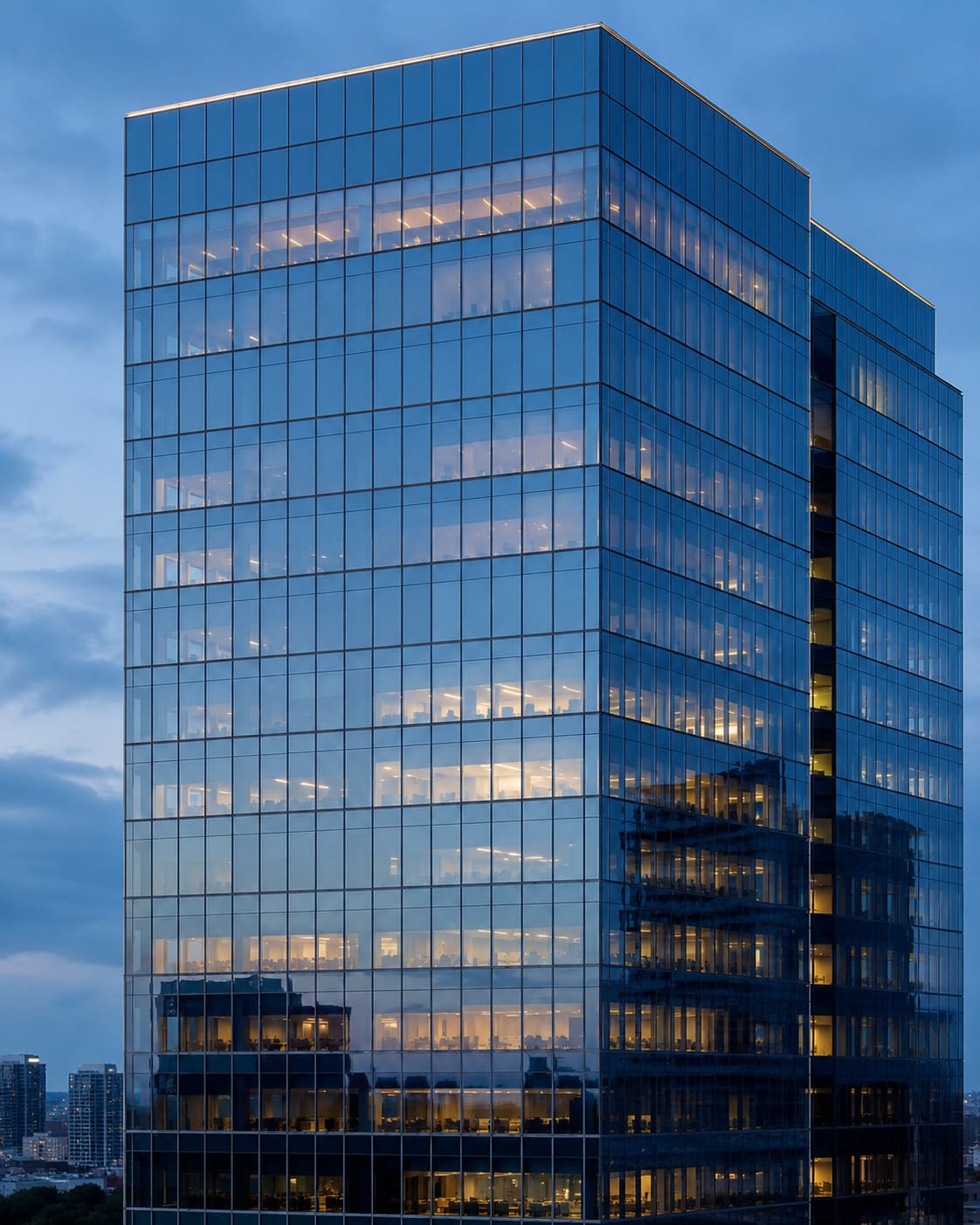
Vision glass is the transparent, see-through portion of a glazed facade that admits daylight and views, whereas spandrel glass is the opaque, non-vision portion that conceals the floor slab, perimeter beams, ductwork and the ceiling-to-floor void between one storey and the next. Both are integral parts of the same curtain wall or structural-glazed system, and from the street they read as one continuous glass skin even though they perform completely different jobs.
The distinction matters because each type is engineered differently. Vision glass prioritises optical clarity, solar control and thermal insulation and is almost always double-glazed, while spandrel glass prioritises opacity, thermal-stress resistance and concealment and is frequently a single heat-treated pane with insulation behind it. Getting the split, the colour match and the safety rating right is what makes a facade look seamless, perform to code and last 25-40 years.
In Hyderabad, Secunderabad and the wider Telangana and Andhra Pradesh region, Hakimi Aluminium and Glass fabricates and installs both vision and spandrel glazing as part of unitised and stick curtain-wall systems. This guide explains what each panel is, how they differ across specification and cost, and how to specify them for the local climate.
What is vision glass?
Vision glass is the transparent glazing at eye and view level through which occupants see out and daylight enters the interior. It is specified for clarity, solar-heat rejection and insulation, and in a modern facade it is almost always a double-glazed insulated glass unit (IGU) rather than a single pane.
- Build-up: a common IGU is 6 mm low-E toughened glass + 12 mm air or argon gap + 6 mm inner pane, giving an overall thickness around 24 mm.
- Thermal: U-values generally range 1.4-1.8 W/m2K, with a solar heat gain coefficient (SHGC) of 0.25-0.35 for high-performance solar-control coatings.
- Light: visible light transmission (VLT) of 40-70% depending on the coating and tint, balancing daylight against glare.
- Safety: toughened panes conform to IS 2553; laminated glass is used where fall protection or overhead safety is required.
In hot cities like Hyderabad, ECBC and BEE-oriented designs favour low-SHGC vision glass to limit cooling load. Many towers in Gachibowli and the Financial District use a reflective or high-performance coated glass facade precisely because the vision area is where most unwanted solar heat enters the building.
What is spandrel glass?
Spandrel glass is the opaque glazing that hides the parts of a building that should not be seen, principally the floor slab edge, spandrel beam, raised-floor plenum and the return-air or service void between floors. Crucially, the opacity is created on the glass itself, not by a wall behind it, so the facade stays visually uniform whether you are looking at a vision panel or a spandrel panel.
- Opacifying methods: ceramic frit (a fired-on ceramic enamel), back-painting, or an applied opacifier film on the fourth, interior surface.
- Substrate: usually heat-strengthened or fully toughened glass to IS 2553 to resist thermal shock.
- Configuration: often single monolithic glass, backed by a shadow box or by 50-100 mm rigid or mineral-wool insulation.
- Depth: spandrel bands typically span 300-900 mm per floor to cover the slab plus ceiling and floor build-up.
- Colour is matched to the adjacent vision glass so both appear identical from outside.
Because spandrel is fabricated to the same module and framing as the vision units, it is installed in the same unitised or stick glazing grid, keeping the sightlines and joint pattern continuous across the whole elevation.
How do vision and spandrel glass differ?
The core difference is transparency versus opacity, and this single distinction cascades into almost every specification decision that follows. Vision panels are tuned for what you see and feel inside; spandrel panels are tuned for what you should not see and for the harsh conditions in the cavity behind them.
- Function: vision glass gives views and daylight; spandrel glass conceals structure and services.
- Glazing: vision is typically a double-glazed IGU; spandrel is often single heat-treated glass with insulation.
- Thermal: vision U-value 1.4-1.8 W/m2K; insulated spandrel assemblies can achieve effective U-values below 0.4 W/m2K.
- Heat stress: spandrel faces trapped heat up to around 250 C behind it, so heat treatment is mandatory; vision glass runs cooler.
- Cost: spandrel glass is generally 10-25% cheaper per square metre than a high-performance vision IGU.
- Proportion: a facade is commonly 60-70% vision and 30-40% spandrel.
Why does spandrel glass crack, and what is a shadow box?
Spandrel glass must be heat-strengthened or toughened because heat trapped in the shadow box behind it creates large temperature differentials that can crack ordinary annealed glass. The shadow box is the sealed cavity between the back of the spandrel glass and the insulation or slab; dark opacifiers absorb solar radiation, the cavity has little airflow, and the centre of the pane heats far faster than the cooler shaded edges gripped by the frame.
That temperature gradient is what breaks glass. When the hot centre wants to expand but the cold edges restrain it, tensile stress builds at the edge; annealed glass fails at around 40 C of differential, which a spandrel cavity easily exceeds.
- Heat-strengthened glass (surface compression roughly 24-52 MPa) resists thermal stress while avoiding the rare spontaneous breakage risk associated with fully toughened glass.
- Ventilated shadow boxes or deliberate edge gaps relieve heat build-up in deep spandrel cavities.
- Wind and structural loads on the facade are assessed per IS 875 Part 3 and the National Building Code of India (NBC) 2016.
- Structural silicone glazing joints follow ASTM C1401 practice for bonding glass to framing.
This is exactly the kind of engineering detail a proper facade consultancy checks before fabrication, because a single wrong substrate choice on a high-rise can mean panels failing years into the building's life.
How is spandrel glass made opaque?
Spandrel glass is made opaque by applying a coating to the interior (fourth) surface of the glass, so the finish is protected inside the assembly and the outward appearance stays glossy and uniform. There are three common routes, each with a different look, durability and cost.
- Ceramic frit: a ceramic enamel is screen-printed or roller-coated onto the glass, then fused during the heat-treatment furnace cycle, becoming a permanent, extremely durable part of the glass. It is the premium option and holds colour for decades.
- Back-painting: a specialised opaque paint is applied and cured on the rear surface. It is cost-effective and offers a wide colour range, but must be a genuine spandrel-grade coating rated for facade heat, not ordinary paint.
- Opacifier film: a laminated foil or film is bonded to the fourth surface, giving full opacity and an even backing colour.
The choice affects how closely the spandrel matches the reflective character of the vision glass. On a DGU facade the vision unit is coated and reflective, so the spandrel opacifier colour is tuned to sit against that reflection rather than against a flat sample, which is why physical mock-ups under real daylight matter.
Getting the vision-to-spandrel ratio and colour match right
A facade is commonly 60-70% vision and 30-40% spandrel, but the exact split is driven by the floor-to-floor height, the ceiling void depth and the raised-floor build-up on each level. Taller floor plates with deep service zones push the spandrel band wider; efficient structural systems let you narrow it and give occupants more glass to see through.
Colour matching is where many facades succeed or fail visually. Vision and spandrel glass are different products, one transparent and one opaque, yet they must read as the same skin from the street.
- Match under daylight: assess samples outdoors at the actual orientation, because coatings shift colour with sky and sun angle.
- Account for reflection: reflective vision coatings can make a spandrel look lighter or darker than a bench sample suggests.
- Mind the transition line: the join between a clear-ish vision unit and a solid spandrel can show a slight tonal step, minimised by correct opacifier selection.
- Consider the interior: from inside, spandrel panels are opaque, so the ceiling and slab detailing behind them must be clean where partly visible at the transom.
You can see how matched vision and spandrel bands come together on completed elevations in our projects gallery, which shows how the split reads across full towers rather than on a single panel.
Cost, standards and specification in India
Vision glass typically costs more than spandrel glass because it is double-glazed with coated solar-control panes, while spandrel uses a simpler heat-treated substrate with an opacifier. On a like-for-like panel size, expect spandrel to run roughly 10-25% cheaper per square metre.
- Indicative rates: high-performance vision IGUs commonly land around INR 900-1,600 per sq ft installed depending on coating and gas fill, while opacified spandrel panels sit lower per sq ft; full curtain-wall packages including aluminium framing are quoted per project.
- Applicable standards: IS 2553 (safety and toughened glass), IS 875 Part 3 (wind load), NBC 2016 (building code), and ECBC with BEE star ratings for energy performance.
- Aluminium framing commonly uses IS 733 / IS 1948 grade extrusions, with a thermal-break profile in high-performance systems to stop heat bridging through the metal.
- System choice: unitised curtain wall suits tall towers on tight sites for speed and quality, while stick glazing suits low- and mid-rise elevations built up on site.
Because vision and spandrel share the same framing and joints, they are almost always ordered and fabricated together so the module, sightline and colour stay consistent across the elevation.
Specifying vision and spandrel glass for Hyderabad's climate
Hyderabad's climate makes the vision-versus-spandrel decision more than academic. Summer temperatures cross 40 C, solar radiation is intense for much of the year, the monsoon drives wind-borne rain against west and south elevations, and airborne dust settles on glass across Kondapur, Kokapet and Hitec City. Each of these puts a specific demand on the two panel types.
- Heat: specify low-SHGC vision glass (around 0.25-0.30) so the transparent area, where most solar gain enters, does not overload the air-conditioning; this is the single biggest lever on running cost.
- Spandrel insulation: 50-100 mm of insulation behind the spandrel keeps the opaque band's effective U-value low and stops the cavity from radiating heat inward at the floor edge.
- Monsoon: rely on properly designed drainage and pressure-equalised joints in the curtain wall so wind-driven rain is managed, not just sealed against.
- Dust and cleaning: reflective and coated vision glass shows dust readily in the dry season, so plan facade-access and cleaning cycles at design stage.
- Thermal safety: in this heat, heat-strengthened spandrel is not optional; the cavity behind a dark spandrel in Hyderabad sun regularly reaches the differentials that shatter annealed glass.
Tenants in commercial hubs like Madhapur and the Financial District increasingly ask for BEE-rated, ECBC-compliant facades, which means both the vision and spandrel specifications have to be documented for the energy model, not chosen on price alone.
How Hakimi fabricates matched vision and spandrel facades
Hakimi Aluminium and Glass designs, fabricates and installs matched vision and spandrel glazing as a single coordinated package across Hyderabad, Secunderabad and the surrounding Telangana and Andhra Pradesh region. Because both panel types share framing, sealants and joints, treating them as one system is what keeps a finished elevation looking seamless.
- Design and engineering: panel split, wind-load checks and thermal-stress review before any glass is ordered, aligned to IS and NBC requirements.
- Colour and mock-up: physical vision and spandrel samples assessed together under site daylight to lock the match.
- Fabrication: IGUs and heat-treated spandrels processed to the same module, glazed into unitised or stick framing.
- Installation and after-sales: sequenced site fixing with weather-sealing, plus maintenance guidance for the local climate.
If you are planning an office front, showroom or tower elevation, get a free quote and our team will help you fix the vision-to-spandrel ratio, glass performance and budget for your building before fabrication begins.